Kailua-Kona, Hawaii. January 26, 2026.
Yesterday, Sunday, was an official free day for our Road Scholar group. Some members took the opportunity to do laundry, others enjoyed a leisurely ocean swim, and still others slept late and embraced the joys of doing mostly nothing. Christine and I counted ourselves happy to be among the last group.
Today the program resumed.We were again up at 6 AM and on the road after breakfast for a day of sightseeing and informative lectures.
First Stop: A “Painted Church”.

This Catholic Church, a wooden structure built in 1899, is plain white on the outside, but wonderfully colorful on the inside.

Murals depict biblical scenes. Columns morph into images of palm trees as they ascend to a star covered sky. Images behind the altar are meant to mimic the grand cathedrals of Europe.

This church is an unusual treasure in that it has survived the decades and avoided destruction from the natural disasters common to the island (not the least of which are the termites!).

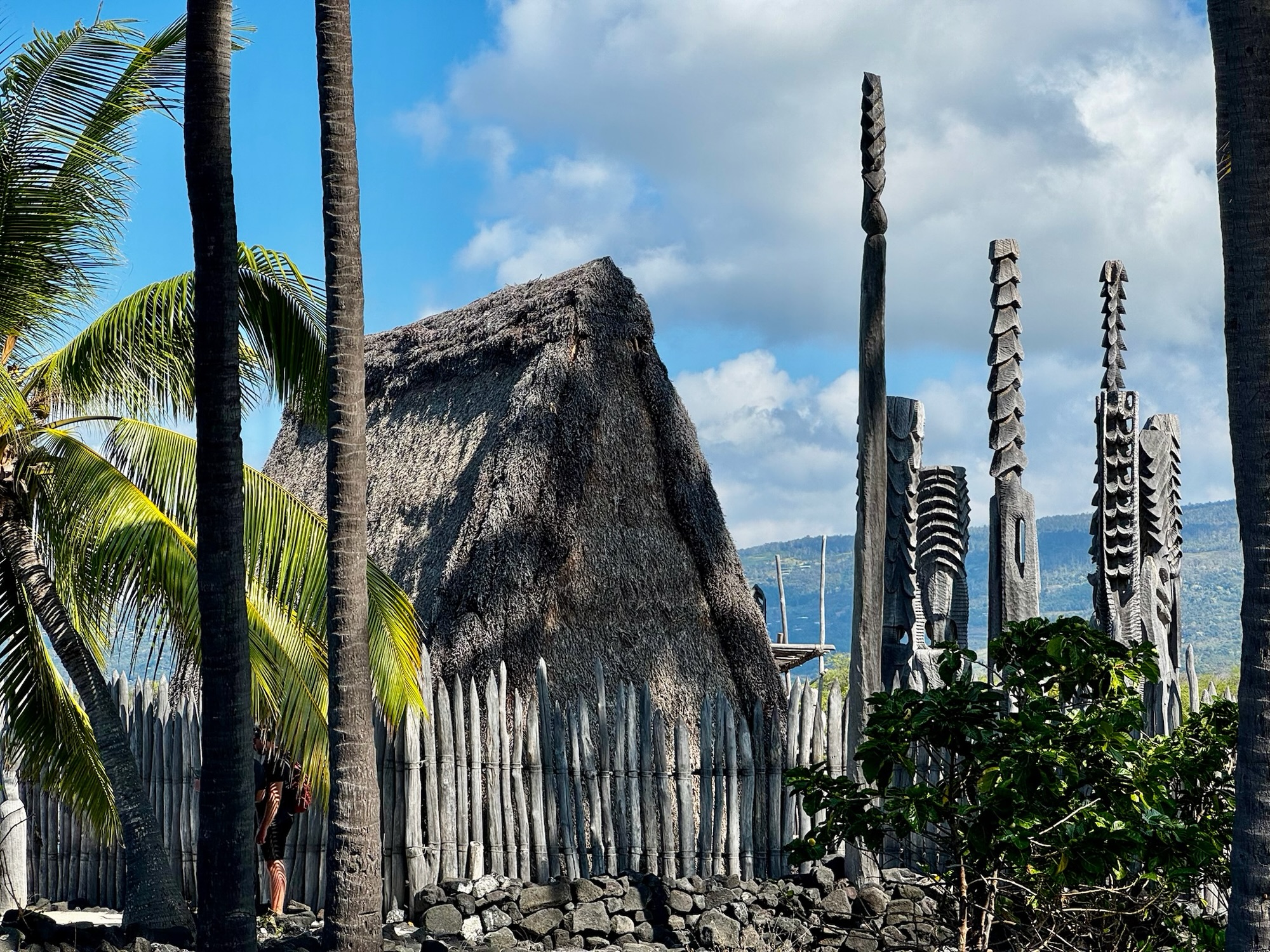
Next Stop: Pu’uhonua o Hōnaunau, National Historical Park.

Tradition holds this to be a place of extraordinary mana (spiritual power). At one time the bones of 23 chiefs were protected in the temple.

These royal grounds were a center of island political, and religious power. It was here that Kapu was declared: The sacred laws and beliefs by which the islanders lived.


Some examples of Kapu are: Men and women could not eat together. Only men were allowed to eat pork, women were relegated to eating dog. Only men could be involved in food handling and preparation. Women, who were deemed unclean, only took care of the children. Women had to segregate themselves from the rest of the tribe during their monthly cycles. Tribal commoners were not allowed to look upon royalty or to even step on a royal person’s shadow. The usual penalty for violation of Kapu was death by strangulation.


However, separate from the Royal Grounds and surrounded by a massive stone wall, 1000 feet long, 10 feet high, and 17 feet thick was sanctuary.


If one were able to escape to the place of refuge behind the wall, he could seek absolution by a tribal priest. At one time there were a number of such places of refuge (Pū’uhonua) in the islands. This one has been preserved as a National Historic Park.
The law of Kapu existed for many hundreds of years, but was finally abolished in 1819. This sanctuary is still held sacred and remains a place of peace, calm, and reflection among Hawaiians.
Final Stop: The Kona Coffee Living History Farm.

This site, a beneficiary from the National Endowment for the Humanities and the State Foundation on Culture and the Arts, preserves and depicts daily life of the Japanese Uchida family. For 81 years these Japanese immigrants leased and worked this coffee farm of approximately 5 acres. They experienced the severe hardships of the Great Depression and the significant restrictions on their liberty brought about by suspicions based on their ancestry during World War II.


90% of the area farms that produced coffee were operated by Japanese families. They were small at less than 5 acres each yet they were the lifeblood of coffee production in this part of Hawaii.


There were usually three or four harvest cycles each year. During each cycle family members and workers were called upon to harvest hundreds of pounds of coffee berries each day. The berries then had to be stripped of the sugary cover, dried, and stored for eventual transport. This was backbreaking work. Each farm had to rely upon one donkey (few farms could support two donkeys) to provide “horsepower“. The donkeys, a social animal, would bray to one another in the distance each evening in what the farmers would call the sound of the “Kona Nightingales”. These small but sturdy animals carried over 500 pounds of coffee beans at a time.
100% Kona coffee is prized for its flavor and richness. It prices locally at over $50 a pound.
Tomorrow:
Tomorrow morning, we bid farewell to The Big Island and fly to the island of Maui.
Peace Everyone. Pete
PS. There is so much more that we have experienced in each day than I can present in these posts. For you who have been here, I hope that I am resurrecting fond memories. For you who have thought about coming to Hawaii, I hope I am providing extra incentive. For those who will never come to Hawaii I hope that I am giving you at least a “taste” of this paradise. -Pete
Bill says:
As I read your report, drinking my morning coffee, Columbian – not Kona but still my favorite, I realize how dependent I’ve become on two things. My daily pot of coffee and your daily update. Wait make that three, my evening scotch – but that comes later. Keep it up I’m not in the mood for withdrawal.
You keep me feeling anxious for another day during this crazy time.
Peace, Bill
Pete Schloss says:
Thank you, Bill. The Kona coffee is excellent… But $50 a pound? Be well, my friend. Pete
Anne Pyle says:
Wonderful history and information about the Big Island! Thank you!
Pete Schloss says:
You are so very welcome, Annie. Thank you and be well. Pete.
JOE TOMELLERI says:
Wow, no idea their laws were so punitive. Even worse than current U.S!
Pete Schloss says:
And Joe, That’s saying something!