I awoke this morning and asked Christine, “Give me an honest answer. Are you ready to go home?”
I received an unequivocal “Yes”.
Had she said “No” our plans would have remained unchanged. Had I not asked the question the issue would not have come up.
I’m tired and so is she.
.
Since retiring we have been “on the road” for as long as 12 weeks at a stretch. I know what we CAN do but I also know what we don’t HAVE to do.
We don’t have to add Brittany and Normandy to a journey that has already covered over 500km by foot (me) or 5 countries in the company of 7 grandchildren (Christine).
Our original plan was to fly to Paris after the Camino and spend another 2 weeks in the “City of Light”, Brittany and Normandy, including 2 nights on Mont Saint-Michel.
An email and our airline reservations were changed. A few more emails and 4 hotel reservations, 5 train connections and 1 tour were canceled. All costs were refunded. Brittany, Normandy and Mont Saint-Michel will remain on our radar for another day.
We will still spend 5 nights in Paris, but only at one hotel and no treadmill schedule to further challenge and frazzle us. Our relief is palpable.
Christine, even though you are now with us I will continue as if this is an “open letter” to you.
Charlie and I arrived in Santiago on the 25th between rain showers.
After visiting the Pilgrim’s Office and receiving our Compostelas and distance certificates we walked to our meeting place for transport to Finisterra.
Monbus wasn’t leaving until nearly 4. That local service had over 40 stops and would take nearly 3 hours. I decided to try the other option, a 2:30 carpool service called BlaBlaCar.
It worked out but there was enough insecurity that I wouldn’t do it again unless no other options were available.
We arrived in Finisterra wet and worn out. We didn’t have the energy to visit the lighthouse or the beach. Nevertheless it was a welcome respite from the last 25 days.
.
Dinner was great. When in a fishing village dine on fresh fish!
Turbot before Turbot after
The next day we were on to Muxia via a Monbus.
With BlaBlaCar there was insecurity that the driver would not show up. With this Monbus ride in the rain I wondered if I would live to see tomorrow.
.
The driver often doubled the speed limit on blind hairpin turns, spending parts in the oncoming lane like a Formula One driver. Tailgating was his norm. I have never bothered to wear a seatbelt on a passenger bus, until now.
Spoiler alert: I survived.
Muxia
Muxia was my favorite post-Camino visit in 2013 and still holds the top spot in 2026.
Our lodging was wonderful, and the view from our room was spectacular.
.
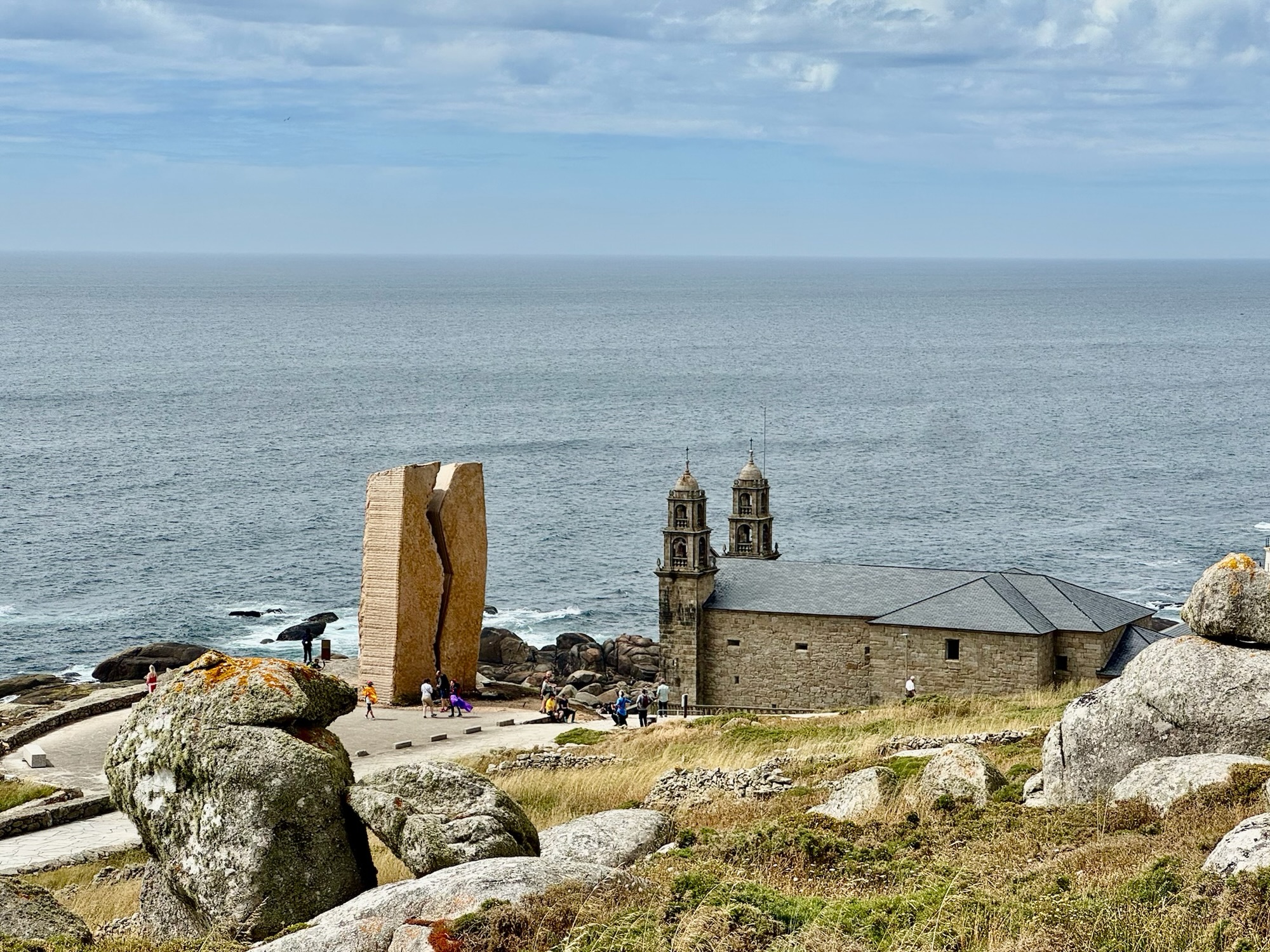
The food was excellent, and the hike to the church and shore brought back the fondest memories.
.Muxia seen from atop the hilltop separating it from the church.The final kilometer marker at Muxia and the monument to the workers who toiled to clean up an environmental spill that devastated the coast. ,
As you recall, The Sanctuary of Our Lady of A Barca (santuario da Virxe da Barca) was struck by lightning on Christmas Day 2013.
All that was left was the perimeter walls. Like Notre Dame it was a tragedy!
The church was rebuilt, and to my eye there were no signs of the earlier destruction.
...Our Lady of the Stone Boat
The seashore is known for three “magical“ rocks that have been celebrated since pre-Christian times. These rocks could literally “rock”.
.
They were huge and believed to have powers of enhancing fertility. Over the centuries many a child was conceived on top of one of those stones.
On the darker side these rocks were also deemed to be judges of guilt or innocence. An accused would be placed upon a stone and depending upon which way it tilted there was freedom or the dread alternative.
I had heard that none of the stones “rocked“ anymore. While sitting on a huge flat stone which measured nearly 20 feet in diameter I had the distinct feeling of movement. At first I thought it was my imagination. I extended my hand down the side of the rock to the ground and confirmed there was slight but definite movement. It rocked! Here is the proof in a video.
.
On the morning of the 27th we again boarded a Monbus, this time piloted by a sane driver.
.
It took us a little more than an hour to reach Santiago where we checked into our hotel and waited for your arrival later in the afternoon.
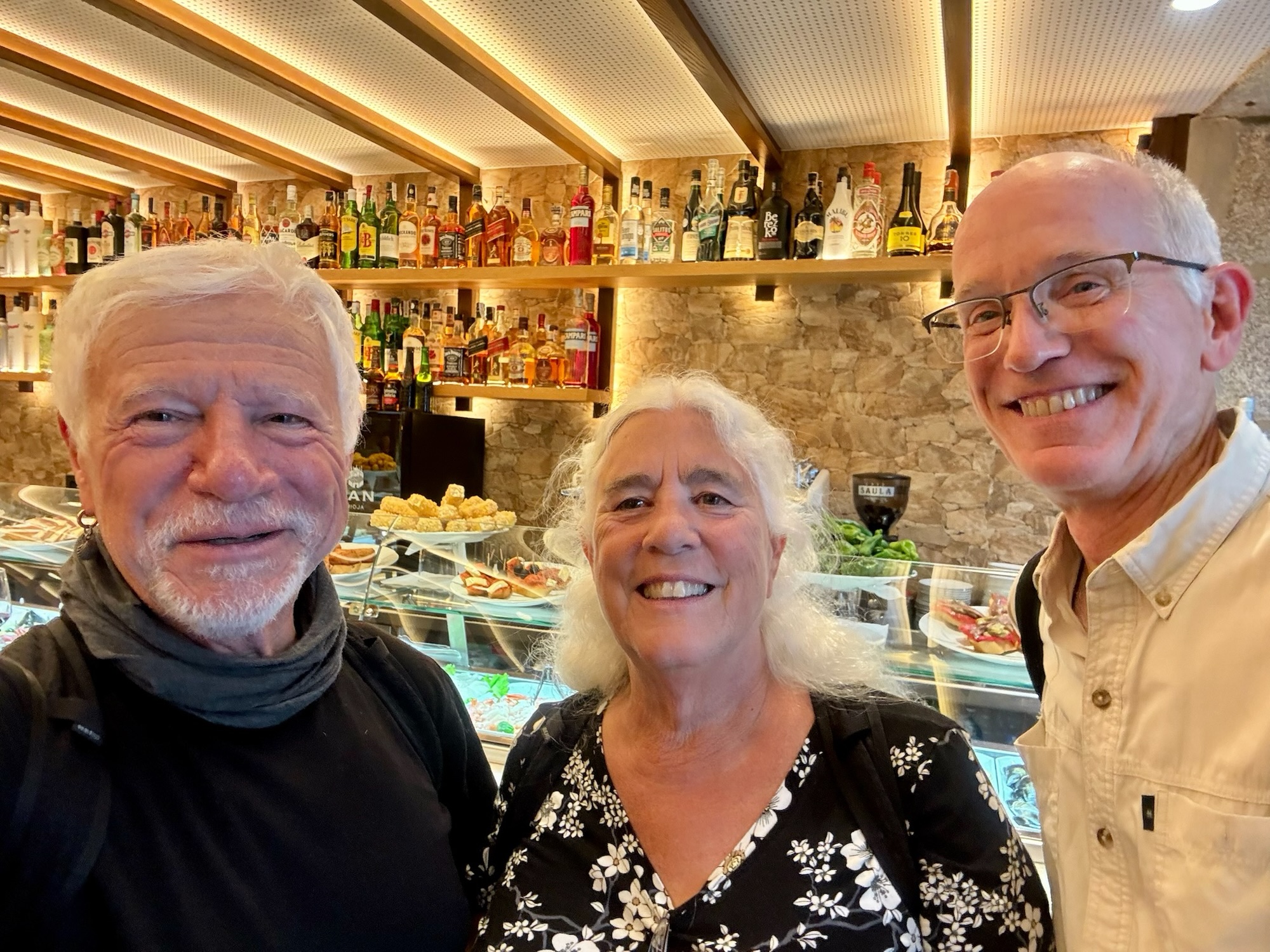
Before you landed we had a wonderful reconnection with our dear Camino friend Madi.
.
I’m so happy that you and she got to meet and then embrace like long lost friends. I hope that the thread of her life will continue to weave through the threads of ours.
Santiago de Compostela, June 25, 2026. Written at Muxia, June 26th.
Dear Followers, Friends, Family, and Christine.
By the numbers: 16 days in 2024, 25 days in 2026. 790 km (285 in 2024, and 505 in 2026). 1,102,000 total steps, 398,000 steps in 2024 and 704,000 steps in 2026.
.
Charlie’s totals are those reflected in 2026.
We entered Santiago on June 25th. Charlie was the 324th pilgrim to receive a Compostela Certificate that day and I was the 325th. A total of 2,489 pilgrims arrived having finished the Camino on June 25th.
.
I brought my credential from 2024. It showing an end in Burgos, and my 2026 credential started in Burgos. Thus I was deemed to have completed the entire French route for the second time, the first time was in 2013. I had previously completed the Portuguese route twice.
It is my fervent hope that someday my grandson will be able to resume the Camino in Burgos as I did.
The practical path:
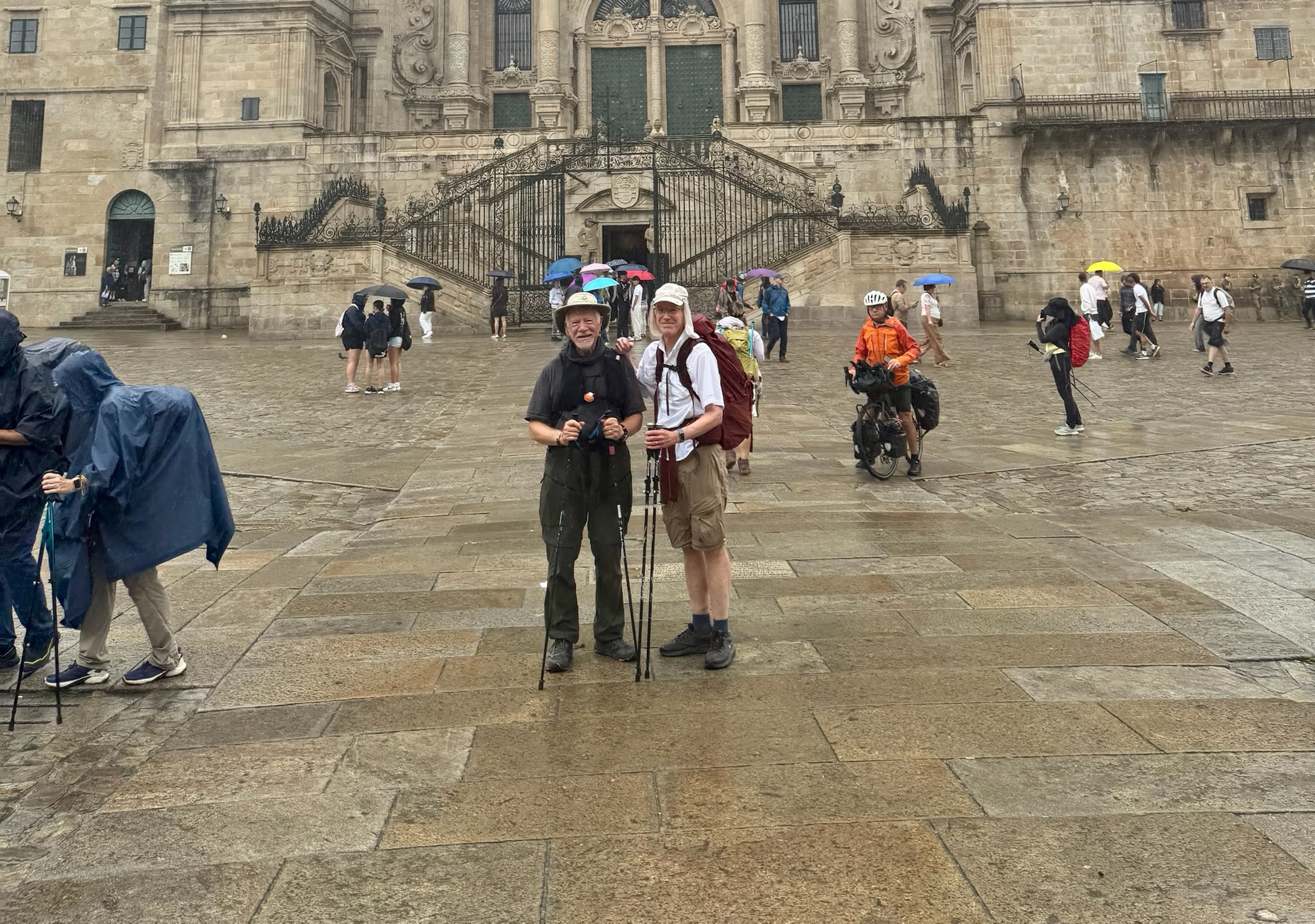
We planned to begin the final day at 6 am. However driving rain delayed our departure by an hour. Light drizzle hounded us the entire way. We could either be damp from the rain or damp from sweat under our rain gear. We chose rain over sweat.
I took very few pictures in the interest of keeping my cell phone dry.
..
It was both a relief and an overwhelming sense of accomplishment that Charlie and I shared standing in front of the Cathedral.
..
The deepest emotions didn’t strike me until I stood at the counter in the Pilgrim’s Office to receive my Compostela. My wish that my grandson were at my side could not be contained and found release in a stream of tears.
Christine, the reality is that we entered the Pilgrim’s Office as Peregrinos but we left as tourists. What has driven us every day since June 1st has been accomplished. What is before us is the challenge of holding fast to the lessons of the Camino.
.
Peace Everyone and Buen Camino. Pete.
PS. Some pilgrims return to their homes, an apparition from an earlier, simpler time…
O Pedrouzo, June 24, 2026. Written at Muxia June 26th.
Dear Followers, Friends, Family, and Christine.
As relaxing as our dinner was the prior evening today was the opposite.
The heat continued and the humidity built, as did the crowds.
..
The pleasantness of walking in nature seemed to evaporate.
One resident trying to beat the heat and enjoying watching the parade of Pilgrims ..A wall of beer bottles 
There were monuments to fallen pilgrims, most famous being to Guillermo Watt.
.,.Age 69 he died one day from reaching the end of his Camino in 1993. 
These “memorials“ often had a variety of small stones, religious cards, and notes left by pilgrims.
There was also a significant increase in graffiti, stickers on signs, and stole stolen kilometer plates from the Camino pylons.
..This marker was still intact. 25 km to Santiago. 
The exchanges of “Buen Camino“ became less genuine, more a reflex. I was just as guilty as the others.
A pilgrim humbling the rest of us as he made his way to Santiago 
Christine, you have noticed over the years how I become somewhat sullen and unapproachable when I am nearing a trip departure or end. Perhaps my reaction is the same when I am preparing to leave the Camino.
Charlie has remained cheerful and upbeat throughout the day. However, even his optimism was challenged when we checked into our pension.
It was a postage stamp of a room. The twin beds barely allowed passage around the perimeter. No air conditioning and no ventilation except for the window which opened to temperatures and humidity both in the 90’s. It was a self fulfilling prophecy that we would have a restless night.
It was Spain’s feast of the Birth of St. John the Baptist. Most stores and half the restaurants were closed. The crowds of pilgrims made restaurant “service” a fiction.
We attended church in O Pedrouzo’s well-known “Shell Church“.
.
It was standing room only in the small church. If there was air conditioning it was soundly defeated by the crowd.
Remarkably, the Mass (entirely in Spanish) was officiated by 12 priests and one deacon. I had observed that many of the celebrants wore hiking clothes as they went to put on their vestments. Clergy walking to Camino in disguise!
In reflection, our first night on the Camino was in a 6 bunk shared room. Perhaps it is fitting that last night on the Camino was another “true pilgrim experience“.
Tomorrow we reach Santiago! I love you, miss you, and I’m counting the “sleeps“ until we are together.
I am “really itching” to tell you about the highlight of the day, but I will put that off until the end of this post.
It has really struck us that this is the homestretch. Tomorrow is the last day that we will walk to an accommodation other than in Santiago. 20 km tomorrow and the final 20 km Thursday. 
As both celebration and condolence we looked for a restaurant that did not specialize in “the usual €15 pilgrim menu”. Not far from our pension was a small eclectic restaurant that fit the bill. The bill did not fit a pilgrim’s budget!
.
Four glasses of excellent Galician wine, a liter bottle of mineral water, a shrimp, appetizer (shrimp wrapped with fine cut pork rind, deep-fried and accompanied by a slightly spicy dipping sauce), wonderfully prepared Hake fish for Charlie and a juicy shoulder steak (served rare) for me… topping it all off was grandmother‘s homemade cheesecake. Worth every euro! (sorry, forgot to take pictures of the meal)
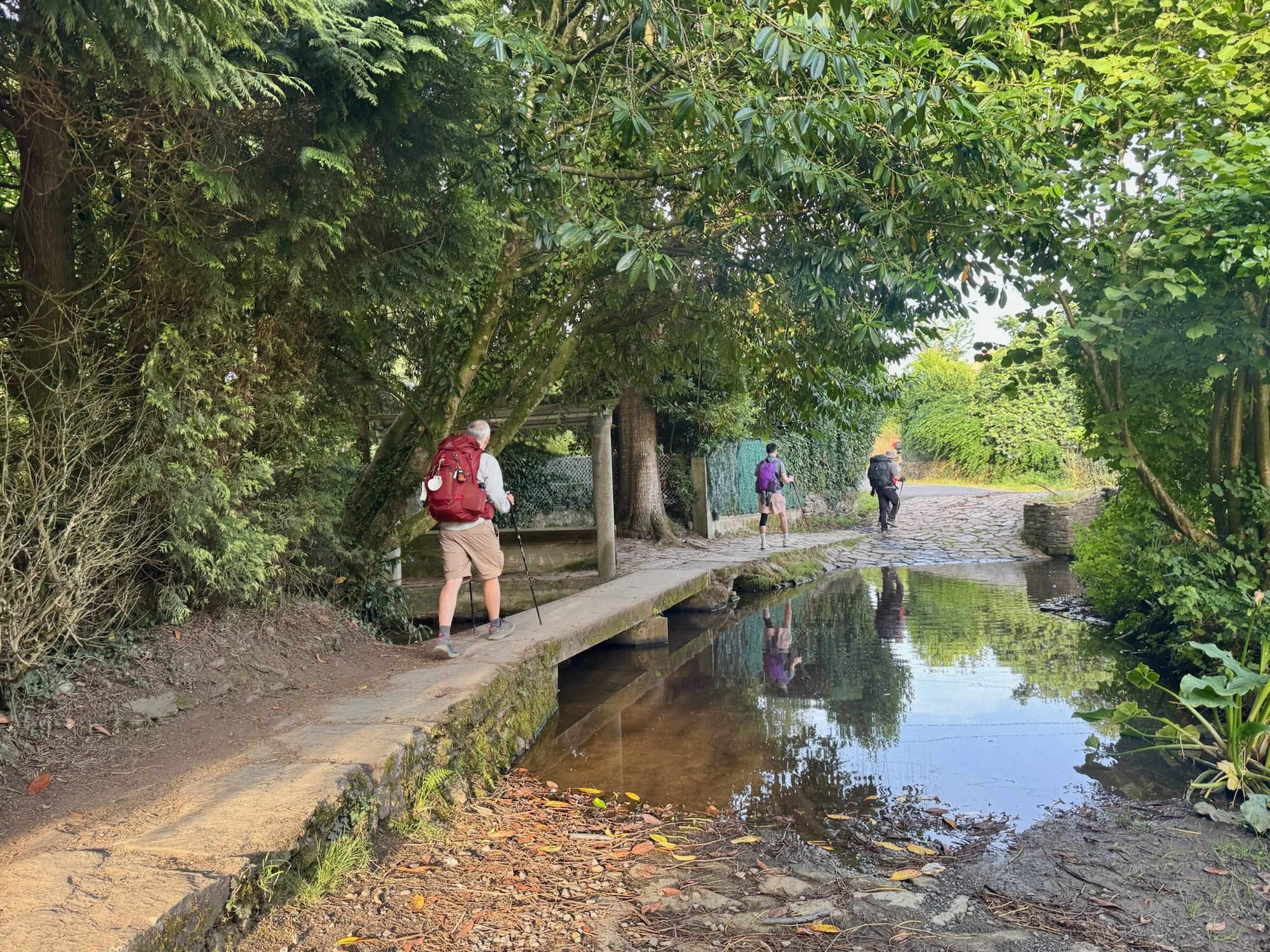
Of course today was hot, but we got an early start and beat most of the heat by the end of our 21 km hike. This was the day for bridges.
.....Not a bridge, but the rural countryside version of a “laundromat“. 
There were also periods of hiking through urban areas, which I did not find interesting enough for pictures. Accordingly, this post is thin on photographs.
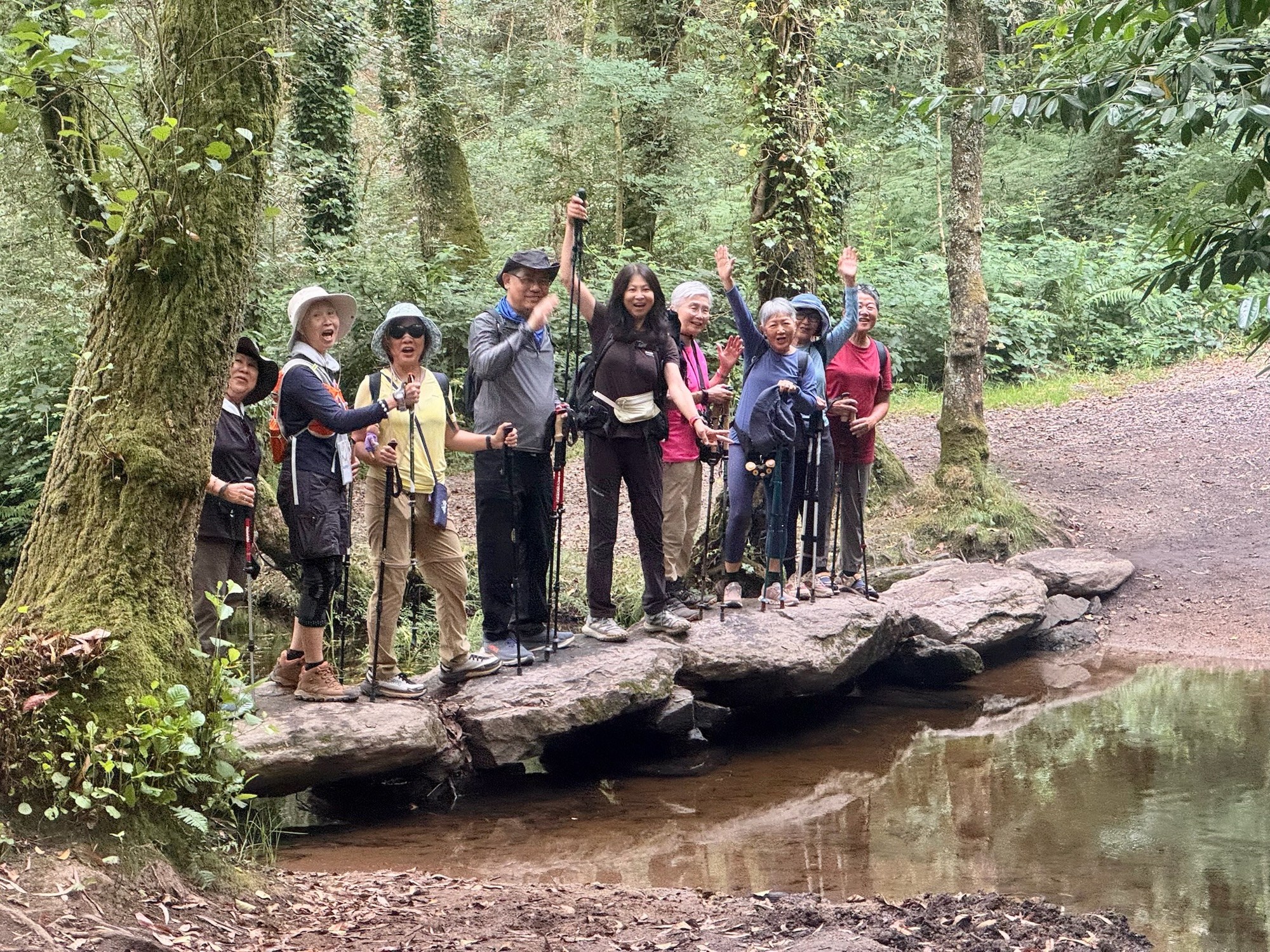
We again ran into our “Malaysian friends“. This time I had the presence of mind to get a photograph of them. They really got into the swing of things and made it an event for all of us.
..
I think more than one of them has taken a shine to Charlie, considering him “cute“.
Now for the “pest” part. I woke up yesterday with the most annoying itching. As the day progressed the itching resolved into red splotches with small distinct centers. Consulting twith Professor Google resulted in a diagnosis of bedbugs! A few days earlier I had commented to Charlie that this is my fifth Camino and I think the whole bedbug controversy is way over blown. How wrong I was.
.
A trip to a pharmacy and a small tube of hydrocortisone has brought some relief. Time will do the rest.
Charlie and I machine washed and dried all of our clothes just to be on the safe side.
Christine, please give all the grandkids and my daughter a big hug. I look forward to seeing them in Paris. I hope to share dinner or even just a cup of coffee with “Mr. B”. I am especially thinking of him and his coming “journey”. Love, Me.