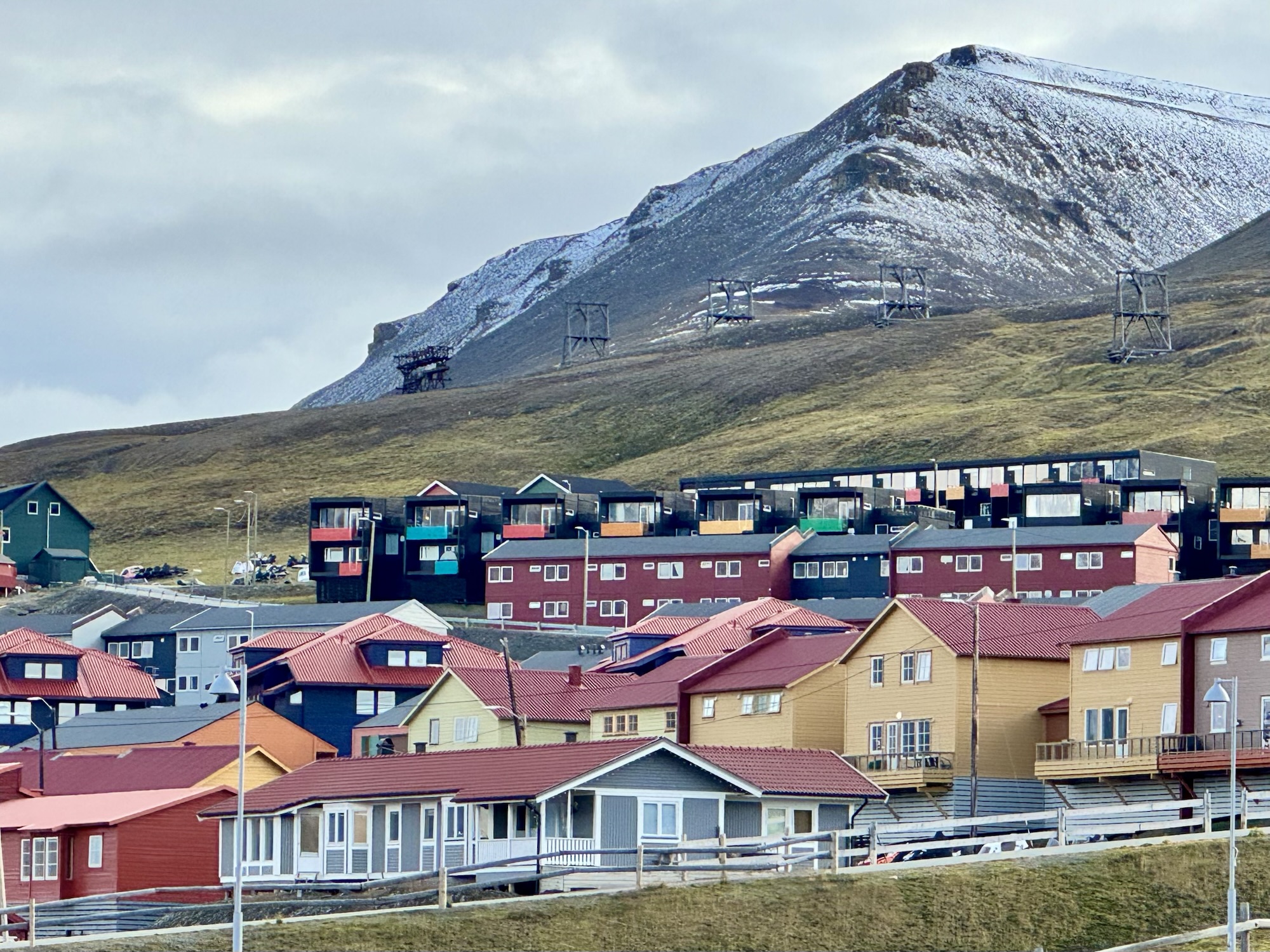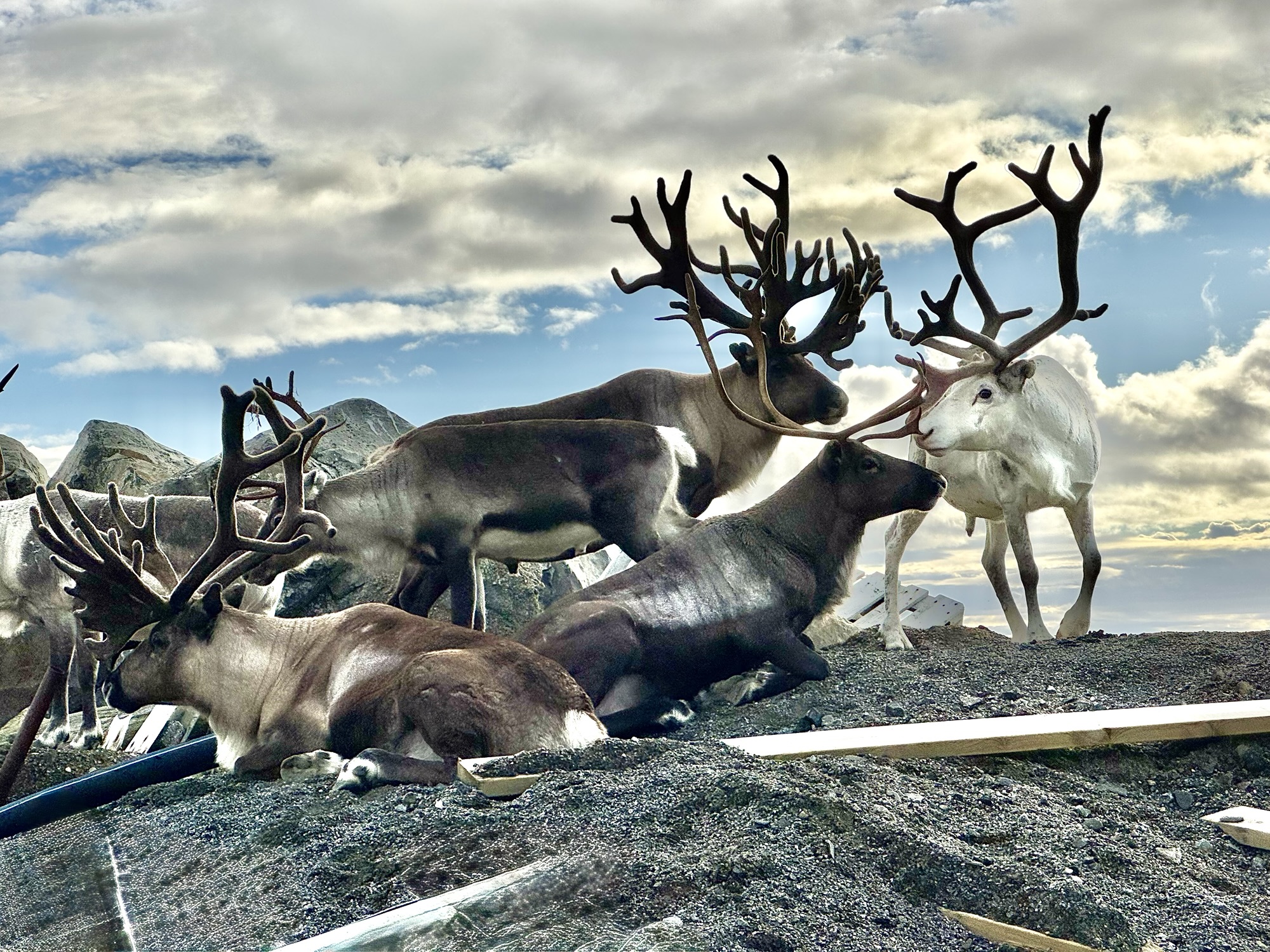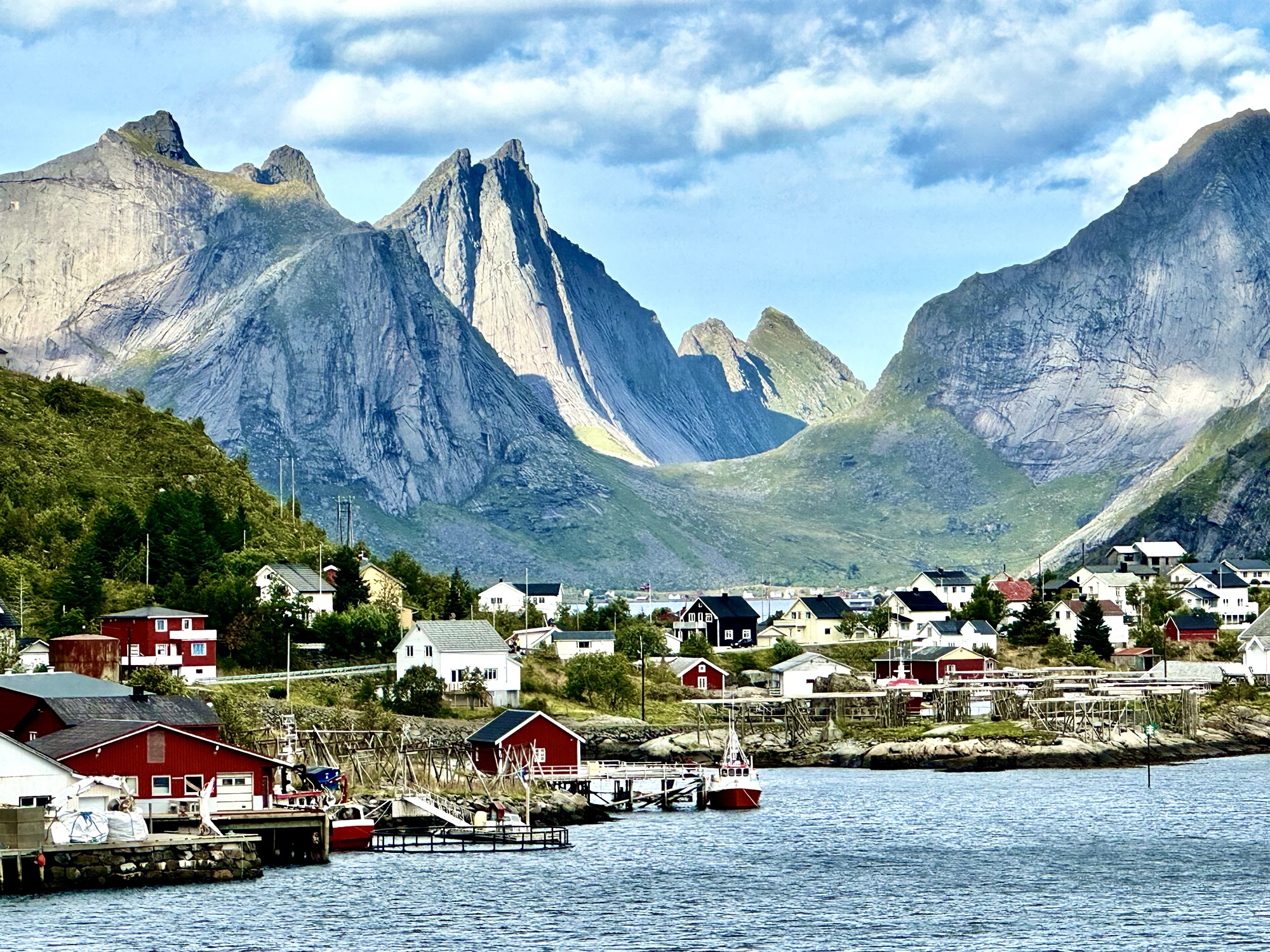
We have reached Ny-Alesund, Norway, the apex of this journey and the northern limit of civilization.

At the 79th parallel we are 750 miles from the North Pole.

One can say that civilization’s limits extend no further north considering that this is the northernmost settlement with a year round population (35 over Winter and 120 in Summer) and the northernmost post office in the world.

Christine sending postcards home.
The Post Office

Our 5 hour ship’s visit briefly doubled or even tripled the local population.

.

Not everyone left the ship to brave the bone chilling cold.

Ny-Alesund was founded in 1917 after previous explorations had determined that rich coal deposits could be mined here.

The coal transfer port
A mine entrance atop the mountain, now a research instrument location.
.
The coal train, now a memorial.
In the small museum is an exhibit of the coal company, physician’s tools. These included a transport basket, dental chair, and a straight jacket!

In spite of the harsh conditions mining was pursued until 1962 when a mine disaster claimed the lives of 21 miners.

The town is also well known as a launching point for polar exploration.

.
.

A 12 room hotel was built here in 1936 and still stands, although it is not currently in use.

.

Famously, Roald Amundsen set off for the North Pole from here in the airship Norge, and became the first person to reach the South Pole (1911) and North Pole (1926). He is also credited as having been the first to successfully navigate the Northwest Passage (1909). He disappeared without a trace while conducting an Arctic rescue mission in 1928.

.
.
.
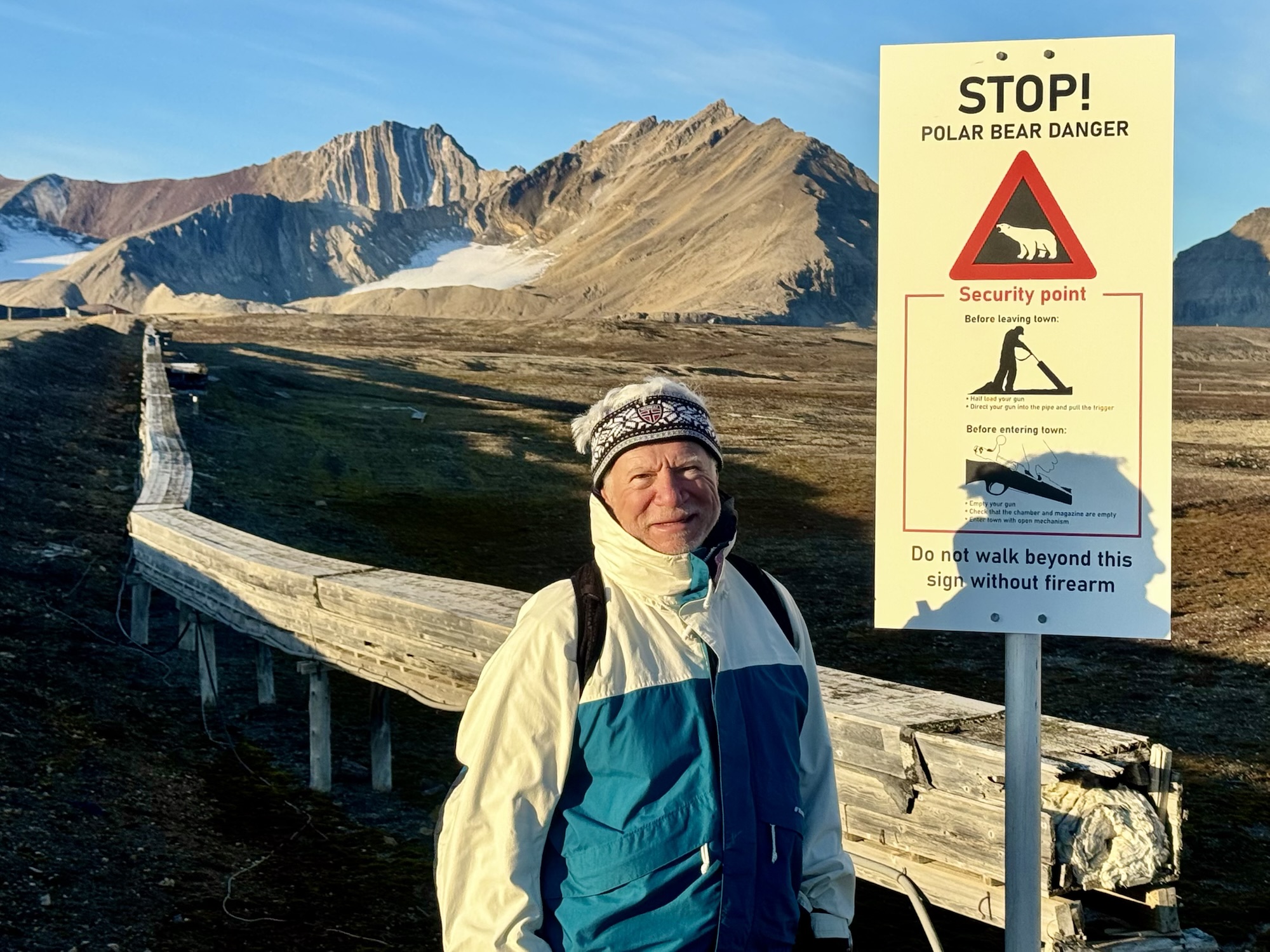
Our obligatory, armed escort.

The mast from which Norge was launched and a bust of Amundsen remain as testament to the man and his achievements.

.

Arctic research gained a foothold in Ny-Alesund in the mid 20th Century. It remains the driving force of the settlement today. 18 research institutes from 11 countries have permanently established facilities. 5 are manned year round.

.
.
.
.

Because of the sensitivity of the scientific instruments a 12 mile exclusion zone exists within which the use of mobile devices, WiFi, Bluetooth, and similar technologies is prohibited.

Polar Bears are a constant concern. Locking exterior doors is forbidden in order to afford an escape route in the event of pursuit by a bear. One is also not allowed to leave the town center unless armed or accompanied by an armed escort.

.

There was a bear in the vicinity the day before our visit.

Christine and I agree that Ny-Alesund is “otherworldly”… “a nice place to visit but I wouldn’t want to live here!”

.
.
.
.
.
.
.
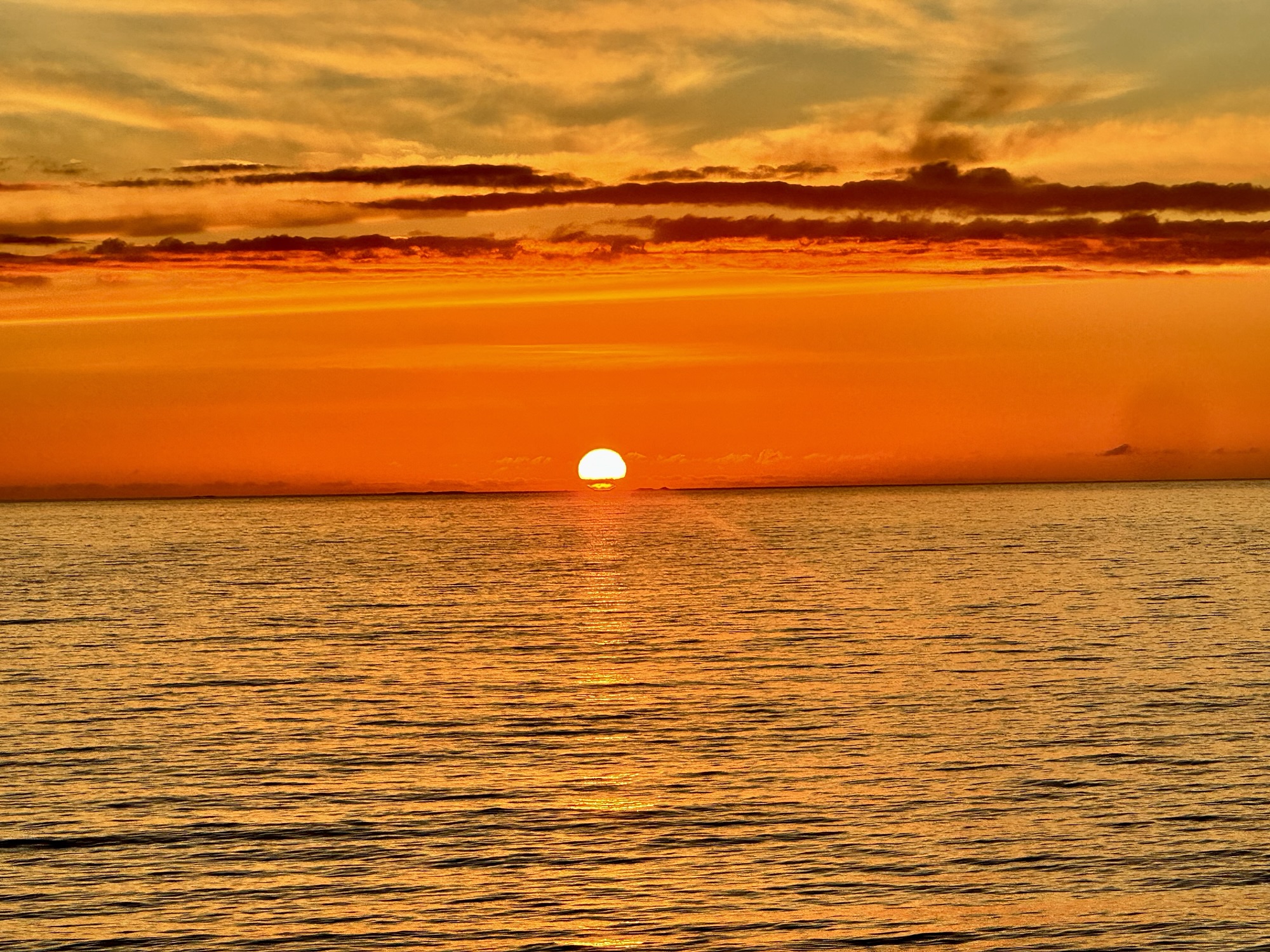
Evening, as we would soon find out, the calm before the storm.

Peace Everyone. Pete

PS. On our return south from Ny-Alesund a shipboard announcement was given: For the next 24 hours high winds and waves are to be expected. Services aboard ship will be limited. Objects are to be secured and passengers are recommended to exercise caution in their movements.

Prophetic words. Wind gusts are near 60 miles per hour and waves are crashing over the ship’s bow. “Climatologically Interesting”

The following day the Captain advised that the waves had reached over 30 feet (10 m).

.
.
.

Tuesday, September 16. After a 36 hour open ocean crossing we approached Svalbard Island. We would visit two ports of call, the first being Longyearbyen, the northernmost town in the world that has a population of more than 1000.

Our rather pedestrian (standard but small) cabin is located on the 8th deck. Deck 9, the observation deck, is a short stroll down the corridor and up some stairs. I threw on clothes and a light sweater and ascended to that deck. I was in for a shock! The weather of the last few days had been like late Fall in Kansas City. What I emerged into was the depth of Winter. Cold, driving wind, and snow on the surrounding shores. So much for light sweaters. Today would be full on foul weather outerwear.

.
.
.
Glacier
.
We listen as the crew describes the nearby abandoned Russian coal mining town.
The abandoned Russian coal mine
The abandoned Russian town
The harsh arctic elements accelerate erosion.
.
A helicopter sea rescue off our port.

Longyearbyen hosts a population of 2,600 (including @500 children) and proudly notes that its residence hail from over 50 countries. It’s an industrial town with an economy based on fishing, arctic research, adventure tourism, and until earlier this year on coal mining.

.
.
.
.
The huge Longyearbyen coal operations, closed earlier this year. The red building to the left is apparently the office building.

The Svalbard Longyearbyen Global Seed Vault is located here, but more on that later.

The town was founded in 1907 by John Longyear, of Michigan, USA, owner of the Arctic Coal Company. The town was almost completely destroyed by the Nazis in 1943 and has since been rebuilt as a vibrant modern community. 

Today Longyearbyen features an airport, hospital, weekly newspaper, and university extension, in addition to various commercial enterprises. 

Interestingly, it does not feature a cemetery. It was found in the 1950s that the permafrost did not allow for the decomposition of the dead. There was fear that biological organisms might remain alive and emerge with the bodies which occasionally surfaced over time due to frost heave. 44 bodies were removed and relocated to the mainland. Thereafter the dearly departed have truly been departed south.

Longyearbyen is ARCTIC! The midnight sun lasts 128 days and polar night is 111 days long. Global climate change/warming impacts Longyearbyen and Svalbard Island more than every other part of the globe.

Humanity’s Lifeboat. The Seed Vault of Longyearbyen.

I’m 73 years old. Those of my generation may recall that in our childhood the elephants, rhinoceroses, hippopotami, great cats, the great apes, whales, and walruses… seemed of an inexhaustible numbers. Sadly, extinction for each of these is a very real concern today. 

Science has identified 5 great extinction events that have occurred over the Earth’s history. Science has also identified a 6th extinction, The Holocene, also called The Anthropocene Extinction. Flora and Fauna species are disappearing at an unprecedented rate. Causes and blame are topics for a different discussion.

Since the early 20th century, there have been significant efforts to preserve plant biodiversity for future generations. Among these:

The Institute of Plant Genetic Resources in Saint Petersburg, Russia was started in 1924. It survived the 28 month siege of Leningrad in World War II because several botanists chose starvation rather than to eat the seed collections and potatoes.

The Millennium Seed Bank near London, UK, was established in 1996 and is the largest seed bank in the world. It is already home to over 2 1/2 billion seeds representing nearly 40,000 different plant species. 

The 12,000 square foot Svalbard-Longyearbyen Global Seed Vault opened in 2008.

The Svalbard Global Seed Vault is a secure backup facility for the world’s crop diversity on the Svalbard archipelago of Norway.
As of February 2025 it has received seed samples from 123 genebanks in 85 countries around the world,
Photo: Michael Major for Crop Trust
My photo, from a distance through a ship window.

The vault is located hundreds of feet underground, deep in the Arctic permafrost, and within 3 foot thick concrete and steel walls. It is designed to withstand earthquakes, nuclear war, and the ravages of time. Temperatures within are sub-freezing, dry, and ideal for long term seed preservation. The purpose of this vault is the preservation of important food crop species. Signatory countries and organizations archive the seeds of their food crops here. Current holdings include approximately 20 million seeds representing over 13,000 years of agricultural history and 1/3 of the most important food crop varieties in the world.

Image from Wikipedia

Most recently Syria withdrew some of its seed stocks in an effort to reestablish agriculture in its post war era.

Seed vaults in general, and Longyearbyen’s in particular, may indeed be humanities lifeboat.

Peace Everyone. Pete 

PS. Yesterday we secured an upgrade to our cabin. We can no longer call our accommodations “pedestrian“. We can no long call it a “cabin”.

.
The “twilight” that lasted through the night

Here are pictures from our visit to Honningsvåg, passage by Bear Island, and first sight of land at the southern tip of Svalbard Island. 

We arrived in Honningsvåg on Sunday, September 14th. It is 25 miles from North Cape, considered the northernmost point in Europe. Monday was an at sea day during which we passed Bear Island (pop. 9, a research station). We arrive today, Tuesday, in Longyearbyen (pop. 2,600) on Svalbard Island, the northernmost town in the world with a population greater than 1,000. We are currently 780 miles from the North Pole. 

Our approach to Honningsvåg
.
.
.
There is evidence of human settlements in this area dating back 11,300 years, at the end of the last Ice age.
.
Honningsvåg
In the Honningsvåg harbor.
.
.
.
The church in Honningsvåg, Built in 1885 and replacing an older church, it is the only building left standing after the Nazi scorched earth evacuation in 1944
.
These fellows came down from the mountain side to wander through town.
.
The lighthouse is only 15 feet tall, the shortest one in Norway.
.
The northernmost phone booth in Norway, perhaps the world. It is now a lending library.
Passing Bear Island
Bear Island
The southern coast of Svalbard Island at 5 AM.
.

Peace Everyone. Pete. 

PS. Evening entertainment in the lounge is courtesy of Gill, a talented pianist and singer. He also has hair as amazing as Christine’s!


September 12th. Christine and I had enjoyed a wonderful day and afternoon in Reine Norway. Come evening I began to experience a nagging discomfort in my lower left back and abdomen. Within 20 minutes I felt forced to lie down in our cabin. Within an hour the pain was excruciating. I was pale, trembling, and sweat had soaked through my clothes.

We sought out the ship nurse. While I reclined in his small infirmary the pain moderated from an “8” to a “6”. His concern and Christine’s were palpable, but I felt that perhaps the worst was over. Vitals were good and we returned to our cabin.

An hour later and the pain had fired up again, worse than before.

The ship’s medical professional and an assistant were summoned. He was in direct contact with the ship’s captain and a shoreside doctor. A joint decision was made to make an emergency detour to the nearest port and arrange for ambulance transport to the nearest hospital. Two injections of morphine were administered.

We were over an hour away from port. Christine and the assistant packed our bags. A taxi was arranged to arrive at port to transport Christine and our luggage. The ambulance transport from port to the hospital would take another hour. A third injection of morphine was given.

I arrived at the small local hospital around midnight. I was met by three nurses and a doctor. Vitals and tests ruled out cardiac and infection issues. Further tests determined that I suffered from a kidney stone. A first level of treatment and watchful waiting brought relief. The hospital staff arranged for a taxi and a late night hotel near the town dock. I was discharged at 3am with prescriptions for 4 medicines. Christine was asked to pay the hospital and doctor bill… $30. The taxi from the port to the hospital had cost $300. Ambulance cost is unknown.

The hotel, normally not open at that hour, was emergency staffed by a kind and accommodating lady. Our room was charged at the lowest rate she could arrange, $130. We got only three hours of sleep as we had to be up early to try and catch an 8am fast passenger ferry to Tromso, hopefully to be allowed to reboard our ship. We were not expected back.

We made it. I was greeted like Lazarus returned from the dead.

I am better, not 100 percent, but better. We continue on, but with an undercurrent of anxiety as we cross open ocean these next two days.

Peace Everyone. Pete.

PS. Filling the four prescriptions cost $32.

This is from our fourth day aboard ship and third port of call, Friday September 12.

Reine is a remote fishing village founded in 1743. Its population numbers fewer than 300. 

.
.
Mount Reinebringen

After fishing, tourism is next most important to its economy. The chief draw is the isolation and remarkable scenery. 

.
Traditional fishing boats, still in use.
Over winter fish are hung on these racks that are located throughout the town. They then “freeze dry”.
.

Mount Reinebringen (altitude 1,470 ft) towers above the village and harbor.

.
.
.

The view of the village from atop the mountain is one of the most photographed landscapes in all of Norway. 

I did not climb the mountain! This is a publicly available image from Wikipedia.

Once considered a very difficult climb, 2,000 steps were installed on the mountain in 2019 making the summit accessible to non-technical climbers.

Some other images from our visit:

.
.
.
.
.
A motel with cabins is located in the village
The rear view of the motel cabins
48 years married, 51 years together… and counting.
.
Notice the variety of roofs.
Scenes from the village cemetery by the sea.
Three graves. Two featuring bronze death masks and the third, a child with her full form sculpted bronze image.
A very old family plot
A memorial to sailors and fishermen lost at sea
.
.
.
.

Peace Everyone. Pete

PS. In the afternoon I joined a shipboard activity; a tasting of some local beers. Prost!!

.
.
.

PPS. Later that evening I encountered difficulties which will explain the delay in making this post. I will share details in a later update.