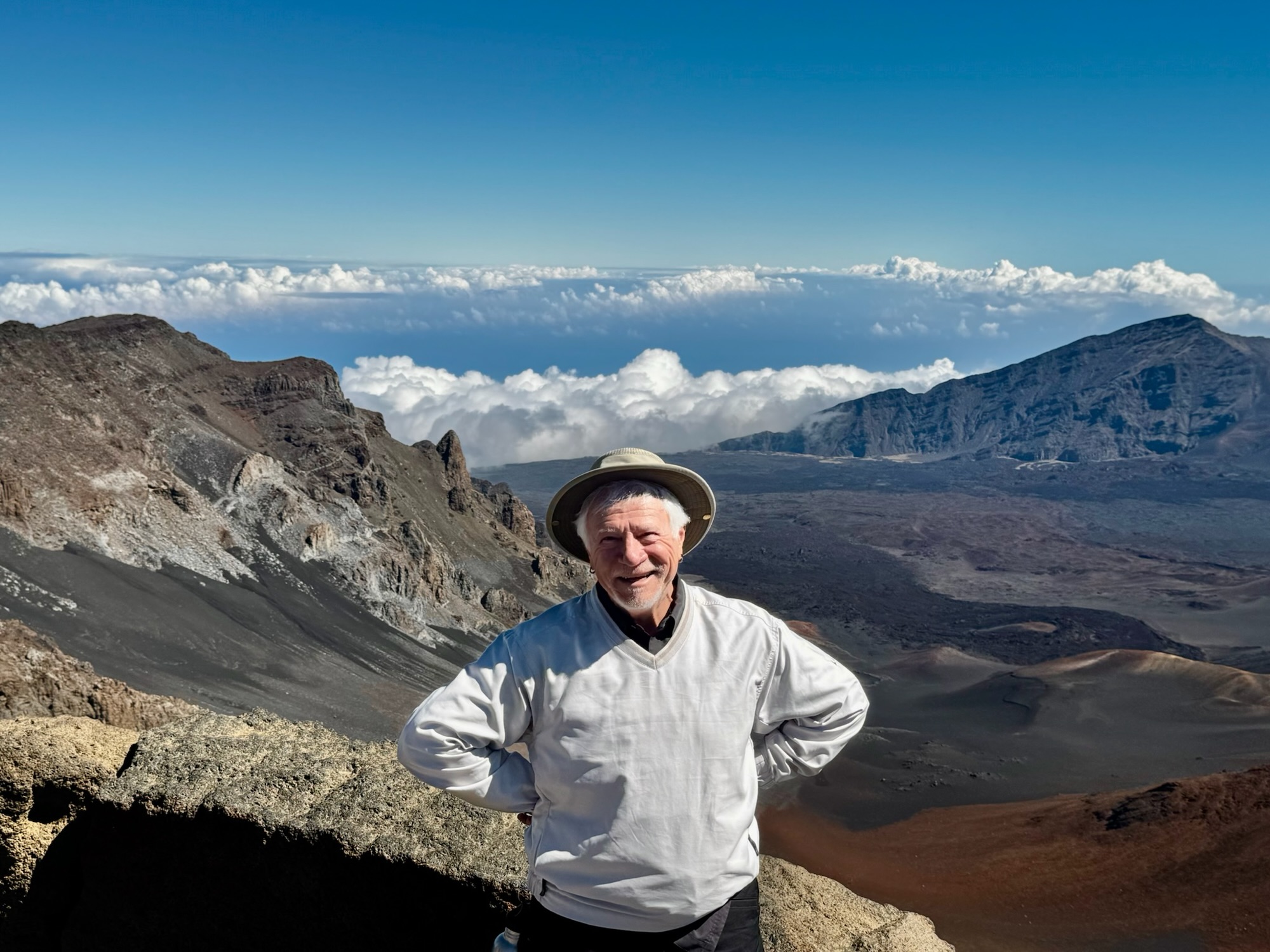
The name Haleakalā is Hawaiian for “house of the sun.” According to a local legend, the demigod Maui imprisoned the sun here in order to lengthen the day.
.
This is a sacred place and treasured by Hawaiians as a place of pilgrimage to witness the beginning and end of the day. The vistas are otherworldly.
It is also very popular with bicyclists!
Designed a National Park in 1976, the park covers over 50 square miles.
.
The rim of the volcano crater, nearly 2 miles above sea level, can be reached by car. The park is host to a network of over 40 miles of trails. Wilderness camping is available and 3 remote primitive cabins can be reserved for up to 3 nights.
..
The park features the dormant Haleakalā Volcano which last erupted sometime between 1480 and 1600 AD. The crater is 7 miles across, 20 miles in circumference, and 2,600 feet deep. The interior of the crater is dotted by numerous volcanic cinder cones.
...
Although located in the tropics, the summit has a desert alpine climate. Night temperatures can descend below freezing, and occasionally there is even snow.
A number of unique and endangered species are found here, including the Nēnē bird (a goose-like bird native to Hawaii and rescued from the brink of extinction) and the Silversword plant which is found nowhere else in the world.
The ranger explaining the Silversword lifecycle. These examples are approximately 18 years old. Without warning they will bloom and then die. A Silversword in the wild. Examples that recently bloomed.
The Haleakalā Observatory, operated by the University of Hawaii, is prized for the pristine viewing conditions. One of its primary functions is to track satellites and space debris.
.
Many in our group considered today a highlight of our trip, me included.
.
After the park we lunched in the unusual Hawaiian “cowboy town” of Makawao. It is famous for its paniolo (Hawaiian cowboy) history, arts scene, and cooler climate. It offers a blend of plantation past and modern creativity. It offered us a great pulled pork sandwich!
...Our lunch spot.
Tomorrow Is once again moving day with our next destination the Island of Kauaʻi.
Yesterday, January 28, was a very full day… How full was it?
.
Up at 6 AM, breakfast at 7 AM, a brief rest until 9,
A 9 AM presentation on the destruction and restoration of Lahaina…
Lunch at the first restaurant to reopen in the downtown, “Lahaina Mixed Plate”…
A long motorcoach drive to the Maui Alexander and Baldwin Sugar Museum…
Another motorcoach drive, this time to the Maui Arts and Cultural Center…
Dinner, and a long motorcoach drive back to our hotel. We concluded at 8:00 PM.
Christine was not feeling her best and chose to remain at the resort. She is again enjoying rest at the resort today. (She went whale, watching in the afternoon, smart woman!)
Today, January 30, we are ascending by motorcoach to 10,000 feet and Haleakalā National Park. While it is 70° at sea level, we anticipate temperatures in the 50s at the top of the mountain. The Park is named after the dormant volcano within his boundaries, the huge Haleakala Caldera. Designed a National Park in 1976, the park covers over 50 square miles. I am attempting with limited success, to type this while we bounce merrily down the road on this four hour round trip.
I will let photographs with some captioning describe the events of yesterday.
....Temporary housing. This has been extended for another year while rebuilding continues.Temporary housingThe rebuilding process is evident everywhere. The last of the great sugar refineries.Some of the heavy equipment utilized in sugar harvesting and processing.Sugar museum staff giving a presentation on the history of sugar production in Hawaii..The superintendents house, now the site of the Alexander and Baldwin Sugar Museum. sugar was “king“ in Hawaii from the early 20th century until 1981. During the years of sugar production, Hawaii was continually faced with a labor shortage. Immigration with contract labor and indentured servitude was utilized. Immigrants were brought in from China, Japan, the Philippines, and Portugal. The typical indentured contract was three years of hard labor. This steam engine which powered the sugar mill, weighed 50 tons, had a 24 foot flywheel, and generated 1500 hp. It was in use from 1903 to 1981. This is a working scale model of the sugar processing machinery. A Portuguese bread oven used by the Portuguese immigrants. A 1930 gas powered crawler tractor, a “caterpillar“.The Maui Arts and Cultural Center. We were fortunate to be on hand for a special exhibit. The center director and the number of the artists we’re on hand to discuss their work......
Road Scholar Hawaii, Four Islands, January 19 – February 8, 2026.
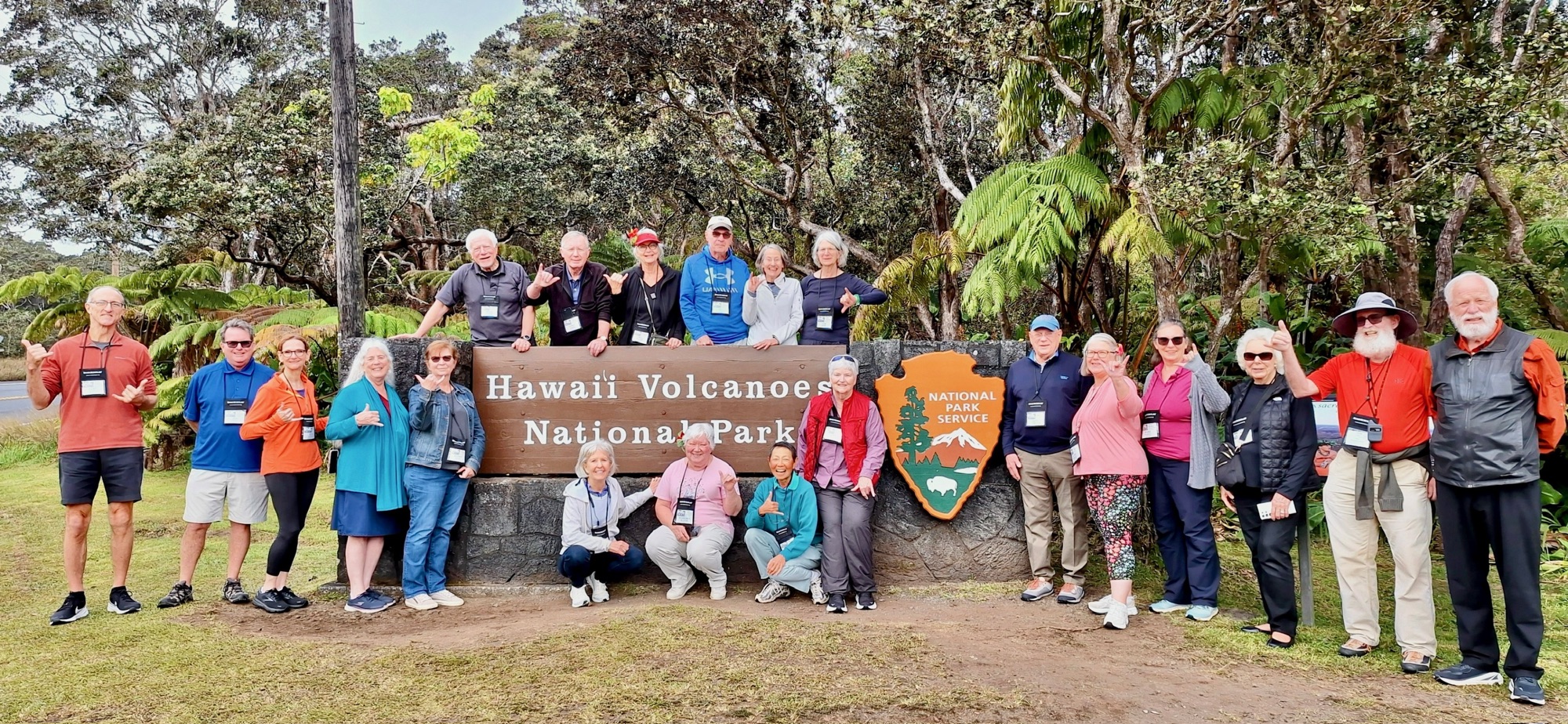
We number 30. Three of us are group leaders and 27 are participants. Most of the group members have traveled with Road Scholar (formerly known as Elder Hostel) many times, some as often as three times a year. Christine and I are in the minority as this is our first Road Scholar experience.
There are 10 couples and seven singles. Among the singles there are six women and one man. A number of the singles have expressed to me that this is an ideal way of traveling for them as they are never “alone“.
We are as young as our mid 60s and as old as 90. Perhaps we have lost a step physically, but we more than compensate in our inquisitiveness and desire to keep exploring our world.
We don’t talk politics, we don’t talk religion, we avoid controversy in favor of fostering a welcoming and inclusive dynamic. I do not sense that any of us represent the extremes of conservative or liberal. Perhaps some are right leaning and others left leaning, but we seem to be mostly centrist. For us, “current events“ represents what we have seen yesterday and will be seeing today and tomorrow.
We are retirees, but many continue to freely donate time and expertise within our communities. We represent the four corners and center of the Continental United States.
As conversations and relationships within the group mature, we learn of spouses lost, children, grandchildren, prior professions, medical challenges, prior travels, milestones…
We learn of special talents and expertise among us; quilting, pottery, music…
For these three weeks I am left with no doubt, this is where I belong.
This morning, we bid farewell to The Big Island. One might think that organizing 30 people’s check-in for their flight, checking baggage, and receiving seat assignments and boarding passes would be a Herculean task.
Our group leader, Susan, made it look easy. She divided the group into subgroups and designated a “leader“ for each group of six. The group leaders each had one reservation with the other five members of the group confirmed under that reservation number. It all worked seamlessly.
.
The flight was on time and in less than 45 minutes we were touching down on the island of Maui. Before proceeding with our tour for the day and subsequent arrival at the hotel, we enjoyed an ice cream style treat and lunch on our own.
This is the only place of its kind in Hawaii. It’s a Japanese style ice cream, somewhere between sorbet, softserve, and gelato. Super tasty!.
First impressions: Maui seems more developed and tourist friendly than the Big Island.
..
It is also the site of an immense tragedy. It is on this island that fires ravaged the community of Lahaina in August 2023. At least 102 people perished in the fire, two are still missing, and property losses we’re over $5.5 billion. 17,000 acres were burned, destroying over 2200 buildings.
There are monuments lining the highway with images of many of the deceased. Out of respect I did not take pictures of those monuments, but rather took pictures of the monuments left to the many dear pets that were lost in the conflagration.
Later this week, we will visit the scene of that devastation and have lunch at the first restaurant to open after the fire.
As a travel day, there was not an abundance of time for sightseeing. Nevertheless, we were able to visit the site of one of the most consequential and bloody battles in native Island history.
...This amazing image is courtesy of Gary Schils , a member of our group. .
In a most peaceful and garden like setting is the Monument to the 1790 Battle of Kepaniwai. This battle was the start of Kamehameha I’s campaign to unify the Hawaiian islands under one rule.
Kamehameha was described by Captain James Cook as “a brute of a man”. He was considered iron-tough, unyielding, and peerless as a warrior in battle. He was also considered a brilliant tactician, and savvy politician.
.
I will allow my pictures to tell the rest of the story and convey impressions of the beauty of this area:
..A floral gift left to the island gods. ..Here we are sampling leaves of a plant that was used traditionally as an analgesic. The leaves and roots were specially effective on toothaches. We chewed and then spent the next half hour with tongues partially numbed. Members of our group ascending 160 steps to a peaceful overlook for a prayer and contemplation.The group waving to me. A moment for prayerful meditation led by Susan.
A little after 3 PM we arrived at our hotel, The Outrigger Kā’anapali Beach Resort. We were greeted by music and dance.
.
A small army of bellmen took over our luggage which later magically appeared in the proper rooms. This is a place worthy of a visit in anyone’s vacation itinerary!
There is a brewery restaurant on the grounds, an amazing beach, swimming pool, and of course the room is without fault.
The view from our room balcony. Again, the view from our balcony. Our room.
Our group shared dinner at the Maui Brewing Company Restaurant. We are really looking forward to the next four nights here!
There is a presentation and sightseeing tomorrow morning. Many people in the group are going whale watching in the afternoon. Christine and I plan to take advantage of the beach and pool and perhaps get some laundry done in the free time.
Yesterday, Sunday, was an official free day for our Road Scholar group. Some members took the opportunity to do laundry, others enjoyed a leisurely ocean swim, and still others slept late and embraced the joys of doing mostly nothing. Christine and I counted ourselves happy to be among the last group.
Today the program resumed.We were again up at 6 AM and on the road after breakfast for a day of sightseeing and informative lectures.
First Stop: A “Painted Church”.
.
This Catholic Church, a wooden structure built in 1899, is plain white on the outside, but wonderfully colorful on the inside.
.
Murals depict biblical scenes. Columns morph into images of palm trees as they ascend to a star covered sky. Images behind the altar are meant to mimic the grand cathedrals of Europe.
Eve, trying to revive her son Abel, who has been slain by her other son, Cain.
This church is an unusual treasure in that it has survived the decades and avoided destruction from the natural disasters common to the island (not the least of which are the termites!).
This little guy was watching us as we left the church. 
Next Stop: Pu’uhonua o Hōnaunau, National Historical Park.
.
Tradition holds this to be a place of extraordinary mana (spiritual power). At one time the bones of 23 chiefs were protected in the temple.
.
These royal grounds were a center of island political, and religious power. It was here that Kapu was declared: The sacred laws and beliefs by which the islanders lived.
.This artisan is hand weaving native head dressings. He is doing it with traditional methods and traditional materials. Each head covering takes from 3 to 6 weeks to complete. .
Some examples of Kapu are: Men and women could not eat together. Only men were allowed to eat pork, women were relegated to eating dog. Only men could be involved in food handling and preparation. Women, who were deemed unclean, only took care of the children. Women had to segregate themselves from the rest of the tribe during their monthly cycles. Tribal commoners were not allowed to look upon royalty or to even step on a royal person’s shadow. The usual penalty for violation of Kapu was death by strangulation.
This game, which looks deceptively similar to checkers, was played between chiefs in order to resolve disputes. It was winner take all and the defeated lost his life, properly, and warriors. .
However, separate from the Royal Grounds and surrounded by a massive stone wall, 1000 feet long, 10 feet high, and 17 feet thick was sanctuary.
Experts estimate that this entire 1000 foot wall was erected in one week. No mortar was used and the stones, many of which weighed hundreds of pounds, were transported without the benefit of the wheel. .
If one were able to escape to the place of refuge behind the wall, he could seek absolution by a tribal priest. At one time there were a number of such places of refuge (Pū’uhonua) in the islands. This one has been preserved as a National Historic Park.
The law of Kapu existed for many hundreds of years, but was finally abolished in 1819. This sanctuary is still held sacred and remains a place of peace, calm, and reflection among Hawaiians.
Final Stop: The Kona Coffee Living History Farm.
.
This site, a beneficiary from the National Endowment for the Humanities and the State Foundation on Culture and the Arts, preserves and depicts daily life of the Japanese Uchida family. For 81 years these Japanese immigrants leased and worked this coffee farm of approximately 5 acres. They experienced the severe hardships of the Great Depression and the significant restrictions on their liberty brought about by suspicions based on their ancestry during World War II.
As we approached the home tradition and ceremony dictated that a small gift would be given to the farmer.We were welcomed into the home and provided an explanation of its use over the years. The home was a beautiful in its simplicity..
90% of the area farms that produced coffee were operated by Japanese families. They were small at less than 5 acres each yet they were the lifeblood of coffee production in this part of Hawaii.
Many of the coffee trees are nearly 125 years old and still producing. Production methods were explained to us. They were decidedly low tech.A major leap in technology occurred around 1930 when a single cylinder stationary engine was installed that drove simply equipment through a series of pulleys and long belts. The engine still works and has run monthly. The farm grounds were also covered with macadamia nuts. Macadamia nuts could be gathered from the ground and cracked open to be enjoyed. Table top nutcrackers were available. I optioned for the Stone Age technique of using two volcanic rocks. I think it worked better than the nutcracker. A macadamia nut ready to be pulled from the shell and enjoyed. 
There were usually three or four harvest cycles each year. During each cycle family members and workers were called upon to harvest hundreds of pounds of coffee berries each day. The berries then had to be stripped of the sugary cover, dried, and stored for eventual transport. This was backbreaking work. Each farm had to rely upon one donkey (few farms could support two donkeys) to provide “horsepower“. The donkeys, a social animal, would bray to one another in the distance each evening in what the farmers would call the sound of the “Kona Nightingales”. These small but sturdy animals carried over 500 pounds of coffee beans at a time.
100% Kona coffee is prized for its flavor and richness. It prices locally at over $50 a pound.
Tomorrow:
Tomorrow morning, we bid farewell to The Big Island and fly to the island of Maui.
Peace Everyone. Pete
PS. There is so much more that we have experienced in each day than I can present in these posts. For you who have been here, I hope that I am resurrecting fond memories. For you who have thought about coming to Hawaii, I hope I am providing extra incentive. For those who will never come to Hawaii I hope that I am giving you at least a “taste” of this paradise. -Pete