Remember, this is just about a tree…

I don’t recall exactly when she first came to my notice, but when she did there was so little hope for her.

We had purchased a home in an old established part of Kansas City. The home was a derelict sitting upon a long-neglected yard that had gone wild. The house was deconstructed, and the salvaged materials were donated to Habitat Restore. Heavy equipment was brought in to fracture, crush and pulverize the concrete foundation. Machines tore the earth leaving a crater where a home once stood. The yard, where it could still be identified as such, bore the scars of tractor treads and heavy trucks. Two wonderfully monumental trees gave their lives, doomed by the crush and cuts to their roots. Virtually unnoticed and soon forgotten were the destroyed flower beds, plowed roses, uprooted shrubs… the plantings that had adorned the property and once given it character. The wildings, vines, weeds, and mix of volunteer foliage were no less the victims of the onslaught, but they were always destined to go unmourned.

Perhaps she was one of the last plantings of the former owner, a five-dollar sapling found in the backlot of a Home Depot. Perhaps she was just another volunteer that had sprung from the earth in the eternal competition for sunlight and water…

Construction of the new home proceeded. Endless sorties of men and machines savaged and then reformed the earth. Wood, iron, and stone were dropped, saturating the site and crushing life. Materials slowly and methodically became structure.

I recall a fork-loader lifting a huge pallet of lumber. A small sapling rebounded from the horizontal press that had been enforced upon her. The earth around her had been scraped bare. I thought nothing of her at the time…

Over the months that followed, minerals and metal, the creation of industry, and wood that had once known life, were forged into a reality that had been the spark of an architect’s inspiration. We lacked only landscaping to transform the ravages of construction into the peaceful repose of a dream that my wife and I had shared. Even here the process of cladding the soil with sod required more equipment to make a final assault upon the ground.

She was still there! Not quite straight but there was a spring in the few pencil thin branches that had not been torn from her. The long deep scars on her inch diameter trunk did not encircle her and I knew that there was a chance she might live. In that moment I appreciated that Nature may give life, but it is for us to grant opportunity. I found a piece of orange flagging and tied it near her crown, just 4 feet above the ground. I asked the workmen to leave her undisturbed. I asked nothing of the tree.

I watched her grow that first year. I saw the scars become bordered with new wood. Buds became leaves, and I watched leaves come into crimson glory in the Fall. In the second year she reprised the first but with surprising vigor. She was strong, straight, and tall. Her smooth sapling bark was developing the lines and grooves that along with her leaves would identify her kind. She is a Sweetgum.

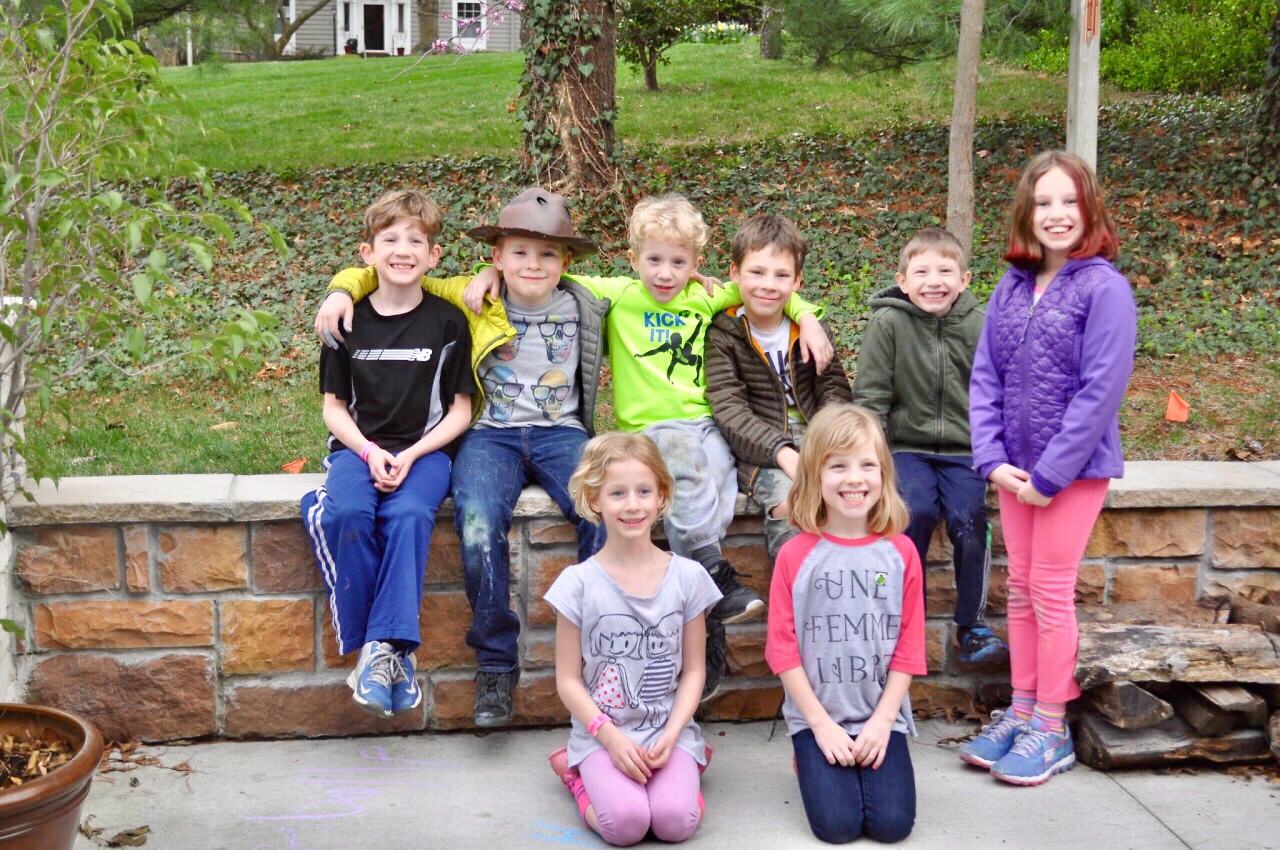
It is year three and she is over ten feet tall! I have shared her story with my grandchildren. They love the tree, often walking up to her and hugging her broadening trunk. She is special to them as she is special to me. Her wounds are nearly healed, but she will carry the elements of damage deep inside of her long after any outward sign of her struggle has vanished. I know that she is not a tree favored by many. Her kind is vilified for the spikey seed balls that they produce. But out of the opportunity that she was given she has returned a lesson for me and my grandchildren. She brings a smile to me whenever I gaze upon her. She offers the promise of shade and she is a glory in the Fall. Those of my generation with whom I share her story often think no further than those “spikey balls” and counsel that I should cut her down. Those of my children’s generation tend to smile politely, giving salute to my eccentricity when I speak of her as a friend. It is the third generation, my grandchildren, that grant the refugee tree their full acceptance and love.

Maybe this was about more than just a tree.

Peace. Pete Schloss
Originally posted February 15, 2016
Update 2/14/18: She now towers nearly 20 feet tall.

Sisyphus, that tortured soul from Greek mythology (and the inspiration for Dante’s fourth circle of hell), was doomed for eternity to endlessly roll a boulder to the top of a hill only to have it roll back down just before he reached the summit. It is a strong metaphor of herculean effort, searing pain, and intolerable frustration, followed by defeat playing out in an endless loop. Over the years I have associated this image with the lives of many people that I have encountered as an attorney and Mediator.

Relationships which have their roots in addiction, abuse, deceit, or dysfunction are stones such as Sisyphus was partnered with. These are relationships where one person appears to assert a superhuman effort to push for the preservation of the relationship, enduring physical and emotional pain, frustration, and finally failure. If it ended there, then the comparison to the struggles of Sisyphus would fail. However, like Sisyphus there are some souls who immediately return to that “stone” (or another like it) to renew the effort, pain, disappointment and defeat. Why? No doubt hundreds of books have been written on the subject by researchers, psychologists, psychiatrists, and social workers. Jerry Springer has made a fortune show-placing the lives of folks caught up in this revolving door. I am an attorney, not a social scientist. However, attorneys are usually keen observers of human interaction. We represent people who are caught up in dysfunctional relationships.

Any experienced family lawyer can tell of storied divorces which played out to conclusion only to have the client return to the office a few years later with the same problems, just a different spouse… sometimes even the same spouse! We scratch our heads, shrug our shoulders and go forward to represent the client to the best of our abilities.

At the end of a divorce proceeding I usually offered a straightforward piece of advice to my client, “Please, do not become engaged in a committed relationship for at least two years.” Occasionally a client would ask “why”, but more often there would be a polite smile and no other acknowledgement of my remark.

I believe that we develop habits of interpersonal interaction and communication. Some of these habits are formed by our experiences as children observing our parents’ relationship. A child raised in a household with spousal violence faces the likelihood of growing up to either be an abuser or a victim of abuse. Some habits of interaction are impressed upon the inexperienced and malleable by the object of their affection. Witness the case of a naïve teen who runs away with a man of ill intention, or one who blindly follows a cult leader. One who is raised in a household burdened by dysfunction has a greater likelihood of becoming an adult member of just such a household. Of course, some of these habits are formed merely as the fallout from a long decomposing relationship.

Why fall victim to the repetition of such misery? Familiarity, no matter how painful, may still be more comfortable than that which is unfamiliar. If a person has learned only one dance step, then that person will naturally tend to dance with the people who dance the same step. Selecting a dance partner who dances to a different beat is uncomfortable, unfamiliar, and threatens to make one look inept or foolish. Learning a new dance takes time, effort, and courage.

Many clients have said “I’m done with marriage forever” but missed the point that they were not done with relationships. I think that real change takes two years, but not two years sitting on one’s hands. This kind of change requires a good support system, counselling, and at the very least “new playmates and a new playground”. It also takes the acceptance that there are things that cannot be changed (the other person), it takes courage to change the things that one can change (oneself), and wisdom to know the difference.

Like Sisyphus, we may make our own hell in this world by trying to change the other person, confusing relationship with endurance. Had Sisyphus taken a 2 year break he might have found the insight to leave that stone for someone else to bear. Of course, that would have been Dante Alighieri’s loss.

Peace Everyone. Pete

(Posted May 28, 2015, amended February 13, 2018)

“”Second Star to the Right, and Straight on till Morning.” That, Peter had told Wendy, was the way to Neverland.” (From “Peter Pan”, by J. M. Barrie)

We have sought Neverland at the tiller of a sailboat. We have searched from the handlebars of a bicycle. Our feet tread the 1,000 year old path of Pilgrims in Spain. Beginning in May, 2015 we have sought it along the roads of North America. Our choices are to either travel the Interstate system or choose the “Blue Star Highways” of America.

The Interstates are beasts of concrete and steel, creature of post World War 2 prosperity and expansion in America. They are a monument to the ability of mankind to wrestle nature’s boundaries and obstructions into submission. They are byways without passion or soul, roads known only by a number and a direction. The Interstate is blunt force that catapults the traveler from one place to another as a bow shoots an arrow.
The Blue Star highways are highways in name only. Now less traveled, they were born in the distant past and were later dedicated to the memory of US soldiers fallen in World War 2. Their courses are typically determined by nature, some portions by the pre-Columbian residents, and other sections by early European explorers. They make a path in compromise with the natural lay of the land. There are only gentle modifications to grade and course. Unlike the Interstate, which blasts through a hill in order to maintain direction and grade, The Blue Stars meander on and around the rise and fall of the land, like a ribbon uncoiling from its spool.

The Blue Stars are living roads that have a personality, they have a soul. I grew to know these roads well during my bicycle ride across America in 2010. Then I was captive to their course, and emotions. As I peddled, a road would smile seductively with her long slow descending curves. At times I was embraced by the safety of a wide flat shoulder but with caprice her mood would change. The shoulder would become a sliver of pavement, the road forcing me uncomfortably close to the onslaught of the wheels of thundering lumber trucks. Her gentle slope would suddenly turn skyward to challenge my legs and my lungs. She could be calm with the smoothness of new laid asphalt or she would thunder anger through my thin tires, shaking me bodily as I rolled over broken and rough damaged pavement. A change in the wind speed, direction, or temperature would either brush my cheek as a kiss, or smack me in the face with force.

The Interstate is a wasteland. In some parts of the country a place which is available to serve travelers with food and fuel is appropriately named an Oasis. People are only permitted within its boundaries if encased in or astride upon a motor vehicle. The Interstate separates us from the environment and creates its own. There are no sounds, no smells, and the sights are relegated to the distance in favor of declarations of speed, distance, and destination.

As one meanders through town and village following upon a “Blue Star” there are dogs to chase you, and children to waive at. Schools, churches, and stores extend their parking lots to you. Cemeteries present the memories of those who have passed before us. The roadsides are picketed as far as the eye can see with the mailboxes of the homes which bordered her lanes… one can not only read the names of the residents, but actually exchange greetings. Bridges nearly touch the water. Slowing, one can peer over the low railings to see the wildlife that the rivers sustain. These roads serve up sights, smells, and sounds as a banquet for the senses.

“Neverland” is not found on the Interstate. For us the “second star on the right” is a Blue Star.
Peace! Pete Schloss
Originally posted May 25, 2015

Everyone should have a “Next Thing”. That is not to say that one should not fully enjoy the “Current Thing”, but while the “Current Thing” engages the person, the “Next Thing” engages the imagination.

As Christine and I approached retirement I became aware of the insecurity of not knowing what we would do, what our purposes would be. We began an active dialogue about what our lives would look like. It struck me that the discussions felt a lot like other times when we engaged our imaginations to visualize an upcoming event, plan, or possibility… a “Next Thing”. “Next Things” are not the “Ordinary Things” of job, bills, household. They are the larger things that excite the mind and engage the spirit. They are the things that one feels compelled to think about, talk about, even doodle about. In order to have a “Next Thing”, one must have the mindset of “how can I make that happen!”. Folks who reflexively address a new possibility with all of the reasons why it cannot or will not be, rarely have a “Next Thing”. That mindset serves only to extinguish the spark of imagination.

Individuals may have “Next Things”, but like fine dining they are best shared with someone else. Dining alone is rarely more than feeding the body while a fine meal savored with someone special nourishes the spirit. I am blessed to be married to a very good woman who is open to the possibilities of “Next Things”. At times Christine has tempered my enthusiasm for a “Next Thing”, but never smothered it. She is one who listens and brings her own perspective into play which usually adds extra dimension to mine. At times, she has opened the process with her own “What if we…”.

In 2012 we went to see a movie, “The Way”, which is about a man’s 500 mile walking journey across Spain on the Camino de Santiago. As we left the theater Christine suddenly stopped and turning to me declared, “I am going to do that!”. My reply of the moment was “Can I go too?”. Thus was born one of the larger “Next Things” in our relationship. Scarcely a day went by that we did not share our thoughts and engage our energies in planning to walk the Camino. Neither of us ever cast doubt upon the sanity of our musings and thus in 2013 the improbable became the actual. Such can be the way with “Next Things”.  (Originally Posted May 24, 2015)

This coming March, 2018 we embark upon our “Next Thing”. For those of you who enjoy following our travels, this “Next Thing” is truly exceptional. More on that in the future.

Peace Everyone! Pete


In August of 2014 Christine and I decided to retire from our professional lives. Our “exit dates” were set for the Spring of 2015. Planning went well, however I encountered an unexpected wall of anxiety at the prospect of losing my “purpose”. The following post is from May of that year and acknowledged the unknown to come:

May 23, 2015
Forty years ago I entered upon the highway of purpose. Early on the journey I slowed for the urban congestion of law school and then accelerated, merging into the lanes of profession and parenthood. I have grown comfortable with being on this journey of purpose, adapting to the rhythm of the mile markers of mail, bills, returning phone calls, and commitment to calendar. There were occasional vacation rest stops, and even the detours of adventure, but always the return to the highway of purpose.
Since last August I have become consciously aware that purpose is a journey and not a destination. The vista of my life path is not endless and to proceed in disregard of this reality is as reckless as to ignore a flashing yellow light. The thought of retirement has been unsettling but only because of the fear of loss of purpose.
These past few months have provided me with the opportunity to reexamine and reconsider my journey. Looking up from my road map I see a sign in the distance and it reads: “Reduce Speed and Prepare to Exit, New Purpose Ahead”.
It is time for a new map.

Peace. Pete Schloss