Written 10 June from Hospital de Orbigo (a town not a hospital)
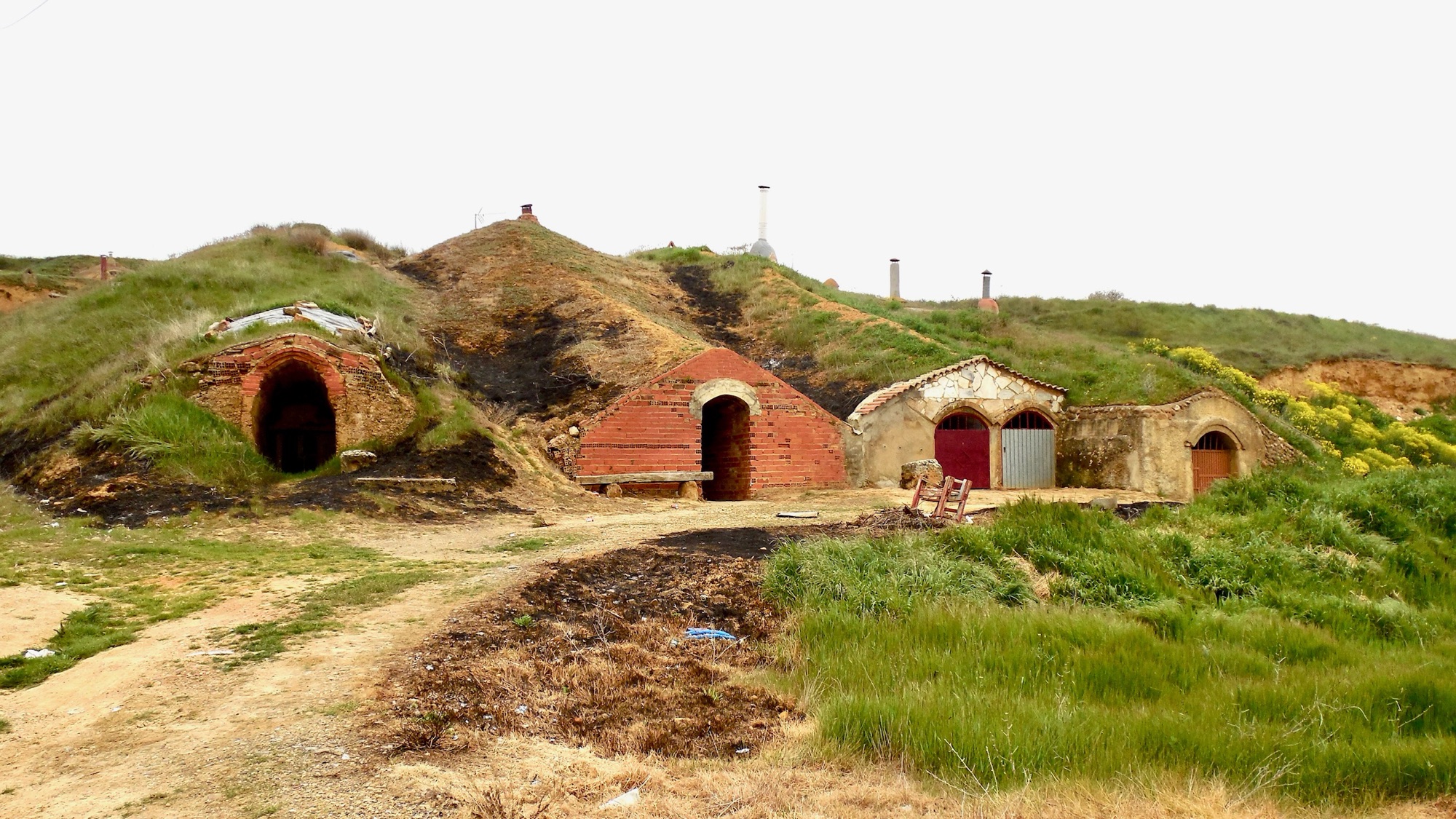
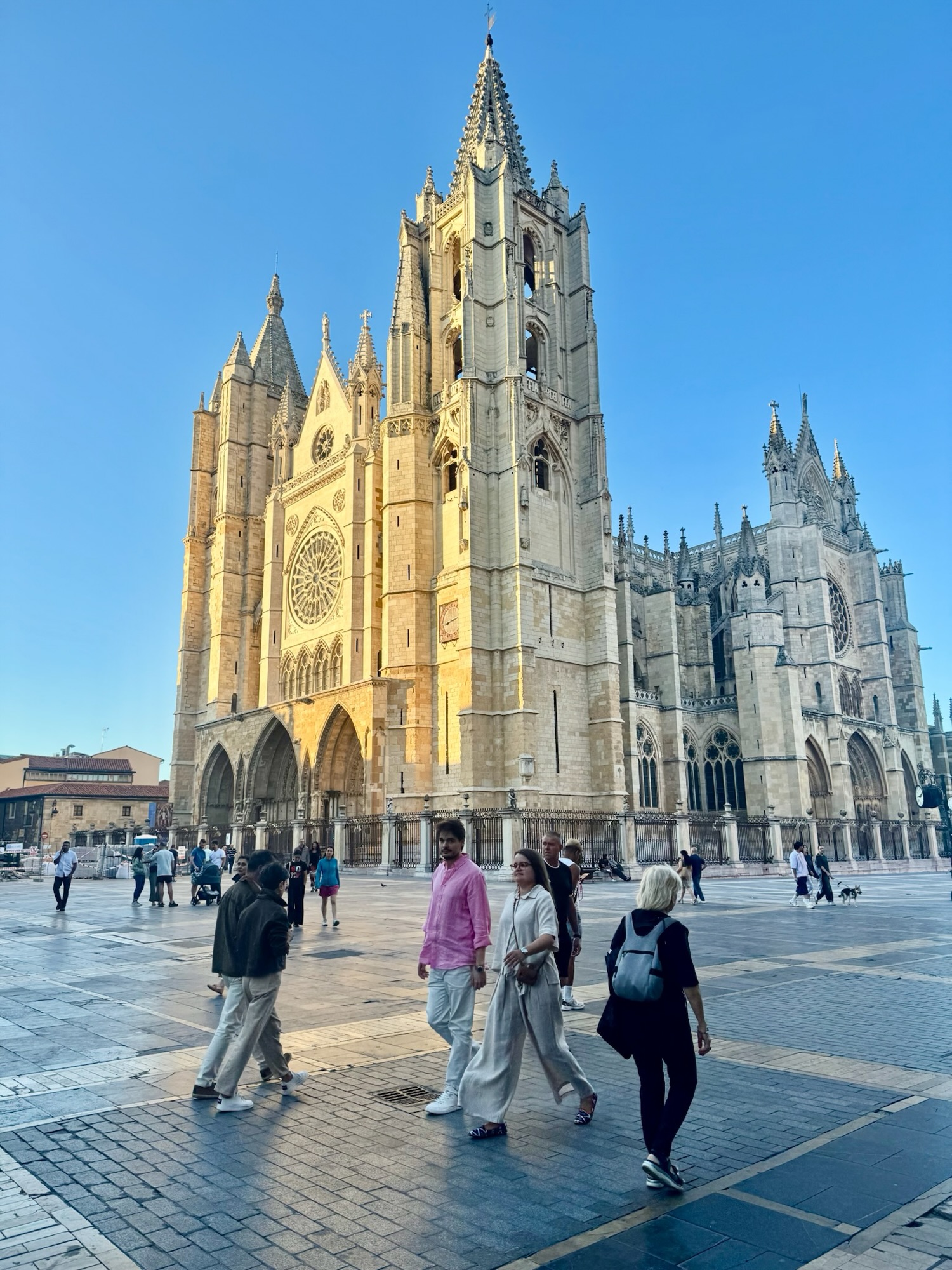
As promised here are pictures of the Leon Cathedral. As a “bonus” we were walking in the countryside and as I passed what I call a “Hobbit House”.(looks like a big underground storm shelter)
Examples from my 2013 Camino.
I saw two young men working to clear an overgrowth of brush.
.
My curiosity drove me to try and communicate a question in pantomime, “What is this??”.
I eventually learned that it was a family bodega, underground wine storage. Originally his grandfather’s, but being restored and purposed by he and his brother. He invited us in!
....
I would not have been surprised to see bodies and Dracula’s bride. I’ve been 24 hours still pulling cobwebs from my hair and clothes.
Love you Christine.
Peace Everyone. Buen Camino! Pete
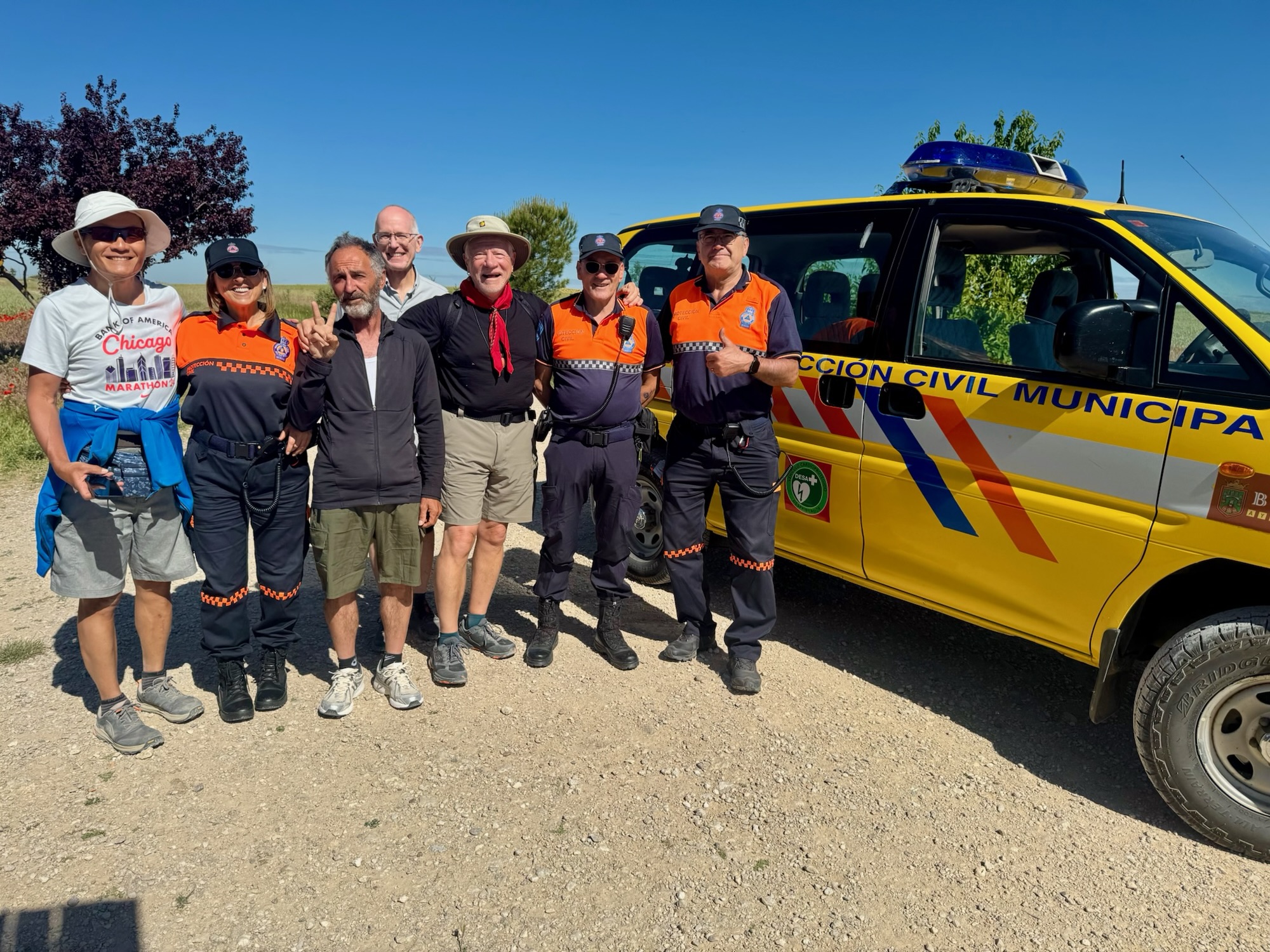
............What post from the Camino would be complete without this and the next picture!Left to right: Michael and Lynn from Australia, Diego from Florida, me, Charlie, and Jane from Germany.
Again I share an open letter to my wife Christine. Please look over my shoulder and be within the closeness. Buen Camino!
Dear Christine.
We arrived in the village of Mansilla de Los Mulas on June 7. The combination of arid breeze, relentless sun and adobe looking ruins were such that I felt I had wandered into an old Clint Eastwood movie. Perhaps “A Fistful of Euros”!
...
As I entered town I vividly remembered that this was the place where I last saw our dear 2013 Camino friends Henk from the Netherlands, and Germans Gabi and Christine.
2013
Such fond memories. I feel so fortunate that we are still in touch with them and so many others from that time.
The garden cafe/restaurant had changed much in 13 years.
2026
Charlie and I ate dinner there with friends Maggie and her daughter Alethia from Virginia.
.
Alethia is a recent university graduate in mathematics and mom is a professor of biology. There was a lot of mental horsepower between those two women.
Charlie and I assumed that the continued meetings with familiar faces was at an end. Nothing could be further from the truth! The following morning as we proceeded to the bus station, Ana from Belgium jumped out of the doorway of a café hollering for us to wait. We were planning to ride the bus into Leon and thus avoid the slog through industry and suburbs. Ana joined us.
.
In Leon it was an amazing series of meetings with friends from the last week. A real gift from the Camino!
..
Our room was less than two hundred meters from the Leon Cathedral. I’m torn between whether the Burgos or Leon Cathedrals are my favorite. Both are magnificent but so different. I will share pictures of the interior of the Leon Cathedral in a separate post.
I understand that you and the grandchildren are touring another magnificent cathedral right now: Notre Dame in Paris, followed by the Eiffel Tower. Wonderful!
Enjoy, and I love you. Me.
Peace to all and Buen Camino. Pete.
Breakfast!..Charlie channeling Antoni Gaudi. Not my toes, but those of a pilgrim from the United Kingdom The Cathedral near sunset
Again I share with you an open letters to my wife Christine. It is meant to be read by all, yet also to conveyed a feeling of intimacy. Please look over my shoulder and be within the closeness. Buen Camino!
Dear Christine.
It is our eighth day on the Camino and the start of our second week. Charlie and I are beginning to find stride within the limits of our abilities. I am listening to my body! So far I’ve managed to avoid blisters. Charlie is managing a couple and being proactive.
I woke with some disquiet this morning. I found myself thinking that before we had left on our respective adventures I had often commented that all I had to do was walk 300 miles while you had the difficult task of “herding cats”. What was meant as humor I now realize is all too true.
Charlie is an excellent Camino partner. Our abilities are similar, as are our outlooks on life. As adults we are responsible for ourselves, yet we watch out for each another. As a grandmother accompanying teenage grandchildren, you are responsible not only for yourself but for them as well. You are their guardian angel. In the 52 years that we have known each other you are still able to amaze me.
You know that in offering condolences I am reluctant to say “I will pray for you“. I find that to be a phrase overused and often given without intention.
I have learned of yet another friend who is faced with a serious and possibly life ending disease. I have on this occasion offered my “thoughts and prayers“.
I mentioned to Charlie that I carry many people in my thoughts, but I do not formally pray. He has given me an insight that is not the formula of the words that matter, but the thoughts given from the heart that constitute sincere prayer. It is a new piece of wisdom for me to consider.
I hope you will enjoy these pictures from the last two days. I love you.
To Everyone: Peace and Buen Camino! Pete
....This is one of a number of models painstakingly created and housed in a church museum. It is not the largest.These are the statistics on the model pictured above. I was able to take a picture looking through the small doorway. The interior is as real looking as the exterior. King Alfonso VI and his queen. The convent chapel where we attended mass and later received a wonderful Pilgrim’s blessing. Charlie gave the first reading at mass in English at the request of the priest. ....A huge private albergue. We enjoyed a private room with bath. One of many gatherings of Camino friends met on The Way. Dinner with Camino friends! A three course dinner with unlimited wine was only €15 per person Sunsets are occurring at nearly 11 o’clock at night. 
In 2022 I decided that my posts from the Camino would be written as open letters to my wife Christine. They were meant to be read by all, yet they also conveyed a feeling of intimacy. I am continuing that “tradition“ from this Camino. I welcome, indeed celebrate, that you will look over my shoulder and be within the closeness. Buen Camino!
Dear Christine.
Charlie and I have completed our seventh day. However, the photographs that follow are from days two and three. We have been so fortunate that the weather has favored us. The extreme heat of the preceding week has moderated. Night temperatures are in the upper 40s and lower 50s (Fahrenheit) and daytime highs are barely above 80. The humidity is so low that I barely need a towel when I step out of the shower. A few minutes and my skin is dry!
We have met so many interesting people and so far none older than me. The “old ones” are out there somewhere!
We had an “interesting” experience at one albergue: shortly before bed the water for the entire village was turned off. We still don’t know why, perhaps it was to repair the system. Our hostess left bottles of water at the sinks which we used to brush teeth and drink. Unfortunately, (and unpleasantly) the toilets could not be flushed. The following morning I got up and stood before the toilet as nature called. When my first few drops hit the toilet bowl suddenly the tank of the toilet began filling, The town’s water was restored! It was a miracle of biblical proportions. Charlie had a great laugh when I told him. I hope you find it worthy of a smile.
I hope all is well with you and the grandchildren and that you are enjoying your own unique “Grandma Camino”. Love, Me
… and Buen Camino, Everyone!
The ruins of San Anton..Charlie shelter from the sun at the top of a long climb Police or emergency workers driving the route to make sure that the pilgrims have enough water and are safe. The Camino!Carla and her daughter India from California .A waitress at our lunch stop. She is from the Ukraine and gifted us two special commemorative stamps honoring a Ukrainian victory that sunk a Russian warship. It was quite an honor! I had explained to her that my paternal grandparents immigrated to the United States from a small German community north of Odessa. ..A beautiful morning, hiking along the canal. .Jerusalem, nearly 5000 km away. I once met a pilgrim nearing Santiago who had walked the Camino from Jerusalem. ....Anna from Belgium and Diego from Florida. .Very long day. Not too bad for a couple of old guys! 
I am sorry that it has taken this long for me to share pictures of our emerging Camino. I finally got the email service fixed so hopefully these missives will upload without further “hiccups“.
As in past Caminos, I am writing these as open letters to you with the intention that they are shared with our larger community of family, friends, and followers.
I regret that the limitations of time and Wi-Fi are such that I can not give an in-depth narrative on what we see and experience. You and I will be able to speak privately, but I hope that anyone else reading this letter will make use of a fertile imagination to fill in the details.