I believe that Norway’s entire population of 5 1/2 million was in Bergen today… At least it seemed that way.
In spite of the crowds we were able to fully enjoy two amazing activities/events. To do them both justice I’m going to separate them in two posts. They will be short on narration and long on pictures.
First the Floibanen:
After breakfast we took a five minute walk to the famous Floibanen funicular railway.
First opened in 1918 this steep 25 degree railway ascends from sea level at Bergen Harbor to Floyen at an elevation of 1000 feet.
The current ultramodern electrical conveyance consists of two sets of train cars. They are connected by a cable.
.
Each set of cars can hold up to 120 passengers. When one set of cars is at the top of the hill the other set is at the bottom. They pass each other at mid journey, the weight of one counteracting the weight of the other. They require comparatively minimal engine drive support.
The journey to the top of Mount Floyen takes about five minutes. A round-trip ticket costed us each $20 (200 kroner). Christine rode the railway back to the bottom, but I hiked down the mountain, a journey of approximately 3 km which took me just short of an hour.
The views from the top were fantastic.
....
There is a restaurant that first opened in 1925.
There are also shops, a café, toilets, a playground, and goats!
.
My hike back to the city center was magical! A forest of massive evergreens, carpeted by moss and ferns.
.....
If you look carefully you will see families of Trolls peaking out from behind the trees… but only if you believe in them.
We are guests for 5 five nights in Bergen Norway at Det Hanseatiske Hotell, located in a historic building within the heart of the Bryggen Harbor District, a UNESCO World Heritage Site.
The hotel is modern, yet successfully retains old world charm.
.
The hotel manager, Erik has been both welcoming and helpful.
Breakfast is served every morning and features an extensive buffet of meats, cheeses, baked goods, traditional breakfast fare, along with hot and cold beverages.
.
Less than 100 yards from our hotel door we boarded a “hop on hop off” bus for one hour tour of the city’s main tourist areas.
This has given us an idea of where we want to focus our wanderings. We are finding Bergen to be very walkable and mostly flat, although it is located in a valley surrounded by mountains. Most of the streets and walkways are cobblestone and warrant a bit of caution underfoot.
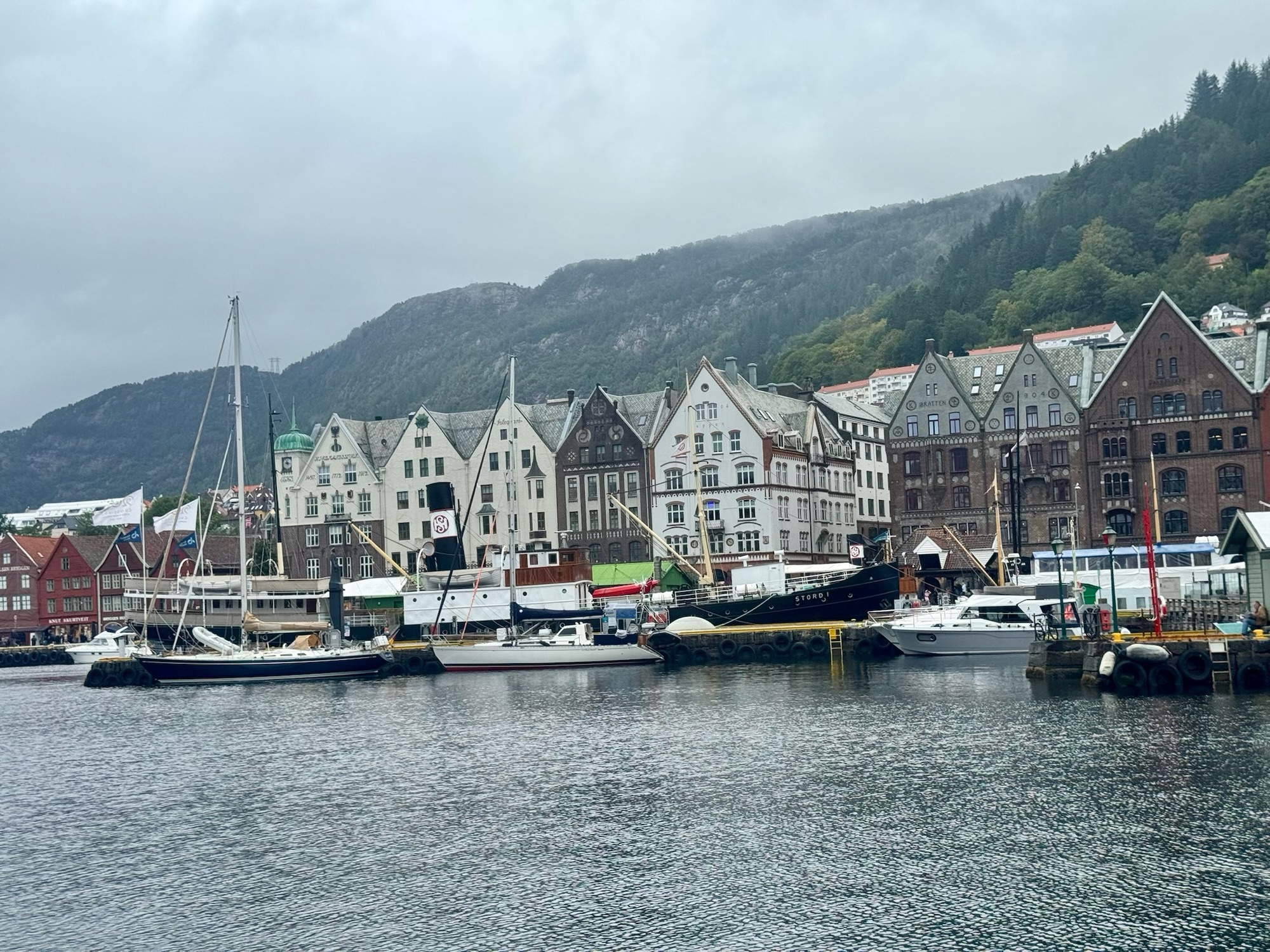
Commerce in the Bryggen Harbor area dates back 1000 years to the Viking era.
The picturesque wooden structures have been carefully preserved, many of them are over 300 years old having been built shortly after the great fire of 1702. They currently house hotels, restaurants, art, souvenir, and retail shops.
.
A short walk further down the wharf area brought us to the castle and fortress complex that date to the 13th century. On the way we passed a magnificent sailing yacht.
It was at least 150 feet long with expanses of gleaming chrome and meticulously varnished teak. I wish I knew more of its details and ownership.
I toured the interior of the Rosencrantz Tower (1270), which features steep, narrow, and winding medieval stairs.
.
Christine welcomed this as an opportunity to relax in the nearby park.
I telephotoed this picture from the tower above while Christine took these of me from down below.
.
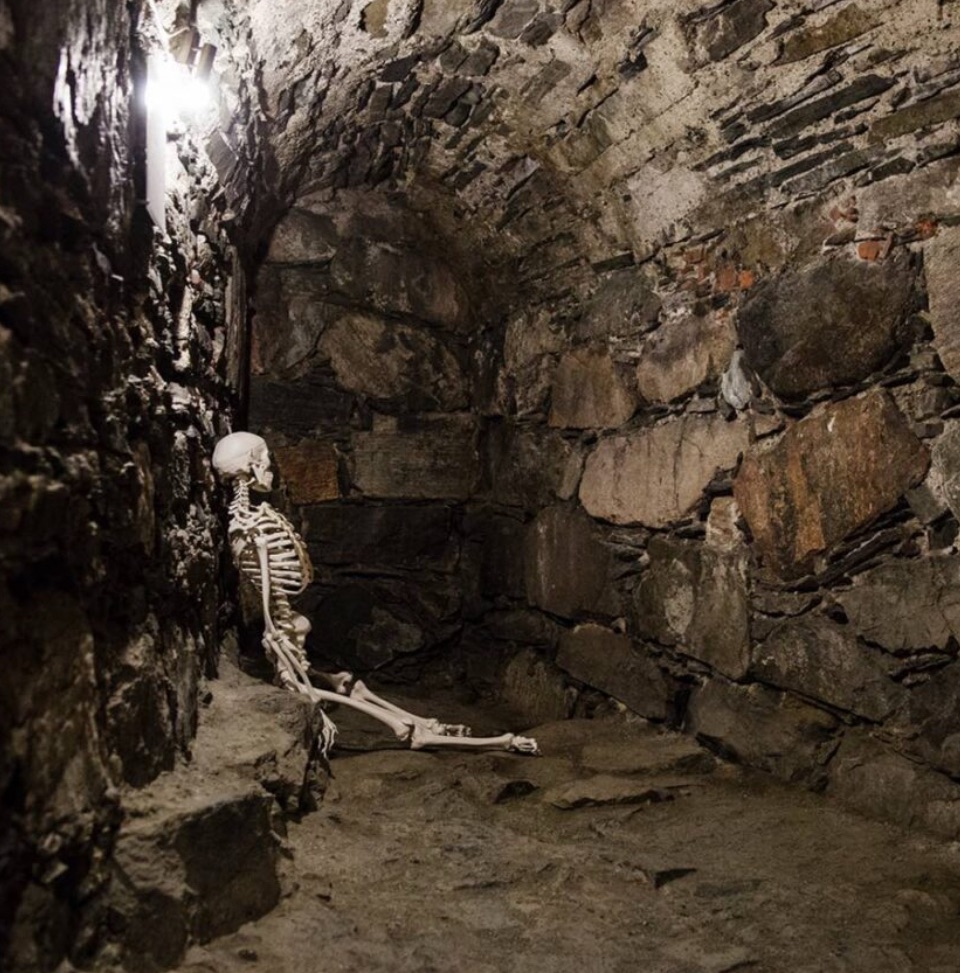
Within the foundations of the tower is a dungeon. Little more than a hole, it lacks fresh air and light. It was used until the 19th century.
The above picture is from the Tower website. The one I took lacked the skeleton who was apparently placed on parole.
The tower was the residence of the last two kings who ruled Norway from Bergen, King Magnus Lagabote, and his eldest son, King Eirik Magnusson.
The tower had only one toilet which was located within the King’s chambers.
Adjacent to the tower is Hakon’s Hall.
This was built by King Hakon in 1247 as a Royal residence and banquet hall. It remains the largest standing building from the middle ages in Norway. It continues to be used today as a banquet facility and museum.
In 1944 a Dutch munitions vessel blew up near the Tower and Hall. This catastrophic explosion destroyed the roofs of both buildings and leveled many other nearby structures. Restoration was undertaken that year and continued over the next 15 years.
Before returning to our hotel for an afternoon nap Christine and I enjoyed an outdoor café, warmed by radiant heaters and sheltered from the intermittent downpours by broad table umbrellas.
.
Life is good!… and of course, Peace Everyone. Pete.
Christine and I were up at 5 AM on September 3rd and thanks to our daughter, Renee’, we were on the road to the airport by 6. En route we received a text message from Delta Airlines indicating that our flight from Kansas City to New York had a two hour delay. We were going to miss our connection in New York for Paris and Bergen!
The Delta ticketing agent sweated the problem for us. She was laser focused for 45 minutes on her terminal screen and ultimately was able to reroute us with a flight from Kansas City to Boston, Boston to Amsterdam, and Amsterdam to Bergen. We were downgraded on the first leg from our first class/Delta One reservation.
We experienced a sigh of relief until we reached to the gate and learned that the new flight from Kansas City to Boston was also now delayed. In Boston it was a foot race to reach the connecting flight to Amsterdam. We made it with only minutes to spare. We later learned that our luggage did too.
We made use of Delta’s Skyclub lounge in Kansas City. Immediately upon entering the lounge I heard my name called. It was our Camino friend Theresa, who was on her way to Milan Italy. She posed with us for a selfie.
Our flight to Boston was unremarkable except that the original reservation was first class and we were now seated in main cabin. Kudos and gratitude to the Delta ticket agent that she preserved the timing of our flight into Norway.
The six hour flight from Boston to Amsterdam was wonderful. Unfortunately because of the change in ticketing Christine and I were no longer situated in adjoining “pods“.
We have only recently begun flying first class, business class, and Delta one. We have come to realize that the horizon of travel for us is shrinking but our need for comfort is expanding. It’s called getting old… not just older, but old.
We made the best of our three hour layover in Amsterdam by the use of KLM’s exceptional passenger lounge.
..
Our tickets were on partnered flights with segments flown by Delta and KLM.
Our “business class“ flight from Amsterdam to Bergen was on a smaller regional jet. The seats were tight and still six across, however, the middle seats were intentionally left unoccupied. We had a boxed breakfast, but it was far from ordinary!
Passport control, and customs were both handled in Amsterdam and took mere minutes. Our bags had been checked through to Bergen. We arrived in Bergen at 10 AM on the morning of the 4th.
The Bergen airport is located some distance from the center of the city. Our options were taxi cab ($50), shuttle bus ($20), or light rail ($2.50 per senior citizen!) We took the train.
Figuring out the ticketing kiosk took a few minutes and would’ve been easier if I had just seen that there was a button to translate it into English.
Norway is fast moving to a cashless economy. As an example the ticket kiosks only accept credit cards to purchase the train tickets. The credit card itself then becomes the ticket. If a rail agent wished to see our tickets all we would need to show is the credit card.
It was a 45 minute journey through picturesque hills and villages.
The train and platforms along the way were immaculately clean, (the windows of our home should be this clean!).
Bergen is the second largest city in Norway, with a population of approximately 250,000. Norway is the size of the State of Montana but with a population of just under 4 1/2 million. English is a commonly spoken in the city. Younger people often have barely a trace of an accent.
..
The Norwegian kroner is easy to convert. Merely move the decimal point one space. In other words, 10 kroner is equivalent to one dollar, 100 kroner is equivalent to $10, etc. Prices in Bergen seemed about on par with those in most major American cities.
...
This is the rainy season in Norway and today was no exception. Temperatures were cool in the mid 60s and there was a near constant drizzle. This did not dampen our spirits as we are staying in the harbor area, which is both charming and beautifully old world. Our hotel, oozes charm, but more on that in another post.
...
This has been “the longest day”. I’ve been up for 36 hours and bed is calling me.
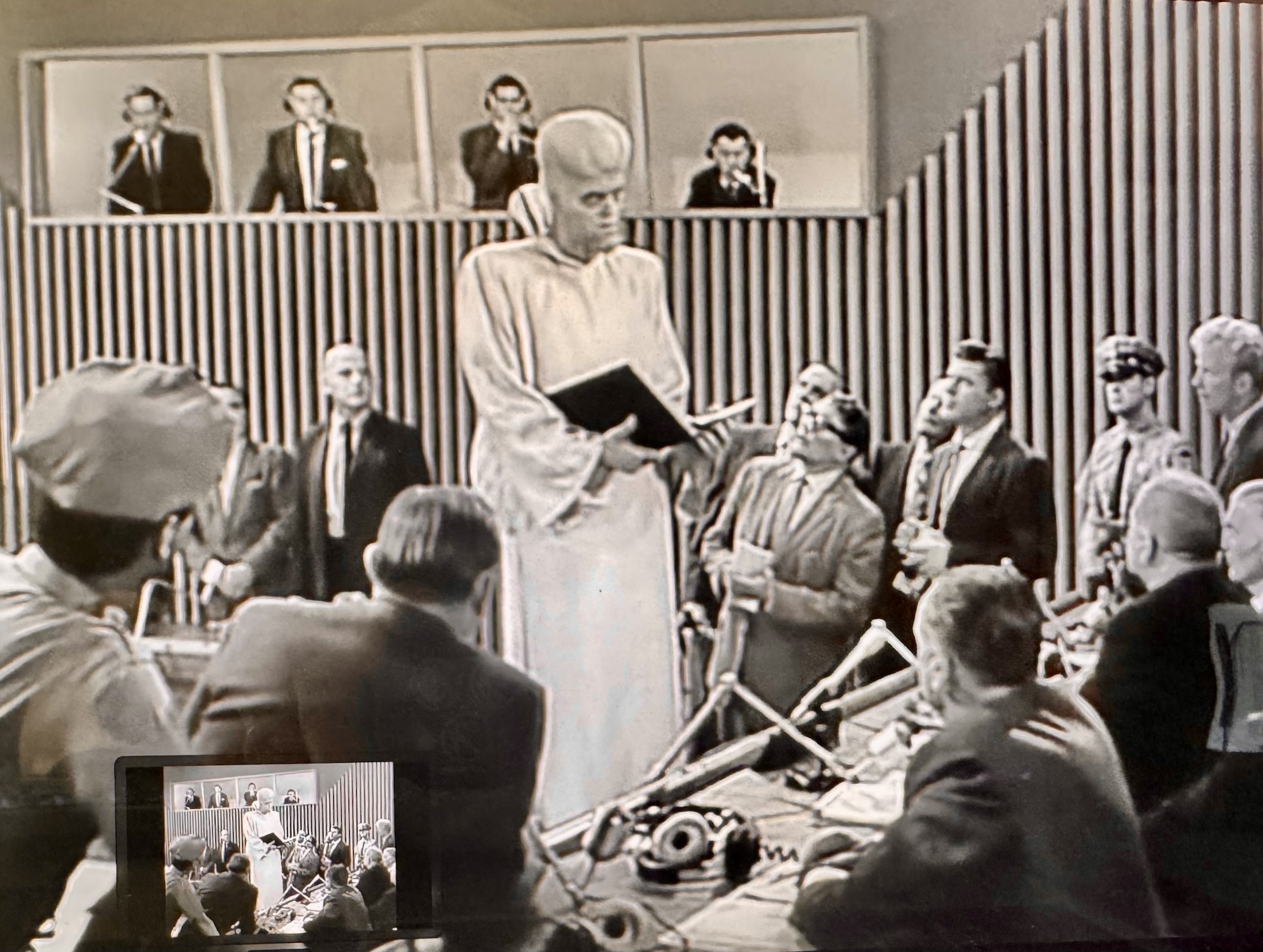
March 2, 1962: “Respectfully submitted for your perusal — a Kanamit. Height: a little over nine feet. Weight: in the neighborhood of three hundred and fifty pounds. Origin: unknown. Motives? Therein hangs the tale, for in just a moment, we’re going to ask you to shake hands, figuratively, with a Christopher Columbus from another galaxy and another time. This is the Twilight Zone.” – Rod Serling (1924 – 1975)
63 years ago. I was 9, less than a month from 10. The television screen was barely 18 inches across, black and white, and so was the Twilight Zone. Later that night, after “To Serve Man” aired, nightmares came for me and millions of viewers across the United States.
TV Guide ranked the episode number 11 on its list of the “100 Greatest Episodes of All Time. The ending was ranked as the “Greatest Twist of All Time”. Similar accolades were served by Time Magazine and The Rolling Stone.
Terror did not depend upon color and ultra-realistic gore. It was more effective and more subtle than that. “To Serve Man”. The title held the key. More on that later for those who do not already know.
Yesterday, Christine and I visited the Kansas City Zoo.
The weather was pleasant, unseasonably cool. We expected that we might have the zoo to ourselves. As it turned out it was filled with toddlers in strollers, nursing mothers with babes in arms, and older children who were perhaps being enriched as part of their home school curriculums.
We rode the Miniature Train, the African Tram, and I the Flying Flamingo (sort of a two-way power zip-line). Christine was a big “No” on the Flamingo.
As we wandered the park I also wondered:
I believe that life exists elsewhere in the universe. But what is “life”? Most definitions are biological, but some are philosophical and others legal. Wikipedia notes that there is no consensus on a definition, and that at least 123 definitions have been compiled in scientific literature.
Whatever life is, if we encounter it how will society respond? If it is life in a simple form will those who have held the belief that we are alone in the universe answer, “Yes, but only we are intelligent life.”
If it is life in a complex form will the reply then be, “Yes but only we are self-aware… only we have souls.”
If they are creatures who are clearly self-aware…?
There is perceivable intellect in the eyes of many mammals. At the zoo I looked like food to the cheetahs, the polar bears, and the lions.
I looked into the eyes of a gorilla. Eerily, it contemplated me right back.
In recent years science has determined that self-awareness is present in many primates, in elephants, and in sea mammals. We are captors of all these species and not so long ago we even justified the capture and enslavement (or worse) of our own species solely based on skin color. We still do so based on an individual’s failure to follow certain established legal or religious codes.
If we encounter life that is clearly “intelligent”, will we believe that we have the right to capture it, subjugate it, display it? What life will we deem as sufficiently “intelligent” to warrant a pass on such treatment? Our history shows that equality of ability has not been enough to earn equality of treatment. What treatment should we expect from a civilization more advanced than ours?
In “To Serve Man” a technologically superior civilization arrives on Earth. Its beings wear white robes and are 9 feet tall. Their apparent societal code of conduct is contained in a large book. The title of the book is translated early in the episode as “To Serve Man”.
The human-centric interpretation that Earth’s experts adopt is that these are benevolent beings who have arrived like angels to serve our needs. The aliens will alleviate poverty, end hunger, and eliminate disease. They even transport humans to their home world. Humans are convinced that they are being led to a heaven-like “Shangri La”.
The episode can still be found online and perhaps in streaming services. I highly recommend it. (Caution! Spoiler Alert!…)
Boarding the alien spaceship, he turns in horror as his assistant calls to him. She has just translated the rest of the book!
June’s misadventures ( “Emergency” ) are thankfully in our “rearview mirror”. With their retreat the adventure that is September looms large for us in life’s “windshield”. Sandwiched in between was a quick road trip in July to visit our daughter Alexis and her three children at Camp Pontiac in New York’s Hudson Valley.
This was their seventh year at camp where Alexis is head nurse. Over the years the grandchildren have progressed from young campers to Counselors in Training and Junior Camp Counselors.
August brought the successful sale of our Colorado home with another road trip to close the transaction and trailer back some special furnishings and personal items to Kansas City. As much as we have loved our time and friendships in Colorado, we are now free to pursue other travel opportunities. The horizon of age and eventual physical limitations grow ever closer.
In all, the July and August driving excursions covered nearly 5,000 miles.
September deserves a rest. Paradoxically, we will spend the month in Norway. The journey begins with a Delta flight to Bergen, Norway.
From the Hurtigruten website.
We will spend the better part of a week in that coastal city (pop. 295,000), the second largest in Norway (pop. 5.6 million). From there the excitement builds.
Det Hanseatiske Hotel, our lodging in Bergen.
Our hotel room, from the website.
In 2017 we met a wonderful couple from Salt Lake City, Utah, Ron and Lena Meck. We were camping on Sitka Island in Alaska and they occupied an adjoining campsite. Over the course of the two days shared with them they spoke of an ocean journey they hoped to take someday in Norway aboard “The Hurtigruten” (which they later accomplished in 2023). I became infected with the idea.
In 2018 Christine and I were in Madrid, Spain on our way to Lisbon, Portugal. I received a text message from Ron Meck; they were also in Madrid! We met for dinner. Remarkably, in 2022 Christine and I were heading north in Newfoundland, Canada while Ron and Lena were southbound on the same roadway. We met for lunch. Some friendships are just meant to be!
Back to “The Hurtigruten”: It was founded in 1893 as a single service to connect the many isolated communities along Norway’s coast (the second longest coastline in the world). Hurtigruten ships expanded operations, day and night, throughout the year, delivering passengers, goods, and post. “Hurtigruten” loosely translates in English to “The Fast Route”. By 1936 nearly 250,000 passengers traveled annually aboard its coastal express service. By 1950 annual numbers were over 500,000 out of a national population of just over 3 million. In 1968 service was further expanded to the Svalbard Archipelago above the Arctic Circle.
From the Hurtigruten website.
From the Hurtigruten website.
Remaining true to its roots, Hurtigruten ships continue to be working commerce vessels that deliver passengers, vehicles, goods and mail to scores of Norway’s coastal ports. However, Hurtigruten also recognized the tourism attraction of its vessels.
From the Hurtigruten website.
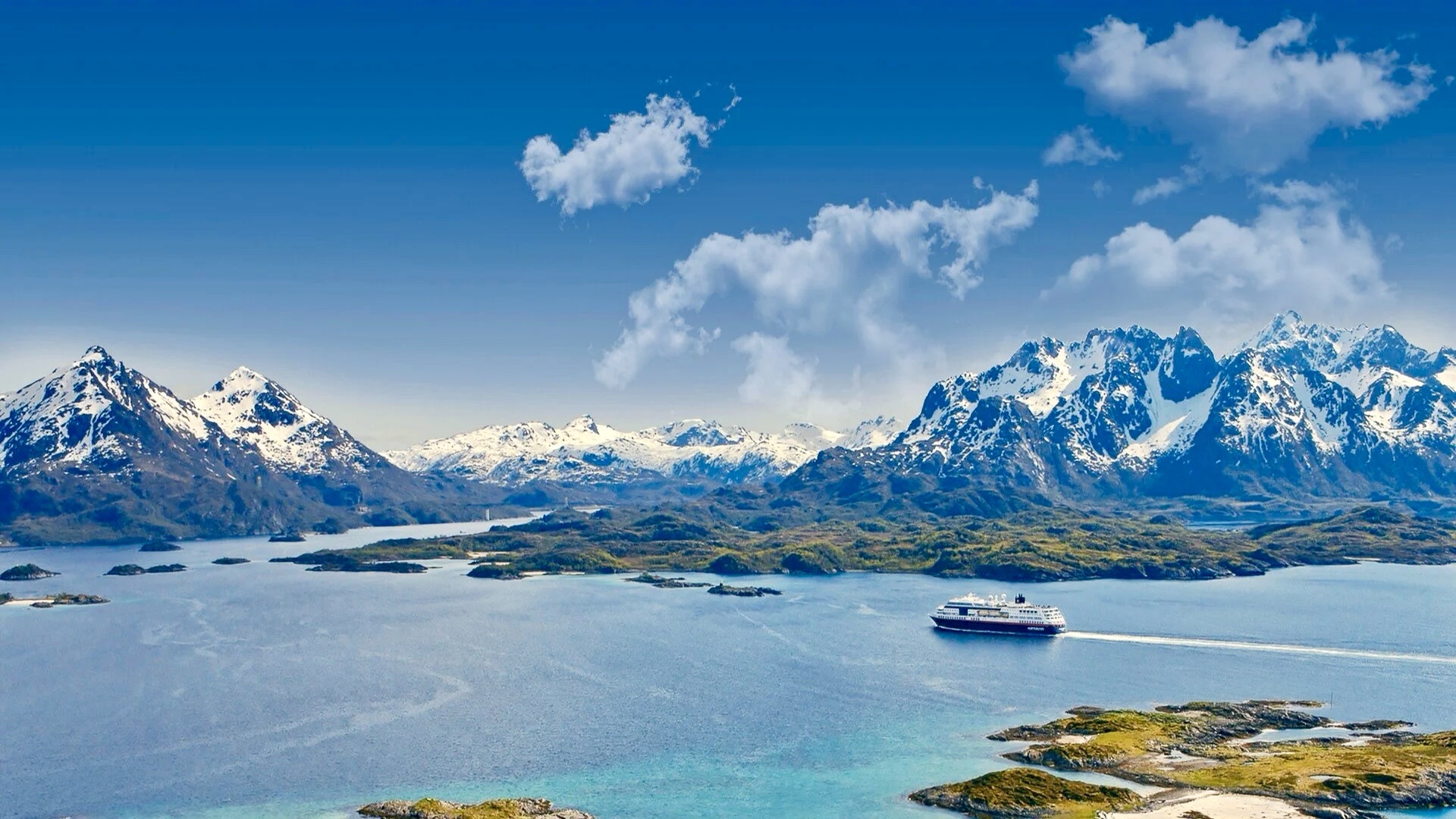
“Signature Voyages” are presented on three Hurtigruten vessels, MS Trollfjord, MS Finnmarken, and MS Midnatsol. With select ports of call and a nod toward luxury these ships, small by cruise ship standards (500 passengers), offer true adventure tourism.
From the Hurtigruten website.
Christine and I are booked for 15 days aboard the MS Trollfjord. Our cabin is small but comfortable.
From the Hurtigruten website.
We will journey from Bergen up to coast of Norway past the Arctic Circle to North Cape, the northernmost point of continental Europe.
From the Hurtigruten website.
We will then continue to Svalbard Island (pop. 3,000), visiting its administrative center, Longyearbyen (pop. 2,000), and Ny-Ålesund, the northernmost civilian settlement in the world (749 miles from the North Pole).
.
From the Hurtigruten website.
Ny-Ålesund is mostly dedicated to arctic scientific research. Its population varies from a summer high of around 115 to a winter low of around 35 permanent residents.
A few Ny-Ålesund curiosities: If one is to venture out it is required that you be armed or accompanied by someone who is armed… Polar Bears. Locking exterior doors on buildings is forbidden in order to provide a possible escape from… Polar Bears. Cell phones, Bluetooth, and Wi-Fi must remain disabled, except in case of an emergency, as they may interfere with sensitive scientific instruments that are in use. Finally, in Ny-Ålesund one can still see the mast from which in 1926 the Norge, a lighter than air vessel, made the first air transit over the North Pole.
1926 Photograph
Our 15-day voyage will conclude back in Bergen where we will board a train to Oslo traveling 7 hours on the Bergen Railway Line, often touted as the most beautiful rail journey in the world.
.
We spend our final week in Oslo where we will visit our foreign exchange student daughter, Hege, (1994-95) and her family.
.
Stay tuned as I hope to provide frequent day journals and photographs… provided I do not get eaten by a Polar Bear.