We had stopped to gas-up, a frequent occurrence on the road. I stood at one side of pump #4 and a very large man, football player large, was filling his 4Runner up on the other side of the pump. I would soon learn he had played a year of college ball when he said, “There are better ways to pursue an education… that stuff hurts!”. In the breezy 40 temps he stood unaffected in shorts and sandals. “I’m a Florida beach bum at heart.” he would explain.

Most folks at the pumps seem to avoid human contact, preferring to focus on the task at hand and then be on their way. This big man had searching eyes, eyes that soaked up the details of his surroundings, seeking to know his environment and those who he shared it with. He drew eye contact like a magnet and once the attraction was established, “Hi, nice trailer… how does it pull with your SUV?”. My reply was barely past my lips as I found my hand engulfed by his firm, friendly, and warm handshake. “Marty, Marty Leake, I’m retired, a traveler and a writer”. (See: https://007pandas.com)

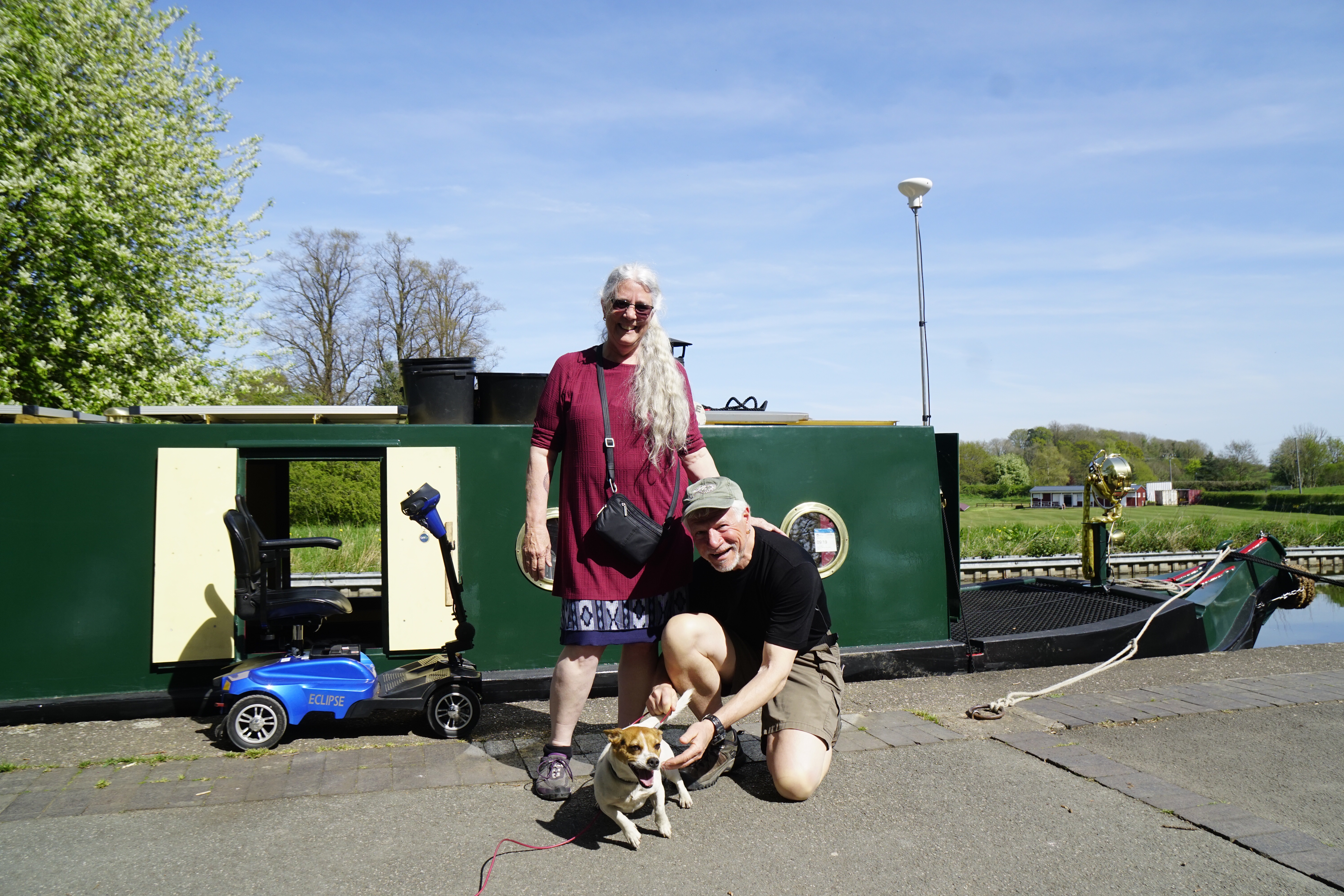
Thus it began. In the time that it took to fill up our cars I had learned he was single, had two sons, had enjoyed a long and successful career in law enforcement in Virginia, was college educated, was a compulsive traveler and blogger, was very well read… I learned more of this man in those few minutes than I know of some folks who have been coworkers and neighbors. I suspect that Marty’s take from his side of the gas pump mirrored mine. We capped our gas tanks and moved our vehicles to the parking area, continuing our fast friendship for another twenty minutes. We were looking at each other across the salad bar of life experiences, sampling from each other’s side but denied a full meal because the plates that time allowed were too small. A picture, exchanged contact information, invitations, “If you pass through Kansas City/Sanibel Island…”, a longer handshake, regret that travel called us in opposite directions, and the chance encounter ended.

Encounters such as this are unexpected treasures. I can plan my destinations, I can plan what we will see, but I can’t plan such a rewarding exchange between kindred souls.

This is the antithesis of the tribalism that divides us. We need more Marty Leakes in this world… we need to take the time to appreciate what we hold in common during the brief lifespans that mortality grants to each of us.

Peace Everyone. Pete

PS. We are camped in Davis Mountains State Park and are in a cell phone “dead zone”. Yesterday we spent the afternoon and evening at the University of Texas McDonald Observatory. I look forward to sharing the experience and images in a future post. Also, the weather and continuing Federal shutdown that is effecting National Parks has caused us to change our plans. We will be heading further south in Texas.

We are on the road traveling about 260 miles to Fort Davis Texas and Davis Mountains State Park. Midway along the journey we passed through the town of Big Lake.

In the late 19th and early 20th Centuries cattle sustained the economy of this region. Cattle drives were the traffic jams of the times, but the spreading reach of the rail system all but extinguished that way of life. Bust!

Then came the oil boom of the 1920’s and 30’s. “Black Gold, Texas Tea…” to recall an old TV favorite. In 1923 the Santa Rita #1 well near Big Lake was the first well to tap the Great Permian Basin oil field. The “Basin” covers 75,000 square miles and is up to 25,000 feet deep. It is the remnant of a huge inland sea that is hundreds of millions of years old. Towns sprang up along with the oil derricks, bringing gangs of riggers, and the collateral economy of food, drink, entertainment, and vice to feed off their wages. Big Boom!

Another long established “boom” of the Great Permian Basin was the Edwards-Trinity Aquifer. So Great was the freshwater discharge into the area creeks that in 1938 a pavilion was built on Comanche Creek for an annual celebration of the Fort Stockton Water Carnival. At that one location the Aquifer released 65 million gallons of fresh water a day… as it had for time immemorial. However, by 1961 agricultural overuse caused the springs to dry. Bust!

Eventually, cheaper oil found elsewhere and overseas caused a retraction in the demand for this local crude and most of the oilfield workers moved on to more promising “pastures”. Bust!

Big Lake survived in a diminished form, its downtown a typical array of small locally owned establishments.

As we approached Big Lake a cloud of dust could be seen in the distance. We were soon to learn it was the result of hundreds of huge trucks entering and leaving the resurrected oil fields and expansive new wind farms. These trucks are the lifeblood feeding the newest boom economy. The center of Big Lake, its old “Main Street”, is like the vacant hole of a donut. The “dough” of that donut now provides the dough (as in money) for the community and is found surrounding Big Lake. Equipment, trucks, energy company offices, and temporary housing for the workers abound. Gasoline prices were 80 cents a gallon higher than just an hour’s drive to the east.

We wondered if the new generation of migrant oil workers came solo or with families. What hardships were they and their families enduring for the draw of a bigger paycheck. What hardships were the local residents and their families enduring in the shadow of the newest boom economy. How long until the boom next yields to bust. Is evidence of that bust to be found in the parking lots of the filling stations the “boom” serves?

Time will tell as it always does.

Peace Everyone. Pete

PS. Our arrival at camp was too late for preparation of a proper meal. We drove a few miles to the town of Fort Davis and chanced upon the Limpia Hotel and Bistro. It was a wonderful find that capped off a wonderful day. BTW, our campground is out of reach of cell service so any silence on my part is imposed by circumstances beyond my control. Pete

I should add that there were some remarkable vistas provided unaided by human hands,

We continue to be challenged by the temperatures. Overnight was barely above freezing and today the high was in the mid-40’s. It’s really too cold to enjoy a campfire and a long hike wasn’t appealing. TripAdvisor touted the virtues of Fort Concho located in the heart of San Angelo, just a 15 minute drive.

Fort Concho was one of a series of US frontier military installations established after the Civil War to protect settlements, travel, and trade routes. This fort dates to 1867 and was located on the banks of the Concho River. At it’s zenith it covered 1,600 acres and billeted between 400 and 500 infantry and cavalry troops. The headquarters, barracks, and support buildings were constructed of native limestone. In spite of the Fort being decommissioned in 1889, it remained in sufficient repair to be a subject for restoration later in the 20th Century. It is in remarkable condition today and for only a couple of dollars provides a nice afternoon diversion.

The enlisted men’s barracks now serve as the main office, a museum, enlisted men’s quarters exhibit, and an artillery display facility. The collection includes two fully operational cannon and a fully operational 1862 Gatling Gun. The clerk on duty told us that she had the thrilling opportunity to rapid fire 10 rounds from the gun.

The piece on display at Fort Concho is of the original 1862 design. It was capable of firing over 200 rounds per minute. The inventor envisioned the weapon as a means of forcing peace by putting the power to stop an army into the hands of just a few men. Perhaps Richard Gatling failed to consider that both sides of a conflict might possess such a weapon. In one sense he was correct, automatic weapons completely changed the face of war, magnifying the potential for carnage as witnessed in the Spanish American War and the First World War.

The exhibits that we enjoyed included examples of the officers living quarters…

A telephone museum (not really related to the Fort’s history)…

The base school…

The base infirmary…

A monument to the 5 soldiers who had been stationed at Fort Concho and were Medal of Honor recipients…

The artillery display…

…and enlisted men’s barrack display.

As a bonus we were able to make friends with three of the Fort’s mules in residence.

It was an afternoon well and pleasantly spent.

We have occasionally fielded questions about why Winter camping. For us, aside from the weather it is a decidedly different experience from Summer camping. There is a challenge that I especially embrace. A daily shower is a luxury rather than a necessity. Clothes stay “fresh” longer. Our Casita becomes a closer experience and demands more cooperation from each of us. It is cozy in a way that feels almost like we are inhabitants of a space capsule. Best of all, the parks are wide open and the natural features are not depreciated by thronging crowds. We have camped in every season, each year, since we retired in 2015. I don’t have a favorite season, just a favorite camping partner.

Peace Everyone. Pete

The weather home in Kansas City has turned nasty, and the tendrils of the Winter blow extended to us in Caprock Canyon. No snow, but with predicted lows in the 20’s we elected to head south. It was a good call. About 175 miles took us to Sweetwater Texas where the skies cleared and the thermometer suddenly added 10 degrees to the mercury. Winds gusted to 35 mph throughout the day, but our good fortune held as they pushed us from the rear, giving us great gas mileage.

Most of our 260 mile drive was on Texas Route 70, a well paved two lane country road that often featured a 75 mph speed limit! There wasn’t much traffic and there weren’t many towns of consequence. In fact, for 175 miles there were no Walmarts, no fast food, and damn few gas stations.

Driving days do not usually provide much opportunity for a “travelogue”. However I made the conscious decision to stop and take pictures of anything “interesting” that we might encounter. I missed the opportunity to take pictures of a few abandoned homesteads that seemed icons to the dustbowl days. Same with the sentinel like Aeromotor windmills that once dotted the Great Plains States. These ubiquitous inventions of necessity pumped water into cattle troughs where no electric service existed. A few that we passed were still in use, a testament to their ageless reliability. At times we could see huge electric wind generators juxtaposed in the distance, the 21st Century replacements for the 19th Century Aeromotors.

Now for the experiences preserved by images:

There was Galvan’s Cafe in Turkey, Texas. This was the second time that we have eaten here and for good reason. The food was plentiful, hot, tasty, and cheap. My eye was drawn to a wall of pictures. Icons of the 1950-60’s television Westerns. Just to mention those with autographs: There was Dan Blocker of Bonanza, Clint Eastwood and Eric Fleming of Rawhide, Steve McQueen of Wanted Dead of Alive, James Arness of Gunsmoke, and Clayton Moore of The Lone Ranger.

Literally in the middle of nowhere (which describes much of Texas 70) is the Midland Drive -In Theater. It’s faded marquis declares, “Between Turkey and Quitaque… New York and LA”. It also displays “Closed for Winter”, but which Winter remains a mystery.

We came upon a series of Historical Markers, the reading of which left somber overtones of past glories and tragedies.

We drove through the center of Dickens (pop. 286), seat of Dickens County (pop. 2,444). The town and county were founded in 1891 and named after J. Dickens who died at the Battle of the Alamo. The County Courthouse and Jail were both built in 1892 and remain in use. They were listed on the National Register of Historic Places in 1980. There is a $25 fine for anyone talking to inmates through the barred windows of the jail!

We passed by the City Park in Spur, Texas…

Cotton fields and bales were evident as far as the eye could see…

And passed a number of the Quanah Parker Trail Arrows which mark sites where the Comanche Indians and their last Chief, Quanah Parker, lived, traveled, and fought. The artist, Charles A. Smith created this network of 22-foot-tall steel arrows in tribute to the Comanches. There are over 70 of these arrows found in 52 counties. Quanah Parker died in 1911, and the sculptor Smith passed away March 3, 2018, 3 years after the great-granddaughter of the Chief adopted Smith into the Comanche’s family. Smith was given the name “Paaka-Hani-Eta”, meaning “Arrow Maker”.

We arrived just before closing at San Angelo State Park, made camp and immediately drove 7 miles to the Zero One Alehouse where I enjoyed excellent craft beer, a stunning Chief’s victory over the Colts, and the company of my Wife. Life is good!

Peace Everyone! Pete

The weather favored us today. Although the temperatures dipped, the rain skirted us to the north. Temps are predicted to fall while the winds are increasing. They have conspired to encourage us to move further south in the morning. Whether we will continue south in Texas or head south west is up in the air right now. Current predictions are for more moderate conditions next week. We don’t mind playing this by ear as we are accustomed to planning on the fly.

Donning an extra layer made for good hiking… the scenery made for great hiking! Cap Rock Canyon is part of the Palo Duro canyon complex, 120 miles long and up to 20 miles wide it is the second largest canyon in the United States after the Grand Canyon.

Towering red buttes surrounded us and conjured up images reminiscent of the Egyptian monuments of Luxor. The near dry creek washes made for near level paths. There was evidence of Bison everywhere (big poop!) that demanded attention to one’s steps.

The red rock canyon cuts were laced everywhere with veins of gypsum. Gypsum is best known as the principal material in the wallboard of most homes built today. Less well known is that it is also a main component in most toothpastes and many cosmetics!

This region has been continuously inhabited and hunted by humans for upward to 15,000 years. The first people known to call this home were of the Folsom Tradition. Hunter-gatherers who were quick to adapt to the changing environment, they were a resourceful and inventive people. As we hiked it was easy for me to imagine the first peoples who claimed these canyons as their own.

It has long been a dream of mine to find an ancient flint tool that has lain undisturbed since it left the hand of its creator. I imagine my touch creating a direct link bridging thousands of years to the hand of another person. It hasn’t happened yet and it might never happen, but If it did happen upon Federal or State lands I would be legally bound to return the artifact to its original resting place. Nevertheless, I would contemplate how we each shared a moment of our lives in that place. How we might each appreciate the skill and “technology” invested in the creation of that simple tool.

Technology. It seems a strange word to apply to the fashioning of a stone into a useful implement. Yet the techniques that improved these tools advanced much as our electronics improve with each iteration. It is just that the leaps of ancient technologies advanced a millennia at a time rather than from week to week.

Millions of years ago a pre-human grasped a rock and at the same time mentally grasped that the power of his fist was thus magnified. Many thousands of years later an insight resulted in the fashioning of the rock to better fit the hand… an edge was found to lessen the effort for its use… a handle was lashed that further extended the power of the rock and had the additional benefit of distancing the user from the prey or adversary. Nearing the time of the Folsom people the handle had already grown long enough to make an effective throwing implement and a monumental improvement then followed in the form of the atlatl, a device that extended the throwing arm to release the spear with great force and effect. Social “technologies” concurrently developed that improved hunting strategies. Of course what followed was the bow and arrow, gunpowder, cannon… technology accelerating to the creation of civilization destroying capabilities.

It is easy to underestimate the impact of the early simple advances in the creation of tools. However, each of those technological leaps improved the odds that the strange creatures who had neither fangs nor claws might survive to avoid extinction.

Will the technologies that we have harnessed remain our salvation or instead be the agent our demise? If I ever find that ancient tool and then return it to its resting place, the person who next discovers it may know the answer.

Peace Everyone. Pete