There are three States whose borders are comprised solely of straight lines, Utah, Wyoming and Colorado. Of these only Colorado and Wyoming are enclosed on just four sides.
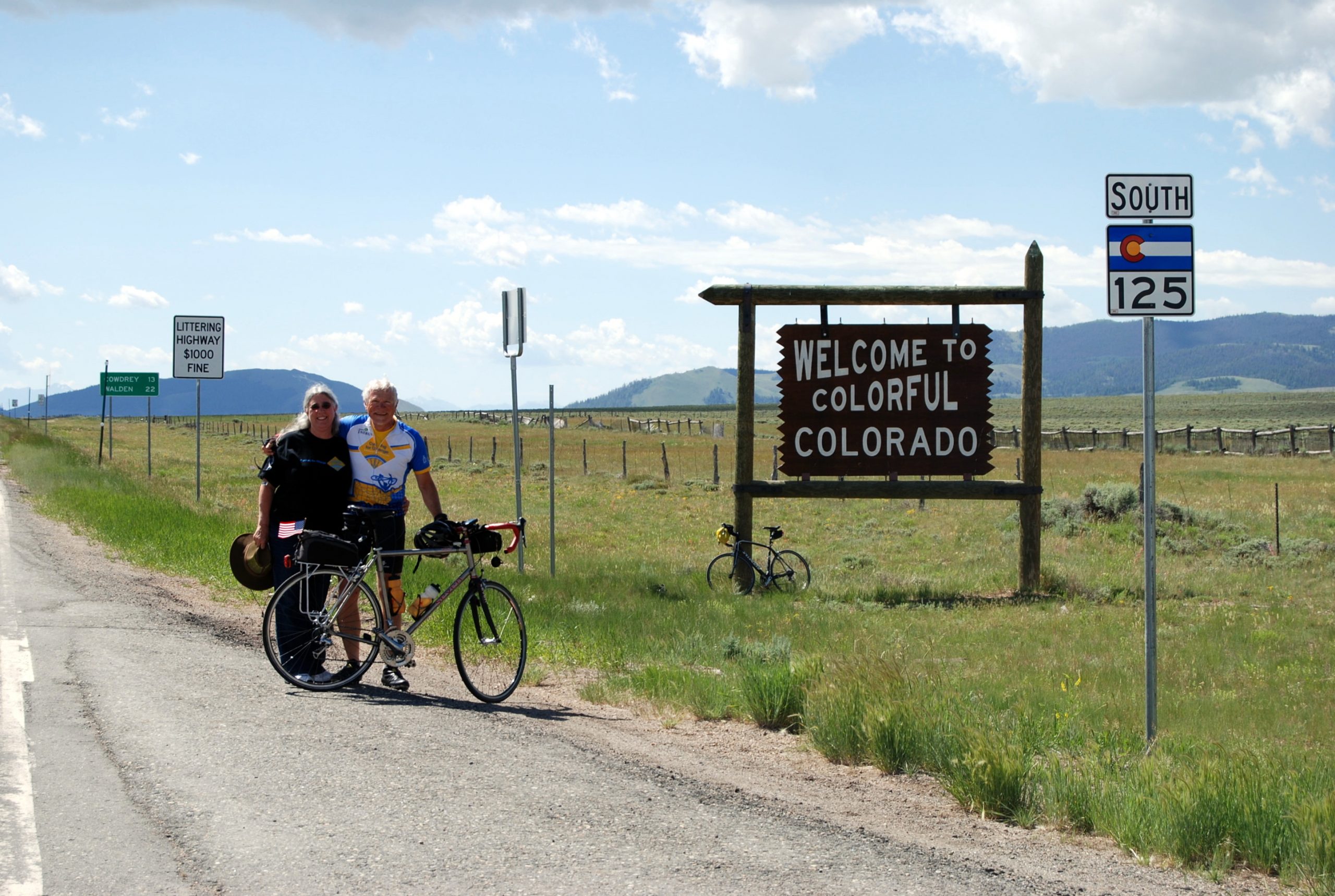
On July 3, 2010, C4C crossed from Wyoming into Colorado. We would spend the next 9 days in Colorado, covering nearly 560 miles over 8 riding days, an average of 70 bicycle miles a day.
In spite of those numbers we found time to connect with friends and family who came out to cheer us on.
Claudia York, a gifted Kansas City trial attorney and friend of the Whittakers and us , had turned in her lawbooks for a career in Colorado as an EMT in Colorado’s backcountry and ski slopes.
The Whittakers were met by two of their daughters, Mary Pat and Sarah.
We were joined by our daughter and her three children. and finally Christine and I were met by Greg and Rebecca Tempel, a friendship shared over decades. Much to my (feigned) surprise Greg made an impulse donation to our efforts.
The ride into and through Colorado represented a fundamental change in our experience. Over the preceding 1,700 miles we had climbed from sub-tropical coastal rainforest through a massive river gorge into mountain high country where in spite of being on the cusp of Summer we endured near freezing and freezing temperatures. We had crossed nearly ten mountain passes and crisscrossed the continental divide perhaps as many times. We were strong and our bodies had long grown accustomed to work at higher elevations.
Southern Wyoming and north central Colorado were high plains country. Arid, flat, and empty.
Roads seemed to extend endlessly into the horizon. The crossing into Colorado was marked by one of those iconic “Welcome to Colorful Colorado” signs that beckon travelers to stop and make it a photo opportunity.
Quite a contrast from the more pedestrian Wyoming sign on the other side of the road.
Between Walden and Fort Collins Colorado lay our last crossing of the Continental Divide and the highest elevation of the journey, 10,276 foot Cameron Pass. It was literally all downhill from there.
Our already full riding calendar included a number of events, many of which were courtesy of the connections of our fellow C4C rider, Jason Christiansen. Jason hailed from Colorado Springs where he was CEO of Catholic Charities.
We celebrated Independence Day in Fort Collins and enjoyed a private tour of the New Belgium Brewery which was closed for the holiday.
Kristi Williams left our company having completed her role as a segment rider. We had added two new riders, Bob Russell and Richard Tadlock, both from St. Louis. In Denver and Castle Rock there were significant events held in our honor…
… Castle Rock’s being a pancake breakfast for us and over 400 homeless citizens…
and the next day a picnic where we became a feature in the advertising of a sunglass manufacturer, each of us receiving a pair as compensation.
Between Denver and the Springs we had the opportunity to ride a shortcut through the private lands of the Jellystone Park Resort. The price… another photo-op, this time with the resort’s owner.
Cyclists joined us as we rode into Colorado Springs, a rainstorm hot on our heels.
Alan Beauchamp, another Coloradoan who had provided assistance to us since Oregon, was a well-known rider and organizer of cycling events along the front range. Alan had arranged for a large group of “adaptive” cyclists to join us riding from Castle Rock into the Springs.
Sadly we were beset by a monsoon like deluge that washed out the event in mid-course. These guest riders were forced to shelter under highway overpasses.
On the evening of July 8th Jason had arranged for a private concert and photo-op with Grammy nominated top 40 recording artist Shawn Mullins.
As we left Colorado’s front range for the plains of eastern Colorado and beyond, we found that our highway “adversaries” had changed from logging trucks to the huge implements of America’s farm belt.
We also found that there were other hazards looming on the horizon.
As we rode south from Grand Teton National Park the vastness of Wyoming opened to us. In total, our passage through the state covered over 450 miles.
From elevations so high that ice still covered the lakes…
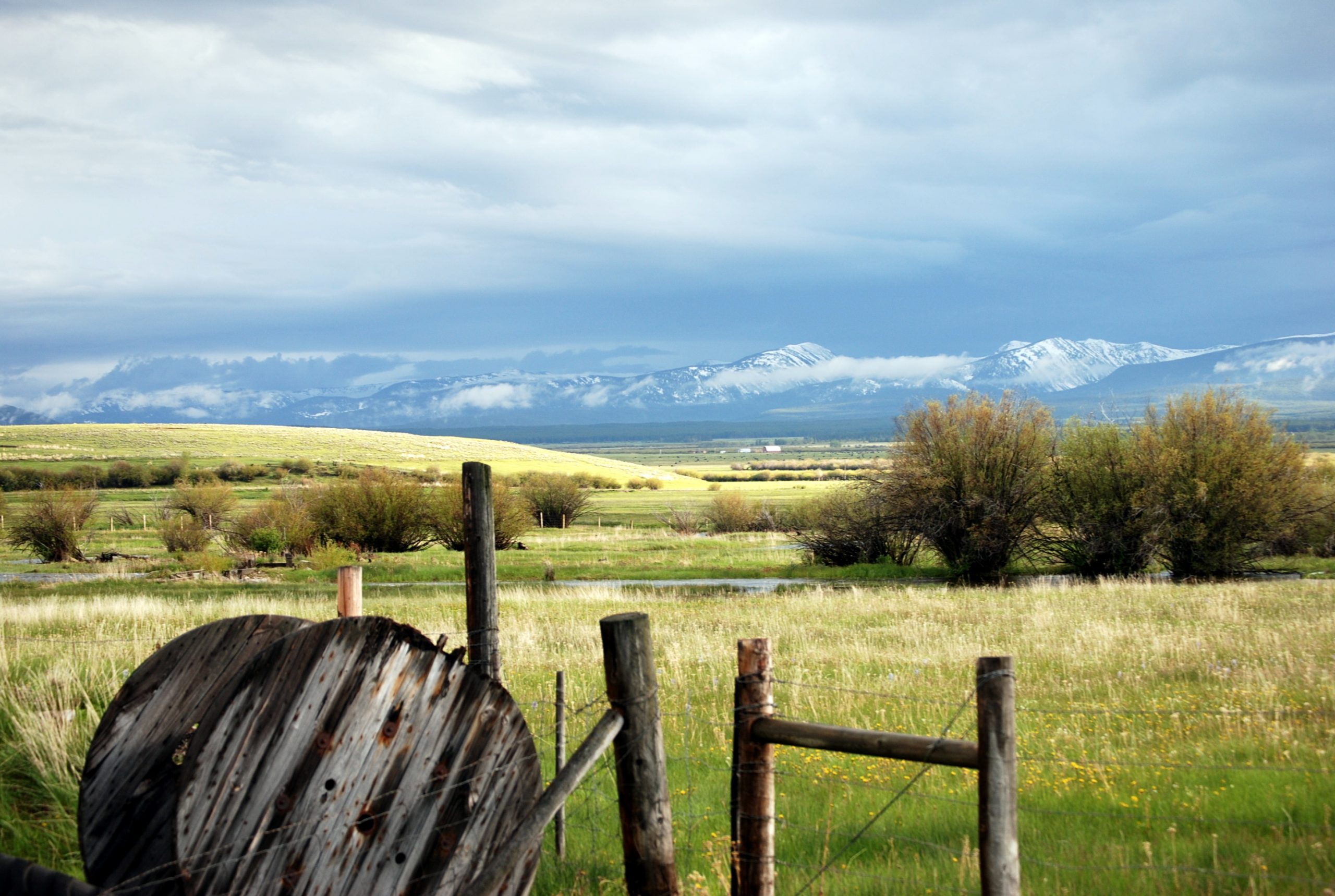
To near endless rolling steppes where the summer grasses bent to the winds in wave upon wave.
One afternoon we did battle with a thunderstorm that hammered us with lightning and gusting side-winds exceeding 50 mph. Sorry, no pictures as it was everything I could do just to keep my bicycle vertical and on the road.
We prided ourselves on riding our bikes every single mile, however there was one location of mountain road construction where non-motorized traffic was prohibited. Kindly, the construction crew accommodated us.
The variety of geology that surrounded us was an ever changing treat.
One morning we encountered a group of young cyclists on the road. They were “Push America”, another charity ride crossing the United States, west to east. Strong riders every one of them. Having “eaten her Wheaties” that morning our petite Lissa, aged well into her 50’s, decided to join their pace line. For miles she rode with them achieving for the day her fastest average speed of the entire Summer, nearly 20 mph.
We crossed through the Wind River Indian Reservation where we were hosted at Mass at St. Stephens Mission Church. It was striking to see how familiar Christian images of worship had been ethnocentrically translated.
Upon reflection that is precisely what our European ancestors had done for millennia in creating images of a central European Christ, and blue eyed Mother Mary, and a Latin liturgy.
On July 1st (2010) we were hosted for Mass and dinner by St. Joseph parish in Rawlins, Wyoming. Near the church we had encountered another cross-country cyclist who we called “Milwaukee Tom”.
Tom (of course from Milwaukee) had recently completed his service commitment in the US Navy. He had mustered out in San Diego California. Tom decided that he was not yet ready to return to the conventions and restraints of civilian life, so he took his discharge pay and bought a bicycle. Tom outfitted his bike for long distance touring and embarked upon a journey of no particular duration to no particular destination. At our invitation Tom enthusiastically joined us at St. Joseph parish for companionship and dinner.
On the evening of July 1st we were joined by a new segment rider, Tom Dillon from Kansas City. Tom’s first riding day with us was on the 2nd, a tough 66 miles to Riverside Wyoming (pop. 52), on the banks of the Encampment River. Our accommodations in Riverside were rustic log cottages that dated to the early 20th Century. The cabins bore such names as, “Sodbuster”, “Wildcatter”, “Mountainman”, and “Muleskinner”.
A welcome sight was the Bear Trap Saloon, situated across the street.
Needless to say…
Next: Into Colorado High Country.
Peace Everyone. Pete
PS: It occurred to me how difficult it must have been for Tom Dillon to join our group of cross-country cyclists, having long solidified into a “family”. Tom’s answer to this challenge was masterfully presented on the morning of July 3rd:
“The Coffee Pot”
I have pondered the inevitable times that we would be called upon to bring “others” into our fold. The “segment riders”… people who wholeheartedly embrace our undertaking, but because of work, family, or other considerations, are unable to assume the obligations of our entire coast to coast journey. What a challenge to suddenly appear, bags and bicycle in hand, among 16 people who have evolved their common experiences into understandings that need no words. We read the shrug of a shoulder, the furl of a brow, the shuffle of a step, as a melody in another member’s day. Sometimes our emotions sing the same song, sometimes another… but almost always with harmony… we are a chorus. Enter the “stranger”, the unknown voice.
Tom Dillon had not bicycled with any of us. He is from Kansas City, but he is a member of another parish. Tom faced the challenge I had pondered… how a “stranger” best enters the ecology of our emotional and physical environment.
Tom arrived in time to join us for the long and challenging ride from Rawlins to Riverside, Wyoming. That day’s ride on July 2nd had seen us persevere over rough narrow roads, through thunderstorms and hail, with headwinds and crosswinds gusting to over 50 miles per hours. There was no time for small talk, and no polite social graces were exchanged. At the end of the day no one was in the mood to “welcome” anyone or anything other than a cold beer, a hot shower, and a warm bed.
At 5:30 a.m. on July 3rd I reluctantly stuck my head out the warped doorway of my cabin and looked through the open and shredded screen. Like “Punxsutawney Phil” of Groundhog Day fame, I was looking to see if there were signs of another day of hell-weather. The sky was ambiguous but the scent was not. My nostrils were assailed by the rich pungent aroma of fresh roasted coffee. There was real caffeine in the air. Not the thin hint of the tepid dark imitation that is served up by most drip machines, but coffee with the raven darkness of abused motor oil. Tom, like the Pied Piper, was calling all of us coffee loving “rats” out of our lairs with the melody of his brew. He stood upon the dew sodden grass, illuminated by the early hint of dawn, with a large old style pewter espresso coffee pot in hand. I and the other “customers” lined up at his bidding, cups in hand. The tribulations of the prior day were forgotten and Tom was instantly “one of us”.
The next few days gave me pause to consider the genius of Tom’s foresight. It occurred to me that anyone entering into an established social order has a limited number of options. One may ignore the group and remain a non-person. One may choose to identify oneself to the group by emphasizing one’s distinctions and differences. And then there is the “coffee pot”. The foresight to think of the others, to strive to embrace what we have in common, what we share, what we understand.
In our cycling group, we are not lawyers, clergy, doctors, social workers, retirees… we are people and we are family. We strive to be “we”, “us”, “our” and never “them” or “they”. As it should be with the human family. It makes it so much easier to help and be helped, to accept and be accepted.
Montana is big, very big. At 147,000 square miles it is the fourth largest US State behind Alaska, Texas, and California. Yet it is the third least densely populated of the States, with only 7 residents per square mile. Only Wyoming (6 per sq. mile) and Alaska (1 per sq. mile) are more sparsely populated. Montana was the largest of the 15 States that C4C crossed. (I and a segment rider, Ben Harring, made an afternoon bicycle detour into Arkansas, thus making 16 States for the two of us.) Over the course of 7 days we rode from Missoula to Yellowstone National Park in Wyoming, covering nearly 350 miles. Remarkably, our transit of Florida was by far the longest at over just over 1,000 miles… a fifth of our entire journey. But I am getting ahead of myself.
On the morning of June 18th (2010) we assembled for our departure from Missoula. Father Matt offered his customary prayer which always included, “Let’s ride with peaceful minds and strong hearts…” and concluded with “God Bless C4C… Buns Up Everyone!” Another customary bell weather for the start of a day was Christine’s instructions to the group which included a summary of the route, lunch arrangements and special instructions. Her departing hug and kiss for me became a symbol of wishes for the safety of all of us.
Along our 51 mile route to Hamilton, Montana, we stopped at the National Historic site of the Flathead Indian Mission of St. Mary’s along the Bitterroot River.
The Mission, founded by Jesuit missionaries in 1841, was the first permanent settlement made by Europeans in what was to become Montana. The grave of Father Antonio Ravalli SJ (1812-1884) is prominent in the Mission’s cemetery.
Ravalli was posted to the Mission from 1845 to 1850 (when it was closed due to incursions by hostile Blackfoot Indians) and he returned in 1866 to head the Mission until his death in 1884. A native of Italy, Ravalli spent 40 of his 50 years as a Jesuit tending to the needs of Native Americans, never to return to his homeland. In addition to Ravalli’s grave monument there is one titled “Salish Kootenai” which honors tribal members whose homeland was the Bitterroot Valley.
The day’s ride featured good roads, some bicycle dedicated paths, and remarkable weather.
I had learned a “trick” that was to serve me throughout the ride: While riding, I could shoot pictures over my shoulder of the cyclists behind me.
A marquis greeting at the motel where we would spend the night was our welcome into Hamilton.
Hamilton’s St. Francis of Assisi Parish hosted us at Mass and dinner. A well-attended presentation about our mission and dialogue with the audience followed.
Except for making miles across an incredibly scenic land there were no public events for us to participate in. Matt had been scheduled on the 19th to make a phone address to a group gathering at Kansas City’s Browne’s Irish Market, but technical difficulties derailed those plans. There was, however, a private celebration that evening; We joined to honor not only the 33 years of marriage that Christine and I had enjoyed, but Lissa Whittaker’s ??th birthday.
The days that followed presented us with a variety of accommodations….
…and remarkable vistas.
There were also some iconic sights that harkened back to earlier times.
The remoteness meant that we traveled many miles without towns or mid-day meal options. The goodness of local volunteers who met us along the route provided us with food, beverages, and welcome rest.
On the 20th we rode under threatening skies. A snowstorm struck Chief Joseph Pass less than an hour after we had crossed…
It was sub-freezing on the morning of the 21st as we departed from Jackson Hot Springs, known to be one of the coldest places in the lower 48 states.
We were told that on average there are fewer than 35 days a year that the thermometer does not at least dip below freezing.
We crossed a number of mountain passes, ascending thousands of feet only to descend just as many into the river valleys below.
Coasting downhill my speed approached and occasionally exceeded 50 mph. At those speeds the utility of a bicycle helmet is likely limited to preserving an open casket option.
62 year old rider John Stigers is a very big man. One might have questioned his ability to sustain those climbs. However, his career as a US Postal Service mail carrier had provided him with the legs of Atlas.
John was not fast, but he was remarkably strong… stronger certainly than the mere mortal tires affixed to our bikes. All of us suffered flat tires over the course of 5,000 miles, I experienced only one. For John they seemed a near daily occurrence. The group stopped counting John’s flats at 20.
June 23rd was especially memorable for Christine and me. On that day, while we were all attending to the maintenance of our bicycles, grandson Peter Nikolaus Schloss was born to our son Peter William Schloss and daughter-in-law Nikola Smith. Little Peter is at least the 6th of my lineage to carry the name Peter since the start of the 19th Century.
Throughout our passage under Montana’s Big Sky we remained mindful that ahead of us lay a tour of famed Yellowstone National Park, experienced from the seats of our bicycles.
The Columbia River begins its 1,250 mile journey to Oregon and the Pacific Ocean in Canada’s British Columbia. It is the longest river in the northwestern United States, and the fourth largest in the US by volume of flow. Humans have inhabited this region for more than 15,000 years, sustained along the Columbia by the remarkable salmon spawning migrations from the Pacific Ocean.
Sadly, these have declined precipitously since the mid-19th Century. The mouth of the Columbia, where it reaches the Pacific Ocean, was the farthest extent reached by the Lewis and Clark expedition of 1803-05. In the mid-1800’s the 2,170 mile long Oregon Trail gave westward passage to over 400,000 pioneers venturing into this region.
For the Cycling for Change bicyclists, support drivers, and our mascot Curtis…
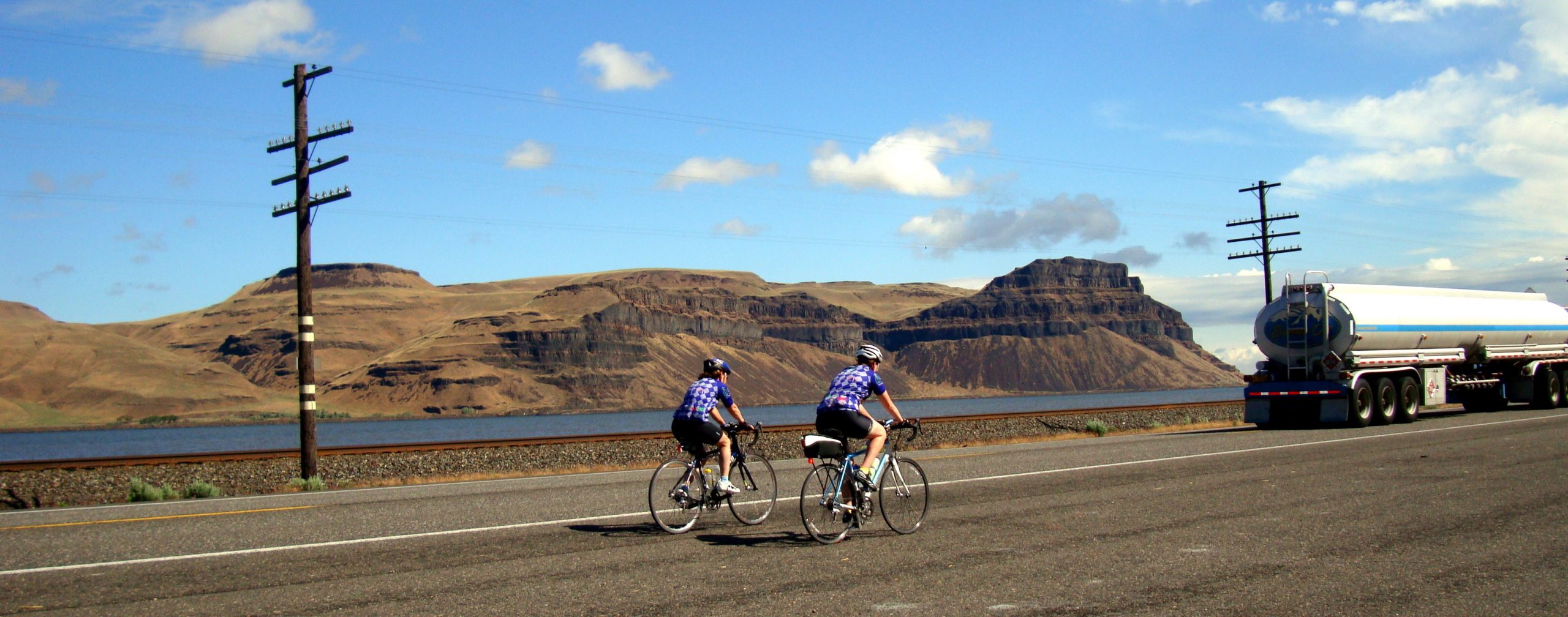
the days spent along the Columbia were some of the most beautiful of the entire Summer.
We cycled the river valley east from Portland to near Wallula where the Columbia turns north, but we continued east to Walla Walla Washington.
We tracked the course of the river for over 200 miles, the total distance to Walla Walla being nearly 260 miles.
This segment was divided into four parts with overnight stays in Hood River Oregon on June 6th (72 miles), Biggs Junction Oregon on June 7th (51 miles), Umatilla Oregon on June 8th (81 miles), arriving in Walla Walla Washington on June 9th (54 miles).
We enjoyed riding a closed segment of old US 30 Highway high on the south bluffs overlooking the Columbia and modern highway below. It is now limited to bicycles and pedestrians.
Summer blooms were an explosion of technicolor.
There were a number of memorable moments:
We stopped for an impromptu celebration upon reaching the 500 mile point of our journey, Mount Hood in the background.
Lissa Whittaker surprised us one morning, gifting each of us with a small stone figurine that she believed represented the spirit of the recipient. Mine was a bear and Christine’s an owl.
We housed in motels in Hood River and Biggs Junction…
but enjoyed the hospitality of private home stays in Umatilla (Chris and I with the Trevino family) and Walla Walla. 83 year old Rose McClellan, mother of 8 sons, provided Chris and me with a delightful evening. Her physician husband had died in 2002.
A rare routing “disconnect” occurred near the 1938 Oregon Trail monument east of The Dalles.
The map showed a paved secondary road. Too late to turn back, the “road” transitioned to gravel and at times dirt for nearly 20 miles.
Even the “good road” frequently lacked meaningful shoulders, weaving, bobbing, and presenting a real cycling challenge.
Exhausted, we concluded our 81 mile day on the 8th at Umatilla Oregon’s Our Lady of Angles Parish where we gratefully received dinner that evening and breakfast the following morning.
In Walla Walla, we were received with open arms at St. Patrick’s parish.
Father Matt was interviewed by both print and television media prior to giving a talk about our mission.
Dinner was festive and featured the most creative table decorations of the entire ride.
Of course even when there were no parishes to feed us, we somehow managed.
Next: Idaho
Peace Everyone. Pete
(June 10, 2010) 2 Emotional Encounters
While on the road today, we stopped at a service station/convenience store. We were resting and refreshing when a woman approached me from the gas pump where she was fueling her late model Subaru. She made eye contact with me as she drew near. When she was within speaking distance she asked me what I and the other riders were doing. I told her of our C4C mission on behalf of Catholic Charities. She smiled and told me that she had a 24 year old daughter who was severely disabled. Her daughter had the mental function of a 6 month old. Catholic Charities of Washington had provided services and assistance to her daughter for many years. She was profoundly grateful to the organization. We spoke for quite some time and she offered to put Christine and me up for the evening if we needed a place to stay. She also shared that she was an avid bicyclist and that she was proud of a 26 mile ride that she had completed early in the week. With tears she explained that her physicians had discouraged her from riding because her most recent course of chemo-therapy would not leave her with enough strength. At this point she was not the only person struggling with tears. She embraced Christine and me, saying “thank you”, and left us her phone number in case we needed anything. Please say a prayer for Kathy from Walla Walla, Washington. – Pete Schloss
(This from a Facebook post) “At a store in Skamania, WA today the riders were talking to a gentleman with his 10-year-old son. After hearing what we were doing the boy reached into his pocket, pulled out all of his money, and gave it to one of the riders as a donation for C4C. That 62 cents meant a lot to all of us. Thank you young man for your generosity. You brought a smile and a prayer of gratitude to all of us today. – Christine Schloss
In the wake of the George Floyd tragedy there have been voices persistent in the assertion that systemic racism no longer exists in America. Interview clips from a few high profile African Americans are featured in videos in order to give credence to the claim.
I have engaged in discussion with a few acquaintances who maintain that claims of systemic racism in America are a fiction fostered by the media of the liberal left.
I am left to wonder and ask myself the question, “When did systemic racism end in America?”
Certainly, racism was pervasive and well established in 1619 when the America Colonies first began participation in the international slave trade. How else could the Colonials justify buying and selling innocent human beings?
Racism remained in evidence during the drafting of the United States Constitution when in 1787 Article 1, Section 2, specified that enslaved persons would count as 3/5 of a free person in determining the number of Congressional Representatives that a state would be entitled to.
Perhaps one might point to America’s 1807 withdrawal from international slave trade as an end to racism except that slavery continued to flourish within many U.S. states. It remained accepted as manifest destiny that White Americans could buy and sell Black men, women, and children… permanently severing child from mother, and husband from wife.
The Civil War of 1860-65 which was “a House Divided” over the question of slavery, resulted in the deaths of 750,000 Union and Confederate combatants. That bloodbath and the defeat of the Southern insurrection must have fully and finally resolved racism, even if the liberation of the slaves under the 1863 passage of the 13th Amendment to the U.S. Constitution did not. It seems like such a long time ago, but then it was the time of my great-grandfather, only 3 generations removed from mine.
If the Civil War had eliminated racism then how was it that African American (men) were only extended the right to vote in the passage of the 1870 15th Amendment to the Constitution?
How then was it that the infamous “Jim Crow” (fn1) laws of the 19th and 20th Centuries could institutionalize racial segregation in such fundamental aspects of society as property ownership, education, freedom of association, suffrage… just to name a few. These were prominent in the time of my Grandfather, remained prevalent in my Father’s time, and enforced by various state and local governments until at least 1965.
In 1913 President Woodrow Wilson initiated segregation in the federal workforce. The U.S. military, already segregated, was not desegregated until 1948. Yet in the last week controversy reigns over whether U.S. military bases should retain the names of military leaders who led troops against the United States in the name of the preservation of slavery. (fn2)
Perhaps racial lynching was a matter extinguished in the era of the Civil War or at least by the 20th Century.
Unfortunately, that is not the case. Between 1882 and 1968 approximately 3,500 African Americans were murdered by extrajudicial “lynching”. Some authorities believe the number much larger as some events and the fates of those victims remain hidden.
Noteworthy was a 1909 public lynching of a Black man in Cairo Illinois which was attended by thousands. Still a historical artifact? As recently as 1998 James Byrd, Jr., a Black man, was murdered by three White men who “hanged” him by dragging him by the neck behind a pickup truck. Using the Tuskegee Institutes definition of “lynching” as a racially perpetrated murder in which three or more persons participated, the number of victims is certainly greater and includes the 2011 murder of James C. Anderson by a group of Whites.
Not systemic? In 1947 President Harry Truman was unsuccessful in his effort to enact a Federal Anti-Lynching law… an effort repeated unsuccessfully in the US Senate in 2005, and again just last week.
But the laws that abolished slavery must have also abolished racism, right?
In 1892 Homer Plessy, a man who was one-eighth Black, was prosecuted and convicted in Louisiana for riding in a “Whites only” train car. The US Supreme Court took the matter up in 1896 ruling against Homer in a 7-1 decision that declared that although the 14th Amendment granted legal equality to the races, it could not overcome or eliminate all social distinctions based on color. Thus, “separate but equal” was a sufficient protection of rights. That decision has never been expressly overturned…
…Yet in the 1954 decision of Brown v. Board of Education the US Supreme Court did declare that in the matter of education, separate is not equal. The law of the land? Not to then Governor George Wallace who in 1963 tried to block the integration of Alabama schools declaring, “segregation now, segregation tomorrow, segregation forever!”
Clay County Missouri, where I worked in the late 1970’s as a State Parole and Probation Officer and later as a practicing attorney maintained a “Whites only” drinking fountain in its Courthouse at least into the late 1950’s. In the 1970’s Clay County Prosecuting Attorney, William S. Brandom commonly referred to “NNR” (N—- North of the River) as sufficient probable cause for law enforcement to stop an African American in the county.
In matters of housing: I live in an area of Kansas City developed in the early 1900’s. Indelibly recorded into the chain of title of homes in this area are covenants that these properties cannot be owned by persons of the Negro race. It was not until 1968 that the federal Fair Housing Act declared such restrictions illegal. Many neighborhoods, mine included, remain de facto segregated as the result of the inertia of history, and resistance of certain sellers, realtors, and lenders (“red-lining”) to change.
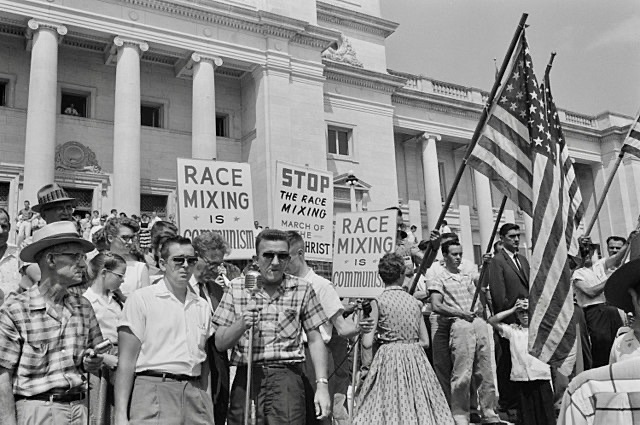
In matters of marriage: It was not until 1967 that the US Supreme Court (Loving v Virginia) struck down state anti-miscegenation laws that made “race mixing” criminally punishable. It remained unusual to see mixed race relationships in public and in the media well into the 21st century. I have been told by couples in mixed relationships that it remains “uncomfortable” in certain areas and among certain groups. (fn3)
Sports? Jackie Robinson broke the “color barrier” in 1947. What is less well known is that collegiate sports remained segregated in the South into the 1970’s. In the 1950’s and early 1960’s Louisiana and Mississippi each enacted laws that prohibited integrated sports competitions. It was not until 1971-72 that all SEC conference teams became integrated. It was not until 4 decades later that the SEC saw its first Black head coach and Black athletic director. Today, African American coaches, referees, and athletic administrators remain an underrepresented curiosity in the United States, especially in light of the proportion of Black to White athletes.
Health Care: I intended to skip this topic because it could justify a stand-alone post. However, today (June 12, 2020) State Senator from Ohio and ER physician, Steve Huffman, implied by question in a senate hearing that the higher rates of COVID-19 infections in the “…colored population” are because they “…do not wash their hands as well as other groups…” He has since been fired from his position as an ER doctor.
Voting: One need only look to the history of “poll taxes”, “literacy tests”, and other “legal” impediments designed to disenfranchise Black voters to understand the purpose of the 1965 Voting Rights Act. Portions of that Act authorizing federal oversight of election procedures in certain states were struck down in 2013 by the US Supreme Court in Shelby County v Holder. The results and controversies remain a matter of current events, just one example being the disparity in the number of polling places to registered voters in predominantly White and Black race Georgia precincts this last week.
Our History: In the absence of systemic racism then surely two very similar massacres would have been equally reported in the annals of history and given equal voice in our schools’ American History textbooks.
In 1867 General George A. Custer and 267 of his officers and enlisted men were massacred at the hands of thousands of “savages” at the Battle of the Little Bighorn, more commonly known as “Custer’s Last Stand”. Who has not heard of the “valor, daring, and sacrifice” of the noble Custer and his men as mythically portrayed in books, movies, and television.
Yet, between May 31 and June 1, 1921, a mob of Tulsa Oklahoma’s White residents looted and burned Black owned homes and businesses. Over 35 square blocks in the Black citizen owned Greenwood District were virtually leveled. Over 800 Black residents were injured, and approximately 300 were murdered. The precise numbers will never be known as Oklahoma did not conduct an investigation into the events until 75 years later. Non-invasive archaeological research disclosed probable mass gravesites. The Greenwood District, then the most prosperous Black community in the nation ceased to exist and over 10,000 residents were rendered homeless. The 100 year silence that has surrounded the 1921 “Tulsa Massacre” is deafening.
Perhaps systemic racism is under attack and continues to erode. Ended?… I think not. As for those who believe otherwise, I will loosely borrow with apologies from Friedrich Nietzsche: “Perhaps those who were seen dancing were thought insane by those who refusedto hear the music.”
Peace Everyone. Pete
Footnotes:
fn1: The phrase “Jim Crow Law” was coined by the New York Times in an 1892 article about Louisiana’s passage of a law criminalizing the mixing of races in rail car accommodations. “Jump Jim Crow” was an 1830’s song and dance caricature of Negros performed by Thomas Rice in blackface which became synonymous with the negative depiction of the Black race.
fn2: For example, Fort Bragg, North Carolina, is named in the honor of General Braxton Bragg (1817-1876) who lead Confederate troops against the Union Army in at least 8 engagements. He was successful in only one and was relieved of command by CSA President Davis. Bragg is considered by historians to be one of the most inept commanders in the Civil War.
CSA General Braxton Bragg
fn3: Today, June 12, 2020, is “Loving Day”, the day that it became universally legal in the United States for members of one race to marry members of another race.