In 2010 46 million people in the United States lived in poverty. 15% of the population… one in every six people. Worse: 22% of children under the age of 18 lived in poverty.

Next to the Federal Government, US Catholic Charities is the largest social safety net provider in the Country, delivering services to over 12 million people from its 2,600 locations.

In 2010, its Centennial year, US Catholic Charities announced an initiative to reduce poverty in America 50% by the year 2020. Father Matt saw in this the prospect of making his departure from St. Francis Parish (SFX) and 3 month sabbatical into something grand and good. Matt often focused upon a core message in the Gospel of St. Matthew; Our duty to feed the hungry, clothe the naked… minister to the needs of the poor and forgotten. Father Matt saw that bicycling across the United States could draw attention and contributions to the Catholic Charities campaign.

Matt had already established himself as both an adventurer and gifted fundraiser. In 2004 he sought to reduce or eliminate the SFX parish debt. Seeking donations, Matt kayaked from the headwaters of the Missouri River over 2,300 miles to St. Louis. He raised nearly a quarter of a million dollars.

“Cycling for Change” was Matt’s creation and his message:

“I can not think of a better way to spend my sabbatical than by helping those most vulnerable across the country… Our Cycling for Change Team is a small group of pilgrims helping those in poverty all over the country by supporting the work of Catholic Charities and raising money to expand the services of the Caritas Center in Kansas City.”

C4C

The C4C campaign stood exclusively upon two pillars; raise awareness and raise money. There was a third pillar, individual in nature. It was the pursuit of an adventure. I confess that but for “the adventure” I would not have committed to those first two “pillars”.

2009 and 2010 lay before us heavy with an array of events, duties, and tasks.

In addition to phone and in-person solicitations I sent out over 150 letters and countless emails to friends, family, and colleagues in the legal community. Christine engaged in similar personal fundraising efforts. Together we raise over $25,000.00 on behalf of C4C.

There were meetings and committees.

CCI05092020

I began assembling the tools and supplies to be our bike mechanic on the road, including building and “trueing” spare wheels for the group.

01d959ef94b456205d72f2cee3f3c31ff1d50d831b

We began cycling together, joining the SFX parish “Flying Fish” bicycle group in organized metro rides.

IMG_7658

Matt spoke at Kansas City’s Irish Fest.

DSC01647

We staffed a booth at the Tour of Missouri event.

DSC_1783

We rode together in the 2 day MS-150 event.

DSC_1919DSC_2276

We sponsored and headlined our own C4C group ride event in Kansas City.

DSC_1307DSC_1309DSC_1361

There were informal C4C gatherings that cemented our group identity.

DSC02834

A grand fundraiser was hosted at the Boulevard Brewery in Kansas City.

DSC02896DSC02889_DSC0005

A weekend retreat was held at Conception Abbey in northwest Missouri. … and there were (many) training rides. The most significant being in Colorado; a week in June to give us experience riding roads and highways in the mountains.

DSC_0713DSC_0623DSC_0838DSC_0972DSC01080

Until the June 2009 Colorado ride Christine had been content to let me pursue C4C on my own. No thought had been given to her personal participation. She was not a “cyclist”, however Christine was an organizational wizard and gifted manager of people. She accompanied us to Colorado for the fun of it, but by the end of the week everyone acknowledged the virtues of including Christine as the chief “cat herder”.

DSC_0958

Matt’s original vision was to ride from the farthest northwestern point of the contiguous 48 states, Cape Flattery Washington, to the southernmost point, Key West Florida. (We traversed the Card Sound Bridge which is just north of Key Largo, the farthest southeastern point.)

DSC05956

Matt is a person of vision, but not necessarily detail. As of June 2009 others had begun to assemble the day-by-day routing and logistics. Christine became an active part of that planning after the Colorado ride.

Christine giving routing instructions to Lissa

C4C was taking shape in a serious way, inertia enough that Catholic Charities of Kansas City secured an SUV, two large vans, and a dual axle trailer for our use on the campaign across America.

The C4C van, outside of our rooms at Hermiston

Next: Part 4, Sendoff to Seattle.

Peace Everyone. Pete

DSC_0560


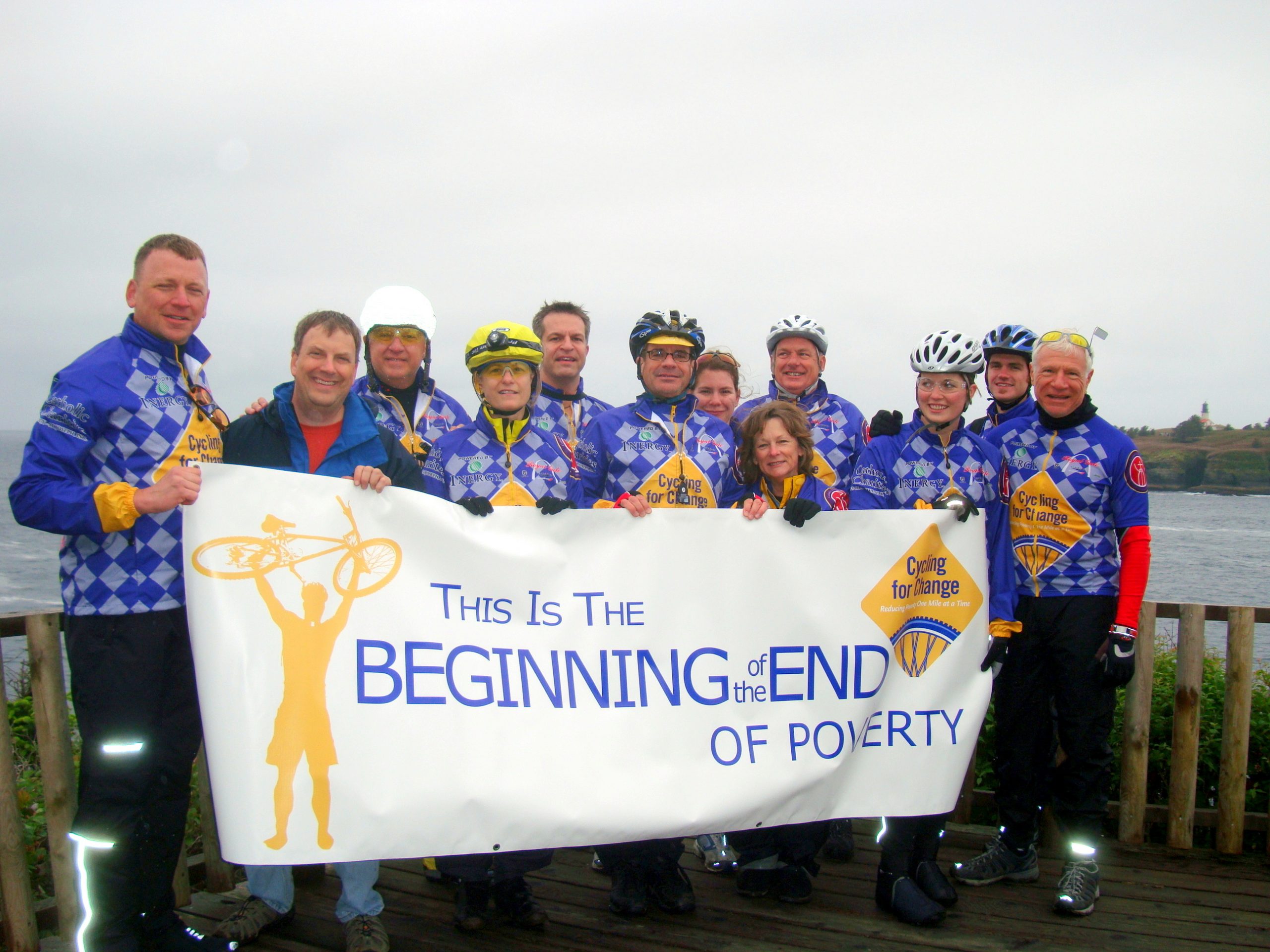
The Cycling for Change (C4C) through riders would number 12. In addition to Father Matt and his parish assistant, Bethany Paul,

DSC01779

we would include:

Dr. Tom Whittaker, JD MD. Physician and surgeon, University of Kansas Department of Ophthalmology.

DSC_1999

Lissa Whittaker, Owner of Rapid Transcript, a Federal Court Transcription service.

DSC_1758

John Mocella, retired and a volunteer with Catholic Charities of Kansas City.

DSC_3646

Sara Terhune, Graduate student.

DSC_1300

Karl Schafer, Physical Therapist.

DSC03833

Jeremy Ruzich, Photographer.

DSC03683

John Stigers, Retired postal worker.

DSC02864

Deborah Hellinger, DO. Musculoskeletal Radiologist.

DSC_1867

Jason Christiansen, CEO of Catholic Charities of Colorado Springs.

DSC03803

and me.

Our support team on the road would consist of:

Stephen Belt, Flight training director St. Louis University.

DSC_3648

Tom and Joy Comeau, SFX parish members. (Joy passed away late in 2018. In less than a month Tom followed. Love long shared resists separation.)

DSC_3489

and my wife, Christine, owner and Director of Northland Dependency Services.

Christine giving routing instructions to Lissa

Logistics and administration in Kansas City would be in the hands of  Catholic Charities staff Suzanne Cronkhite and Kathy Conwell.

DSC_3441

DSC_1315

C4C was scheduled to begin on Memorial Day 2010 in Cape Flattery Washington and conclude 100 days and 5,000 miles later with riders crossing the “Finish Line” on Labor Day in Key West Florida.

As viewed in January of 2009, Memorial Day 2010 seemed a long way off, but there was so much to do. Each participant had committed to engage in considerable group and individual fundraising. There were events to plan and host, promotional rides to organize, meetings… and of course the training. Each of us had to continue with the routine challenges of home, family, and work while juggling the significant requirements of C4C. The 16 of us began 2009 as relative strangers. By the end of that year we were family.

0163a5c9c92356e5856c6b776112976465ff65e3de

Next: 2009-10 Promotion and Preparation.

Peace Everyone. Pete

Every story has a beginning and this one dates to 2008: I was 56 years old. Married for 31 year, a father for 30 years, an attorney for 28 years, and we had welcomed 2 new grandchildren into our lives early that year. There would be a total of 9 born within 30 months of that January. I had dreamed of riding a bicycle across North America… never… not even once.

01eb2594f456a18a1eb9de2949165ab5b328cdfec7

After a 40 year hiatus I had rediscovered bicycling in 2006 and stood as proof that once learned, one never forgets how to ride a bike. My bicycle was a far cry from the 26” chrome fendered beast that I rode as a young teen. My “Seven” (the brand name) was a sleek custom build titanium job that had cost almost twice what my first new car did (a 1974 Toyota Celica GT). “Guy jewelry.” was my curt reply to Christine as she gasped upon reading the invoice. It explained everything, and nothing. I ride it to this day.

019f8d001eb55e243962c69247dc27b96b9a2a6b5e

My father had long suffered from Multiple Sclerosis and so it was natural for me as a bicycle enthusiast to participate in the MS-150 charity rides sponsored in Missouri. In 2006, 2007, and again in 2008 I had ridden over 150 miles in the course of the 2 day event. I considered that to be quite an achievement.

01eab3c48e9b043eba34ad45b54c8cfe11416dde65

Bicycling 5,000 miles coast to coast, crossing through 16 States, was unthinkable… certainly beyond my contemplation.

In 2008 we lived in Liberty Missouri but traveled weekly to Kansas City for Mass at St. Francis Xavier Church (SFX), the Jesuit parish next to Rockhurst University. From 1977 to 1989 we had lived a short walk from SFX and were very active in the parish. I had served a term as President of the Parish Council and Christine served as President of its School Board. By 2008 we had long retreated to pews nearer the back of the church.

01143741efd960065b85e6a8f90740baa4b115b0c1

In the 1950’s SFX could boast 1,500 registered parish families. In the 70’s and 80’s there were perhaps 150. The architecturally significant church was cavernous. In the early years of our attendance it rarely approached capacity except at Easter and Christmas.

01f6bed2cc9e6681235c48f7ce6a7f176ea22f1d4e

The church was the spiritual home for a small but dedicated core of parishioners.

Around the year 2000, SFX experienced something of a renaissance with the arrival of its newest pastor, Father Matt Ruhl, S.J.. Among homilists Matt was a “rock star”. He drew a following from across Metro-Kansas City and SFX once again enjoyed near capacity attendance each Sunday. Matt was never one to presume the mind of God. Words like “God wants you to…” were usually absent from his sermons. Instead he challenged us to know and love ourselves and thus our neighbors in thought provoking presentations. He preferred to forego looking down upon us from the pulpit, instead walking up and down the aisle among the congregants. Mid-sermon he would often shake a hand, pat a shoulder or wink an eye without skipping a beat of his message.

01f593900afe85186b948ec7fb424a313d69d10e37

His popularity was legendary and perhaps the source of jealousy from Kansas City’s Diocesan  bishop at the time who ended up ordering Matt to return to the pulpit as was “expected” of a dignified clergyman. That bishop would later find notoriety as the first of his standing to plead guilty to the crime of failure to report the sexual abuse of children.

It is said that all good things must come to an end and so it was with Matt Ruhl’s tenure at SFX. One Sunday in mid-2008 he addressed the congregation and announced that in May of 2010 he would be leaving for another assignment. Those were sad words for his dedicated followers.

It was a rare Sunday for us as we were joined in the congregation by our adult children, their spouses, and our two infant grandchildren.

01a14bfc40bc99e4ecb0590b648894ff0979a4e979

Matt’s message was not of particular interest to the family until he added an unusual twist: Father Matt had received permission to take a sabbatical over the Summer of 2010. Joined by a few hand chosen riders he would bicycle across the United States, delivering the message of the Catholic Charities’ campaign to reduce poverty in the United States. He and his cycling companions would raise both awareness and funds as “Cycling for Change” (C4C). Matt would be seeking riders to join for segments of the journey. The members of my family collectively gasped as they turned to look at me. Mesmerized, I stared up at Matt. Bicycle… across the United States… across America… Wow. My family knew me all too well.

After Mass I sought out Bethany Paul, Father Matt’s assistant. “I would like to sign up for the entire ride.” Bethany looked at me without expression. I am sure that my face was familiar to her and Matt, but beyond that I was an unknown. I repeated myself. Politely, Bethany found a blank piece of paper and took down my particulars. They would be in touch. It never occurred to me that I might not be chosen to ride. I began regularly calling Bethany for “status updates”. I ignored that no one had acknowledged my “application”. In retrospect I am sure that I was something of a nuisance. My persistence won out and I was taken seriously. I would be one of the “through riders”. Eventually we would number 12, including Matt and Bethany.

DSC01779

There would be segment riders, and there would be support participants who would drive the vans, one pulling a cargo trailer that would be our SAG (“Support and Gear”).

I had not yet considered how I would meet my commitment to raise $25,000.00 on behalf of C4C. I had not considered how I would suspend my law practice, and thus my income, for an entire Summer or how in my absence I would continue to pay my office overhead and my assistant’s salary.

010f445664b0eb176dbf527c2b37868f8f8f51d26f

I had not given thought to being away from Christine for over 3 months. Those were just details. I was going to ride across the United States on a bicycle!

Next: Part 2. Joy, Tragedy, and Becoming Family.

Peace Everyone. Pete

01814ff91a3b4758670ac19171ce7605d622a48200


This is the final post in my “Armchair Tour of Kansas City” series. For context you may click on this link to be redirected to the series Introduction: Armchair Tour Intro

Pleasant Day Outings:

Watkins Woolen Mill

25 miles to the north is the remarkably well preserved Watkins Estate and Woolen Mill. Waltus Watkins, a resourceful polymath, was born in 1806.

He moved to Liberty Missouri (north of Kansas City) in 1830. In 1839 he purchased his first 580 acres and by 1880 his holdings had grown to over 3,600 acres.

With rolling hills and forest this has become a well-managed Missouri State Park. The Watkins 1850 mansion and 1860 steam operated Woolen Mill are a treat for young and old visitors alike.

Bike and Hike Trails

0116115f967a280c38d327c265724ed5b2a7a6dd46

Kansas City has done much in the last few years to become more bike friendly. According to Trail Link, the metro area features nearly 500 miles of dedicated trails and bike lanes. Among the many are the “Trolley Trail” which follows the old central trolley line right-of-way from near the Plaza south 7 miles through the heart of Kansas City.

010786a4114a69def229dc5ecc681d2a289e2c0b8b

Another is Cliffside Drive, which serpentines along the south bluffs of the Missouri River east of downtown.

bf959f1e-0f7b-429e-af2a-adc4df5eccbd

0112b27a266672b920b0ceadbf6790d8e1db33f9f9

Swope Park has miles of wooded single-track mountain bike trails. For the truly adventurous, Missouri’s Katy Trail, a “Rails to Trails” State Park and the longest recreational rail trail in the United States, links Kansas City to St. Louis via 240 miles of groomed limestone chat. (An experience I enjoyed in 2010)

01114268c54e43a150159075f4734b5eee7b224766

Powell Gardens

0191cd4d8e5bfb60ceb4de1159dad26cb747e0fde1

This 970 acre botanical garden is located 30 miles east of Kansas City. It features nearly a quarter of a million plants from over 6,000 varieties.

Cemeteries

Kansas City has many cemeteries located throughout the metro area. A few are particularly noteworthy for a visit:

In nearby Fairway Kansas is the Shawnee Indian Mission Historical Site and Cemetery.

IMG_3150

The Mission’s 3 existing buildings sit upon 12 acres. The Mission buildings are open to the public as a museum.

IMG_3142

The Mission was founded in 1830 by Methodist minister Thomas Johnson who sought to educate and convert to Christianity the Kansa and Shawnee Indian tribes. The Shawnees, led by Chief Fish, had been forcefully relocated to the unorganized territory (that later became Kansas) from their traditional home in Ohio.

IMG_3153

A few blocks from the Mission is a small cemetery (1839-1930) that was the final resting place for Johnson and members of his family.

IMG_3156

About 5 miles west is another cemetery. This small, sad, nearly vacant patch of ground is all that remains of the Shawnee Indian Cemetery, once known as the Blue Jacket Cemetery, named after the family of Chief Bluejacket, whose members were buried here between 1837 and 1870.

012ec2c001a709912fc6f4eb93207a3a81bfa9e21b

01e34787efdd2f7c2e02f23e3cccda4f39b99139fe

The graves are mostly unmarked. A grouping of broken markers have been mounted in a single flat of concrete in an apparent effort to preserve them from further damage or theft. 01d1033c880ce95650f062c5f91b75f99a1c251c7f

Union Cemetery was founded of necessity in 1857.

01add7a1ff84fa8f358ca7fa879cbea34863bd41d1

The nearby towns of Westport and Kansas had suffered a devastating Cholera Epidemic and were in need of burial space. 49 acres located between the two towns were secured for that purpose (27 acres remaining today) and the cemetery, a “Union” of the two communities, was established.

01197d14b7a798544f16a88836a2fa618c0b93280a

It was believed that it would serve the needs of the communities forever. Although Civil War era graves are located within the cemetery, its name is not derived from that conflict. The cemetery is located on Union Hill, near downtown Kansas City.

A few miles east of Downtown Kansas City is 43-acre Elmwood Cemetery.

0112ea71b9cfe37cbe9207569eb6bf097d4c672327

Formally established in 1872 (although the earliest grave dates to 1840) this is the final resting place for many of Kansas City’s elite and powerful, including mayors, politicians, Civil War generals, business executives, and even Sarah Barret who was sweetheart to Abraham Lincoln.

0148dbd0991a3eedcace9a838e788d40c2a291169d

0135a562390ccbb76bab21ed1f6c4aeb4192734325

Over 36,000 people are buried here. Ella, an orphaned deer born in the cemetery in 2011, was a tame and popular “resident” until she was shot for fun by a 19 year old miscreant in 2013. She was known to follow mourners and stand watch at burials. Her remains were cremated and returned to the cemetery.

By the way, for those who have been looking… we found Waldo.

015181dbea5bf872d7e5c0b28b89f727256e85930f

Finally, Memorial Park Cemetery (also known as Park Lawn Cemetery) adjoins the southern perimeter of Kansas City’s Swope Park. It is the largest privately owned cemetery in the State of Missouri. I mention it only because it’s rolling wooded acres are quite beautiful and it will likely be our final “travel destination” at Fate’s calling.

01c43778d8d8e1174d6006ef9dc8a12ec17097bbb2

Wants, Needs, Purpose, and CPR for the Spirit:

Including the Introduction, the “Armchair Tour of Kansas City” consisted of 10 posts. The entire effort, from driving around the metro area, taking pictures, assembling information, and writing copy… through the publication of the last post on May 9th covered about a month. There is so much more to Kansas City than I can hope to have covered. Perhaps I have encouraged readers to better appreciate and someday explore this hidden gem.

I have been much the beneficiary of my own efforts; enjoying the outdoors, visiting the sites, learning, and connecting with readers who have followed along. Most of all, I enjoyed having a “purpose”. Loss of purpose is one of the underappreciated consequences of the pandemic shutdown. Confined to our homes and insulated from our friends and family, many of us have suffered the suspension of purpose.

The grocery story workers, health care professionals, first responders, postal workers, and others who continue the pursuit of their regular “purpose”, do so under a shadow of very real danger. Through their efforts the disruption of our lives has been reduced. We may find that we can not always satisfy our wants, but they are the reason that we can still satisfy most of our needs. To them we own gratitude and thanks.

The quality of life is not defined solely by our wants and needs. There are things that momentarily transport us from our anxieties… experiences that cause us to reflexively smile, to taste a minute of youthful joy: The carefree children riding their bicycles on a weekday afternoon… families walking and playing together… the fragrance of the first blossoms of spring… feeling the kiss of a rain-born breeze fresh upon the cheek. The peace that we derive from moments such as these is subtle, casual, and not the product of intention. There are exceptions…

Recently, at random intersections in the surrounding neighborhoods one might observe an ordinary silver SUV draw to a stop and park at the curb. There is nothing to catch one’s eye until the driver emerges from the vehicle attired in full Scottish Highland regalia.

0107adc4ca3ea15902c8a50c5e97ae08a9bdd1983e

He reaches into the back seat of his car and tucks a dark bundle under his arm. Striding to the intersection he assumes a rigid posture and unfolds the bundle. Bagpipes. He begins to play.

010fb98f9acc73d55cfae846a59f45350fb9e9528f

Children cease their recreation. Families emerge from their homes. Cars stop and park. All face this man, their cares momentarily forgotten. Some in the audience record the performance with their phones, intent on sharing with others not fortunate enough to have been there in person.

01829bdd7da9d6d2c4866839af732e1148fc1e0b11

For 30 minutes the songs follow one upon the other, concluding with “Amazing Grace”. There is applause and then John Tootle, retired EMT and Kansas City firefighter, returns to his car quietly bound for the next random intersection where he will resuscitate the spirit of another neighborhood.

Peace Everyone. Pete

PS. Next week I begin a new series, “Across America by Bicycle”.

This post is one in a series from my “Armchair Tour of Kansas City”. For context you may click on this link to be redirected to the series Introduction: Armchair Tour Intro

Robert Long (1850-1934)

Robert Alexander Long was a lumber baron who established the Long- Bell Lumber Company which was the largest lumber company in the world in the early 20th Century. His holdings included 61 lumber mills and over 500,000 acres of forestland across the United States. He spent most of his life in Kansas City.

Scarritt Point

Named for Nathan Scarritt (1821-1890), a Methodist minister who taught the Native Americans for many years, this historic district is located high on the bluffs overlooking the Missouri River east of downtown. It is one of the oldest neighborhoods in the City, and in it’s day was the most affluent.

Today over 6,000 Kansas Citians reside in this neighborhood. The area includes hundreds of acres of parkland, wooded hiking trails, and stately mansions from the late 19th and early 20th Centuries.

Scarritt Point stands above and in stark contrast to the poor and industrial lower east bottoms.

It was on 3 acres located upon Scarritt Point that Robert A. Long built his monumental “city mansion” in 1911.

It was named “Corinthian Hall” due to the mansion’s large Corinthian columns. Construction required the relocation of two other mansions that were on the site.

Those mansions remain in the vicinity as private homes. The acquisition of the grounds, relocation of the 2 pre-existing mansions, construction of the home, 2 story carriage house and stables (the largest within the city),

reportedly cost over 25 million dollars (2020 equivalent). The 35,000 square foot 72 room French Renaissance structure has been the home of the Kansas City Museum and its collection of over 100,000 artifacts of local and regional history since 1940.

The Museum is currently undergoing an extensive renovation but is scheduled to reopen later this year.

Here are a few historical photos of the mansion’s interior:

Longview Farm

In 1913 Robert Long established his Longview Farm and Mansion on the distant outskirts of Kansas City. The 2,000 acre farm had 50 buildings, 250 acres of manicured lawn, gardens, and 4 greenhouses. Construction of the farm took only 18 months but engaged over 2,000 laborers. Craftsmen included 200 Italian stonemasons. The farmstead mansion measured 22,000 square feet with 48 rooms. Long built the farm in part because the stables located at his Scarritt Point mansion (Corinthian Hall) were suitable only for a few dozen of his nearly 200 prized horses.

One feature of the farm that is dear to my heart is the 1915 Longview Chapel.

It was within that chapel that I married Christine in 1977.

At the end of this post are images from a number of information boards for those who wish to delve deeper. Hopefully the resolution will allow them to be read.

Next: Part 9, “Pleasant Day Outings and CPR for the Spirit”

Peace Everyone. Pete