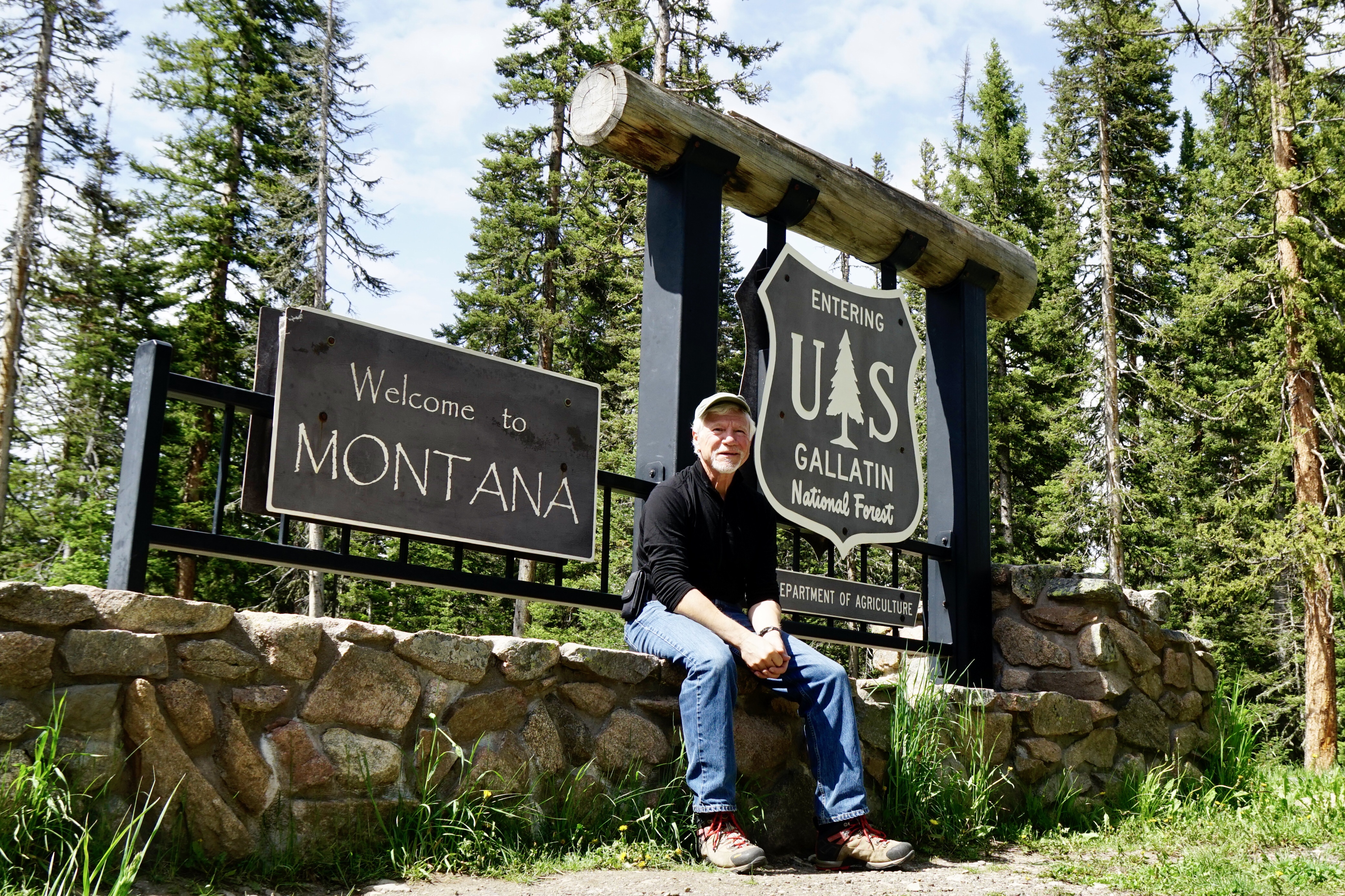
The Beartooth Highway spans a little over 70 miles from Red Lodge Montana in the east to just beyond Cooke City Montana in the west. It is there that it enters the northeastern portal to Yellowstone National Park. Its journey is split between the States of Montana and Wyoming as it serpentines across the boarder 3 times.

Built in early post-depression America it was a marvel of engineering that sought to flex the muscle of America’s emerging optimism, the despair of the late 20’s and early 30’s becoming more a scare than an open wound. It has been declared “America’s Highway”, a pre-Interstate Highway conquest of terrain and climate.

The Beartooth retains much of its rugged individualism. It is closed in the winter, is subject to late Spring and early Fall snowstorms, and in mid-season frost heaves occasionally pock and fold the pavement.

It is not a road of commerce as vehicles longer than 30 feet are discouraged by the daunting switchbacks that demand white-knuckled attention to steering and brakes.

Interspersed along its path are US Forest Service campgrounds. These are primitive affairs offering only pit-toilets, picnic tables and fire grates (no water, no electricity, and no cell service) yet they fill quickly in mid—season. They attract a certain type of camper who wishes to flirt with the edginess of the wild, yet have the security of a shared encampment. Cautions of bear activity abound and are not mere words. Many campers, and the camp hosts walk about with cylinders of bear repellent holstered like a six-shooter. I count myself among them.

What a rare bear encounter may do in one paw-swipe, swarms of mosquitoes (the little blood sucking bastards from hell!) invariably do a drop at a time. These mosquitoes are a hardy lot as they seem just as active at 40 degrees as at 80. Oh well, another predator, another spray.

Most folks don’t linger on the Beartooth. It is a passage experience with occasional stops at overlooks that flood the senses with Nature’s proudest sights, and smells.

The day visitor tends to embrace “the other Beartooth”, to be found in Red Lodge on the east and to a lesser extent at Cooke City to the west. For those desperate for a tourist fix mid-route there is the Top of the World Store which features a single gas pump, a concentrated assortment of souvenirs, and a few shelves of snacks and booze.

Cooke City is a city in name only that is narrowly spread for a few blocks on both sides of the Beartooth.

Eateries/bars, souvenir shops, sporting goods, lodgings, fuel, and a couple of minuscule casinos are its main offerings. It attracts visitors from beyond America’s borders.

At mid-day many of the restaurants present waits of up to an hour for a table. I found an exception at the east entry to town.

The Antler Lodge features a newly opened restaurant and bar, yet to be discovered. 15 craft beers on tap and gourmet burgers… I saw an “appetizer” of onion rings, enough to feed two lumberjacks. They were at about 50% capacity when I lunched there. That should change as the word gets out. While the restaurant is new, The Antler Lodge itself is one of the oldest traveler rests in the region.

Log construction, lots of trophies adorning the walls, and a welcoming hearth room make this an original Beartooth experience.

The “town” of Red Lodge is a much larger and more vibrant big brother to Cooke City.

It is more accessible and features stores and shops that serve the needs of a general population as well as the tourist trade. It’s a fun visit, but for me only as a punctuation mark to the experience of 4 days camped at 9,000 feet on the Beartooth.

At camp last night I engaged a couple of my generation in some fireside chat. The conversation took a turn to “the young people of today”. The couple launched into an opinionated slog that the youth of today are lazy, lack ambition, lack morals, and in spite of those deficiencies, generally worthless. The wife offered as proof, “I worked retail.. I know”. Rather than engage into controversies I held my tongue and shortly thereafter excused myself.

I have heard it said that “youth is wasted on the young”. Perhaps youth may reply that “retirement is wasted on the old”. In either case is seems that some of my generation are jealous of the world that waits to be explored by the young…perhaps regretting opportunities missed in their own youth.

Many who read my “Thoughts” have expressed that they are traveling with me vicariously, taking in as a virtual experience what they can not in everyday life. Similarly, I take vicarious pleasure in visiting with young people… tasting the thrill of a seemingly limitless horizon of possibilities.

The camping couple have apparently missed the joy of knowing my children and youth like them. Hard working, moral, bright with optimism for their future and the future of the children that they bring into this world.

In that same vein I wish that the couple could have met my server at the Antler Lodge Restaurant.

Sarah is a recent college graduate who bubbles with excitement as she shares that she will soon be off for a year in Austria. She has hired on for the year as an au pair to a family with two small children. She will assume the role of nanny and English teacher to the children for 18 hours each week, living with the family and taking intensive German language classes throughout her tenure. Beyond that graduate school awaits Sarah.

Bright, personable, hard working, and ambitious. She is “the youth of today” who hold America’s future in their hands. It is the duty of the older generations to give them an America worthy of their talents and ambitions.

Peace Everyone. Pete

PS. In Red Lodge I came upon an unusual fossil shop. I was fascinated by the mounted trilobites and crinoids. Is it possible that I may be bringing a souvenir back home?

I awoke at sunrise to a 32 degree morning brushed with heavy frost. Fortunately, my trailer has an adequate heater that kept things above 50 overnight and when turned up it gave a toasty 68 degrees that made for a comfortable breakfast.

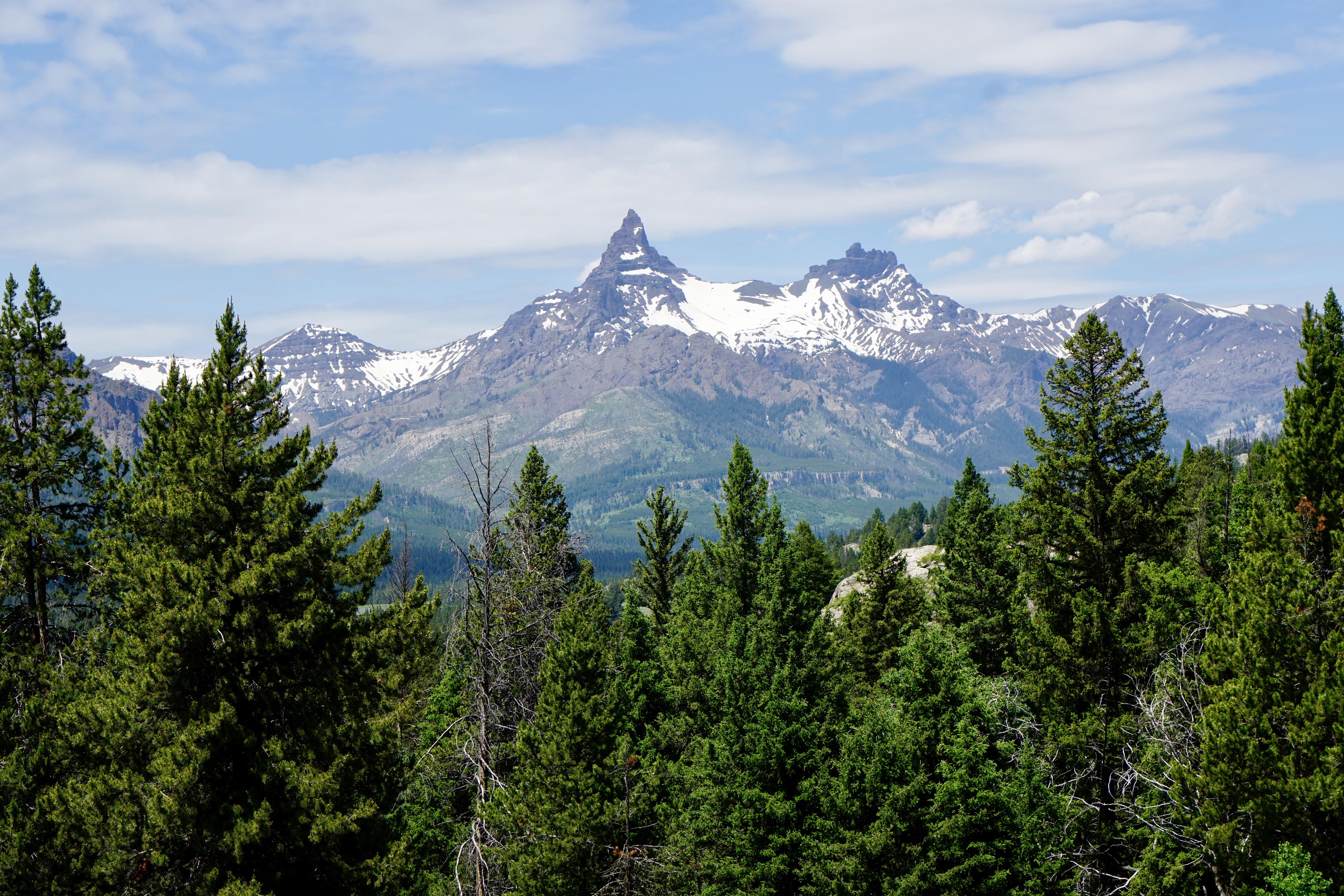
Still in my bedtime “scrubs” I wandered toward the outhouse but was stopped dead in my tracks by the explosion of light and color radiating from Beartooth Lake and 10,000 foot high Beartooth Butte in the background.

Reversing course I grabbed my camera and headed through the woods down to the shore. Glorious!! The snowcapped Butte was a beacon of light. Its mirrored reflection on the lake doubling the effect and elevating beautiful to breathtaking.

On the distant shore two elk played in the water, while the herd sunned and grazed on the slopes above.

They were only discernible to the naked eye through focused attention and were barely captured by my camera, the lens and zoom pushed to the limits.

I stood to take the scene in for nearly an hour. While my legs were idle, my mind was not.

What I am about to share is not meant to proselytize. This is merely an expression of my own beliefs which are neither superior or inferior to anyone else’s. I was raised a Catholic in a Catholic family and provided a Catholic education. While I self identify as “raised Catholic”, that provides no more insight into who I am or what I believe than does my identification as a Caucasian, second generation of immigrants. Who I am and what I believe continue to be a work in progress.

At two significant moments in my life, separated by 41 years, Catholic clergyman have admonished me to unconcern my self with dogma and “the rules” and instead listen to my conscience. They each tasked me to honestly follow the guidance of my conscience. I try and mostly succeed.

I find it impossible to listen to my conscience without also exploring some of the larger questions that have been pondered for millennia. Among those questions is whether there is a Creator, and if so does that Creator (“God By Any Name”) intervene in our daily lives.

We are (perhaps) unique in the animal kingdom as having a “free will”. We are burdened by innate physical urges to satisfy hunger, procreate, protect, survive… just as other animals, but we have the capacity to intentionally override those compulsions. Humans can starve themselves to death just to make a point. They can choose to be celibate. They can choose passive resistance. They can choose to end their own life. We can make choices in ways that no other creature can. We can make good choices and we can make really bad choices too.

If the Creator intervened to rescue us from our bad choices then our free will would be a fiction. I have made my share of mistakes (as the song goes, “Mistakes, I’ve made a few, but then again too few to mention…”) and I have usually had the good sense to discern and make other choices that resolved matters. Some folks avoid the mistakes in the first place, while others never abandon their bad choices. I don’t see an active hand of the Creator in these matters, except perhaps in the voice of conscience.

Life by its very definition is a lottery that sooner or later ends in death. In a river a salmon spawns thousands of eggs from which a few will survive a gauntlet to the sea, returning later to repeat the circle of life. My daughter gave birth to very tiny naturally occurring quads, one passed at 7 weeks and the remaining 3 thrive on their way to adolescence. In the last year we have lost good friends to accident, disease, and intention. All were good people in the truest sense of the world. I don’t believe the Creator actively chooses the fate of salmon, children, friends, or World Series victors. Nevertheless, I find that my senses are inadequate to fully explain all that occurs with me and around me.

My parents gave me an excellent start in life. I was well fed, well clothed, and well educated. They provided me with a model of parenting from which I could choose how I would later parent. Christine and I have strived to do the same for our children. My parents are not entitled to credit for my successes, or blame for my failings. They are entitled to my gratitude for the start in life that they gave to me. The same goes for the Hand that gave me breath and free will.

I am grateful for my life, for my humanity, and for this day. But the life that was breathed into me did not include a parachute to rescue me from my free will.

Peace Everyone. Pete

Comment:

Nice Post Peter Michael. Who do you think has been posting the suggestions to your conscience all of these years?

Sincerely, God

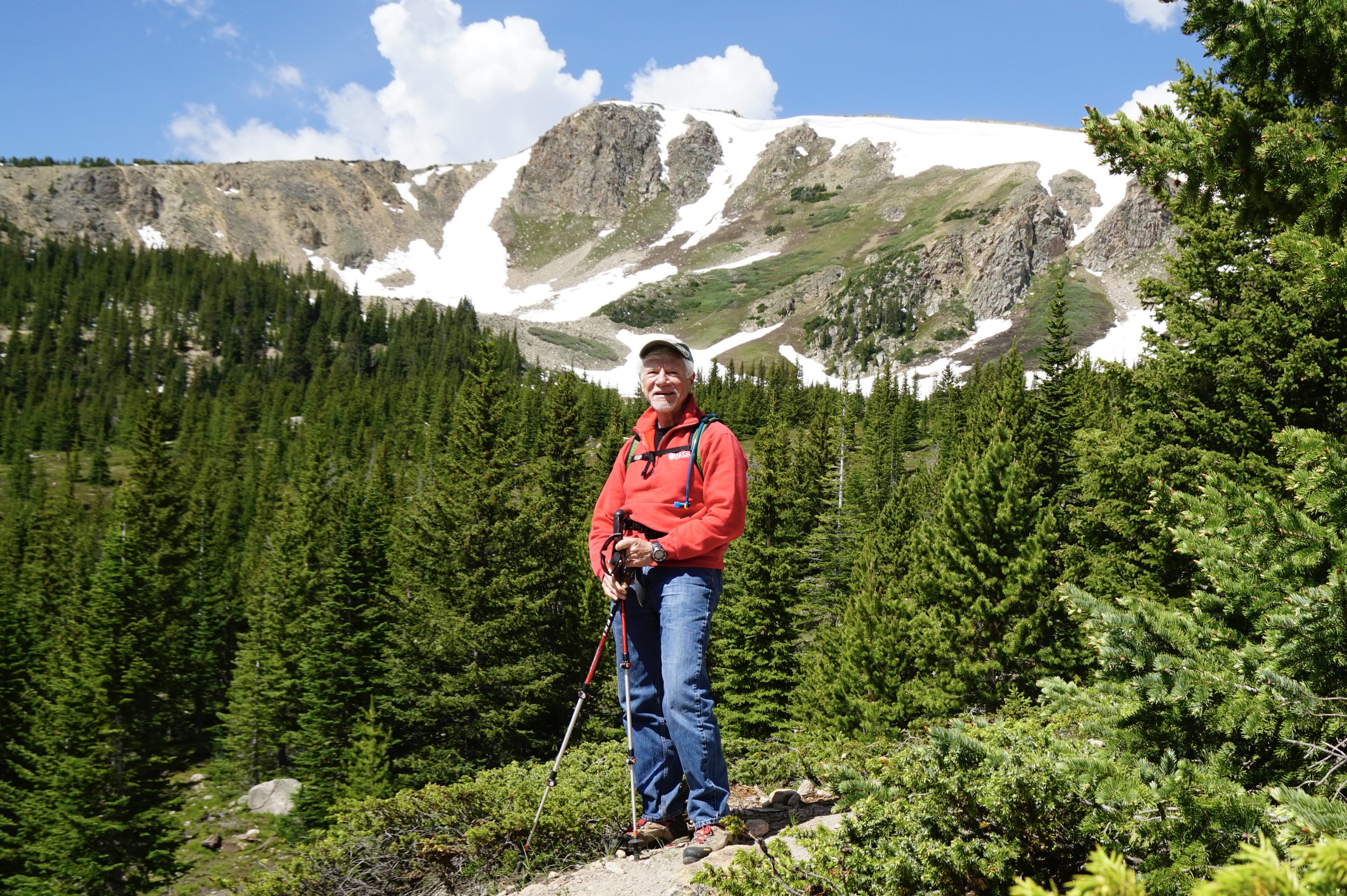
It was a good day for a hike. Breakfast eaten, dishes done, and camp made “ship shape” I drove to the Second Creek trailhead.

With my camera, Camelback (water), and trekking poles I began my ascent. 10,600 feet to about 11,600 feet. For a local this would not qualify as much of a climb. As a non-acclimated flatlander I found this to be challenging enough. Snow banks became plentiful as I reached and then continued above tree line.

The sapphire blue sky was pierced by a full sun that baked the skin and pained the eyes.

Step into a shadow and the temperature seemed to plummet. Amidst the trees, sweatshirt on… in the open, sweatshirt off.

The vistas did not disappoint and my 3 hours spent hiking provided ample opportunity for pictures and thoughtful rumination.

There are populations that make their homes above 12,000 feet, principally in the South American Andes Mountains and the Asian highlands of Tibet. However, over one-third of the world’s population lives less than 300 feet above sea-level. Far less than 1 percent live above 10,000 feet. This is the study of hypsographic demography.

As I periodically stopped to catch my breath I began to consider how quickly the air thins as elevation increases. Humans are not well designed to flourish above the clouds… there is a reason that the salinity of our blood closely matches the salinity of the oceans. We are physically happiest at the altitude of the seas from whence we emerged eons ago.

So here I am loving the mountains, the dry air, the smell of pine, the big brown bear that wandered through my campsite… yet I will never achieve the full aerobic capacity that I enjoy at 900 feet back in Kansas City.

The world is approximately 8,000 miles in diameter. Depending on the scientific discipline, the Earth’s atmosphere may be deemed to extend upwards to about 60 miles. Of course no human can survive at that altitude. Mount Everest (29,029 feet) is the highest point on Earth, not even 4 miles in elevation, and yet the fittest human can only briefly survive at that extreme.

Our inclination to be species-centric burdens us with the illusion that we are masters of vast (near endless?) realms and inexhaustible resources. However, if the Earth were reduced to the size of a 3 foot diameter ball, then the corresponding atmospheric equivalent of 10,560 feet (2 miles) above sea-level would be 9 thousandths of an inch (0.009”)! To put that into perspective, that is roughly the thickness of two pieces of ordinary copy paper.

The reality is that we are fragile creatures living within an incredibly thin envelope of breathable air. Borrowing upon an ancient proverb, “It’s an ill bird that fouls its own nest”… or perhaps more to the point, it is an ill fated humanity that chooses to break the wind that it breaths.

Peace Everyone.

Today began a solo camping trip that will extend through the end of July. Day one was a hot 400 mile slog west down the non-inspiring lanes of I-70. My first real destination is Denver, 600+ miles from home. An overnight in Goodland is a prudent alternative to a 12+ hour marathon drive while towing a trailer.

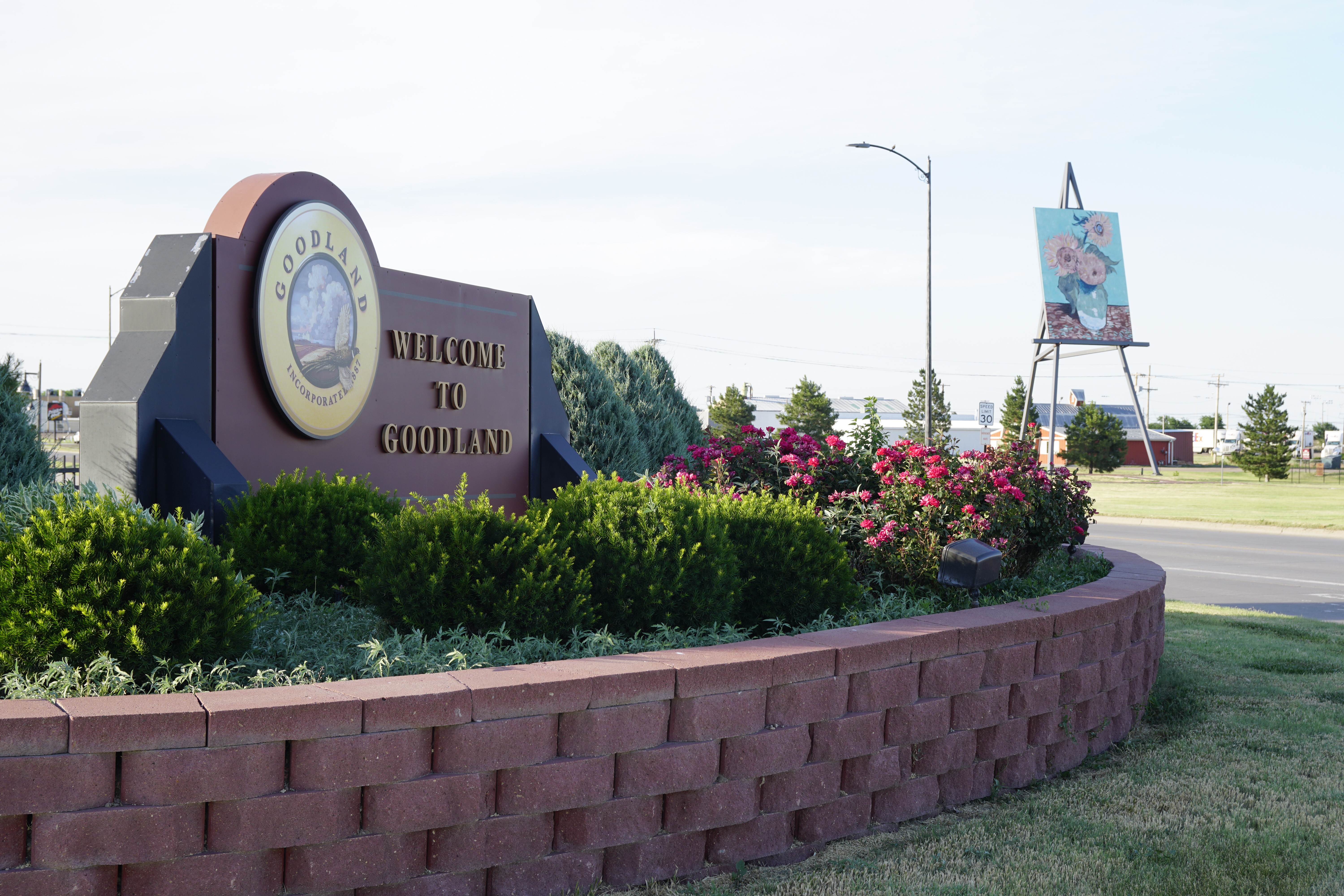
These days most folks only see a hint of Goodland as they zoom past the outskirts on the Interstate. Not much there except that a sharp eye might catch a glimpse of a very curious piece of art that towers in the distance.

I am camped at the Goodland KOA, located on the east side of Goodland, along less traveled US-24.

One might say that this is the backyard of Goodland. One might also incorrectly assume that there is not much to see here. Back to that piece of art…

In 2000, Canadian artist Cameron Cross approached the trade group, Sunflowers USA, with the idea of recreating VanGogh’s painting, “3 Sunflowers in a Vase” in Goodland. The proportions would be breathtaking; the painting would be 24 feet by 32 feet (VanGogh’s original was not even 2’ x 3’), and it would sit upon an 80 foot tall easel, the largest in the world. $150,000.00 was raised and the completed work was dedicated in 2001.

Continuing my 2+ hour sojourn I came upon a number of other notable finds:

In the 1950’s and early 1960’s Studebaker Motors of South Bend Indiana produced the “Hawk” in a number of variant forms. It was a design ahead of its time and from a styling and engineering standpoint it rivaled Chevrolet’s Corvette and Ford’s Thunderbird of that era. This lonely (1956?) model sits waiting for a tender heart and deep pocket to restore it’s former glory. Price unknown.

A few blocks later I encountered the equally forlorn (1951?) Hudson Hornet.

This was a low slung beast of a car weighing in at nearly 2 tons, and featuring what was then the largest 6 cylinder engine in the world. Capable of speeds in excess of 100 mph and featuring excellent handling, the Hornet was perhaps America’s first muscle car.

Known for it’s sturdy strength, if not its speed, was the depression era McCormick-Deering 10-20. This example likely dates to around 1928.

There was more…

How about a 28hp 1948-53 Allis-Chalmers WD in tricycle configuration parked next to a 1955 Ford Sedan Delivery Wagon…

Finally, central Kansas is known for its ability to produce food. Signs along the highway tout that each Kansas farmer feeds over 155 people.

Walking down a dusty road I found evidence that production (in this case corn) far exceeds the ability to market or deliver that commodity.

Literal mountains of grain lay near concrete silos already filled to capacity. Some of the grain was covered against the elements, but some was not.

Tariffs? Over-production? Distribution problems? I do not claim to know, but over 40 million Americans live in poverty… 1 in 8 Americans are deemed “food insecure”. There is something wrong with this picture.

Peace everyone. Pete

We landed back in Kansas City the evening of May 21st. Our daughter Alexis and her children were at the airport to greet us and drag our weary bones home. The flight home began with our arrival at Manchester England’s airport at 4:00 a.m. with a 6 a.m. international departure for Brussels Belgium, a layover, an 8 hour cross-Atlantic flight to Washington Dulles, another layover, and finally a flight of nearly 3 hours to Kansas City. The marvel of it all is that we arrived home by 8:30 p.m. on the same day that we departed. However, the effect of crossing 7 time zones meant that our bodies had been without any meaningful sleep for over 24 hours.

The cross-Atlantic segment was made a bit more pleasant as we secured a class upgrade. Bigger seats, two meals and a snack (with real plates and cutlery!), an “open bar”, and expanded entertainment options. I binged two movies, “Glass”, and “Arctic”, both of which I recommend. I started to watch “Aquaman” but soon found the premise and the acting to be all wet.

It didn’t take long for me to fall into the old routine. Up early the next day and mowed the lawn. Sifted through the pile of mail, sorting the “junk” from the important… I find it remarkable that even after 6 weeks the stack of “real” mail is pretty small, yet a few days of junk mail probably required the killing of a tree.
Our first priority was to glory in time with the grandchildren. Over the next few day we unpacked, did laundry, stocked the refrigerator, visited the barber, did some landscaping, enjoyed time with friends, took in a movie, and took our grandson Kane to a Kansas City Royals baseball game which was his birthday present that had been delayed by our travels.

On the road my possessions are contained within a backpack. It takes a house to contain them when we are not traveling. On the road the scope of our experience expands to cross states, countries, and continents.

Here in Kansas City most of what matters occurs within a few miles of our home. We miss our family and friends when we travel yet find and embrace new friendships as we wander. Paradoxically, I tend to be silent and a bit introverted here at home yet compelled to reach out with my “Thoughts” on a near daily basis during our journeys.

We were gone six weeks. Our 2018 Europe trip took 13 weeks, and our 2017 trip to Alaska and the Yukon was 12 weeks long. We have come to the conclusion that 6 weeks is long enough for any single journey. On the road I don’t eat or exercise as well as I should. The scale tells the disappointing tale upon my return. The grandchildren miss us, and we miss them. Nevertheless, before we landed my thoughts had already turned to considerations of our “Next Thing”.

Late last year I found a company in the Netherlands that provides on-line tools for converting a blog into a book. I spent about a week rearranging and modifying content from the posts I had written during our 13 week journey. The result was a 202 page full color coffee-table book that reads like a personal diary. We bought 6 copies, one for each of our children’s homes, one for my Mother, one for Christine’s Dad, and one for our home. I was very pleased with the results and will likely do the same thing with content from this most recent journey. The cost is not insignificant, but in the case of our children and grandchildren I consider the books to be an investment. I hold a special hope that our pursuits in retirement may become a model for our children as they journey through life, and a spark to ignite the imaginations of our grandchildren.


Since childhood I have embraced the notion of a “Next Thing”. Initially this was a product of daydreaming and an active imagination, but as I matured, the pursuit of the “Next Thing” became conscious and directed. “Next Things” excite the imagination and engage the spirit.

My life has been a series of these “Next Things”, some relatively minor and lost to a memory that fades with the passage of time. Others have been monumental. It has been my good fortune that fate gifted me a partner who embraces these things. Christine’s encouragement and participation have been a priceless part of the planning and execution of our “Next Things”.

We retired in the Spring of 2015. Retirement came easier for Christine as she naturally fell into the cadence of being the matriarch and grandmother extraordinaire to our family in Kansas City. For me, finding a new purpose was a bit more challenging. “Next Things” became central to my new purpose. “On the road” I find joy in sharing the sights, experiences, and my thoughts with others.

Don’t put off until tomorrow the things you may find you are then unable to do, and whatever you do in life may you always Have Fun, Do Good, and for the sake of those who love you, Be Safe!

-Peace Everyone. Pete

PS. We gratefully acknowledge the following: The many people who provided for our needs in the restaurants, hotels, and Bed & Breakfasts that hosted us. The brief encounters that became friendships were like the blossom of a flower, enjoyed in the beauty of the moment but soon to be a memory when the paths of life took us in different directions.

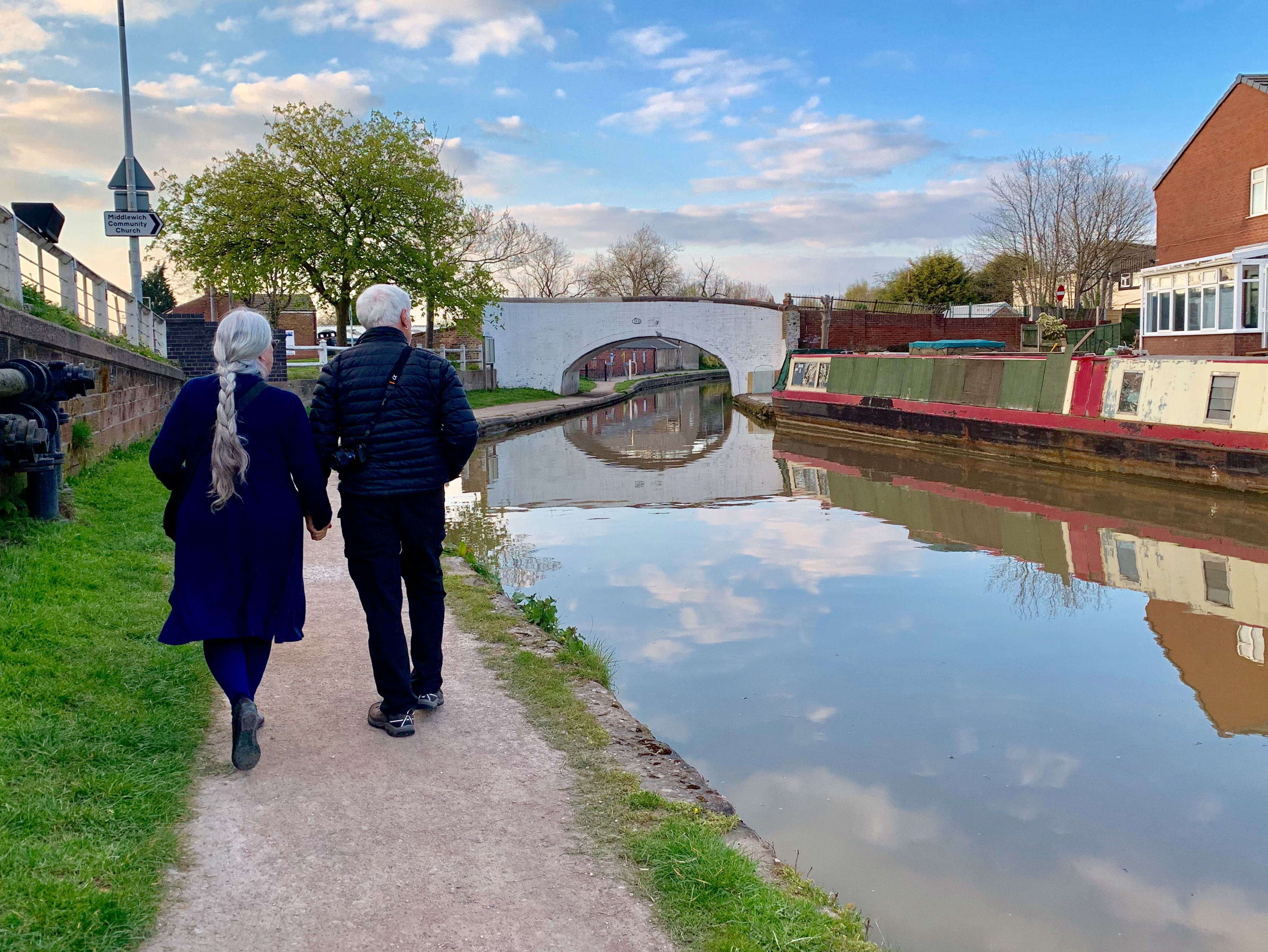
Our thanks to the staff of Andersen Boats and the many volunteers of the Canal and River Trust who as a labor of love maintain the remarkable canal system of the United Kingdom.

Our special thanks to Kris Ashton, Tom Shillington, Nanci Burns, and Huw and Nina Thomas who were each a treasured part of this adventure.

Thank you to those who follow us. You continue to give me a venue for expression that I would not otherwise have.

Lastly, we thank the ancient hands that created the towns, churches, castles, and monuments that are found throughout the United Kingdom and the Channel Islands. What they raised for either war or the glory of God has become a treasured heritage.