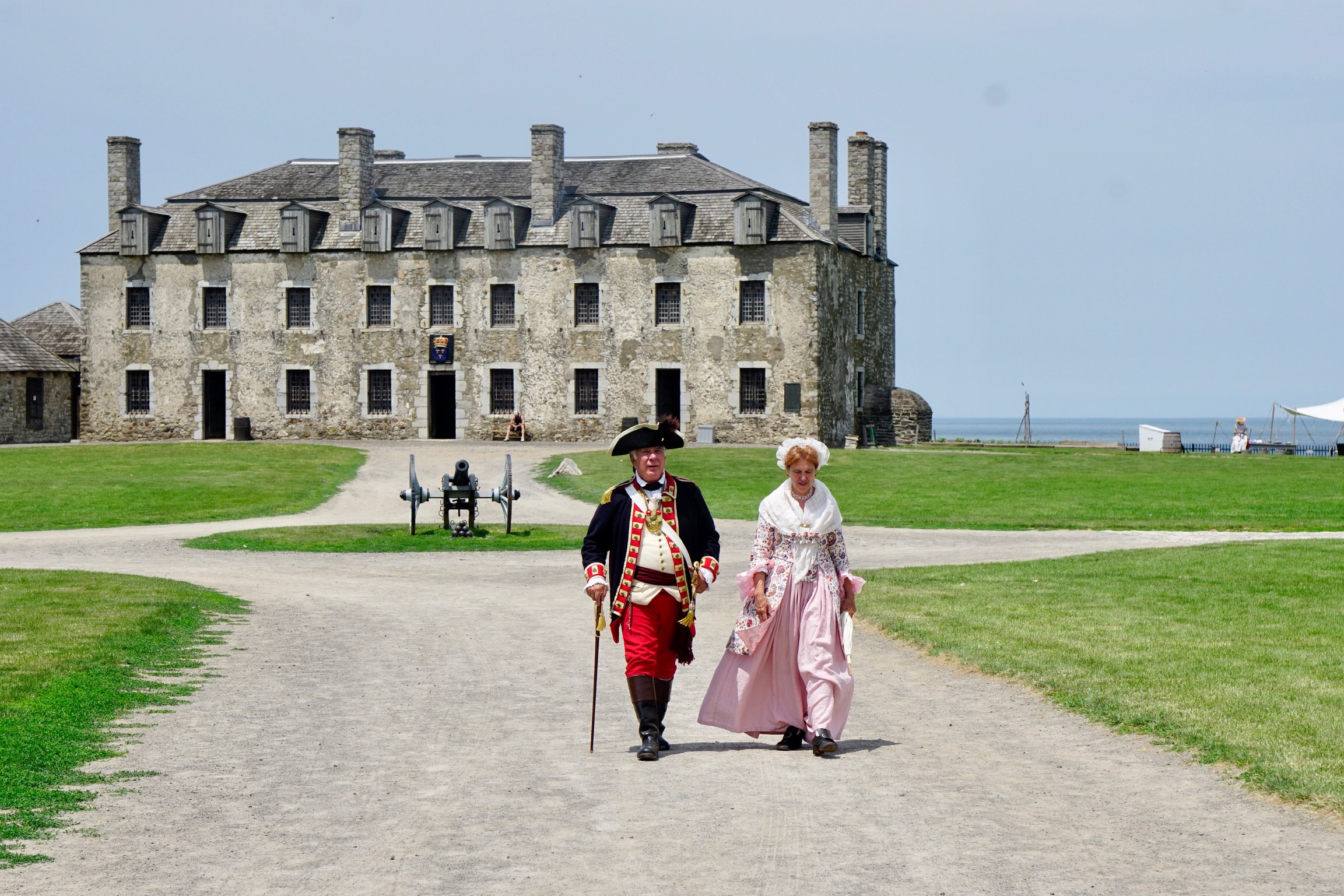
June 14-15, 2022. The highlight of these two days has been a visit to one of the oldest military installations in North America. Fort Niagara has served troops under 3 flags and its origins date to 1678.

The three flags, British, American, and French naval, are in the configurations as flown in their era. The French naval ensign, a white flag, does not symbolize surrender. Rather, the tradition of a white flag being one of surrender was not adopted until over 100 years later.

It even housed German prisoners of war during the Second World War. But before I launch into more detail about this fascinating historical treasure a bit about where we are staying.

We arrived for two nights in New York’s Golden Hill State Park the afternoon of June 14th. The park is small by most New York State Park standards.

Our campsite has water and electrical hook ups so we could use our air conditioner, however, the cool Lake Ontario breeze made that totally unnecessary. The park features the 70 foot tall, “30 Mile Point Lighthouse” that dates to 1875.

It was built at a cost of $90,000 and once housed a 3rd order Fresnel lens that magnified a single kerosene flame to an equivalent of 600,000 candle power. The beacon was visible for over 18 miles.

The above image is of the St. Simons, Georgia, Lighthouse 3rd order lens.

Sadly, the lens assembly which stood over 6 feet tall, and its clockwork mechanism that rotated the beacon were removed by the US Coast Guard in the late 1950’s and have subsequently been lost. The lighthouse is open for tours and presents an accurately restored interior.

A second lighthouse keeper’s quarters, also attached to the main structure, sleeps up to six adults and is equipped with modern facilities. It can be rented at a cost of $200 per night.

Now back to Fort Niagara.

France was the first European colonial power to systematically explore the interior of northern North America. It found numerous opportunities for wealth, one being in the lucrative fur trade. The only practical way to reach the continent’s interior was by water. France soon learned of the extraordinary resources of the Great Lakes, and that these tremendous bodies of water emptied into the Atlantic Ocean, first passing into Lake Ontario through the narrow straights of Niagara, also called inaccurately the Niagara River. At the site of Fort Niagara this “river” is less than a mile across, and provided an ideal location for securing military control over the commerce of the Great Lakes.

The greatest military power in the region at that time, and perhaps in North America, was held by the 5 nation Iroquois Confederation. France asked permission of the Confederation to build a “Peace House”, representing that it would be a large house in which to hold meetings and house tribal and European dignitaries. However, the “Peace House”, although resembling a large chateau, was specifically designed as a fortification.

The walls were stone constructed and 4 feet thick. The first floor had iron barred windows, and the open area third floor featured dormers with openings extending outward, thus permitting defenders to fire directly down upon any attacking force. There were accommodations for enlisted men and officers. Finally, the “house” water well was located inside, along with a secure powder magazine.

As this was a French built fortification, it even had a Catholic chapel.

By the time that the Native Americans realized the subterfuge it was too late for them to stop the continuing expansion of the fortifications.

Great Britain, however, chafed at the French effort to monopolize North America. In a number of the Native American Nations England found ready allies. War became a foregone conclusion between these historic European rivals. Arguably, the French and Indian War (1754-1763) was a true World War as it engaged multiple nations on two continents and at sea.

Fort Niagara was such a prize that the British focused their efforts upon its capture. For 19 days France successfully withstood a British siege. However, the British learned of the location of a 1,000 soldier French relief detachment and were able to lay an ambush, killing over half of that number and dispatching the remainder into retreat. The fort then fell to England.

England continued the expansion of the fortifications, adding a huge powder magazine with 12 feet thick walls and ceiling, and two “redoubts”, which are forts within forts.

The complex included vast earthworks and masonry walls.

Fort Niagara again played a role during the American Revolutionary War. It was held by Colonists who remained loyal to Great Britain. Britain ceded the fort to the victorious Colonies in 1783, yet the “loyalists” retained possession for another 13 years.

During the War of 1812 the Fort’s guns sank the British ship Seneca. A year later the British recaptured the fort thanks to Fort George, located across the river, having a 9 foot height advantage that made the difference in the artillery duel. Again Britain ceded the fort back to America at the end of that conflict.

A huge American flag had flown over fort Niagara at the time of its capture. This flag was commissioned by the same senior officer who ordered the flag that flew over Fort McHenry, the inspiration for Francis Scott Key’s poem which in the 1930’s became our National Anthem, The Star-Spangled Banner. The flags were of similar size, measuring over 30 feet long, and made by the same women. Fort Niagara’s flag, however, did fall into British hands.

The Fort has since served as a defensive and training post in the American Civil War, Spanish American War, World War I, and as I have said as a prisoner of war camp in World War II. It continued to be an active Army facility up until 1963. Although it is now a historical site, just outside of its walls is a US Coast Guard Station.

The following are additional images, some with brief explanations.

Along the shore of Lake Ontario one can see the skyline of Toronto on a clear day. We were also treated to a spectacular sunset. From our camp the sun sets upon our “Northern Neighbor”.

Peace Everyone. Pete

PS. Lewis Leffman (1798-1885) A True Soldier’s Soldier.

German born, Leffman enlisted as a young man in the German Hanoverian Army, and then the British Army, serving as a private in 1817 at the Battle of Waterloo. By 1824 he had come to the United States, enlisting it the US Army.

Leffman served until he retired in 1879 at the age of 81. He achieved the rank of Ordinance Sergeant, then the Army’s highest non-commissioned rank.

He served at Fort Niagara from 1845 until his retirement, and for 10 of those years he was the only soldier manning and maintaining the fort! Through a special act of Congress, Leffman was the first enlisted man to be awarded a pension by the United States Armed Forces. He is buried at Fort Niagara along with his wife and members of his family.

He is one of the “known” soldiers interred among the “Unknowns” who fell in the French and Indian War, the Revolutionary War, and the War of 1812.

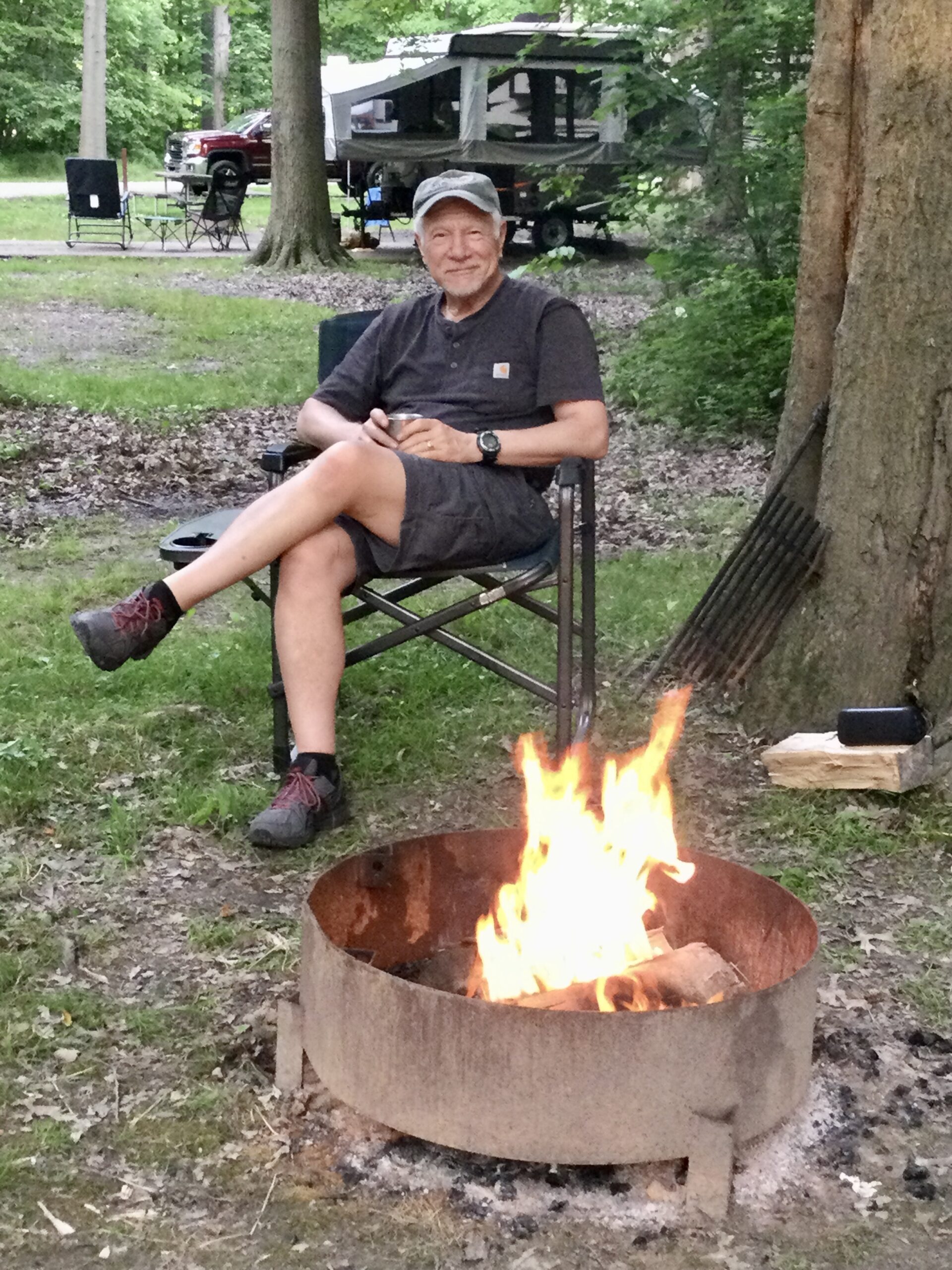
We arrived on the south shore of Lake Erie at Ohio’s Geneva State Park on June 12th. Registered for two nights we are finally transitioning into “real“ camping. However, not completely.

A two mile walk from the park leads to the town of Geneva on the Lake, a resort community that dates back to the mid-19th century.

The charm of that era has been replaced by a strip of arcades, ice cream shops, bars, and all things that attract families with children, motorcyclists, classic car aficionados, and old campers like us.

We have enjoyed our campsite and campfire but we have not yet broken out the camp stove. We were intrigued to read of a restaurant in Geneva On the Lake, the GOTL Brewery, which serves its entrées atop an 850° lava rock.

You are responsible for the temperature of your protein which you then cook at the table. Christine’s steak and my Ahi tuna were exceptional, as was the beer. About 10 minutes into dinner Christine exclaimed, “We’ve been here before!“ A short discussion comparing the eerie familiarity we both sensed, confirmed her observation. Apparently, there is a downside to the amount of camping we have done over the last seven years… we are beginning to forget where we have been!

For us the principal entertainment boiled down to walking the strip, taking in the sights, and finally enjoying sunset at the beach.

We have also enjoyed a nice 6 mile hike that revealed a “fairy village“ laid out neatly at the foot of a large tree in the woods.

Next we head up the shore of Lake Erie, through Buffalo, and onto the south shore of Lake Ontario in the state of New York.

Peace everyone! Pete

PS. As I was seated at a picnic table near the park office, taking advantage of their WiFi to type these notes, a bicyclist rode up and addressed me. His was a heavily laden touring bike, and his first words betrayed a foreign accent. “Sig” was from Sweden. He was spending his 5 week holiday bicycling the south coast of Lake Erie, bound for Niagara Falls. He sought some guidance on securing a campsite.

As the result of our discussion, “Sig” obtained a site for the night and later joined us at our campfire. A few beers and hours of pleasant conversation are proof that it takes only kindness to shrink the world one smile at a time.

We are on the road again bound for northeast Canada’s Labrador and Newfoundland. Our first day was not without issues. A few days ago I had replaced the trailer tires, but as we approached St. Louis I discovered an unusual bulge in the sidewall of one of the new tires. A 20 mile detour delivered us to a Discount Tire Store.

They had the tire in stock and within 45 minutes had us back on the road after swapping the defective tire at no cost to us. Near Terre Haute Indiana we encountered a torrential downpour that made for some real “white knuckle” driving. At 500 miles from Kansas City we stopped at a Texas Roadhouse restaurant which provided a meal, a beer, and a parking lot where we “camped” for the night.

Since we are now just making miles this is a good opportunity for me to step back into April and share five wonderful days that we spent visiting New York City.

These last three years have left us feeling travel starved. Christine had accumulated some free companion airline tickets and spring in New York City beckoned to us.

We booked a hotel in New York City’s Times Square, and purchased tickets for the Broadway production of “Macbeth“, featuring Daniel Craig of 007 fame.

Times Square may at first overwhelm with its crush of humanity, endless traffic, cacophony of sounds, and kaleidoscope of light.

A beer, and perhaps a hot dog, can do much to normalize the experience.

Once acclimated a visitor can begin to more fully appreciate the human diversity.

I suppose to these folks, we represent “odd”. It’s a symbiotic relationship in which they provide color and entertainment for the visitors, and the visitors provide income in the form of tips given for a photo opportunity.

There’s a lot to see in New York City’s Manhattan Island. A “hop on – hop off” bus tour is a convenient way to take in much in just a few days.

It’s not perfect. Pop-up spring showers are known to occur with frequency.

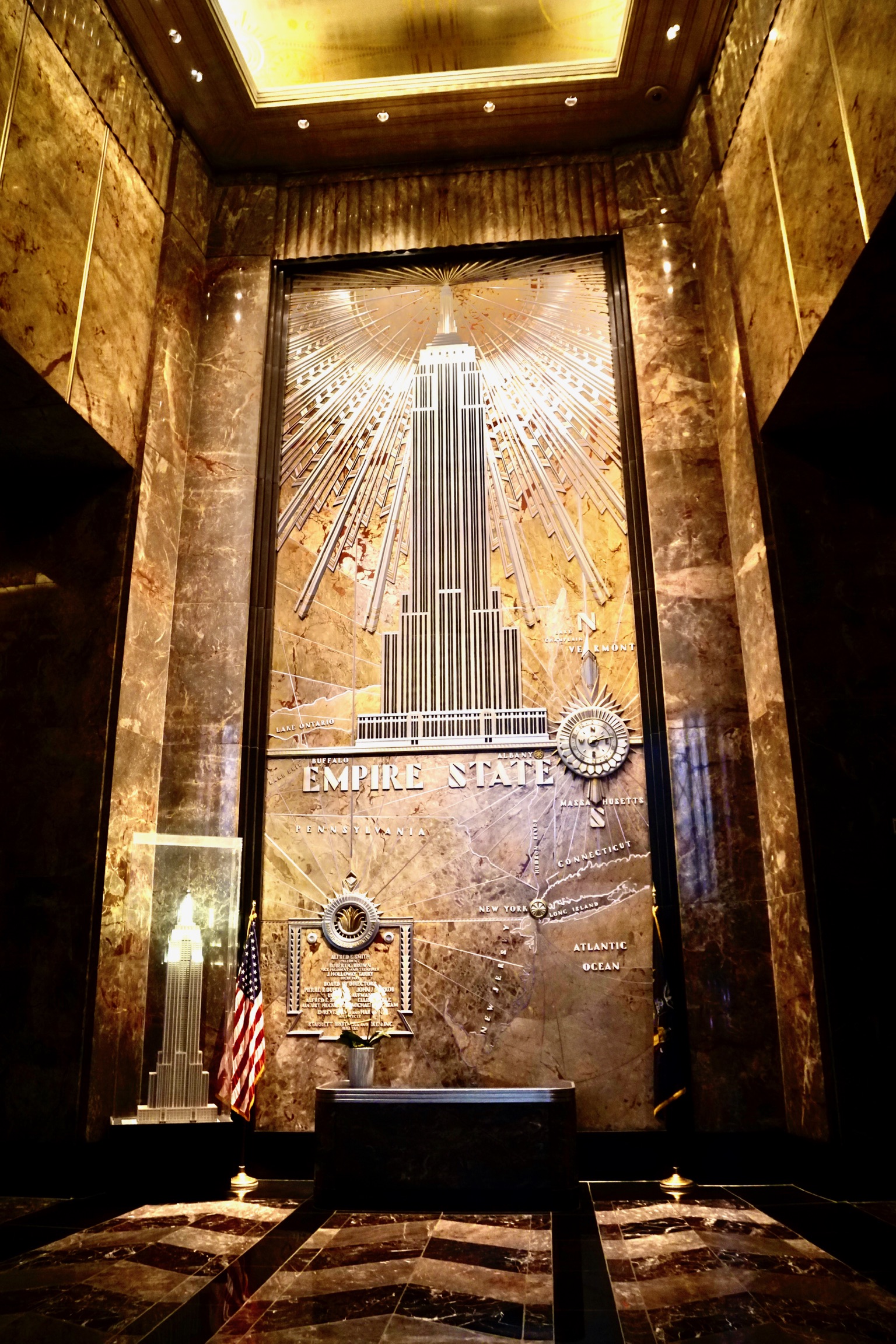
What is a visit to New York city without a panoramic view taken from the top of the Empire State building?

This remarkable 1,454 foot skyscraper is a monument to the ingenuity of early 20th century America. It long stood as the tallest building in the world, but has since been eclipsed by 53 other buildings, 6 being in New York City. What may never be equaled is the rapidity with which it was built. Ground-breaking to opening took only 13 1/2 months!

New York City’s skyline is breathtaking as viewed from atop this wonder.

We have reserved a visit to One World Trade Center, The Metropolitan Museum of Art, and a few other sites for another time, perhaps next year.

Highlights of this visit included:

St. Patrick’s Cathedral.

Saint Sharbel is a patron Saint of Lebanon, homeland of my maternal grandparents. I lit a candle to their memory.

The New York Public Library.

Bryant Park.

Grand Central Station.

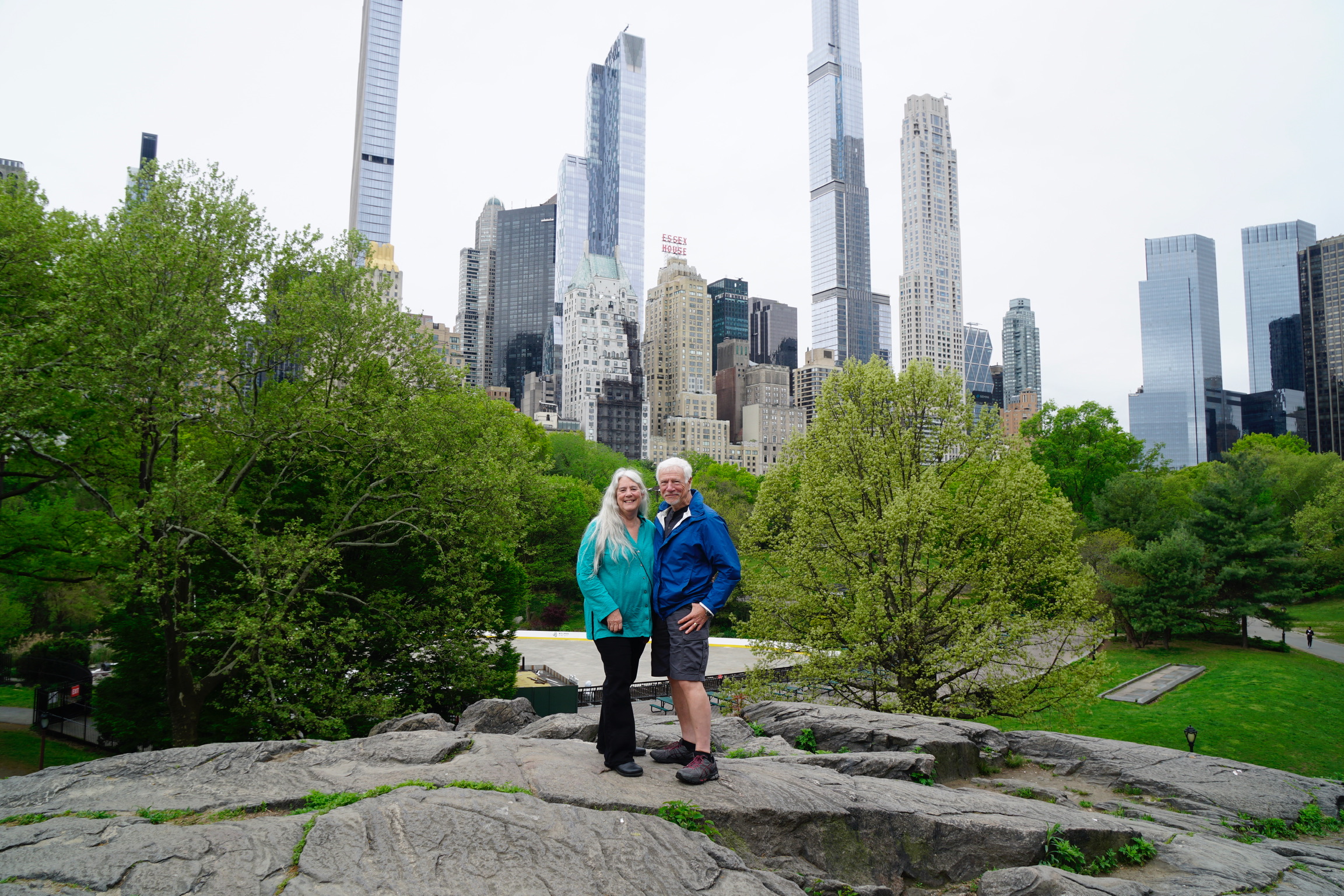
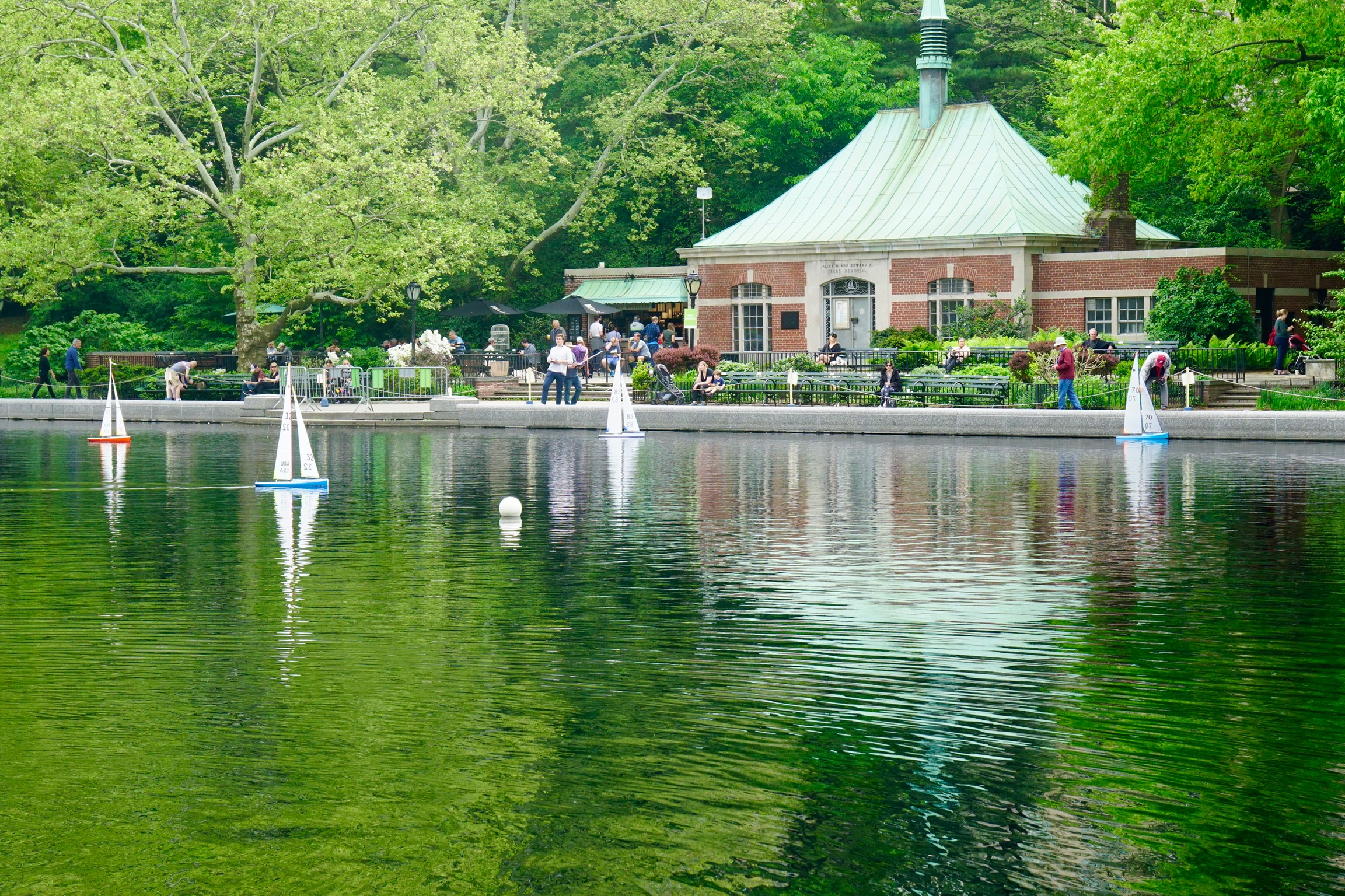
We found Central Park so compelling that we visited it in on two separate days. The first visit was courtesy of a pedal cab tour. Our guide, Chouib, was knowledgeable and very entertaining.

At the urging of Colorado friends we contacted him and made an appointment. The tour of nearly 2 hours exceeded all expectations. If you wish his contact information please reach out to me privately.

There are literally thousands of benches in Central Park. Each bench can be rented for $500 a year during which your personally selected message is affixed to the bench. This one caught my eye.

Is this building familiar? Who you gonna call?… Ghostbusters!

Our second visit included a delightful lunch at Tavern on the Green.

There were two other exceptional meal experiences. The first of these occurred when Kansas City neighbors sent a message asking, “Are you in New York City?… So are we!“. This resulted in dinner together at Carmines Italian restaurant. It is indeed a small world.

The second dining experience came on the heels of an expensive disappointment. Dinner at Gallagher’s steakhouse was an elegant 2+ hour affair.

The disappointment: At a cost of nearly $600 we had purchased tickets to see Daniel Craig in the Broadway production of “Macbeth“.

There was virtually no scenery, “costumes” we’re mostly 20th Century street clothes, and actors frequently stepped out of their roles to execute “special effects“, such as holding flashlights on the faces of the other actors, and walking around the stage with a handheld smoke machine. Macbeth‘s “royal robe” was a common bathrobe, and his “armor” was a bulletproof vest. Of course, performance pictures were not allowed. However, this shot of the stage is what constituted “scenery”.

The critics (rightfully so) gave terrible reviews.

We had no intention of returning to Kansas City with any souvenirs. However, an artist fair in Bryant Park resulted in the acquisition of two tapestries which now adorn the great room of our home.

Unfortunately, we unknowingly returned home with another souvenir…

Peace Everyone! Pete

PS. Spending this excellent time with my wife has caused me to ponder what is the difference between thankful and grateful. I invite your thoughts.

Over the next two months we will wind our way north and east through New England, onto Nova Scotia, Labrador and Newfoundland, New Brunswick, Québec, and Ontario. There will even be a day-trip to France. I hope to share images and narrative as Internet connections allow.