Have you ever walked into a room that was exclusively designed to take a life? A room where fewer living beings exited than had entered? Until August 8, 2010 I had not.
The Louisiana State Penitentiary at Angola is the largest maximum security penal complex in the United States.


It covers over 28 square miles and currently houses over 6,500 inmates and 1,800 staff. It is naturally secure in that it is surrounded on three sides by the Mississippi River and the inhospitable insect, snake, and alligator infested swamps that precede the river’s edge and surround the prison. As we were to learn, over 95% of the inmates inhabiting Angola will not live to see freedom.
Angola was founded in 1830 as one of 6 plantations owned by Isaac Franklin. Franklin’s wealth came from his establishment in 1828 of the firm Franklin & Armfield, the largest slave trading company in America. Angola remained a plantation until 1880 when it was sold to former Confederate States of America officer, Samuel L. James who had been leasing prison labor in Louisiana since 1869. James was unable to run the plantation profitably with paid labor, but he could do so by utilizing leased prison laborers (mostly Black) from the State of Louisiana.
Post-Civil War Louisiana and other Southern states found that they could recreate a slave labor force by implementing a convict leasing program which was primarily targeted at the Black male population. Arrested for minor infractions, a defendant who could not pay the fine was pressed into convict servitude. Plantations and businesses leased the inmates for a fee and became responsible for the convict’s housing and necessities. At one point in the late 1800’s, over 70% of the State of Alabama’s annual operating revenues were derived from this system. Convict leasing was abolished in 1941 by President Franklin D. Roosevelt.
Samuel L. James’ extensive use of leased convicts in the late 1800’s effectively created the Angola Penitentiary. This was formalized in 1901 when the plantation was officially acquired by the Louisiana Department of Corrections.
We 16 members of “Cycling for Change” arrived in St. Francisville, Louisiana on August 8, 2010. Catholic Charities of Baton Rouge, including David Aguilard and Ms. Tonna Fournet (who graciously hosted us for lunch) were instrumental in obtaining access to Angola for a lengthy and unique tour that included the “Red Hat cellblock” and the State’s current lethal injection chamber. Our tour guide was the prison’s youthful Chaplain, Brad Delaughter.


Brad provided insights into the history of Angola from its early days as an abusive and corrupt system through the reform efforts of then Warden Burl Cain. Cain served as Warden from 1995 to 2016.
Our tour included the Reception Center…

The inmate cemetery…

The inmate rodeo facility where an annual event is held by the inmates that is attended by up to 10,000 paying members of the public…

… And a “road trip” that provided us with views of the various maximum security compounds that are located throughout the 18,000 acre grounds.

Photographs of the interiors of facilities then in use were not allowed. Fortunately, I was able to photograph the infamous “Red Hat” cell block which has been on the National Register of Historic Places since 2003. I have also supplemented this post with images from the internet which are in the public domain.
The “Red Hat” cell block stands alone among open fields as a somewhat non-descript one story concrete building.


It was created after the bloody 1933 escape engineered by Charlie Frazier of George “Pretty Boy” Floyd’s gang. After Frazier’s recapture he was placed in the end cell of Red Hat and his cell door was welded shut. He remained entombed in that cell until near the time of his death 7 years later. Red Hat was finally taken out of service in 1972.


Red Hat derives its name from the red cone shaped hats that its residents were required to wear as they worked the surrounding fields. Guards were under orders to “shoot to kill” any Red Hat inmate who removed their hat outside of their cell.
The building consisted of 30 cells that measured approximately 5×7 feet. Red Hat had no heating system. The cells lacked plumbing. Inmates were each provided with a steel bucket for use as a toilet. The buckets were emptied once a day. Ventilation to each cell was a small 1×2 foot steel grate located near the top of the high cell wall. A solid steel shutter was controlled by the guards who could foreclose even that minimal inmate access to fresh air. There was no view to the world outside the cells. The building was stifling in the oppressive Louisiana summers and frigid in the winter.


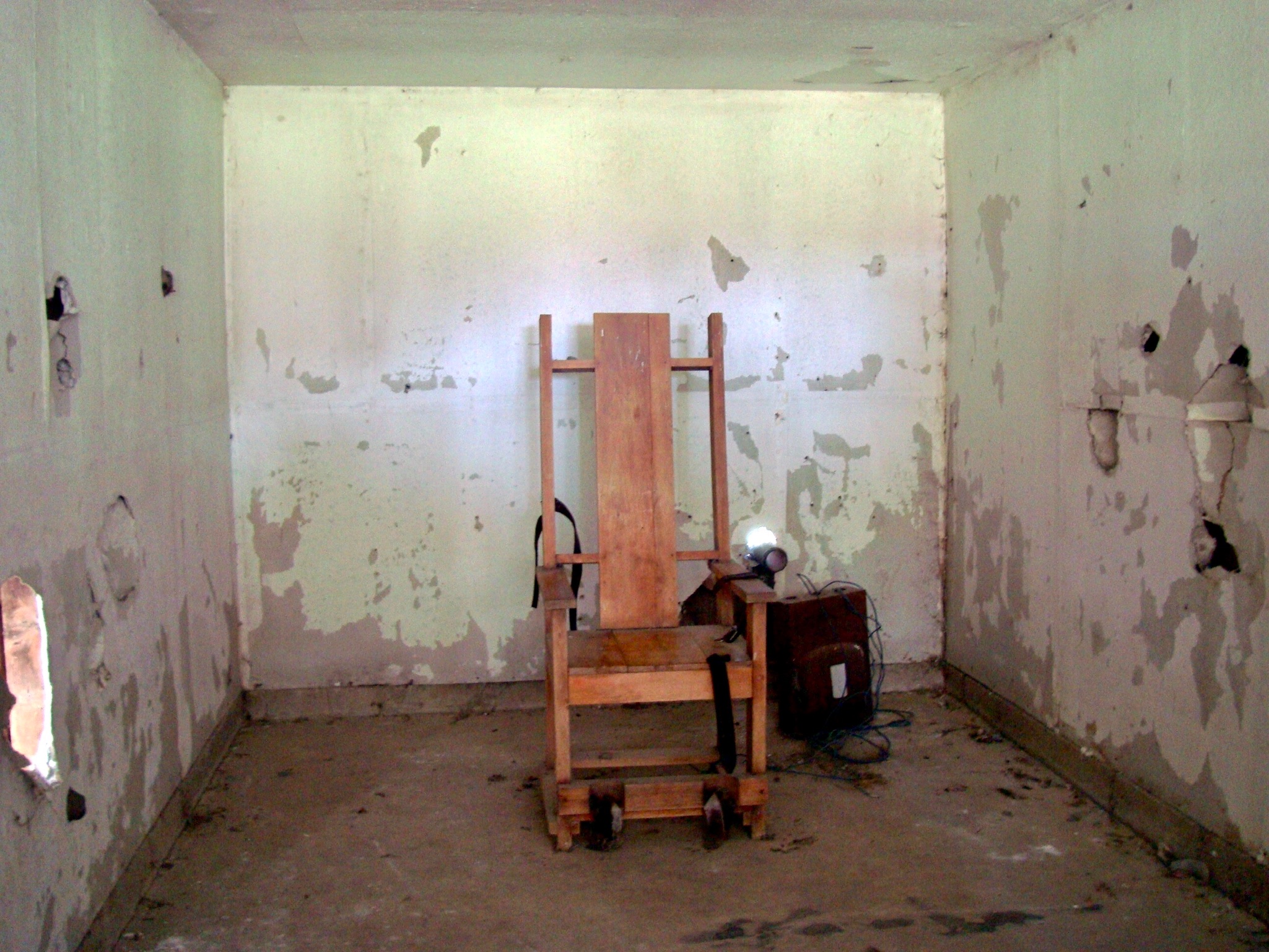
Adjoining Red Hat was the former death chamber, home to the electric chair known as “Gruesome Gertie”. The chair currently in place is a replica, the original is on display in the prison museum.
As seen today…

… and when it was operational:

Outside of Red Hat is the generator that gave life to “Gruesome Gertie” thus enabling her to take the lives of 87 condemned, including Elmo Patrick Sonnier who was chronicled in the 1995 movie, “Dead Man Walking”, and Willie Francis who is the only man to ever survive his “execution” in an electric chair. Willie, convicted at 16, was 17 at the time of the failed 1947 execution. He was successfully put to death in that chair one year later.

Angola is a working farm. Inmates provide the labor. It is known for the quality of the beef that is raised but not available for inmate consumption. It is also known for the husbandry and training of horses used by law enforcement throughout the United States.
The somber “highlight” of the tour of Angola was our admission into the Louisiana lethal injection chamber. It is currently in use and has seen the demise of 8 convicts. 69 inmates currently await execution in Angola on Louisiana’s death row. In the post-1976 “modern era” of capital punishment Louisiana has executed 28 people. Below is my 2010 reflection on our experience in the present execution chamber.
Our visit concluded with Mass and dinner, both attended by selected inmates.
Next: On to New Orleans.
Peace Everyone. Pete
“Seven Seatbelts for Angola” (August 10, 2010)
At 3 p.m. on August 9, 2010, the Cycling for Change contingent arrived for our tour of the Louisiana State Penitentiary at Angola. Our group was augmented by representatives of Catholic Charities of Baton Rouge, the bus driver (Mr. Washington), and Brad the prison chaplain.
It is 100 degrees outside. Factor in the humidity and that number exceeds 110. The sun is relentless, coating its unshaded victims like molten glass. Our bus briefly stops under a corrugated canopy, and after a guard takes a headcount and examines our picture ID’s the gate opens and our bus proceeds onto the prison grounds.

Angola is unlike any other prison. It was created from former antebellum plantations and encompasses an area that is roughly the size of New York’s Manhattan Island. The Mississippi River, which is nearing the end of its 2,500 mile journey forms an imposing natural barrier on three sides of Angola. The fourth side lacks a perimeter fence, but the dense mosquito infested swamp is considered an adequate deterrent to escape attempts. Brad comments that the last fellow to try his hand at “the swamp” emerged to surrender himself after 5 days, nearly eaten alive by the insects.
There are no imposing walls, and no medieval looking stone structures. Located here and there in Angola are razor wire enclosed “camps”. These are self-contained penal complexes of varying size, each one holding a portion of the total inmate population. Brad tells us that the camps are designated by letter: Camp “A”, Camp “B”, and so forth. We learn that Camp “J” is the discipline Camp, a jail within the Prison housing around 600 offenders who present special problems and risks.

If Louisiana’s prison needs grow, it is a simple matter to build additional camps in Angola. The spacious grounds look vacant, each camp appearing as a distant community separated by flat expanses of farmland. Angola is one of only three agricultural prisons in the United States. There are miles of row crops, vegetable farms, 3,500 head of cattle, and one of the largest horse husbandry stables in the Country. Inmates are the sole source of labor on these grounds. With the exception of the medically, mentally, or behaviorally unfit, every inmate has a job. The grounds are impeccable. There are decorative flower gardens, neatly trimmed right-of-ways, and pristine white cattle fencing. This could easily be Churchill Downs if there were only more trees and a racetrack.
Brad conducts our driving tour of Angola, directing Mr. Washington on where to turn and when to stop. Brad is a curiosity in his own right. He is a man/boy of 27, married and father of two small children, his baby face and soft eyes seem ill-suited for a chaplain who ministers to the spiritual needs of one of the “hardest” of congregations. Brad is a very big man who turned down a major college football scholarship in favor of the seminary and God’s calling. He Brad talks about Angola and its residents with love and respect.
Brad speaks of the reforms that have occurred at Angola over the last 30 years. Gone are the days of the “hot boxes”. Inmates are provided with a well-conceived system of freedoms, privileges, and incentives. He reports that prison gang activity has been largely eliminated and serious inmate on inmate violence has been reduced from over 500 incidents per year to less than 100 annually. Offenders have opportunities to advance their education with GED classes and college courses taught by volunteers from local colleges and Loyola University. Inmates eagerly seek to take advantage of those programs, even if they will never have the opportunity to use the knowledge in the free world.
As we proceed down one of the flat ruler straight roads Brad instructs Mr. Washington to stop at the small one-story concrete structure ahead on the left. This is the “Red Hat Cellblock”.

Angola’s Warden, Burl Cain, is credited with many of the reforms and improvements at Angola. Red Hat was closed by a prior Warden in the 1970’s. Rather than level this structure, Cain had it placed on the National Register of Historic Places as a monument to a penal system of abuse.


The grounds surrounding Red Hat are desolate and forsaken. At the rear of the Red Hat cellblock is a large rusted electric generator. Wires still run from the generator into a side room of Red Hat, the sole purpose of those wires being the delivery of a massive surge of electrical energy into the hand and feet restraints of a stout wooden chair. Within that room is also the original, but now rusted, three blade switch that delivered the lethal current of electricity to end the life of the chair’s occupant. Except for the wires and wooden chair the place is more like a room in a long-abandoned farmhouse; holes in the walls and ceiling, cobwebs, and mud wasps flying about. Returning to the bus we leave Red Hat, but the images of Red Hat will never leave us.

We arrive at the last stop of our tour. The bus pulls into a parking lot. In contrast with our experience at Red Hat, there is a well-maintained parking lot. The grass is trimmed with the precision of a golf course putting green. Flowering shrubs abound in front of and on the sides of the newer single story white building. There is no fence, but the pastel colored doors have curiously large locks, the kind that take keys which are the size of those made for a toddler’s play. We are greeted by uniformed prison staff, and Brad is addressed by name. We proceed into a group room that has 5 or 6 large round tables. The brightly painted cement block walls are decorated by two large murals. They are well executed paintings of Biblical scenes from the Old Testament; Daniel in the den of lions, and Elijah riding a chariot to Heaven.
Brad gives us brief instructions before leading us down a corridor and through another steel door. We enter. On my right is an opened door through which I see two small adjoining rooms which are separated from each other by a sliding wood paneled door. Each of these two rooms has two rows of short but comfortable leather chairs, the kind that might be found around an office conference table. One of these two rooms is slightly smaller and contains fewer chairs than the other. The chairs in both rooms are arranged to face large picture windows that look into our destination room, the lethal injection chamber.
We enter the death chamber in silence. The air is emotionally pulled from our lungs. In the center of the ceramic tiled floor is a single cruciform table secured upon a white enamel steel pedestal. Thin black vinyl pads cover the top and the arms of the table. Without instruction we arrange ourselves around the perimeter of the room which measures approximately 14 feet on each side. Near the head of the execution bed is a small window of one-way glass which conceals its interior and the identity of the executioner. The only connection between that room and the chamber in which we stand is a circular 4-inch port. On the wall near the left arm of the bed are two red telephones. We are told that one is connected to the State Superintendent of Corrections and the other to the Office of the Governor of Louisiana. At the right arm of the bed are the two viewing windows. These windows are crystal clear and provide the witnesses an unimpeded view of the execution proceedings. High above the bed the room’s lighting is furnished by 4 fluorescent fixtures. The light is harsh even though the fixtures’ lenses have browned with age. For some occupants of the bed the light might have been easier to gaze upon than into the eyes of the observers in the adjoining rooms. A large round clock is located ominously above the two red telephones.
“Let those who enter here abandon all hope.”
This is a foreign place. It is a place where few have been. It is a room where fewer have left alive than have entered. We are given 5 senses to know our surroundings, but here our nature resists the use of our senses. The only sounds in this place are those that we make by our presence. There are no smells. There is nothing within for the preservation of life; nothing to taste, nothing to drink. None of us touch the bed even though there is nothing to prevent it. What we know is delivered in stark clarity by our eyes. What our eyes disclose is strange, unfamiliar, not a part of our prior experiences… except that lying upon the cruciform bed I see seven common but out of place objects, and I understand the irony:
About 20 years ago, somewhere in this country there was a factory. Within that factory a worker stood at his or her duty station. It might have been a day like any other for that person. Perhaps the worker took pride in the knowledge that the simple task being performed would result in the saving of lives, the avoidance of serious injury, the enhancement of safety and security for thousands of people. On that day the worker carefully selected and packaged 7 seatbelts, addressing the shipping label: “Louisiana State Penitentiary, Angola”.
Peter Schloss