Omitting the British canals of the Roman era and those of the Middle Ages associated with the construction and support of castles and monasteries, the dawn of the “modern” UK canal system dates to the mid 1700’s. It coincided with the Industrial Revolution, but whether the Industrial Revolution gave birth to the canals or the canals were the progenitor of the IR is in the realm of what came first, chickens or eggs.

By the end of the 18th Century construction of a remarkable system of connected waterways was well underway. It was the 18th and 19th Century equivalent of the United States Interstate Highway system. At its zenith the canal network of the United Kingdom extended to over 2,000 miles of inland waterways providing the efficient transport of coal, raw materials, and manufactured goods throughout the realm. It was a technological tour-de-force in its day and remains a marvel in the 21st Century with parts of the system declared as UNESCO World Heritage Sites.

Steam rail service in the late 19th and early 20th Century became the chief rival of the canal system. Train operators undertook to purchase segments of the canals and then raised canal fees to a level that made them uncompetitive. The death knell for the canals was struck in the Great Winter Freeze of 1962-63 when the entire system closed due to ice. Rail service had won its century long battle for supremacy.

Visionaries and conservationists believed that the Canals might again find relevance… not as networks of commerce but purposed as a recreational windfall. In the 1960’s the Inland Waterways Association was founded to restore the canals. This effort was later passed to the management of British Waterways. Finally, an act of Parliament placed the ownership and management of the canal system into the hands of the newly formed Canal and River Trust, a not-for-profit that has been responsible for the restoration and maintenance of the system since 2012.

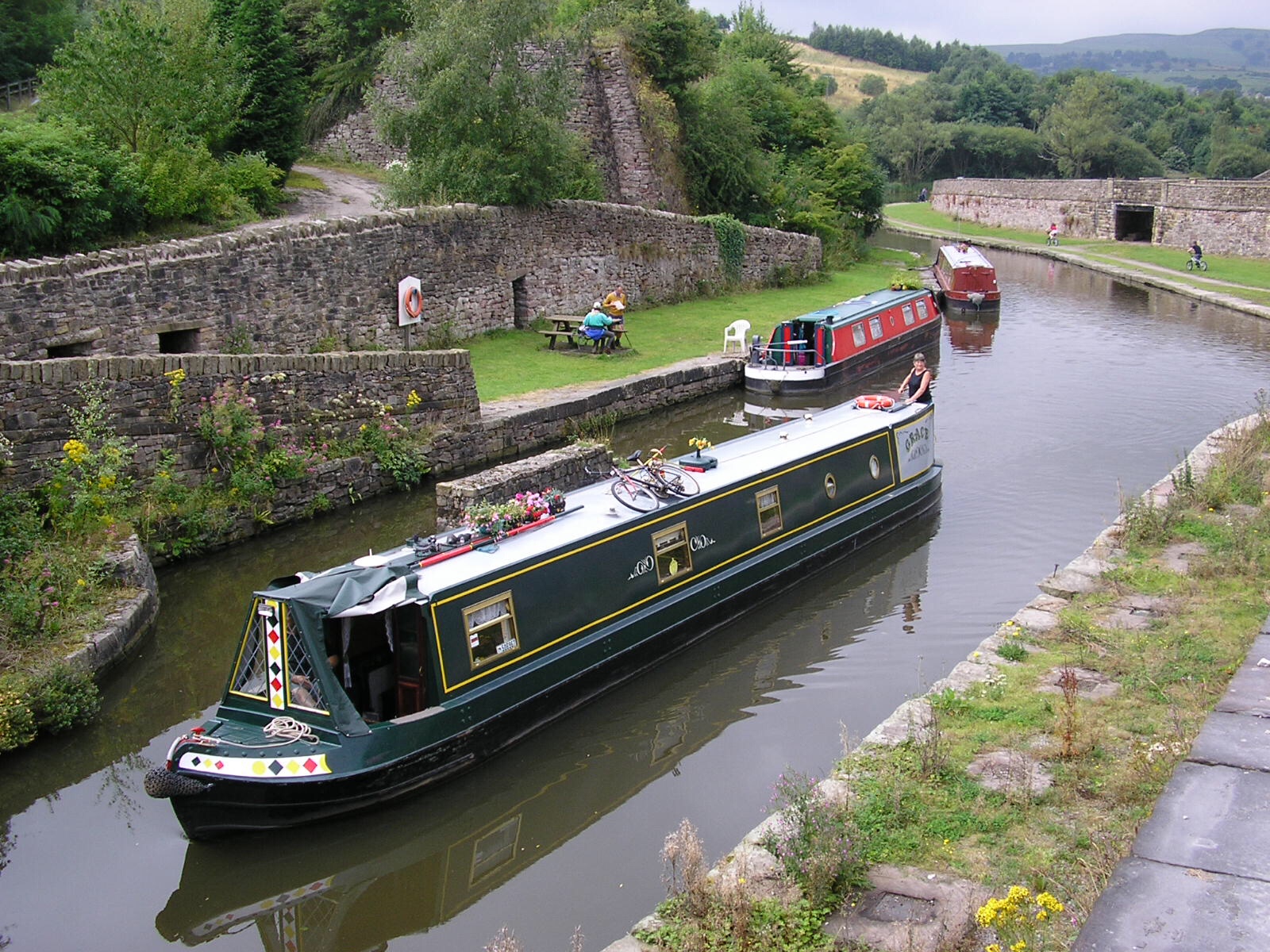
On April 12th Christine and I will take the tiller of a 61 foot long, 8 foot wide “Narrowboat”, the Salten-Fjord. She will be our personal magic carpet upon the waterways of England for three weeks. During the first portion of the journey we will be joined by friend Kris Ashton of Denver. The final days will be with our Canadian friends Tom Shillington and his wife Nanci Burns.

Narrowboats are… NARROW! Here is a diagram of the Salten Fjord’s interior:

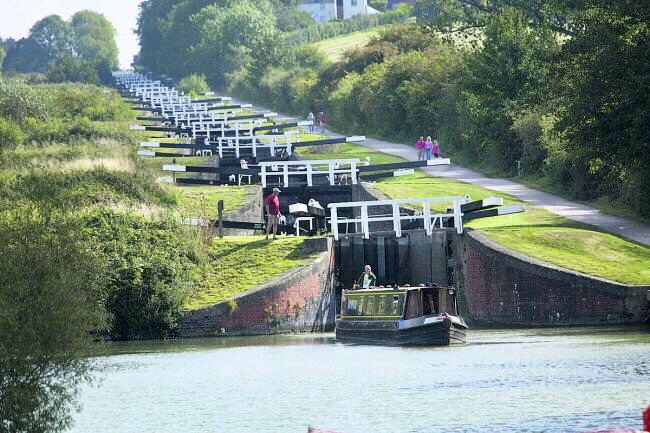
I have borrowed liberally from internet images to present an overview of the canal experience that we hope to embrace.

The interiors of the vessels provide accommodations for sleeping, cooking, bathing, and relaxation. These boats are powered by small inboard diesel engines that are designed to propel the narrowboat at the canal speed limit of 4 mph. Interiors are comfortable if not spacious.

The canals wander across country, connecting villages and cities alike. England is not flat. In order to accommodate the undulating landscape engineers of the 18th and 19th Centuries had to devise systems of locks to climb hills and descend valleys, hundreds of locks. Most are human powered by the narrowboat operators (us!). In some locations there are “flights” of locks, as many as 21 in a 3 mile stretch! There will be no lack of exercise for any of us.

Where the hills were too daunting tunnels were dug, the longest of these being over 3 miles long, pitch dark, and taking over 3 hours to transit from end to end.

In the pre-diesel days of the 1800’s men would hire themselves out as “canal walkers” to propel the vessels through these tunnels using their feet against the tunnel walls and ceiling!

The Anderton Boat Lift, constructed in 1875, still lifts narrowboats 50 feet from one waterway to another. Its 21st Century equivalent, the Falkirk Wheel, looks like a huge Ferris Wheel and lifts boats nearly 80 feet to the connected canal.

Finally, there are the cast iron aqueducts that carry narrowboats in 200 year old cast iron troughs 175 feet above the valley floor below.

Travel upon the canals of the United Kingdom is essentially safe, but not entirely free of peril.

We are counting down the days to departure in earnest. We hope you will travel along with us through my “Thoughts”.

Peace Everyone. Pete

(Note: Most of the preceding post was first published by me in August, 2018.)
How I came to read the July 1974 issue of National Geographic is lost to me. Perhaps it was in a barbershop chair. Perhaps it was in a dentist’s waiting room. How is not so important as the context of the time. July 7th I had arrived in Kansas City a recent graduate of Southern Illinois University. I was scrambling to rent an apartment and making preparations to report for work on the 15th as a newly hired Missouri State Parole Officer. A few weeks later I would meet a young lady named Christine. 3 years later we would be married. Our relationship has since flourished for more than 45 years, as has the dream sparked by an article in that issue of National Geographic; “Exploring England’s Canals”.

Nat Geo Canal Issue

The story described a vast network of canals in England dating back hundreds of years. These canals had fallen into ruin but were slowly being restored and repurposed for recreational exploration. The self-powered barges, known as “Narrow Boats”, were similarly being restored. Holds and bilges that once carried coal and commerce were being outfitted with galleys, berths, and heads. For the uninitiated that translates into kitchens, beds, and toilets. The photographs of the verdant English countryside, meandering waterways, and the intrepid navigators piloting these craft became images burned into the retina of my imagination. I have held preciously to my love of Christine, and I have held tenaciously to the dream of one day becoming one of those canal boat pilots.

img_3093

In 3 weeks at a dock in Middlewich England I will be handed the keys to the Salten-Fjord, a 61-foot-long 8-foot-wide diesel-powered canal boat. It will be entrusted to us for 3 weeks. We will be joined for the first half of the charter by our good friend and Camino companion from 2013, Kris Ashton. The second half of the charter will be shared with our “doppelganger” friends from the 2018 Camino, Tom Shillington and his wife Nanci Burns. It is our hope that over the course of 3 weeks we will traverse 200 miles of canals, navigating scores of locks, water viaducts, tunnels and drawbridges. Countless pubs and backwater dives will beckon, and I pray we will be up to the challenge.

It is my intention over the next week to post information about this upcoming “adventure”, so please “stay tuned”!
Peace Everyone. Pete

(Pictured below on the far side of the canal lies the Salten-Fjord)


Our second day featured a bus tour of the city. It was packed with facts and figures, anecdotes and events… too much to express in this post. However, I will share a sequence that illuminated the ubiquitous above ground tombs that New Orleans has been known for.

The above ground cemeteries of the city are not due to a fear that the rising groundwaters will float the dearly departed back into the yards of their loved ones. Rather, New Orleans was once a Spanish possession and the burial practice of surface crypts reflects the practice of that Spanish heritage that carried forward through the French era and into modern times.

Furthermore, New Orleans is an island in a delta swamp, bordered by a huge (20×40 mile) inland sea (Lake Pontchartrain). Real estate is at a premium and the surface crypts present a certain (if macabre) economy in the burial arts. These family mausoleums are typically of modest dimension, most appearing to be less than 8 feet deep by 4 feet wide and 8 feet high. Nevertheless, the older ones “house” the remains of up to 30 family members! How…?

The freshly departed is interred in a casket and the tomb is sealed, not to be reopened for at least a year and a day. Should another family member pass during that period they are placed in a holding crypt to wait their place inline. After the requisite time has passed, the casket is removed and the (now desiccated) remains are unceremoniously dumped on the floor of the crypt. The “next in line” then takes the shelf in his/her coffin for the next year and a day. It works, and it is reminiscent of the ossuaries that we encountered years ago in Italy. One such monastery ossuary in Rome made designs with the bones of thousands of its dead monks. There was even a skeleton fashioned from the remains of many brethren that held a sign expressing in Italian and English, “What you are, I once was… What I am, you will become”. A chilling confrontation with the reality of Dust to Dust.

Early evening we adjourned for dinner to Muriel’s Restaurant located near Jackson Square. The restaurant dates to 2000, but the building within which it is housed is on the National Register of Historic Places, dating to the 18th Century. Muriel’s had ambiance!

We enjoyed well executed cocktails at the bar…

…and an excellent dinner. Christine savored smoked “double-cut” pork chops, and I a Drum filet.

If you have never seen a Drum, it is a butt-ugly bottom feeding river fish. At our waiter David’s urging I took the bait and ordered the Drum. It was as fine, delicate, and flakey a white fish filet as I have ever eaten. The dinner was finished with a decadent bourbon-pecan bread pudding and flowerless chocolate tort. Both were remarkable.

Ambiance, CHECK!… Cuisine, CHECK! The only thing left for consideration was the service.

There is an art to being a professional waiter. It requires a certain detachment that does not imply haughtiness. It is a “dance” in which the customer engages as the deserving recipient of the server’s dedicated respect. It would be comical to imagine the waiter acting and speaking in the same manner among friends and family.

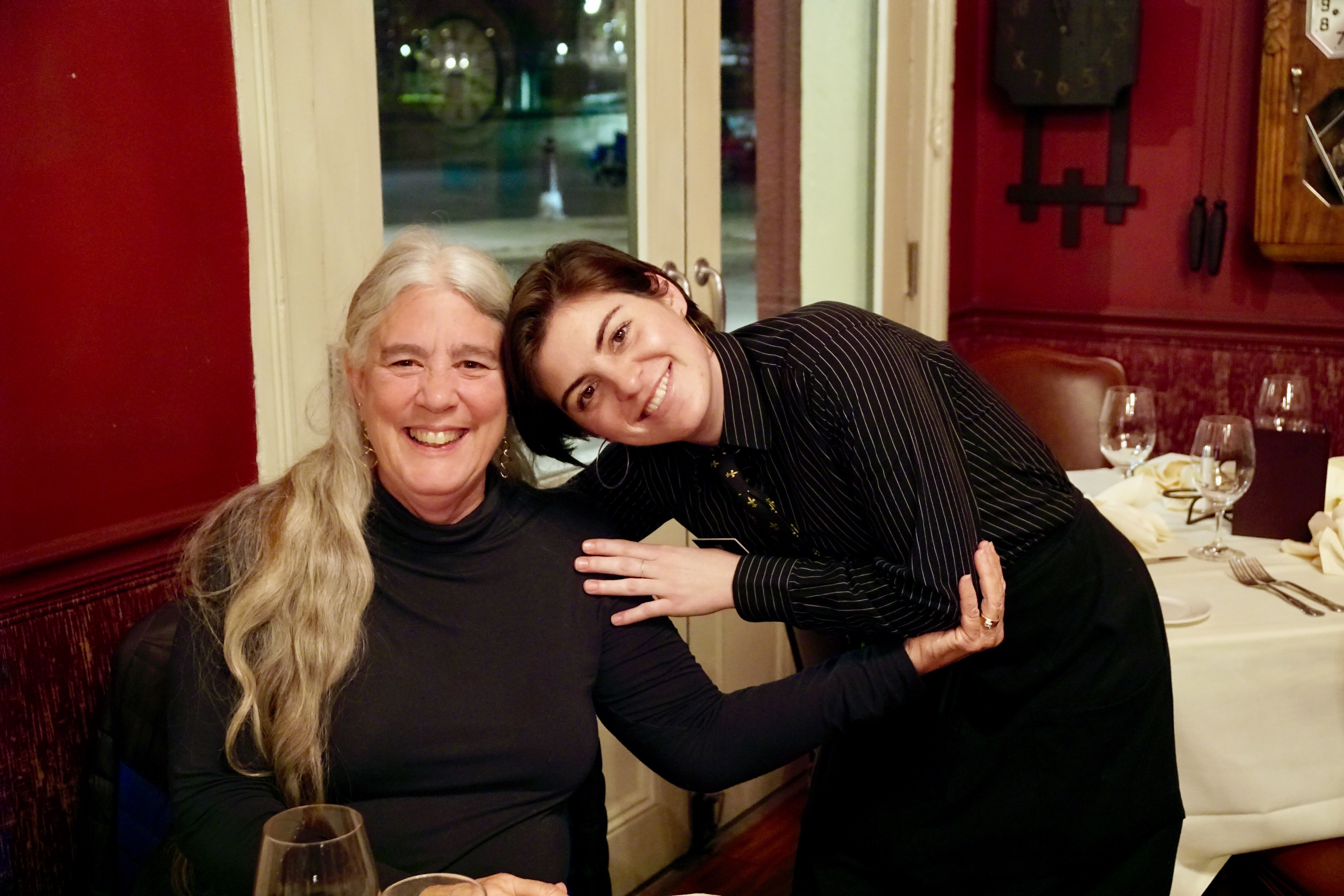
We enjoy breaking that mold in a way that expresses our appreciation for their job well done. Occasionally the server will not step out of his/her “character”. It is understandable though disappointing. More often the server will relax the guard but not entirely. We appreciate that and we are grateful to have engaged with a highly trained professional. Then there is that rare server whose intuition is so finely tuned as to allow a deeper connection. Tonight that server was Liz. We bantered a bit with her as she opened the wine. There were incrementally relaxed comments back and forth in the course of dinner. Finally at one of Liz’s visits to our table Christine stated her appreciation for the expressive eye-contact that Liz practiced. “Thanks Mom!” was the reply Chris received. It absolutely made Christine’s day, our evening, and capped a 5 Star evening.

Day 2 is in the books. New Orleans Day 3 will dawn in a few hours. Sadly, Christine will be flying back to KC on Saturday to be with her Father and the grands. I will slowly wind my way back home over the following 10 days. It just won’t be the same without her.

Peace Everyone. Pete

Please enjoy a few images from today:

Most days of our lives present a relatively narrow range of experiences. The most memorable may be those that expand that spectrum and allow us to appreciate a fuller range of the human condition. Today was such a day.

Morning sprang with the chill of near freezing temperatures in a lush Louisiana State Park. In less than 3 hours we were entering the environs of “The Big Easy”… New Orleans. As we approached our destination we beheld hundreds of tents pitched beneath the overpasses of I-10. These were not recreational campers, but those whose circumstances have reduced them to the struggle of seeking food, warmth, and the next day of life. We passed them and turned right into our “campground”, The French Quarter RV Resort.

The “Resort” is located in gated environs, protected by an 8 foot concrete wall that is topped by inconspicuous razor-wire. It looks like a Soviet era gulag from the outside, but within it is an elegant $100 dollar per night RV park that is only 2 blocks from the French Quarter and 4 blocks from Bourbon Street. Passing through the gate I felt like Dorothy did as she awoke to the technicolor experience of OZ.

The Resort provides a swimming pool, hot tub, rec-hall, fitness room, plus the usual amenities of bathrooms, showers, and laundry. Full hookups are a given. Most of the “campers” are in large “sun blocker” motor coaches that cost more than the average home. We count ourselves among the few micro-campers. We are not envious… au contraire, we pity them the burden of their mass.

After making “camp”, we walked 10 minutes to Alice’s Wonderland, here known as Bourbon Street.

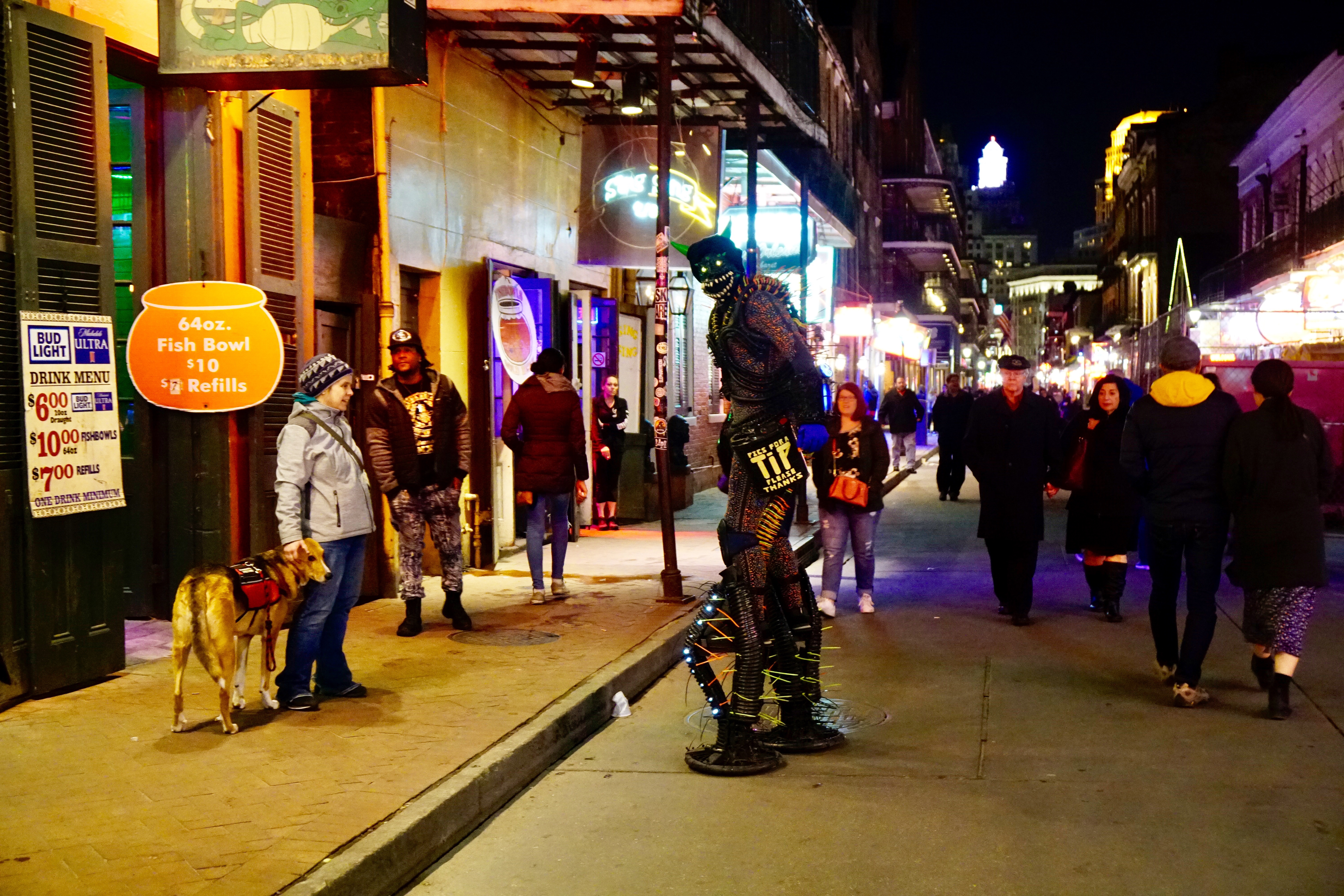
Sex and Alcohol are the prominent neon lit themes that adorn the antebellum buildings and illuminate the street. The effect is intoxicating, even for the sober pedestrian.

Liberally mixed among the tourists are those whose hands are reaching out for spare change. There is sadness to be found in some, and larceny in the intentions of others… not easy for the uninitiated to discern.

We were approached by a friendly 50ish woman who represented that she was seeking donations for “Meals for Wheels”. Christine donated and we then received the gifts of a Hare Krishna Cookbook and Bhagavad-Gita. It was not the “Meals on Wheels” that we assumed she represented. Were her intentions honorable? We will never really know… I choose to presume the best of intentions until proven otherwise. I believe that she holds as firmly to the dedication of Diety as any Christian, Jew, or Muslim. Had I the presence of mind I would have liked to have engaged her in a serious discussion.

A few days ago we walked the beaches of the Texas Gulf Coast. I happened to look down upon an ocean clam and suddenly wondered at the chasm of intellect that separated it from me. How could it ever fathom my intentions as a superior being. If the Universe is the creation of an omniscient and omnipotent Being, how much greater is the separation of it’s intellect from mine. Is it not presumptive for humans to claim to know the mind of that Being, and yet as a species we have been driven to do so for nearly a hundred thousand of years (human and Neanderthal ritual burial has been documented for that long). It seems to me that The Bible, Koran, Book of Mormon, and the Bhagavad-Gita, among others, are human expressions of an inadequate effort to understand the Infinite.

Back to Earth… We enjoyed some music and the 2 for 1 beer specials that abound up and down Bourbon Street.

The spectacle allows one to turn a blind eye to the well worn establishments, street hawkers, and less than sanitary bathrooms.

Hunger drove us to first find Chicory coffee and Beignets at Cafe du Monde, a New Orleans tradition since the mid-19th Century.

We then adjourned to the very upscale Restaurant GW Fins. Less than a block from the helter-skelter of Bourbon Street we found the calm opulence of white linen table cloths, a well ordered bar, and a dignified professional staff.

This was another expansion of the spectrum of the day’s experiences. Christine, a “slightly dirty” Martini, me a Rye Manhattan (served up, but in a rocks glass). We then settled into a review of the last 41 years.

Dinner followed. Christine, a succulent Filet Mignon, and me a flaky, melt-in-your-mouth Halibut-Scallop combination. As spectacular as the meal was it was overshadowed by the attentive staff. We were graced with the exceptional services of Rod, Benjamin, and Moose.

It is common for a patron to ask directions to the restroom, but entirely uncommon for the waiter (Benjamin) to then take the arm of the lady (Christine) and accompany her to that destination much as one would be ushered in a wedding. Totally endearing!

We count today memorable and leave tomorrow for consideration on another day.

Peace Everyone. Pete

151 years ago financier Edmund Mcllhenny suffered the loss of his fortune and prospects having been a resident of Louisiana and a southern sympathizer during the Civil War. He had gifted his rare collection of the complete works of William Shakespeare to a Union officer rather than see the volumes lost to the looting Union troops. The collection was later returned to the Mcllhenny family and is now a treasure in their Tabasco Museum.

While eating lunch he asked for some pepper sauce to liven up the otherwise bland fare. The proprietor demurred saying that peppers were out of season, but that he would pay dearly to have some. McIlhenny was thus inspired!

Experimenting, he hit upon a process (not unlike making sauerkraut) of mashing select chili peppers, brining and aging the mash in white oak barrels (for up to 3 years), then extracting and bottling the pungent red elixir. Tabasco sauce was thus born.

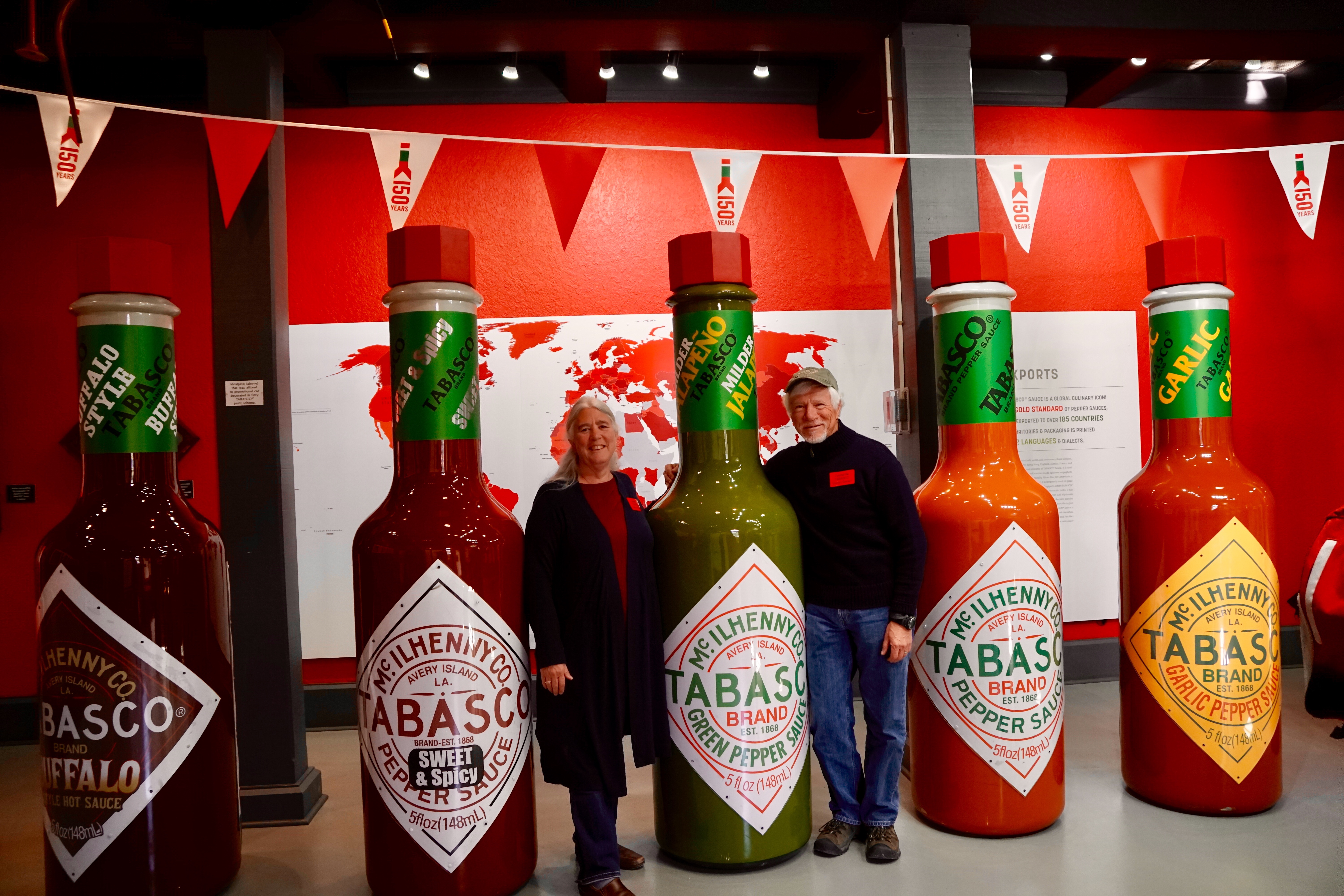
It has been exclusively produced on Avery Island ever since. The company exports world wide and prints its labels in 22 different languages.

Control of the company has remained in the hands of the Mcllhenny/Avery family since its inception. Many of the executives have been known for their valor in the service of the United States Armed Forces, most notable being John Avery Mcllhenny who (literally) served next to Theodore Roosevelt as a Rough Rider in the Spanish American War battle of San Juan Hill.

Others were notable adventurers such as “Ned” Avery Mcllhenny who was an Arctic explorer and naturalist.

We toured the Tabasco factory today.

It is entirely contained on Avery Island, named after Mcllhenny’s father-in-law, Judge Daniel Avery. It is a small circular island about 2.5 miles in diameter that was formed upon an ancient salt dome.

The factory is remarkably small and understated when one considers the market strength of Tabasco products.

On this day alone over a quarter million bottles of Tabasco sauce were filled for shipment to Japan.

Many of the Tabasco employee families have multi-generational ties to the company, some living on the island in company furnished housing. One employee lived in the same company house for 89 of his 91 years!

Most of us are familiar with “Original” Tabasco Sauce, it’s label design essentially unchanged for at least 135 years. Today I was treated to samples of a dizzying array of other Tabasco “tastes”, including Tabasco Scorpion Sauce. Christine could tell it had heat by the sweat rolling down my brow. There was even Tabasco Ice Cream!

I have always been a fan of Tabasco, and those who remember me from my tie wearing lawyer days will recall that I had quite a collection of their neckwear.

The last 2 nights we have been camped in Louisiana’s Palmetto Island State Park. It is perhaps one of the finest State Parks that we have encountered in our camping tour of 49 states. Spacious campsites, full utility hook-ups, WiFi throughout the campground, spotless bath facilities, and a free laundry!

We are only 15 minutes from Abbeville, 40 minutes from Avery Island, and 120 miles from New Orleans, our destination for tomorrow.

Peace Everyone. Pete

PS. Local temps are predicted to plunge to near freezing tonight. People in these parts are a bit frazzled by the cold-snap, but we are feeling pretty fortunate since Kansas City will be below zero, and where my Mom lives near Chicago will hit over 20 below zero… with a -60 degree windchill! Stay warm everyone!