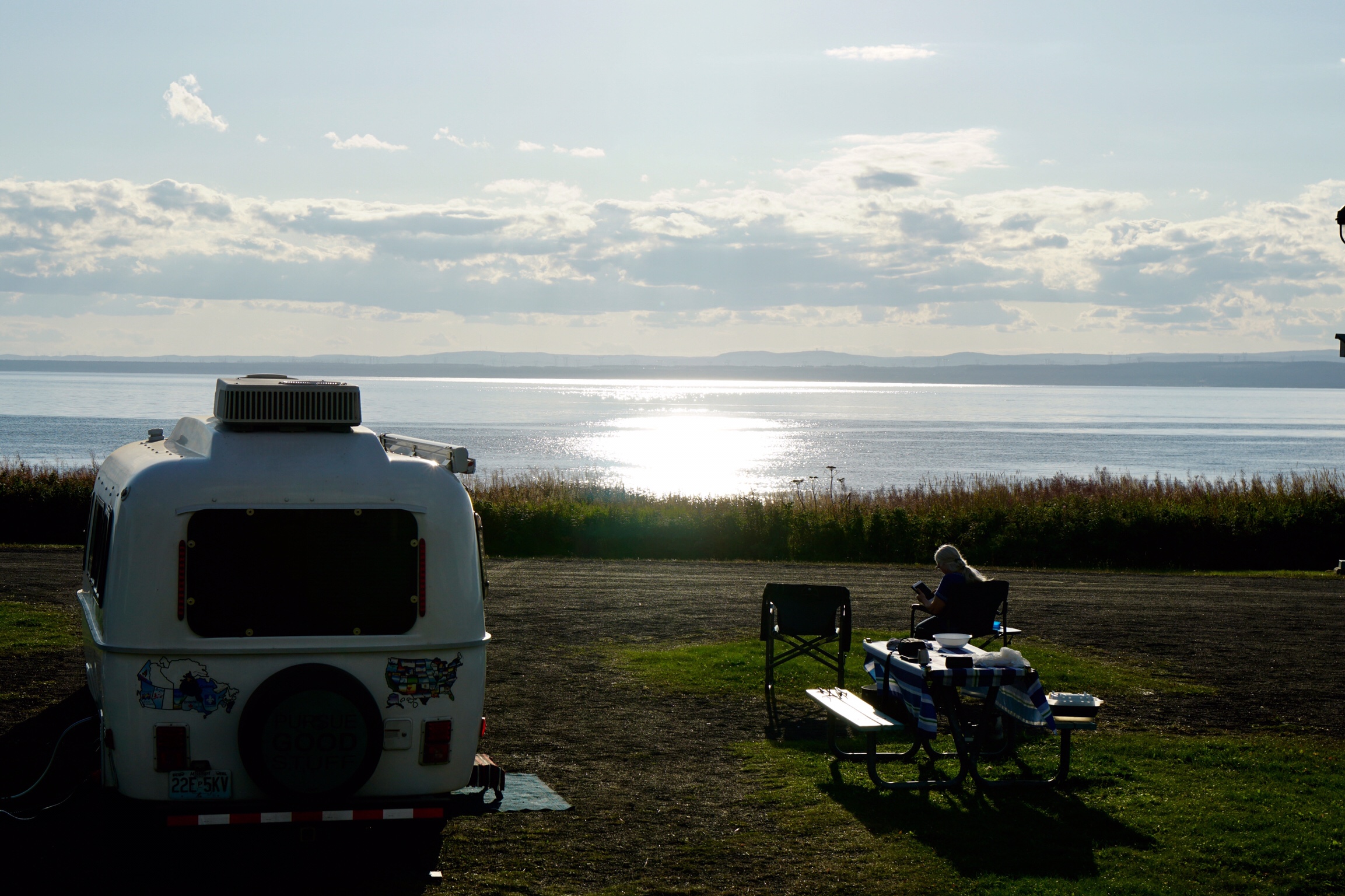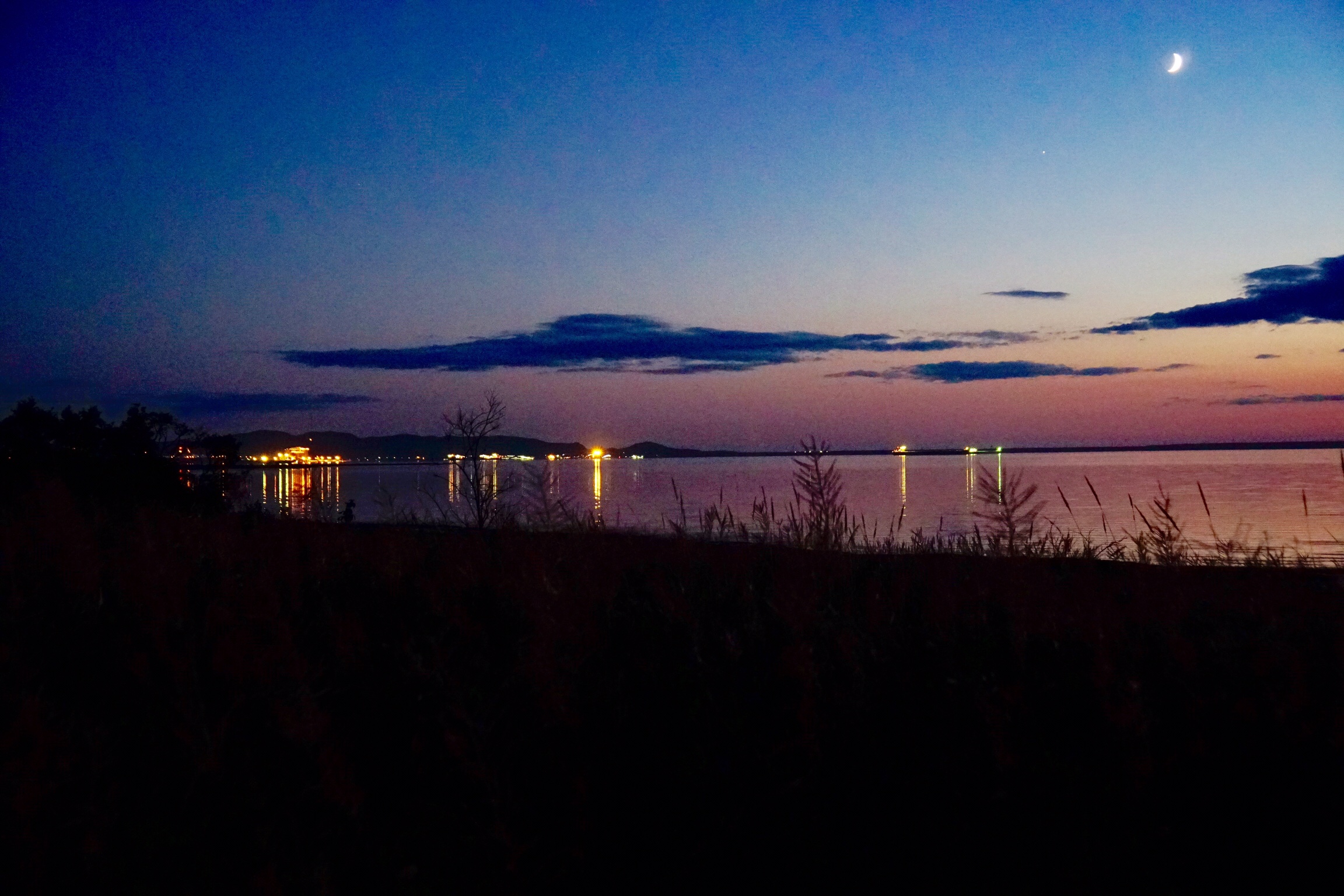
After overnight camping near Baie Comeau we returned to Godbout for our 11 a.m. ferry crossing to Matane on the south shore of the St. Lawrence.

This is at least the 12th time that we have transported our car and trailer aboard a ferry. Every time feels like a bit of an adventure as we slowly drive across noisy metal ramps, occasionally scraping the hitch, and descend steeply into the bowels of the vessel.

On this occasion the ferry was one of the huge ocean capable varieties. We were the first cargo on and the first cargo off. As we waited to load we watched a seemingly endless parade of vehicles that had originated on the south shore depart the ship. There were motorcycles, transports, RV’’s, and even a huge 40+ wheel semi bearing a construction crane.

The crossing took a little over 2 hours but the ship featured unexpected comforts that were more akin to those found on some cruise ships. There were luxurious recliners, a first rate cafeteria, and a topside promenade that was abandoned to the cold damp weather.

I spotted a couple of Minke Whales, and there was even a report of a huge Blue Whale sited about 2 miles ahead of the ship.

Once on shore we began making our way to our overnight destination, the municipal campground at Trois-Pistoles. Along the way we beheld a large lighthouse situated on the Pointe-au-Pere promontory and detoured to have a look. The unusual lighthouse was built in 1909 and at 108 feet tall it is the second tallest in Canada. It features a large 3rd order Fresnel beacon that is visible for 22 nautical miles. I would have taken the tour to the top but the lack of time and the dense approaching fog bank dissuaded me.

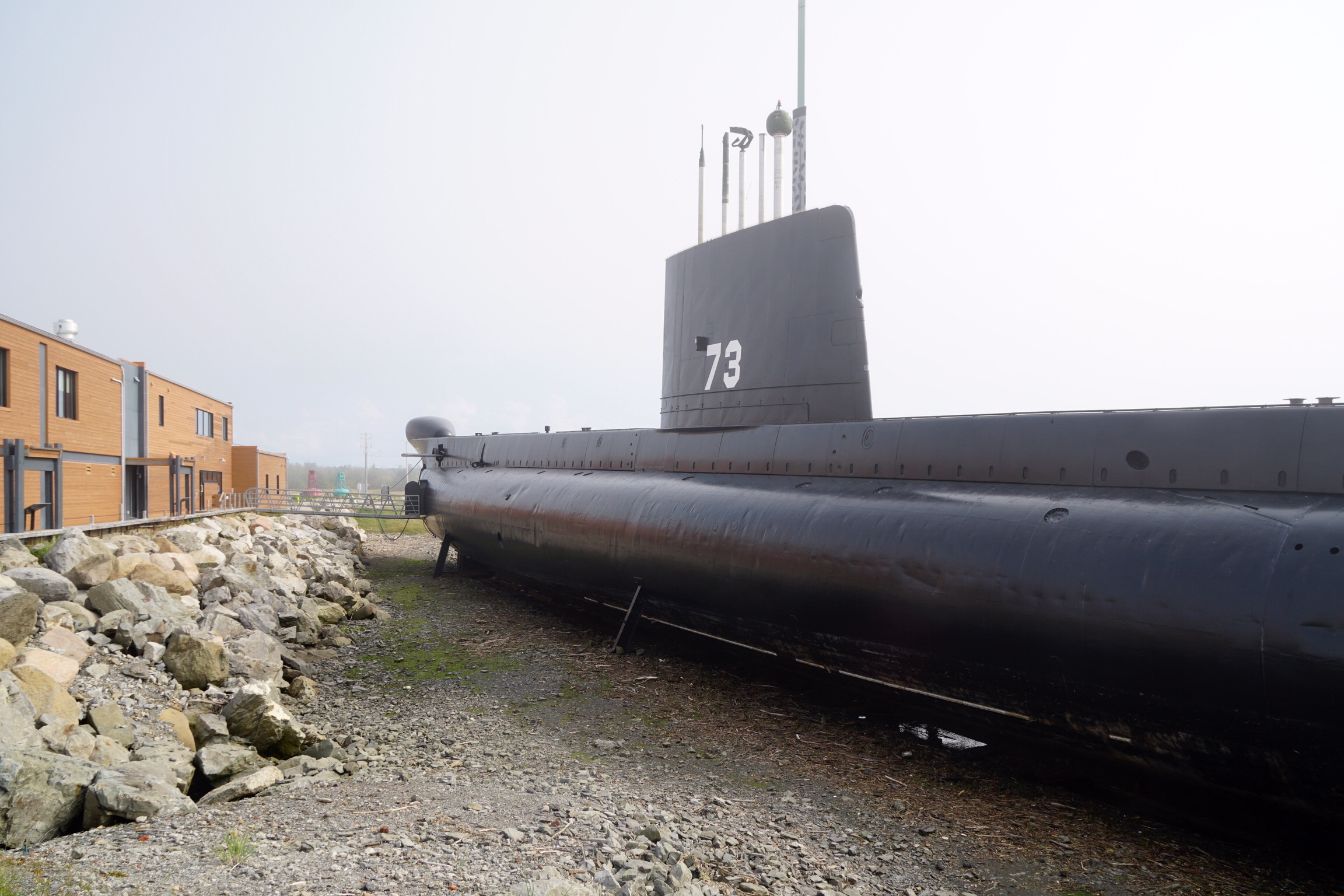
However, there was a submarine to tour!

The Oberon class submarine, Onondaga (S73) was launched in 1965, commissioned in 1967, and served in the Canadian Navy for 33 year. It was retired from service in 2000. It is the only sub open for tour in Canada.

The vessel is 295 feet long, displaces 2, 400 tons, and its 2 x 3,000 horsepower electric motors could propel her at a speed of 12 knots (14mph) on the surface and 17 knots (20mph) submerged. Her batteries allowed her to cruise submerged for 3 days at a time and only required 3 hours to be fully recharged by the two huge diesel generators. She was capable of safely diving to 1000 feet. In the course of her lengthy career she traveled over half a million miles.

With the crossing of the St. Lawrence the focus of our travel has shifted to a homeward journey.

Peace Everyone. Pete
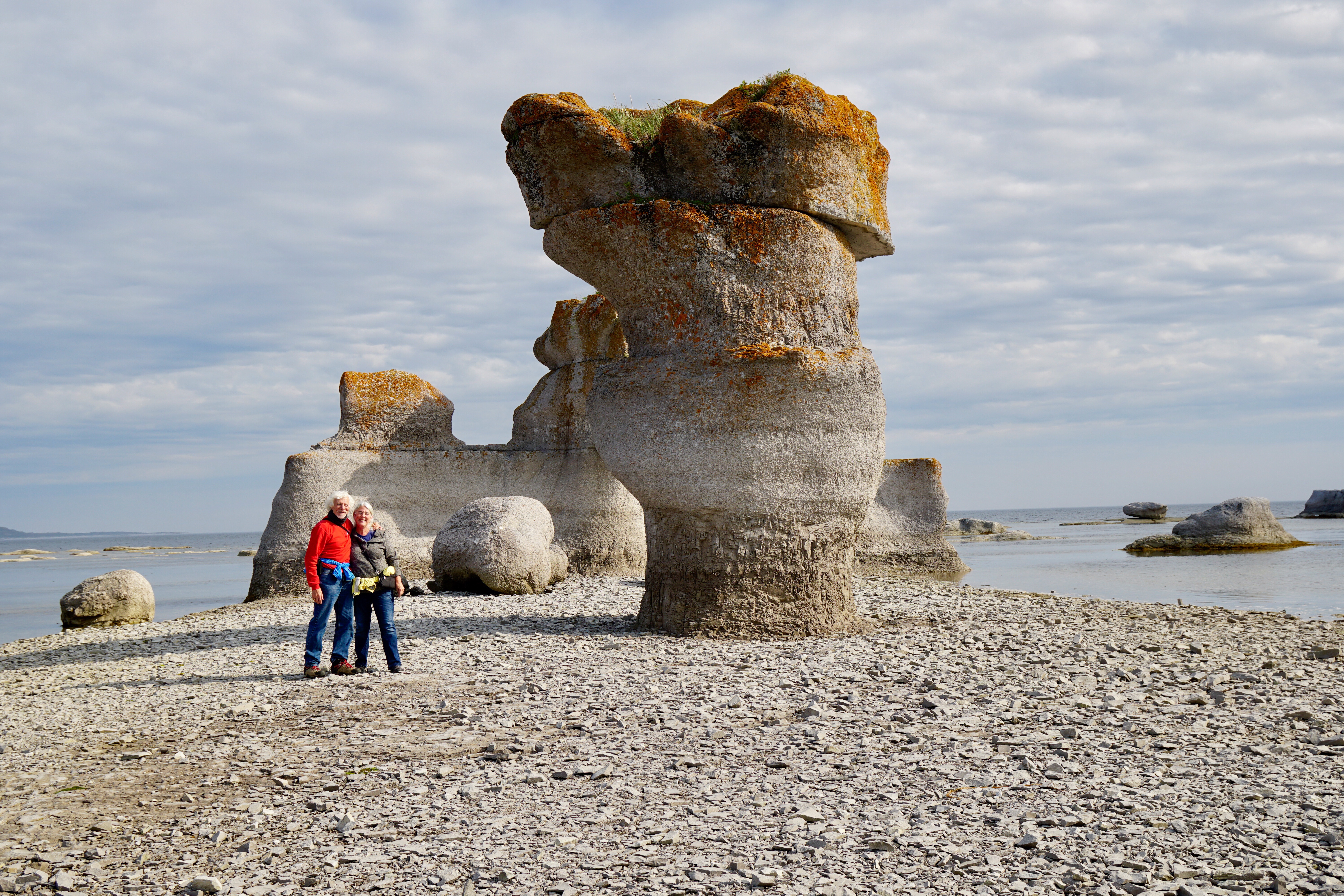
Good fortune and fine weather allowed us a visit to the spectacular Monoliths on the Mingan Archipelago islands.

The fog of the previous day gave way to partly sunny skies and attracted additions to the 8 of us who had signed up for the 4 hour tour the previous day.

The Mingan Archipelago began forming millions of years ago where the 1 billion year old rock of the Canadian Shield met the 500 million year old limestone sediment of an ancient sea. Waters cascading off of the Shield created fissures and cracks in the limestone. 20,000 years ago marked the beginning of the last Ice Age. A crust of ice nearly 2 miles thick formed over this region, the weight of the ice pressed the land downward many hundreds of feet. 10,000 years ago as the ice melted away the land rapidly rebounded and was subjected to additional erosion from the glacial runoff. The land continues to rebound even today at the rate of 3 millimeters (about 1/10th of an inch) per year. Thus wind and water erosion continue the slow process of carving these unique Monoliths which once were under 250 feet of water.

The Archipelago consists of a group of 40 islands that are now a protected environment within the Mingan Archipelago National Park Reserve of Canada. The National Park Reserve itself extends over 125 miles along the north coast of the St. Lawrence and includes over 2,000 islands.

Our tour of two of the Mingan islands featured a National Park docent, unfortunately we soon learned that she “docent” speak English!! Christine and I were the only passengers who were not either Francophones or bilingual. We satisfied ourselves with proceeding solo along the well marked paths and boardwalks of the islands.

Rustic camping is allowed along with other recreational activities, but access is only by water and carefully regulated to protect the environment.

We were rewarded with the wonderful experience of viewing and examining these stunning natural wonders unencumbered by the presence of other milling spectators. We were soon joined by a Camille and Janice, a very nice couple from near Ottawa who could understand the (very lengthy) explanations of the naturalist, but preferred the solace we were enjoying.

Our return to Havre-Saint-Pierre included a sighting of a Minke Whale. Unfortunately I was not quick enough with the camera.

Tomorrow we drive 350 miles back to Godbout where we will overnight in the ferry parking lot to await our 11 am Monday departure for the south shore of the St. Lawrence Seaway. The passage will take about 2 1/2 hours and often features views of migrating whales.

Peace Everyone. Pete

We have arrived at Havre-Saint-Pierre which is the end of our road, but Canada 138 continues east for at least another 150 kilometers. The 250km (about 150 miles) we traveled yesterday was both beautiful and remote. With the exception of a few small seashore villages there were no signs of habitation. A sign warned us early on that there were no gas stations for 110km.

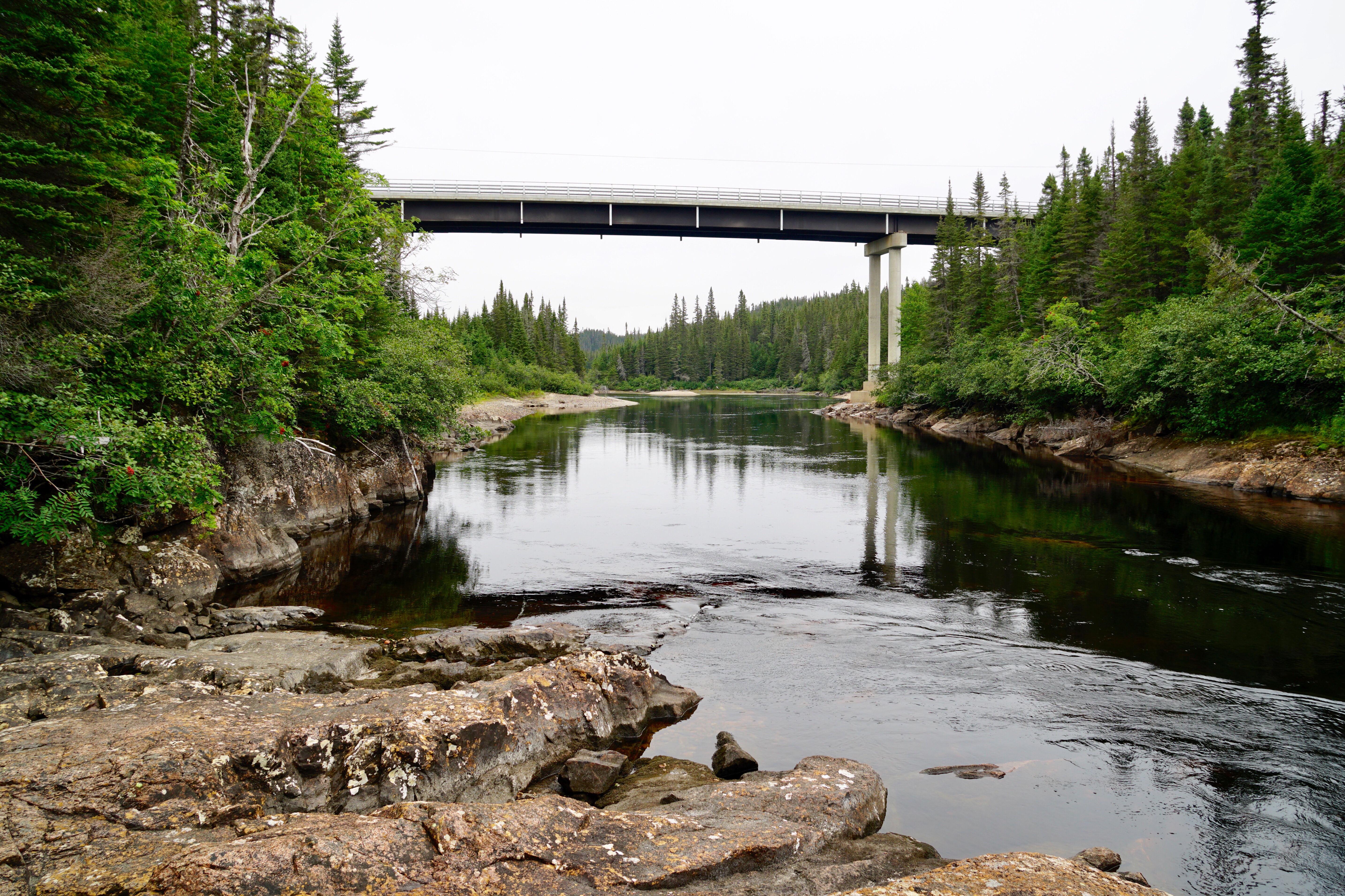
We enjoyed an opportunity for a brief hike to take in views of one of the many rivers cascading from down from the north on to the St. Lawrence.

The Municipality of Rivière-au-Tonnerre is comprised of the town itself and 3 small neighboring villages. The total population for the 244 square miles of this political subdivision is 307 people, down 21% from 10 years ago. There are no gas stations, no restaurants, no cell service, and we saw only one small convenience store. Folks are almost exclusively employed in fishing to supply crabs to a local processing factory. However, there is a remarkable church. Built in 1903, L’Eglise Saint-Hippolite is surprisingly large and constructed entirely of wood. It is like no church that we have ever seen before. We had the good fortune to be given a tour by its caretaker who only spoke French. Christine hung on linguistically for all she was worth as he gestured here and there about the church, speaking with obvious pride in rapid-fire French.

We have also entered a region where First Nation people predominated. Signs are now printed in both French and the local indigenous language. Political authority in many places is here vested with the local First Nation Tribe.

Ordinarily Havre-Saint-Pierre would be an oasis for tourism, however the season has ended. We arrived at the relatively large seaside municipal campground (86 sites) only to find that the electricity is off, the bathrooms are locked up, and all of the seasonal tenants are long gone. The gate has been left open for the few hearty souls like us who still wander this area. The camping is now free and fortunately the water is still on and the trailer sewage dump appears to still operate. We are the only camper visible in either direction.

The fog along the coast has been relentless. The inland air is clear as crystal, but on the shore it is as if the crystal has been frosted opaque. Moreover, the dampness really drives the cold inside of you. The temperature dropped to 40 degrees in the night and as we are now “boondocking” (only using our self contained propane and battery power) we embrace a heightened sense of adventure.

We came here in hopes of visiting the Mingo Archipelago National Reserve. It is renowned for its flora, fauna, and the remarkable stone monoliths that abound along its shores. Unfortunately, it can only be reached by water. Fortunately, the daily boat is still operating. Ordinarily the vessel would carry dozens of people to the reserve, but we will be joined tomorrow by only 6 other passengers. We are keeping our fingers crossed for clear skies and most of all, no fog.

Peace Everyone. Pete

The following appeared in my archive from two years ago today as we traveled New Brunswick and Nova Scotia. It is worth sharing once again.

September 14, 2016:

Most of the time my postings focus on the things that we see and the things that we do. Last night I received a heartfelt and personal email from a staff person at 5 Islands Provincial Park. I will only say that it was most touching for both Christine and me. It reminded me that there is the third dimension to our travels, the people whose lives we touch and who touch ours. These encounters do not often meaningfully lend themselves to pictures or description. However, in replying to her I offer a window into this third dimension of our experiences. I share my reply with you.

Dear ——. Our visit to your park has presented us with a series of memorably, and in some cases extraordinary experiences.

In the morning I took in the Red Head Trail, enjoying a brief interlude with a couple from Germany, taking advantage of a tart green apple that was just within my reach, and being overwhelmed by the scarlet expanse of the cliffs extending before my eyes.

Christine and I visited the Dutchman Cheese Farm where we stopped to watch 3 calves play like children in a schoolyard. After sampling an array of cheeses and chatting with the proprietor (who had just gotten off the phone with her mother in Holland), we left with a box of cheeses that may not make it back to Kansas City.

We lunched on fish and chips at Diane’s down the road, making the acquaintance of a most pleasant waitress.

In the afternoon we walked along the base of the towering red cliffs, leaving footprints on the sea floor that in a few short hours would be erased by 40 feet of incoming tide. There we met a couple from Quebec and their Great Dane who did not seem so taken with the magnificence we all appreciated.

From the elevation of our campsite we watched the return of the tide and the departure of the sun. With no campfire, we found our focus on the stars and a bright near-full moon. I casually remarked to Chris that it had been quite some time since we had seen a shooting star. Not two seconds later the sky was slashed before our eyes by the bright trail of a streaking meteor! First we laughed and then we marveled at the joke that Nature had played upon us.

Like I said, this was an extraordinary day… but little did I know that the best was yet to come. It arrived in the form of a kind and thoughtful message from you. Thank you so very much for sharing the joy of a moment when life paths briefly intersected, merged, and then proceeded over the horizon of each other’s experience.

In life may you always have fun, do good, and be safe for the sake of those who love you. Oh, and also Live Long and Prosper!

Peace. Pete and Christine.

Late last February I launched my new website and began publishing my “Thoughts”. Most of the posts have been written while we have been on the road, taking the form of a travelogue with photographs and occasional personal reflections. I knew there were some dedicated followers and I held some hope that the audience might grow. However, what has occurred has exceeded any expectation.

My website provides me with a continuously updated tally of the number of visitors, and a record of the the countries that they are logging in from. I can’t see who is visiting, but I can see where they are visiting from.

As of today 20,000 visitors from 61 countries have read my “Thoughts”. I know that professional bloggers would scoff at these numbers, but I am grateful for the time that each of you give to us.

We revel not only in the exploration of places, but in the forging of friendships and the discovery of new dimensions to our own relationship. For me this is a labor of love. Thank you for being a part of it.

Today we traveled from Baie Comeau to Sept-Iles on the north shore of the St. Lawrence. En route we stopped at the ferry terminal at Godbout and made a reservation for a Monday crossing to Matane on the south shore.

This is the farthest east ferry crossing available to us. The passage will take about 2 hours and the cost to transport us, vehicle and trailer is about $200.00. Matane is about 175 miles northeast of Edmundston, New Brunswick. It is at Edmundston that we will cross back into the United States at the northernmost tip of Maine. From there we will begin our slow return south and west to Kansas City.

Between today and Monday we will spend Thursday night camping in Sept-Iles and then travel on to Havre-Saint-Pierre where we will camp for two nights before returning to the ferry dock at Godbout.

The last few days along the north shore of the Saint Lawrence have been a spectacular mix of dense north woods, rolling hills, stark rock promontories and seaside vistas. We are given to understand that the best is yet to come. We look forward to sharing it with all of you.

Peace Everyone. Pete

PS: This area is a mecca for the generation of hydroelectric power. We stopped to view the dam at the Sainte-Marguerite River. Before the 1980’s traffic crossed the river on a narrow roadway atop the dam. A major bridge was constructed to span the river canyon. On October 30, 1984 tragedy struck. As a crew was laying the final pavement on the bridge deck the substructure failed and the bridge collapsed into the rushing waters 200 feet below. 6 workers lost their lives.