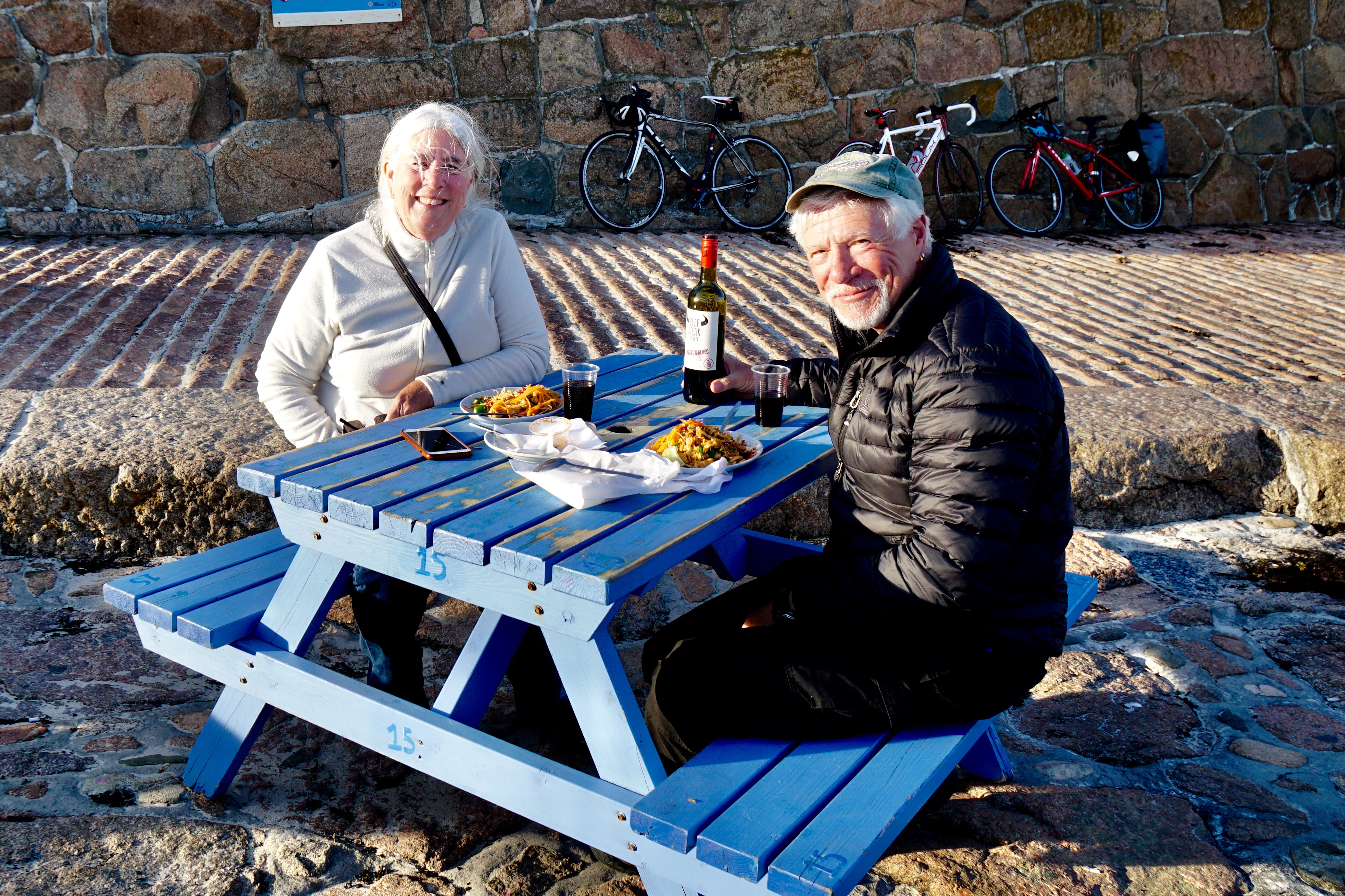
Friday (photos are from Friday and Saturday):

Our rather rainy day was spent pleasantly walking the streets of Guernsey’s capital city, Saint Peter Port. It is a city of about 18,000 that is dominated by its harbor and the 13th Century Castle Coronet.

The seafaring nature of this culture was humorously exemplified to us in the spectacle of children participating in sailing lessons in the harbor parking lot.

We continue to find the amazing 33+ foot tidal range and adaptations to accommodate this 6 hour “heartbeat of the sea” to be remarkable.

The fort has successfully repelled invaders for centuries, but not the Nazi troops who overran the island in 1940.

These days it is also insufficient to resist thousands of invading tourists who arrive via huge cruise ships. The throng temporarily packed the streets of the city, overloading sidewalks and shops.

More sanguine is the presence of the privately owned sailing vessel, Eos. It is the largest sailing vessel in the world. She is 305 feet long and carries masts that are 200 feet tall, the maximum allowable for navigation under bridges worldwide.

Castle Coronet is now maintained as a popular museum that chronicles the fort’s history from the Middle Ages through the end of the Second World War.

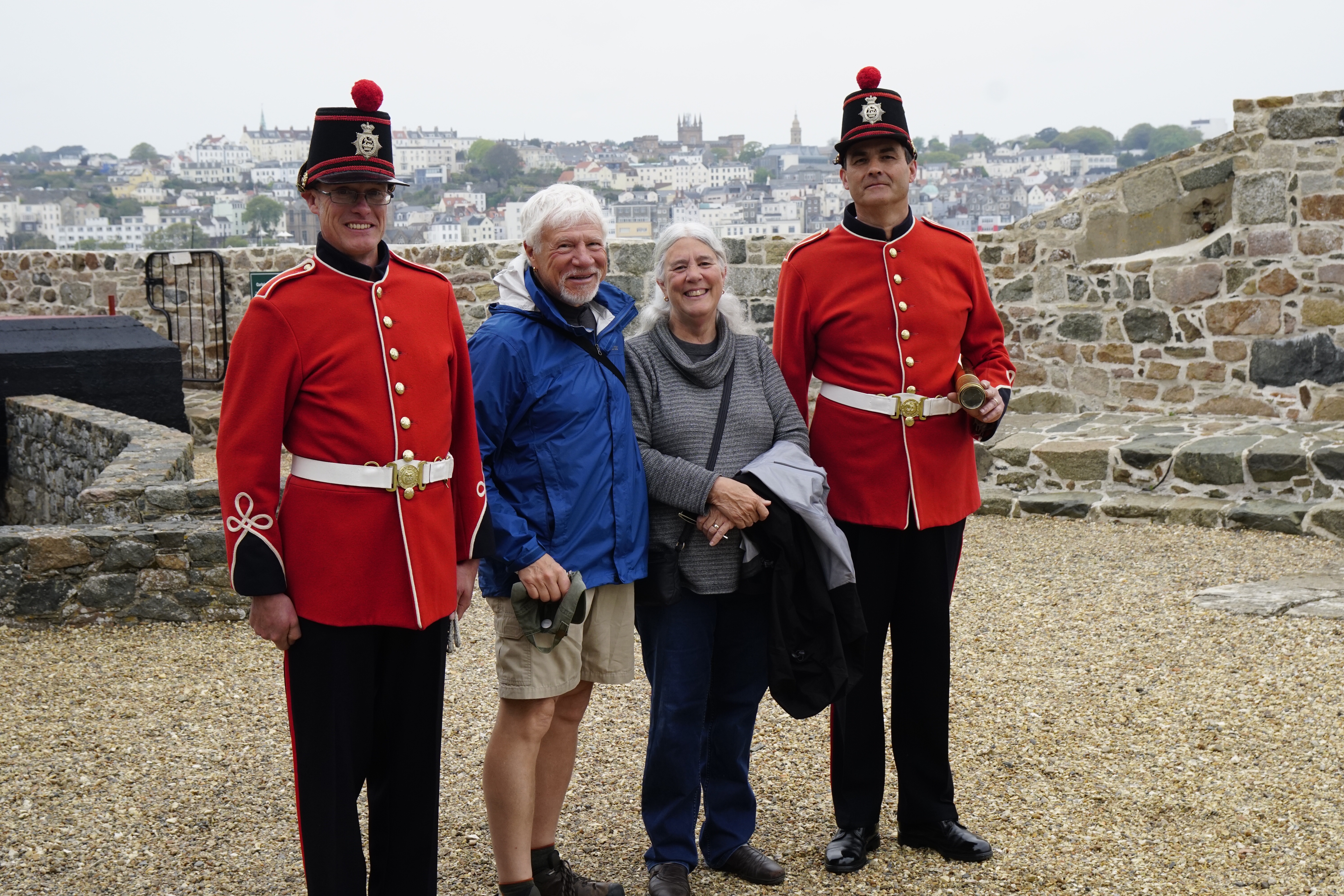
At noon each day soldiers dressed in 19th Century garb prime and fire a huge canon over the harbor.

Other volunteers make presentations about earlier life on and around the island nation.

A short walk on Friday from the Castle brought us to the more somber La Vallette Underground Military Museum. It presents a huge collection of artifacts and memorabilia from the time of the Nazi occupation. The facility was originally an underground refueling storage dump for German U-Boats. The concrete bunkers are now lined with weapons, uniformed manikins, and propaganda posters from that era. Included are a number of chilling declarations announcing the executions of residents for prohibited acts.

Our Friday afternoon continued with a commuter bus ride that circled the island. The bus service costs £1 a ride, but for £7.50 each we purchased unlimited passes that are good for 2 days. Service is convenient and covers the entire island.

Our one hour ride gave us some ideas on places to hike on Saturday, assuming that the positive weather forecast prevails.

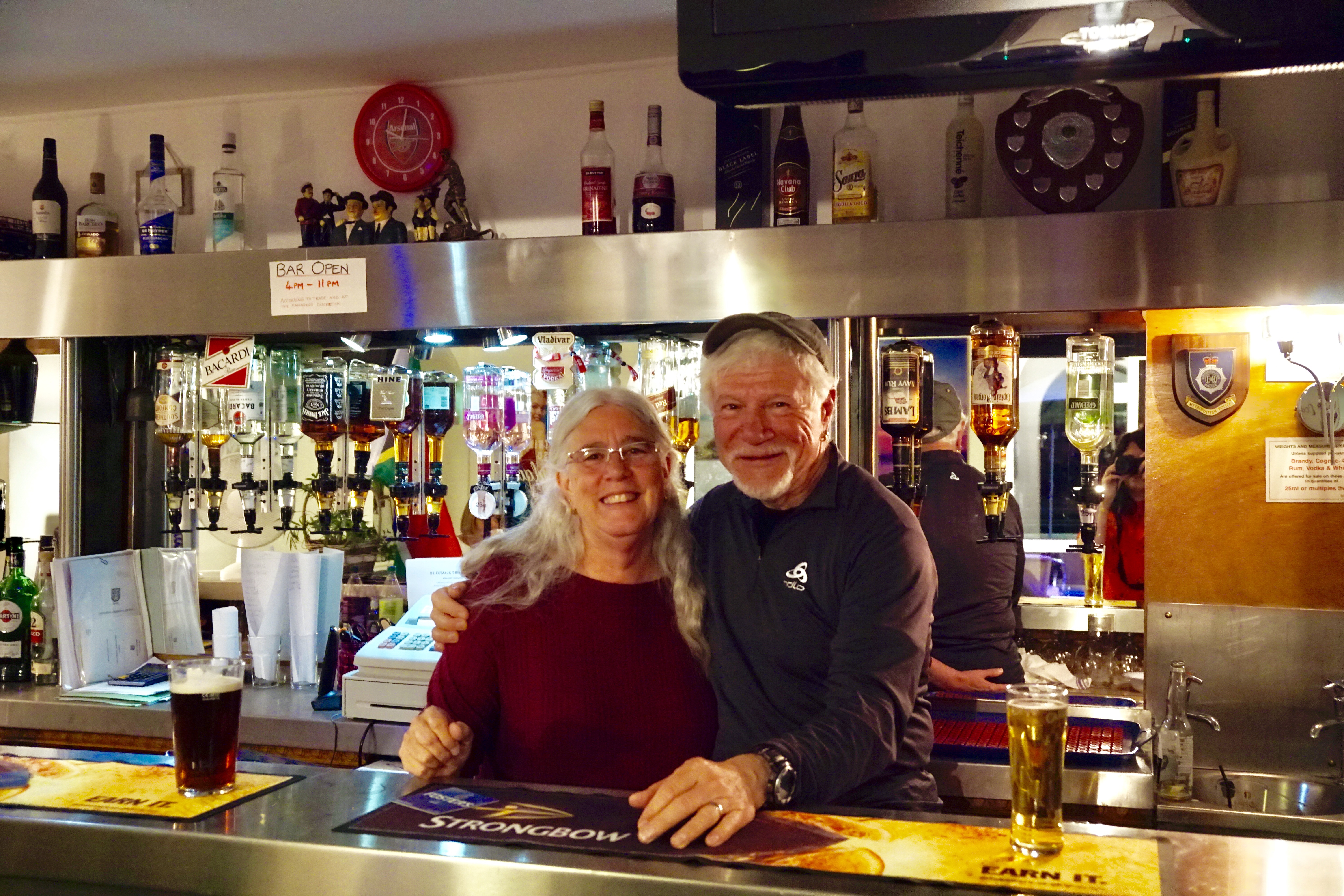
Friday evening brought us to a pint and dinner at a very nice Inn next to our B&B.

In the course of relaxing I received a very disturbing email. The ferry service that was to take us from Guernsey to Jersey on May 12th was canceled due to engine problems. Additionally, the overnight ferry that was to take us to Portsmouth England on the 15th was rescheduled and rerouted to Poole England. We had already booked and paid for our non-refundable 3 day lodging on Jersey Island and lodging in Portsmouth. There are no flights available on the 12th between the islands so this was a problem of the first order to be addressed at the ferry office first thing Saturday morning.

Saturday, May 11th:

Problem solved, sort of. We successfully booked an alternate ferry crossing for tomorrow. Unfortunately it sails late in the day and denies us time that we had counted on in Jersey. Furthermore, we will lose at least 2 hours and about £75 making connections from Poole back to Portsmouth. It could be worse…

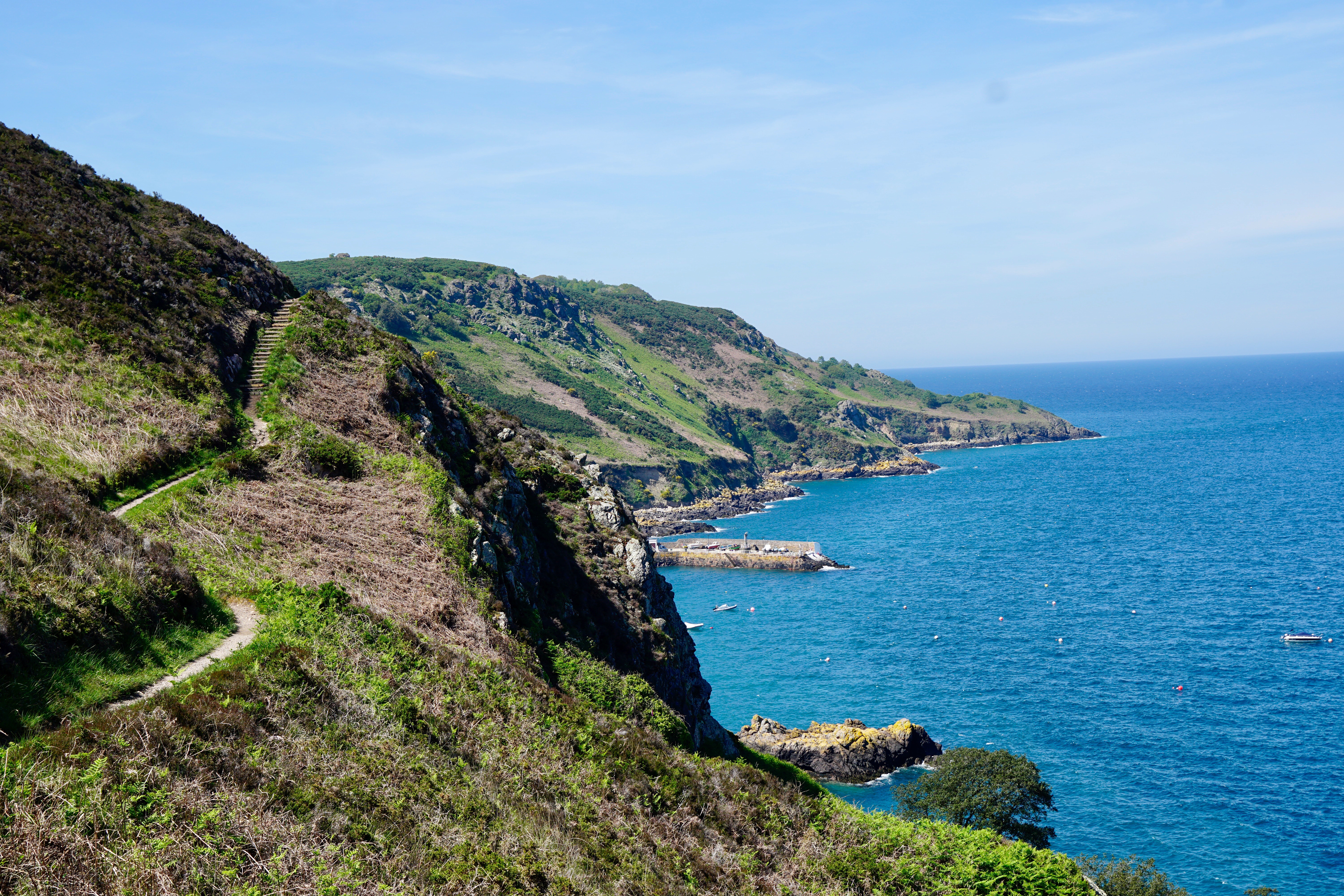
Christine elected to remain in Saint Peter Port while I spent the afternoon on a hike along the island’s south cliff face, through the bluebell woods, and on to the west coast.

Along the way I came across a British Battalion war cemetery in which 111 German soldiers were interred. The cemetery was significantly upgraded in recent years, a joint effort of British and German soldiers.

The perimeter of Guernsey bristles with fortifications. Some are from the Napoleonic period, but most were constructed by slave labor imported by the German troops during the occupation of 1940-45.

Reminders of that sad period abound. It seems that one cannot walk a quarter-mile along the coast without encountering a reinforced concrete fortification.

It has been 75 years since the occupation ended, but those events remain fresh in the collective memory of Guernsey’s citizens.

My walk also passed more pleasant sites which included the four unique bathing pools that date to the mid-19th Century. These include the “Gentlemens Pool”, “Ladies Pool”, “Children’s Pool”, and the “Horseshoe Pool” that provides increased privacy for its users.

These cleverly designed pools flush and refill 4 times a day with fresh sea water as each high tide overtops the impoundment. The water is retained when the tide drops.

A “perfect storm” in 1974 all but destroyed the 125+ year old pools. Even though the cost was exceedingly high, the popularity of the pools resulted in a successful funding campaign from private contributions. Moreover, a small army of 400 local volunteer workers provided much of the labor.

The quaint village atmosphere represented in the recent movie about Guernsey during the Second World War no longer exists. Instead it is highly developed with modern homes, some are even palatial.

The biggest surprise of my hike was stumbling upon a 6,000 year old Neolithic burial crypt that was open to my wanderings. Phenomenal!

Tomorrow is Mother’s Day in the United States. Until then…

Peace Everyone. Pete

John Churchill was named 1st Duke of Marlborough by England’s King William III in 1702.

This was in recognition of his military service to the Crown. His career went on to amass a remarkable string of 26 military victories without defeat. Churchill’s most noted victory occurred at The Battle of Blenheim where over 100,000 troops were engaged in combat.

Churchill dealt a stunning defeat to the French army which suffered over 30,000 casualties. Churchill dispatched word of his success in a note that he personally wrote on a tavern bill.

Shortly after this victory the King granted him an indeterminate lease of the estate that came to be known as Blenheim in honor of that victory. In 1704 Parliament authorized nearly a quarter million Pounds for the construction of a palace upon the grounds.

The Duke contributed another 60 thousand Pounds. The result was the construction of the monumental Blenheim Palace, the only non-royal “country home” in England to bear the designation of “Palace”. It is now a UNESCO World Heritage Site.

England’s monarchy remains owner of the property so long as the Dukes of Marlborough continue to pay the “rent”, which consists of delivering a French battle flag to England’s monarch at Parliament each year on the anniversary of the Battle of Blenheim.

The First Duke died without a surviving male heir. Parliament acted to protect the family’s rights by passing legislation that allowed the Churchill family to pass and hold title through its females, the first and only time that such an Act has ever been granted. Twice this has preserved the family’s hold on Blenheim.

The Estate has remained in the hands of the Churchill’s and Spencer-Churchill’s for over 300 years and is currently the possession of the 12th Duke of Marlborough, James Spencer-Churchill. The Spencer line of the family included the ill fated Princess Diana. The Churchill line included the famous Sir Winston Churchill who was born on the property in 1874.

He is buried in a modest family plot in nearby St. Martin’s Church, at Blandon.

The Palace is incredible in its size, design, and contents. Upon visiting the estate one of England’s kings was heard to say, “We have nothing to equal this!”

The various reception rooms display remarkable art, priceless tapestries, and artisan created furnishings of incredible rarity.

There are 22 clocks in the palace, the oldest dating to 1690. They all are in operation and are maintained by a staff clockmaker.

The library is the second longest room in the entire United Kingdom.

Apart from the Palace’s historic interest, this was the birthplace and home of Sir Winston Churchill. A portion of the tour was dedicated to his memory and considerable accomplishments. Aside from his role as Great Britain’s Prime Minister during the 2nd World War, his oratory stirred the soul of the United Kingdom during it’s “darkest hours”. He was a polymath, accomplished as an artist who’s works (submitted anonymously) were accepted for exhibition at London’s Royal Academy.

He was also a Noble Laureate in Literature for his “…mastery of historical and biographical description, and brilliant oratory in defense of human values”. His life works include writing 42 books in 60 volumes, plus 5,000 speeches and articles… in all over 30 million words!

Sir Winston died January 24, 1965. He is only the 4th former Prime Minister in Great Britain’s history to have been afforded a full State funeral. 110 world leaders were in attendance and the ceremony was watched by over 350 million television viewers around the world.

Our evening and this chapter of our journey concluded with dinner at a Portuguese restaurant in Portsmouth England with our Welch friends Huw and Nina. My thoughts turned to a 15 minute encounter in Porto Portugal with Mafalda and Rita, 2 young ladies who extended us a favor. We consider them friends for life even if our paths never again cross. Our life has become punctuate by many of these friendships. Far flung places take on the faces of these people and become personal to us.

Just today these posts have been read by scores of people in at least 15 countries. In 1869 Mark Twain said, “Travel is fatal to prejudice, bigotry, and narrow-mindedness…” 2000 years ago Christ compressed his entire philosophy into a single admonition that directed us to love our neighbors as we love ourself. (Matthew 22:35-40)

“Neighbor” is not defined by race, creed, gender, or geography. A neighbor is any person who celebrates the birth of a child, or mourns a child’s death. A neighbor is one who’s empty belly craves a meal, or who rejoices at the breaking of bread with those who are held dear. A neighbor knows the sweetness of first love or the bitterness of first love lost. A neighbor is anyone who sings with the wind, smells the flowers, or smiles at seeing what is whimsical in the clouds.

Travel and seek your neighbor. Travel in your heart, travel with your mind, and travel to any place where a common language may be spoken with just a smile.

Peace Everyone. Pete

The day for us began in the center of Lacock Village at the Red Lion Inn with a “proper English Breakfast”. The sad thing about this spread is that a week from now I will again be hungry.

Breakfast concluded we walked a through the village to its namesake, Lacock Abbey. A number of the village buildings date to the 1300’s, including King John’s hunting lodge, and the old stables.

This was also the “home of Harry Potter’s parents” located next to the 14th Century church.

The Abbey itself was founded in 1229 by Countess Ela of Shrewsbury. She was the widow of the illegitimate son of King Henry II, and dedicated the Abbey to his memory. Even though she was a very powerful woman in her time she joined the Augustinian Order of Nuns and became the Abbey’s first Abbess where she lived out the remainder of her years.

The Abbey and grounds are stunning and have a remarkable history.

The Abbey prospered through the Middle Ages until the time of King Henry the 8th’s dissolution of England’s monasteries in the 1500’s. Most abbeys were destroyed by Henry, but he sold Lacock Abbey to Sir William Sharington who converted the grounds and many of it’s austere buildings into a private estate.

Next is a photograph of original stonework that bears the stonemason’s mark or “signature”. The three chevrons on the right side of the mark signify that this was made by a fourth generation member of the family of stoneworkers.

From it’s simplicity as an abbey parts of Lacock were converted into a palace.

The estate passed through the hands of many noble families over the years that followed, eventually becoming the property of the Talbot family in the 1700’s. It was inherited by one of photography’s earliest pioneers, William Henry Fox Talbot, who in 1835 took a picture of a lattice window.

This was the world’s first “negative image” picture. That photograph ushered in the era of modern negative process photography that was to remain the dominant media into the late 20th Century, finally superseded by the digital cameras of today.

The Abbey became the property of England’s National Trust in 1944. The Trust has maintained the property not only in its forms as an ancient abbey and country estate, but also as a museum dedicated to the scientific genius of Talbot.

Our tour of the Abbey and grounds occupied our morning and much of our afternoon. There was still time to enjoy a driving tour of the Cotswolds which included brief stops in the towns of Bourton-on-the-Water, Slaughter, and Stow-on-the-Wold.

Much of the Cotswolds countryside and many of it’s villages remain quaint and untouched. The same can not be said of Bourton which draws tour buses and large groups of selfie-taking tourists like a magnet.

Our home for the night is the Kings Arms Inn located in the pleasant Cotswolds town of Woodstock. The evening concluded with dinner in a charming Italian restaurant and a post dinner glass of an excellent golden grappa.

We continue on tomorrow at Huw and Nina’s direction with a tour of Blenheim Palace, the birthplace of Sir Winston Churchill.

Peace Everyone. Pete

We were met at the Cardiff Wales central train station by our Welch friends, Huw and Nina Thomas. This friendship dates back nearly 20 years and includes travels together both in the States and abroad.

Huw has laid out a plan for our 3 days together and as soon as we had loaded our bags into the “boot” of his car we were off to Bristol and the S.S. Great Britain!!

Designed by the noted engineer I. K. Brunel (represented here by an actor) the ship was launched in Bristol England in 1845.

When launched she was the largest vessel ever built and the most technically advanced. At 322 feet long she was the first ship to combine the elements of an iron hull, advanced reciprocal steam engine, and propeller drive. She was a hybrid in the sense that she was equally capable as either a tall masted sailing ship, or a steam propelled vessel, and she could sail using both features simultaneously. When not under steam power her sailing efficiency was enhanced by a remarkable (even by today’s standards) feature that allowed the crew to disengage the huge prop and in a matter of minutes raise it into a recess within the hull, all by remote control.

The ship has a storied history that included over 1 million miles of sailing throughout the world. She could carry up to 700 passengers in accommodations that ranged from barely tolerable steerage to opulent first class.

The S.S. Great Britain last sailed commercially in 1884 and was abandoned in the Falkland Islands where she became a floating warehouse. She was scuttled and sunk in 1937.

In 1970 UK philanthropist Jack Hayward resolved to recover the Great Britain. He spearheaded her recovery, return, and restoration. She is now a remarkable museum ship that is located within her original construction dry dock in Bristol Harbor.

Actors dressed in authentic Victorian era attire stroll the area lending realism to the experience. Included was a detachment of British soldiers from the Crimean War who put on a demonstration of rifle fire and close order drill.

My highlight of the day was the opportunity to climb 100 feet into the ship’s rigging and out to the end of the yard spar. Christine and our companions documented the effort with still photos and video. Below are links to the video clips.

Up the Mast: https://youtu.be/8aPzd910mH8

Out on the Yard Spar: https://youtu.be/EGTJttAl5q4

Our day continued with a drive through amazing countryside and villages and included a pint in a ancient tavern in the town of Castle Combe.

Combe’s environs, including the tavern and church, have been the location for many television and movie shows, including scenes in the Harry Potter movies.

We spent the night in the village of Lacock, which is a living museum owned and preserved by Great Britain’s National Trust. The homes and businesses are leased under condition that the authenticity of the village is maintained.

We dined at the George Inn. The fireplace still sports the original meat rotisserie that was powered by a small dog running in a wheel!

Our chambers for the night were wonderfully appointed at the Red Lion Inn which had also been the setting for many period movies and television programs. We continue on in the morning.

Peace Everyone. Pete

After 3 days in historic Chester, which included another day trip to Liverpool, we have bid farewell to our Canadian travel partners, Tom and Nanci. We shared some adventure on the canals, iconic historical sites, great pub food, and a “few pints”. Partings such as these are tinged with sadness, but at dinner last night we began formulating “what-if” travel possibilities for the future. Will it be a long distance bicycle ride, a sail down the St. Lawrence to the Madeleine Islands, or camping in the Yukon?… only time will tell.

Waiting for us in Cardiff Wales are our Welsh friends Huw and Nina Thomas. We are looking forward to a 3 day auto-tour of southern England at Huw’s able direction.

Our train departed at 8:19 and is scheduled to arrive in Cardiff at 11:15. Departure was precisely on-time for this comfortable 2 car train. We have found that timeliness is the rule rather than the exception when it comes to overseas train travel. I am taking this 3 hour transit as my opportunity to write this post.

A question persists for me. Would I plan another narrowboat trip? Certainly the 3 weeks that we experienced on the canals of England and Wales were filled each day with new sights and experiences. We estimate that we covered over 250 miles, navigated over 60 locks, at least 15 drawbridges, 10 long underground tunnel passages, and accomplished 4 high aqueduct crossings. While this may sound like a lot, it really just scratches the surface of the 2,000 miles available for the intrepid canal pilot.

Much of week one was spent tackling the learning curve with the assistance of two “competent women”, Christine and Kris. Week two was solo with Christine and spent further honing our skills. Week three brought Tom and Nanci aboard, both eager to lend a hand and embrace a totally new experience. By week three I had grown comfortable enough to consider myself unconsciously competent… reacting to the vessel and circumstances more with instinct than focus. As we approached Middlewich on the final day there was a lock that is sized to fit two narrowboats at the same time but with only inches to spare. The pilot of an especially attractive 70 footer and I approached the opened lock gates in tandem and each executed a perfect entry with nary a jostle of the other’s craft. We began to speak, each at our respective helms. He was surprised to hear my North American accent as it seemed inconsistent with the accomplished execution of our joint maneuver. With satisfaction I realized that the canals had presented me with a surprise “final exam” and I had passed.

Given the right opportunity I would not hesitate to reprise this experience. However, with each passing year I am increasingly aware that the horizon of opportunity is limited and ever closing in upon us. The gift of good health is a fragile one. We experience the loss of friends and acquaintances with increasing frequency. The possible “next things” waiting to be explored may be many, but the opportunities may be few. Our choices must be made mindfully and with a balance drawn between time spent at home with loved ones and time spent in the pursuit of our next adventure. I have often said, “Don’t put off until tomorrow the things that you may find you are then unable to do.” Those things include giving and receiving love from those who you hold dear.

Peace Everyone. Pete