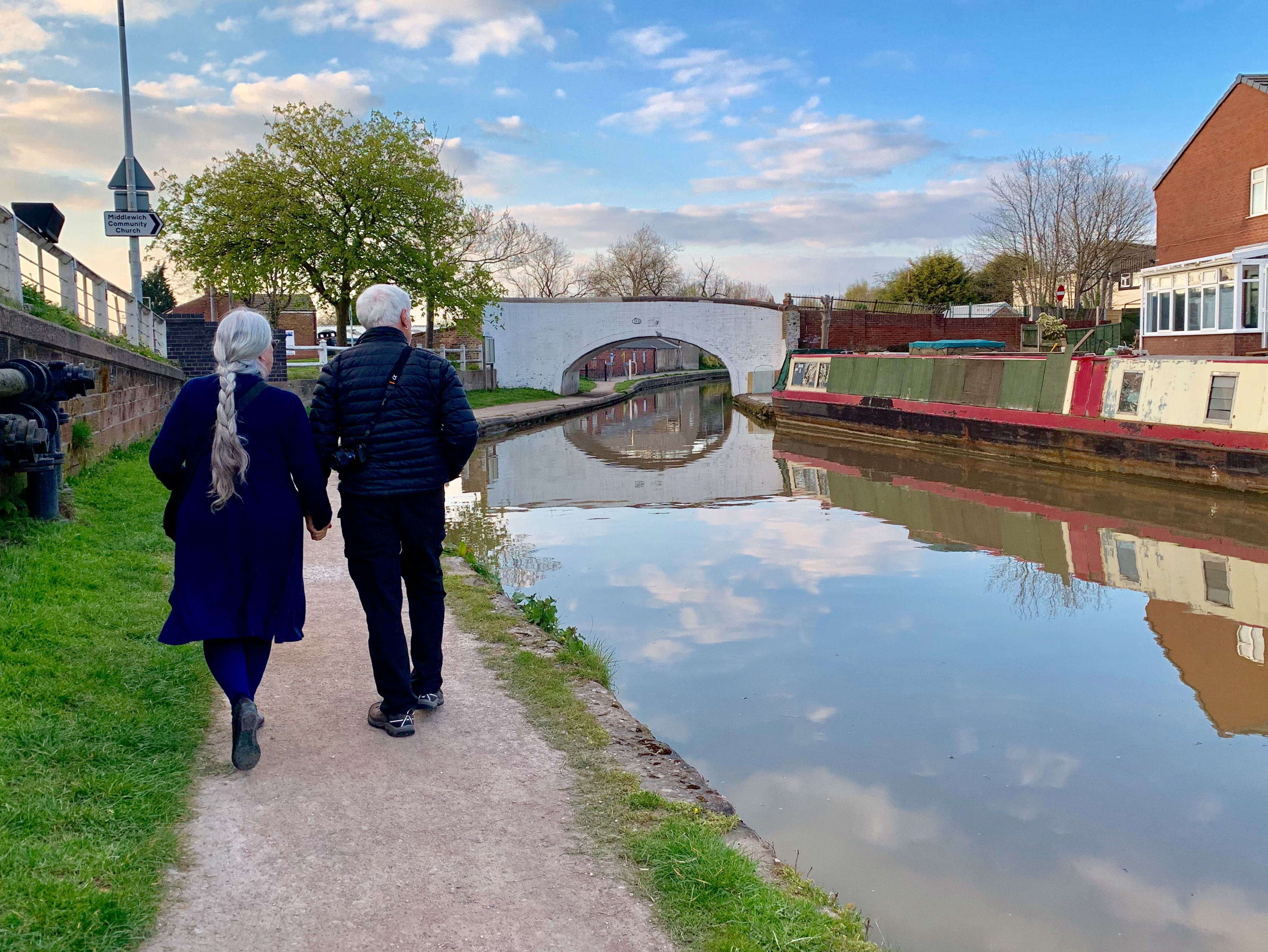
Solitary pilots plying the canals of England are a rarity. The locks and drawbridges typically command the attention and efforts of at least two who are able bodied. We have observed that cruising couples seem to fall into a routine of cooperation, one manning the narrowboat and the other the onshore equipment. They are not gender specific roles. The mold set very early for us. Christine deferred the vessel to my skills even though the physical requirements of the lock gates and paddle gears are not insignificant. Her emotional comfort superseded her physical comfort.

In matters of seamanship it is customary for one person to be designated the skipper. This is not just mindless autocracy, but rather is a matter of safety that can even be lifesaving in an emergency. Committees may be well suited for contemplative decisions, but urgency requires immediacy. For on-shore relationships to survive off-shore protocols there must be respect and cooperation that flows in both directions. I can not imagine a dysfunctional partnership surviving long aboard any vessel.

The most successful relationships are not driven by gender stereotyping but rather by frank acknowledgment of the strengths that each partner brings to the union. If the husband has the patience and energy to manage home and children while the wife has the marketable skills to better command financial security, then logic should determine their roles. The partners and the children are the beneficiaries. Sadly, that runs contrary to long established social norms.

27 years ago Christine approached me with the idea of starting her own business. It required a significant financial investment, she would be giving up her regular paycheck, and we had 3 children ages 10 through 13 at home. She asked for my trust and confidence in her ability. She received both along with a good measure of encouragement and support. There were challenges through the years, but her’s was the hand on that tiller. Success followed her as it often does with capable and resilient people. Perhaps my most valuable contributions were not getting in her way and suppressing any tendency that I might have had toward being misdirected by ego. We, our children, and our grandchildren became the beneficiaries of those choices that we made.

Undertaking a “Canal Boat Holiday” has presented me with a metaphor for marriage. Canal boating is not for every couple, and neither is marriage. Ironically, I doubt that many people undertake the purchase or charter of a narrowboat without first critically examining their suitability for the venture. I have learned over my decades as a lawyer and mediator that folks often leap into marriage without giving the consequences a second thought. If canal boating doesn’t work out all one needs to do is exit the vessel. It is not so simple with a marriage.

Peace Everyone. Pete

PS. This bit of irreverent wisdom came to me recently from a friend: A man takes a wife believing she will never change, which she does. A woman takes a husband In the belief that he will change, but of course he doesn’t.

We arrived in Nantwich today on the Shropshire Union Canal. The plan is to remain in this port until Thursday, and then return to Middlewich Friday where we will be joined by our Canadian friends, Tom and Nanci. The weather is predicted to take an unfortunate turn for the week that they will spend with us, colder temps and rain. It is what it is. A bad day on the canal is still glorious.

The “wich” in Nantwich and Middlewich harken from the time of the Roman occupation and signifies a place of salt production. Salt had been produced here over the millennia not only as a condiment, but for the tanning of leather, as a food preservative, and for the production of world renowned Cheshire cheeses. At one time there were over 400 salt houses (16th Century), the last one closing in the mid-1800’s.

Nantwich is a larger community with a population of over 17,000. It is believed to have once been the location of a sacred pre-Roman forest grove worshiped by the Celts. It was listed as an urban area in the Domesday Book at the time of the Norman Conquest (AD 1066), though the Normans burned and sacked the town leaving only one building standing.

Disaster again visited Nantwich’s resurrected community in 1583. A massive conflagration again leveled the town, sparing only a few buildings. Queen Elizabeth I (1533-1603) personally contributed to the restoration of the community. From the ashes of that disaster arose a beautiful market center that, second only to Chester, boasts the highest concentrations of historically listed buildings in England. The town center is littered with buildings dating to the late 1500’s.

As we wandered the serpentine streets we beheld a beautiful church and green space. The green displayed a stone announcing that it was a sacred burial ground that had been “closed to new burials” for the last 200 years. Anglican St. Mary’s Church is the oldest listed building in Nantwich, and is stunning!

Construction began in 1286, was suspended from 1349 to 1369 by the Black Death, and then completed in 1390. The church twice served as a prison, once in 1644 following the Battle of Nantwich and again in 1648 during the 1st Jacobite uprising.

The church features scores of remarkable gargoyles, and a beautiful red sandstone exterior.

The interior is breathtaking, with colorful stained glass windows, and a choir comprised of 20 “misericords” which are 600 year old intricately carved wood choirstalls.

The St. Nicholas’ side-chapel features funerary effigies of a church founder, Sir David Cradock (d. 1390), and Sir Thomas Smith and his wife Dame Anne (dedicated 1614).

Another intriguing feature are the score of hand needlepoint kneeling cushions, they are in daily use and courtesy of the local guild.

This is a fitting place for a linger day on the canal. We look forward to visiting the many shops, taking a coffee and later a pint, and perhaps returning to the church for moment of contemplation and gratitude.

Peace Everyone. Pete

PS. Lest I have given conflicted messages regarding the current state of my spirituality, I offer the following: I believe in the philosophy and teachings of Jesus Christ, but not to the exclusion or rejection of all other faith traditions. I have long had difficulty with the “rules of religion”, but at two important times in my life I encountered priests who admonished me not to concern myself with the rules, but to listen to my conscience. The first of those meetings occurred when I was 20, the second when I was 60. Each priest was German and each “meeting” occurred in Europe during a rare visit by me to a Confessional. Each priest asked if I considered myself a “good person”, and then expressed confirmation that they believed that I was. As an act of penance, the second priest commissioned me to always listen to my conscious and be so guided the remainder of my life.

My difficulties with the state of many religions today are manifold: Many (not all) create god in man’s image and likeness. Many (not all) mispronounce “dogma” as “faith”. Many (not all) mispronounce “exclusion” as “inclusion”. And many (not all) adherents profess to follow the teachings of Christ but never stop to ask, “What would he have done”…

Again, Peace Everyone. Pete

We navigated 9 locks on our way from Wrenbury on the Llangollen Canal to to Nantwich on the Shropshire Union Canal. The entire passage took just under 6 hours and covered less than 10 miles.

Canal travel expands time and invites a microscopic examination of the flora, fauna, and folk that pass in slow motion before us.

It also creates a meditative climate for the examination of ones thoughts. Insignificant things trigger an expanded awareness like winter frost crystals blooming across an automobile windshield.

So it was as we approached a solitary lock in the countryside. No other vessel was in sight, yet standing sentinel at the lock was a lone gentleman who appeared well into his eighth decade. As is practice, I slowed before the lock to drop Christine off for her short trek to open the water gates and enable our passage. It is a job best accomplished by two, but she has become adept at fulfilling the duty single-handed. Unbidden, the elderly gentleman produced his own windlass handle and began operating the port side mechanisms as if he were one of the crew. With her own windlass handle Christine mirrored his action on starboard. I slowly piloted Salten-Fjord center between them into the lock.

The gentleman engaged me in conversation as I and our vessel slowly sank with the water level that was being released from the lock downstream. He provided me with some helpful insights into canal and lock conditions. He looked longingly at our vessel and commented approvingly at her condition and canal-worthiness. He then added that he loved life on the canals. It had been central to the years and memories that he and his wife shared. Unfortunately, she was no longer physically able to help aboard a narrowboat. A few years ago they sold their boat. Throughout our pleasant talk he smiled but his eyes were tinged with sadness. I imagined him returning to his wife at the end of the day with a cheerful greeting that fails to conceal the sadness from her. I further imagined that she assumes his burden through her faultless inability to return to their days together on the water. Love long held pierces the artifice that otherwise conceals deep feelings from the rest of the world.

The lonely lock keeper now tastes his moments on the canal with each passing narrowboat. How many of those who pass through pause to consider, “What I am, he once was. What his is I will become.”

Peace Everyone. Pete

It was not our intention to attend Easter services today. I rationalized that our cruising day was under the canopy of the Creator’s original church and that the music of the songbirds along the canal was a chorus unlike and beyond any composed by mankind.

The days leading up to Easter were peppered with not so cryptic messages from my Mother, “So Peter, do you have any plans for Easter?”, or “Will you be able to get off the boat on Easter?”…

I was raised in a very traditional Catholic family. Missing church on Easter would have been unthinkable. Even though I have become even less than a self identified “cafeteria Catholic”, and I find that my beliefs have wandered away from religion based theologies, I don’t think that I have ever missed attending church on an Easter Sunday. Today was to be the first exception, or so I thought.

5 hours on the canal brought us to a mooring near the town of Whitchurch in Shropshire. We intended to spend the afternoon and evening ashore and not stray out from the mooring. Easter assured that there would be no active commerce in town. However, restlessness after a day at the tiller compelled me to venture out on foot. Nearby I encountered an information board that touted the virtues of Whitchurch as the oldest continually settled community in the region, dating back to the establishment of a Roman garrison at 79AD. In Saxon times it was called Dodington, and it was mentioned prominently in William the Conqueror’s Domesday Book after the Norman conquest of 1066. Pictures on the signboard showed a liberal sprinkling of old waddle and daub buildings, one being a pub that dated to the 1,400’s.

I returned to Salten-Fjord and encouraged Christine to join me for a walk into town. A well kept footpath followed the course of a long abandoned canal into the town center. More signboards announced town history and prospects for a restoration of the canal into town including the creation of a marina. The canal system has become a powerful draw for tourist dollars/pounds, and Whitchurch is seeking it’s share.

The walk was about a mile, and wandering along the winding streets was rewarding to the eye. As I suspected, everything was closed with the exception of two pubs which were located across the street from one another, “Old Eagles”, and “The Bull’s Head”.

Raucous cheers emanated from Eagles as a crowd was watching the televised football match between Liverpool and Cardiff (Liverpool won, 2-0). The Bull’s Head, a quieter option, presented an opportunity for pleasant reflection over a pint. That concluded, we continued our winding walk through town back toward the canal.

Near the edge of the town center we came upon the edifice of Anglican St. Alkmund’s Church.

The doors were open and the interior invited me in for a look. A small group of seniors appeared to be gathering, but a very pleasant usher gave us some history of the church (see below) and encouraged me to take pictures.

The priest, Rev. Judy Hunt, bedecked in her traditional robes, was assembling the choir at the back of the church for their opening procession and song. As if reading my Mother’s mind, the usher handed Christine and me the Common Book of Prayers, Hymnal, and Service Program for the Evensong service. It seemed that my Mom’s prayers for the continued salvation of my soul had been answered. Beyond any intention on my part I found myself attending Easter services commemorating the most important event in Christendom.

Last year in Puerto Rico as we prepared to cross the Atlantic on a journey that would include walking the pilgrimage of the Portuguese Camino, our B&B host Eddie repeatedly admonished me, “Peter, in life there are no coincidences”. Perhaps our visit to St. Alkmund’s Church is another confirmation of those words.

Peace Everyone. Pete

We have returned to spend the night moored at Ellesmere… and so it seems has everyone else! This is Easter weekend and a prime time for narrowboaters. We secured the last available spot along the town wharf and took the opportunity to visit Tesco and re-provision.

Walking down the line of moored vessels we beheld an array of boats that shared only two characteristics, they are long and they are narrow. Beyond that there are some painted battleship grey, others in Scandinavian multi-color. Brass is polished on some, others not so much. At the extremes were vessels that could be classics in a museum and at the other end of the spectrum those that can only be described as “feral”.

We passed a real standout of the former category, the vessel Namaste. She was pristine, and supported a huge brass searchlight at the bow that was polished to a jewelry shine. It was the open hatches amidships that drew my attention.

For those who have ever visited a classic car show, you know how 60 year old Corvettes and 60’s era muscle cars are staged with hoods open to display spotless chrome garnished engines. Well, peering into Namaste’s open hatches I beheld the narrowboat equivalent. As I pointed out some of the finer details of this wonder to Christine, a very nice lady of our generation cautioned me, “If Les hears you he will talk your ear off and never let you go!” Of course, I thought she was merely being pleasant and not being literal. I was wrong on the second count. Les heard me, and like their little dog “Lucky” was on me like a Rat Terrier is on a rodent. We had just met two of the most likable folks (and their dog) plying these waters.

The couple have been together 6 years. Namaste is Les Walling’s third canal boat and clearly his passion. I wish that I had the time to more fully explore his life story, but I know that he has extensively traveled the United States, and he was once a well know off-shore powerboat racer (“Peter, In my past If it went fast I drove it… Look at me now throttled down to 4 miles per hour!”). Les told of his last vessel, nearly lost in a flood enhanced tidal current on the Thames near London. He and Sue were ashore when the unexpected surge tore his narrowboat from its bow and stern lines. Held only amidships, but cantered 90 degrees to the current she was beginning to roll and capsize. Lucky and all their belongings were aboard (Les and Sue are full-timers). In order to have any hope of saving the moment Les was forced to cut the boat loose and hope for the best. The best came in the form of crew aboard another vessel who leapt aboard, engaged the engine, and succeeded in bringing the boat back with nary a scratch! Another example of a boating “angel”.

Les is proud of his thick Lancashire accent. He makes no bones about retaining it untamed to his grave. I confess that there were times in the conversation that I thought I was listening to another language. Nevertheless I was able, at times with Sue’s help, to decipher most of the conversation.

For the mechanically inclined here are some of the details that Les shared about Namaste: She is a 60 foot long Tug-Narrowboat with thrusters fore and aft. The hull is new and he is in the process of designing the paint job that he will execute as a part of her fitting out. The engine, restored by Les, is a 70 year old Gardner 2LW that makes only 28 horsepower from her 2.8 liter displacement. What she lacks in horsepower she more than compensates for in massive torque. She turns a flywheel that is over 100 pounds, and in turn powers a huge prop through a modern hydraulic drivetrain. The engine idles at less than 400 rpms and makes 1,300 rpms at maximum throttle. She turns only 650 rpms to cruise 4 mph. Modern diesels will be decades in the junkyard when the Gardner is still powering boats on the canal.

Les has installed 8 solar panels, a 3kw inverter and has a massive bank of batteries with a capacity of over 1200 watts. Now back to the rest of you readers.

Les has Parkinson Disease. It is profound and he carries aboard a power chair as a mobility assist. Sue told me that when he announced his intention to take on the Namaste project and Gardner power plant restoration, she discouraged him because of his condition. He scoffed and said that he wasn’t done with life yet… and indeed the proof of those words is to be beheld in his craftsmanship and energy.

In this wonderful encounter I am again reminded that the rewards of travel are found in the people that we meet as much as in the sights that we see.

Peace Everyone, and Happy Easter. Pete

PS. This morning we bid farewell to our dear friend and travel companion Kris Ashton. We give thanks to her friendship which was a gift of our 2013 meeting while walking the 520 mile Camino in Spain. We look forward to future adventures with her. Christine and I are also looking forward to welcoming aboard our Canadian friends Tom and Nanci for our final week on England’s canals. That friendship was a gift of our 2018 meeting while walking the route of the Portuguese Camino. Buen Camino to All!