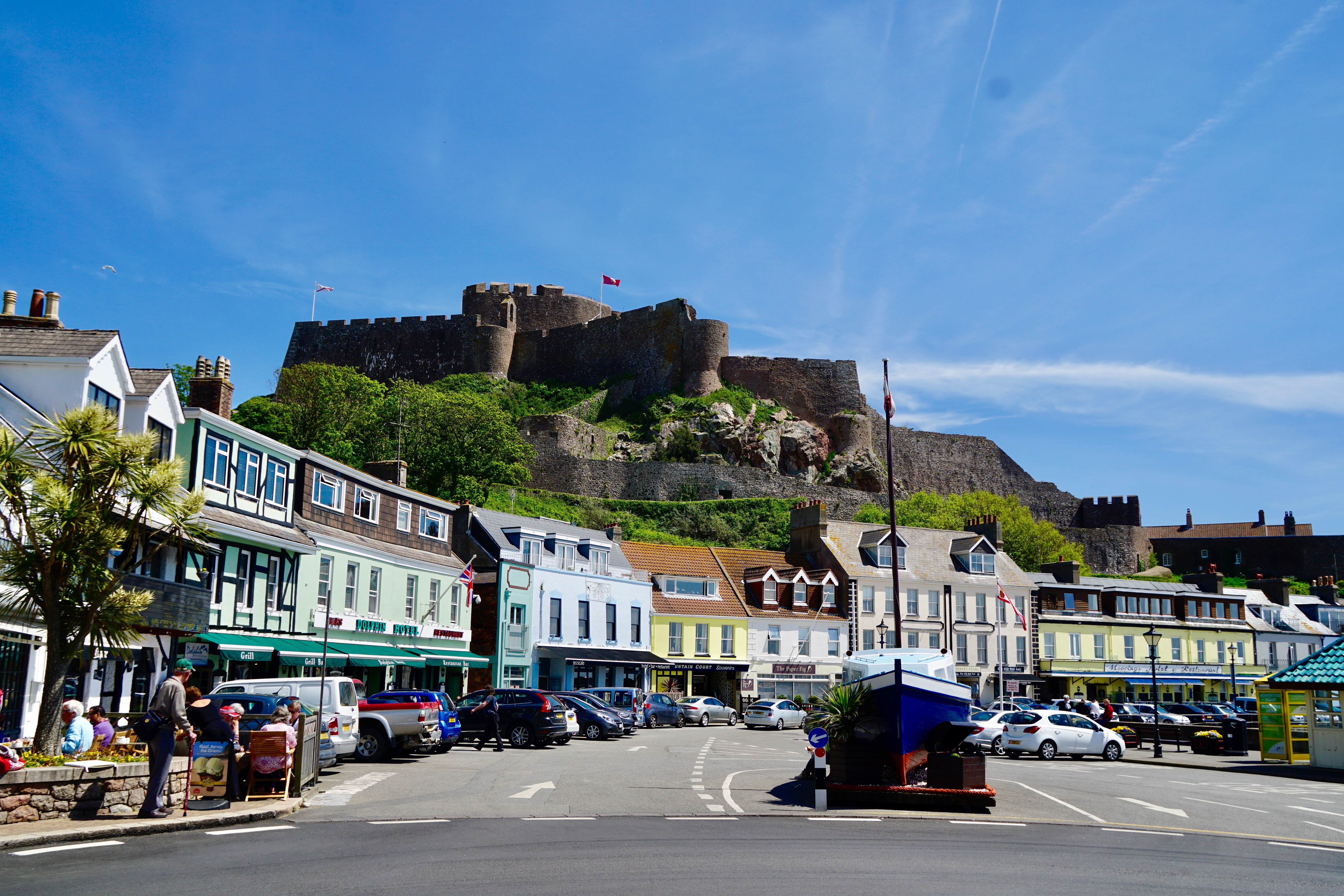
Our last day on Jersey Island was extended due to the change in the ferry schedule and ferry destination that was unfortunately imposed upon us. We took the opportunity to “make lemons into lemonade” by spending the day at Mont Orgueil, better known as Gorey Castle.

“Gorey” was built in 1204 upon a site that had featured fortifications for thousands of years dating back to Neolithic times. It remained Jersey Island’s primary defense until advances in gunpowder and cannon rendered it obsolete in the early 1600’s. Over the preceding 400 years Castle Gorey underwent many additions and improvements.

It was ideally situated for viewing the coast of (then) military rival France, only 14 miles across the water.

It again became important with the Nazi occupation in 1940. Those troops, with the use of imported slave labor, converted portions of the castle into reconnaissance and gun positions.

As currently presented, Gorey is a well preserved labyrinth of rooms, stairways, and passages. We frequently found ourselves turning a corner only to find that we had traveled in a circle.

It also has become a venue for a variety of interesting and unique art pieces that are relevant to the Castle’s place in history.

We boarded the ferry at 7pm for an 8pm departure. The terminal, and subsequently the vessel, were significantly more crowded than our previous two passages. This was due to the combined passenger loads of two ferries, the one we were on and the cancelled ferry we had intended to travel. Fortunately, we still were booked into a private en-suite cabin that allowed us a good night’s sleep and hot showers.

Not so lucky were most of the other passengers who passed on the extra cost of a cabin and instead curled up in whatever nook, cranny, or floor space was available to them.

Before bed Christine and I secured a table in the bar for a nightcap. Tables were at a premium so I held the table while Chris went for drinks. There were 4 chairs at our table, two obviously unclaimed. An attractive woman of our generation approached and asked is she and her husband might join us. This was the most fortunate question of the day as Liz and her husband Fred, who happened to be standing next in line with a Christine at the bar, were as pleasant a couple as one could hope to meet.

We spent the better part of 3 hours laughing and sharing our “stories”. They were originally from mainland England but years past had fallen in love with Jersey and made it their home. We agreed to meet for breakfast aboard ship at 6am prior to our arrival in Poole.

Before our evening ended the discussion turned to my annoyance with the change in the ferry itinerary and the challenges that this presented to us. A gentleman at the next table overheard and joined the discussion long enough to offer to drive us to our hotel in Portsmouth. This was Kevin, and his offered kindness saved us over 2 hours of travel and $150 dollars in added costs the morning of our arrival. Kevin declined our offers of compensation explaining that the detour only added a few miles to his trip home. Of course he was ignoring the fact that the rerouted ferry also impacted him. Sharing his cost would have been fair.

Liz, Fred, and Kevin are good examples of the friendliness and generosity that we have continually experienced in the UK. These good people are our “neighbors”, our Allies, our brothers and our sisters. We share the bonds of a common heritage. As a people, we should not allow those gifts to be thoughtlessly trashed by the whims of any one person or administration.

Peace Everyone. Pete

PS. The afternoon I typed the above (May 17th) we encountered a English gentleman who upon learning of our nationality waxed longingly of a trip he dreams of one day taking across the States traveling old Route 66 on a Harley Davidson motorcycle. His ardor had a pilgrimage quality and he specifically mentioned the “Rocket Man” statue located in Wilmington Illinois, a scant 30 minute drive from where I grew up. Pilgrimage may be defined as an intentional journey to a place of spiritual significance. Some may scoff at the notion that icons found along Route 66 are spiritual. However, spirituality is found within the pilgrim’s heart and not that of the audience. I understand how the dream of a journey feeds the soul, even if it is to stand at the foot of a 25 foot tall “Rocket Man”. I also know of two Scots from Glasgow, Sean and Garry, who understand this as well. We all need our dreams.

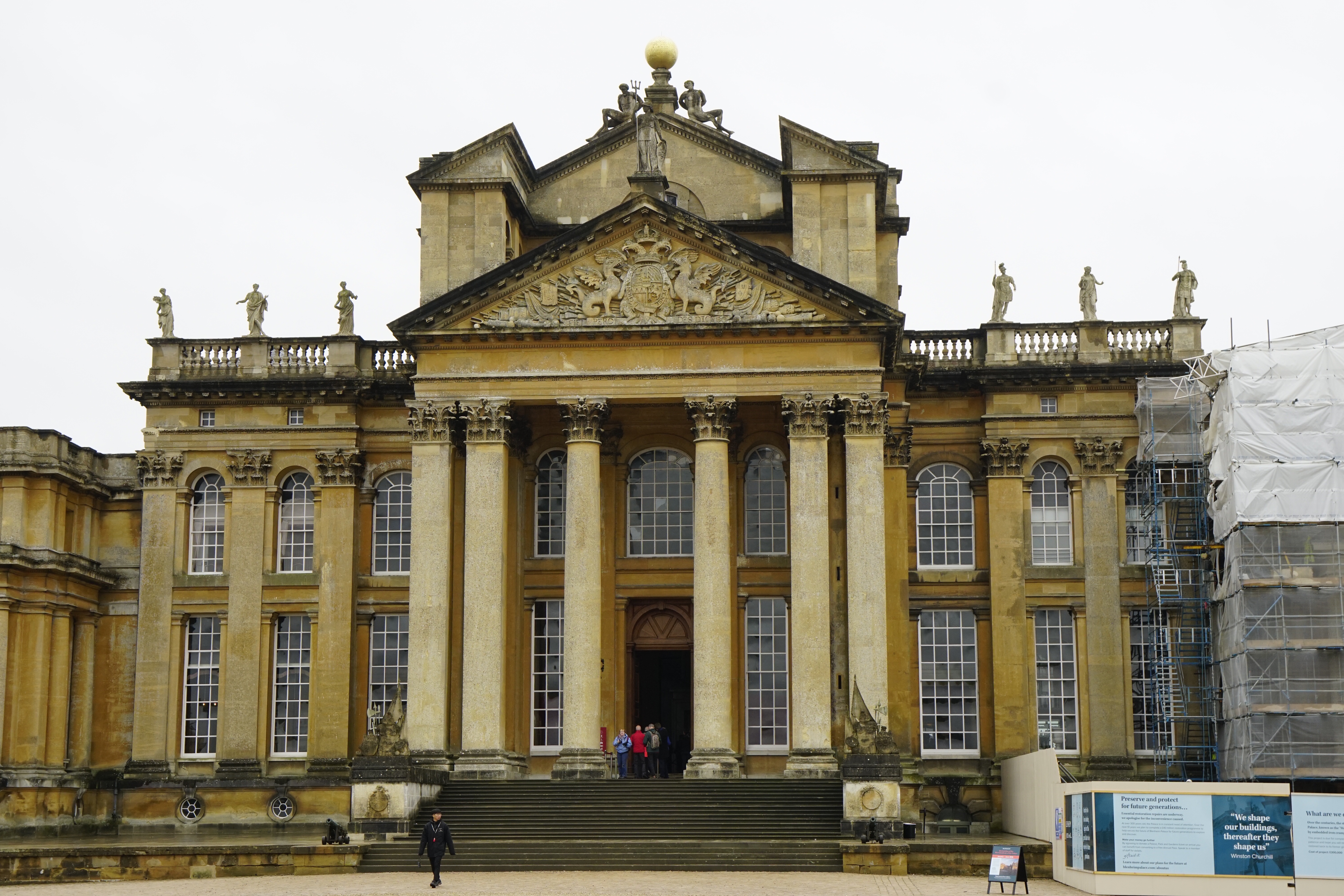
John Churchill was named 1st Duke of Marlborough by England’s King William III in 1702.

This was in recognition of his military service to the Crown. His career went on to amass a remarkable string of 26 military victories without defeat. Churchill’s most noted victory occurred at The Battle of Blenheim where over 100,000 troops were engaged in combat.

Churchill dealt a stunning defeat to the French army which suffered over 30,000 casualties. Churchill dispatched word of his success in a note that he personally wrote on a tavern bill.

Shortly after this victory the King granted him an indeterminate lease of the estate that came to be known as Blenheim in honor of that victory. In 1704 Parliament authorized nearly a quarter million Pounds for the construction of a palace upon the grounds.

The Duke contributed another 60 thousand Pounds. The result was the construction of the monumental Blenheim Palace, the only non-royal “country home” in England to bear the designation of “Palace”. It is now a UNESCO World Heritage Site.

England’s monarchy remains owner of the property so long as the Dukes of Marlborough continue to pay the “rent”, which consists of delivering a French battle flag to England’s monarch at Parliament each year on the anniversary of the Battle of Blenheim.

The First Duke died without a surviving male heir. Parliament acted to protect the family’s rights by passing legislation that allowed the Churchill family to pass and hold title through its females, the first and only time that such an Act has ever been granted. Twice this has preserved the family’s hold on Blenheim.

The Estate has remained in the hands of the Churchill’s and Spencer-Churchill’s for over 300 years and is currently the possession of the 12th Duke of Marlborough, James Spencer-Churchill. The Spencer line of the family included the ill fated Princess Diana. The Churchill line included the famous Sir Winston Churchill who was born on the property in 1874.

He is buried in a modest family plot in nearby St. Martin’s Church, at Blandon.

The Palace is incredible in its size, design, and contents. Upon visiting the estate one of England’s kings was heard to say, “We have nothing to equal this!”

The various reception rooms display remarkable art, priceless tapestries, and artisan created furnishings of incredible rarity.

There are 22 clocks in the palace, the oldest dating to 1690. They all are in operation and are maintained by a staff clockmaker.

The library is the second longest room in the entire United Kingdom.

Apart from the Palace’s historic interest, this was the birthplace and home of Sir Winston Churchill. A portion of the tour was dedicated to his memory and considerable accomplishments. Aside from his role as Great Britain’s Prime Minister during the 2nd World War, his oratory stirred the soul of the United Kingdom during it’s “darkest hours”. He was a polymath, accomplished as an artist who’s works (submitted anonymously) were accepted for exhibition at London’s Royal Academy.

He was also a Noble Laureate in Literature for his “…mastery of historical and biographical description, and brilliant oratory in defense of human values”. His life works include writing 42 books in 60 volumes, plus 5,000 speeches and articles… in all over 30 million words!

Sir Winston died January 24, 1965. He is only the 4th former Prime Minister in Great Britain’s history to have been afforded a full State funeral. 110 world leaders were in attendance and the ceremony was watched by over 350 million television viewers around the world.

Our evening and this chapter of our journey concluded with dinner at a Portuguese restaurant in Portsmouth England with our Welch friends Huw and Nina. My thoughts turned to a 15 minute encounter in Porto Portugal with Mafalda and Rita, 2 young ladies who extended us a favor. We consider them friends for life even if our paths never again cross. Our life has become punctuate by many of these friendships. Far flung places take on the faces of these people and become personal to us.

Just today these posts have been read by scores of people in at least 15 countries. In 1869 Mark Twain said, “Travel is fatal to prejudice, bigotry, and narrow-mindedness…” 2000 years ago Christ compressed his entire philosophy into a single admonition that directed us to love our neighbors as we love ourself. (Matthew 22:35-40)

“Neighbor” is not defined by race, creed, gender, or geography. A neighbor is any person who celebrates the birth of a child, or mourns a child’s death. A neighbor is one who’s empty belly craves a meal, or who rejoices at the breaking of bread with those who are held dear. A neighbor knows the sweetness of first love or the bitterness of first love lost. A neighbor is anyone who sings with the wind, smells the flowers, or smiles at seeing what is whimsical in the clouds.

Travel and seek your neighbor. Travel in your heart, travel with your mind, and travel to any place where a common language may be spoken with just a smile.

Peace Everyone. Pete

How many “Big Things” can one really expect to see and experience in the course of travel? Big Things are the major sites and attractions that are featured in tourist brochures, Trip Advisor, Wikipedia… They are the things that friends and family ask about upon our return home. 2 or 3 in a day? 7 or 8 in a week? Certainly not more.

The remainder of time on the road must then be occupied by something, and it occurs to me that they must then be the “Little Things”.

Little Things give context to be big ones. They provide texture and depth… they are the Kodachrome of daily reality that give the color of life to the otherwise black & white starkness of Big Things. They are also the overlooked joys that mindfulness reveals.

A warm shower is something taken for granted at home, but aboard a narrowboat where water conservation is required that shower becomes a celebration that sparks a 10 minute conversation.

A sunrise, a formation of clouds, a sunset. These are the ever changing “art” that hangs upon the endless horizon of our experience.

In the weeks of extended travel we compress a closet full of clothing into a small backpack. A change of socks or a fresh t-shirt bring an appreciative sigh to one’s spirit, not to mention the olfactory senses of self and others!

There are countless things that are taken for granted at home but become little moments of happiness on a journey. They are inadequate if measured against their home equivalents but become huge in the context of travel. Gratitude springs from the Little Things as awareness brings appreciation.

Relationships also come into sharper focus. At home we suffer the distraction and background “noise” of daily life, media, bills, house and myriad other duties. Appreciation for those we love often suffers accordingly. However, in the compressed spaces that we inhabit on the road attention is forced into a refreshed appreciation for the qualities of our life partner and for the absent loved ones who we miss.

The friendships that we share with our travel companions are not an occasional evening out, but are minute by minute experiences.

In 2001 a chance encounter at a restaurant in southern France brought our daughter Alexis into acquaintance with Huw and Nina Thomas of Wales. From that 20 minute conversation sprang a friendship that continues to this day. They have are like family to us.

In 2013 while Christine and I walked the Camino de Santiago in Spain we were passed afoot by another “pilgrim”. Peeking out from a recess on her backpack was a small stuffed bunny. That sight brought a smile to my face and sparked my greeting to the pilgrim. She was from Denver Colorado and the “bunny’s” name was Marshmallow. Conversation ensued, she offered to take a picture of Christine and I together, and what sprang from that insignificant moment was our enduring friendship with Kris Ashton.

In 2018 while we walked the Portuguese Camino a gentleman commented upon the hat that I was wearing. It was a “Tilly Hat”, made by a small firm in Canada and well regarded for sailing and travel. He commented, “Nice hat!”. I turned to see that he too was wearing a “Tilly”. Pleasant banter ensued which quickly included our spouses. They were from Ottawa Canada and the friendship that sprang from those hats brought Tom and Nanci to share this week with us aboard Salten-Fjord. How different life became because of a stuffed bunny and a couple of wide-brimmed hats.

Our “stories” abound with moments that seemed small and meaningless, but in the rear view mirror of time they loom large as the major crossroads in our life journey. One such moment brought Christine and I together. That “Little Thing” became the biggest thing in my life.

Peace Everyone. Pete

PS. Sometimes the “little things” come as sample sized glasses of really excellent British cask ales!

Solitary pilots plying the canals of England are a rarity. The locks and drawbridges typically command the attention and efforts of at least two who are able bodied. We have observed that cruising couples seem to fall into a routine of cooperation, one manning the narrowboat and the other the onshore equipment. They are not gender specific roles. The mold set very early for us. Christine deferred the vessel to my skills even though the physical requirements of the lock gates and paddle gears are not insignificant. Her emotional comfort superseded her physical comfort.

In matters of seamanship it is customary for one person to be designated the skipper. This is not just mindless autocracy, but rather is a matter of safety that can even be lifesaving in an emergency. Committees may be well suited for contemplative decisions, but urgency requires immediacy. For on-shore relationships to survive off-shore protocols there must be respect and cooperation that flows in both directions. I can not imagine a dysfunctional partnership surviving long aboard any vessel.

The most successful relationships are not driven by gender stereotyping but rather by frank acknowledgment of the strengths that each partner brings to the union. If the husband has the patience and energy to manage home and children while the wife has the marketable skills to better command financial security, then logic should determine their roles. The partners and the children are the beneficiaries. Sadly, that runs contrary to long established social norms.

27 years ago Christine approached me with the idea of starting her own business. It required a significant financial investment, she would be giving up her regular paycheck, and we had 3 children ages 10 through 13 at home. She asked for my trust and confidence in her ability. She received both along with a good measure of encouragement and support. There were challenges through the years, but her’s was the hand on that tiller. Success followed her as it often does with capable and resilient people. Perhaps my most valuable contributions were not getting in her way and suppressing any tendency that I might have had toward being misdirected by ego. We, our children, and our grandchildren became the beneficiaries of those choices that we made.
Undertaking a “Canal Boat Holiday” has presented me with a metaphor for marriage. Canal boating is not for every couple, and neither is marriage. Ironically, I doubt that many people undertake the purchase or charter of a narrowboat without first critically examining their suitability for the venture. I have learned over my decades as a lawyer and mediator that folks often leap into marriage without giving the consequences a second thought. If canal boating doesn’t work out all one needs to do is exit the vessel. It is not so simple with a marriage.

Peace Everyone. Pete

PS. This bit of irreverent wisdom came to me recently from a friend: A man takes a wife believing she will never change, which she does. A woman takes a husband In the belief that he will change, but of course he doesn’t.

We arrived in Nantwich today on the Shropshire Union Canal. The plan is to remain in this port until Thursday, and then return to Middlewich Friday where we will be joined by our Canadian friends, Tom and Nanci. The weather is predicted to take an unfortunate turn for the week that they will spend with us, colder temps and rain. It is what it is. A bad day on the canal is still glorious.

The “wich” in Nantwich and Middlewich harken from the time of the Roman occupation and signifies a place of salt production. Salt had been produced here over the millennia not only as a condiment, but for the tanning of leather, as a food preservative, and for the production of world renowned Cheshire cheeses. At one time there were over 400 salt houses (16th Century), the last one closing in the mid-1800’s.

Nantwich is a larger community with a population of over 17,000. It is believed to have once been the location of a sacred pre-Roman forest grove worshiped by the Celts. It was listed as an urban area in the Domesday Book at the time of the Norman Conquest (AD 1066), though the Normans burned and sacked the town leaving only one building standing.

Disaster again visited Nantwich’s resurrected community in 1583. A massive conflagration again leveled the town, sparing only a few buildings. Queen Elizabeth I (1533-1603) personally contributed to the restoration of the community. From the ashes of that disaster arose a beautiful market center that, second only to Chester, boasts the highest concentrations of historically listed buildings in England. The town center is littered with buildings dating to the late 1500’s.

As we wandered the serpentine streets we beheld a beautiful church and green space. The green displayed a stone announcing that it was a sacred burial ground that had been “closed to new burials” for the last 200 years. Anglican St. Mary’s Church is the oldest listed building in Nantwich, and is stunning!

Construction began in 1286, was suspended from 1349 to 1369 by the Black Death, and then completed in 1390. The church twice served as a prison, once in 1644 following the Battle of Nantwich and again in 1648 during the 1st Jacobite uprising.

The church features scores of remarkable gargoyles, and a beautiful red sandstone exterior.

The interior is breathtaking, with colorful stained glass windows, and a choir comprised of 20 “misericords” which are 600 year old intricately carved wood choirstalls.

The St. Nicholas’ side-chapel features funerary effigies of a church founder, Sir David Cradock (d. 1390), and Sir Thomas Smith and his wife Dame Anne (dedicated 1614).

Another intriguing feature are the score of hand needlepoint kneeling cushions, they are in daily use and courtesy of the local guild.

This is a fitting place for a linger day on the canal. We look forward to visiting the many shops, taking a coffee and later a pint, and perhaps returning to the church for moment of contemplation and gratitude.

Peace Everyone. Pete

PS. Lest I have given conflicted messages regarding the current state of my spirituality, I offer the following: I believe in the philosophy and teachings of Jesus Christ, but not to the exclusion or rejection of all other faith traditions. I have long had difficulty with the “rules of religion”, but at two important times in my life I encountered priests who admonished me not to concern myself with the rules, but to listen to my conscience. The first of those meetings occurred when I was 20, the second when I was 60. Each priest was German and each “meeting” occurred in Europe during a rare visit by me to a Confessional. Each priest asked if I considered myself a “good person”, and then expressed confirmation that they believed that I was. As an act of penance, the second priest commissioned me to always listen to my conscious and be so guided the remainder of my life.

My difficulties with the state of many religions today are manifold: Many (not all) create god in man’s image and likeness. Many (not all) mispronounce “dogma” as “faith”. Many (not all) mispronounce “exclusion” as “inclusion”. And many (not all) adherents profess to follow the teachings of Christ but never stop to ask, “What would he have done”…

Again, Peace Everyone. Pete