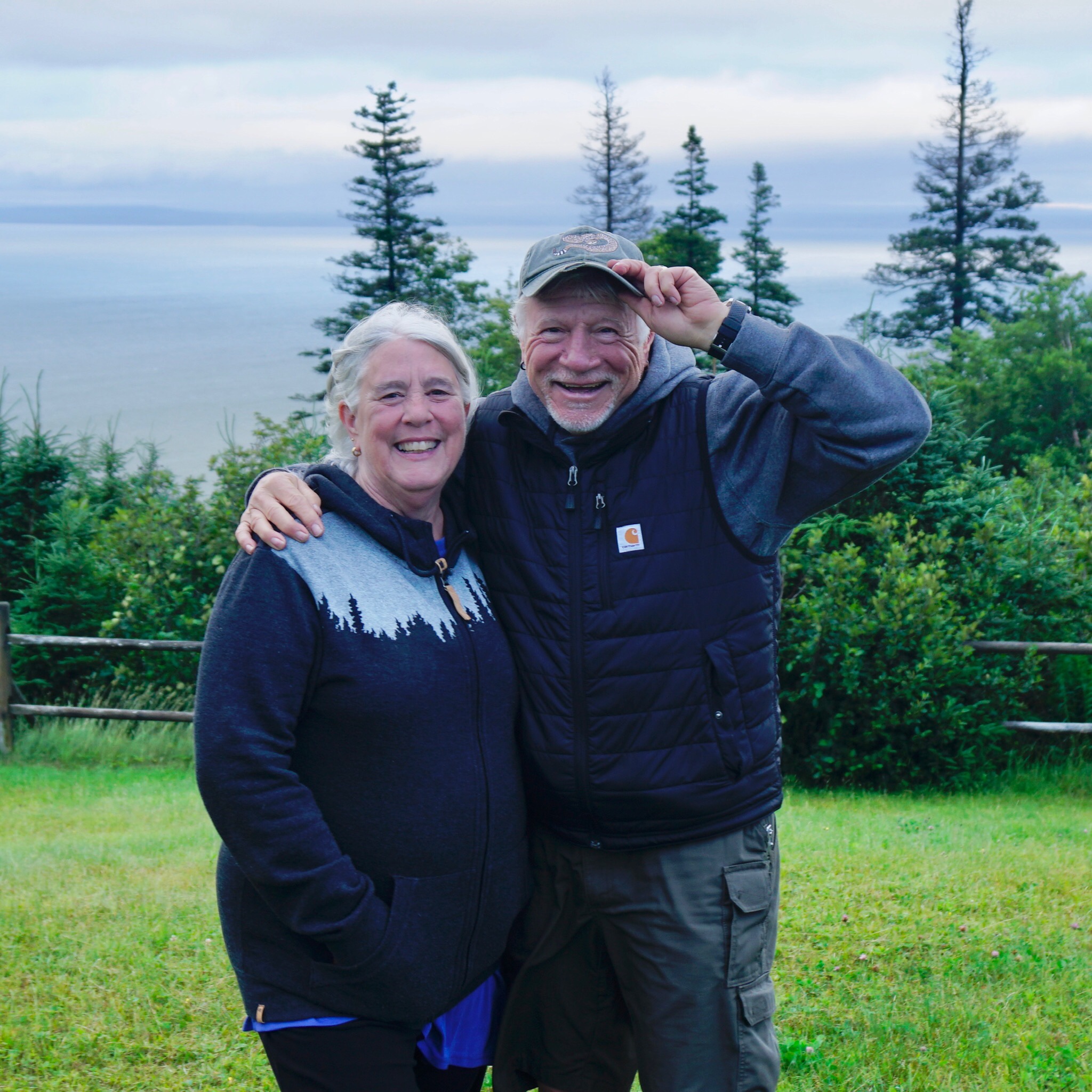
We have been camping the last 2 days in one of Canada’s premier National Parks, Gros Morne (“Lonely Mountain”).
At nearly 700 square miles this is the second largest of Canada’s Atlantic region National Parks.
It was first established as a National Reserve in 1973, achieving National Park status in 2005. It was designated as a UNESCO World Heritage Site in 1987, because “The park provides a rare example of the process of continental drift, where deep ocean crust and the rocks of the earth’s mantle lie exposed.”
This is one of very few places on Earth that its mantle, normally located deep under the Earth’s crust, is exposed. Rarer still, it is situated in a location accessible to people. We spent a part of yesterday “walking on the Earth’s mantle” on a park ranger led hike.
The geology of the mantle is stark and obvious.
On the right side of the road in this following picture are ordinary features, flora, and fauna. On the left, however is the mantle, dense heavy rock, laden with heavy metals and toxic to most plant life.
The sparse vegetation that does exist is courtesy of plants that have adapted, including a few species of insectivorous plants such as the Pitcher Plant, which is the Provincial flower of Newfoundland and Labrador. These plants eat bugs.
Another unusual adaptation pointed out to us is an ability of some plants to absorb and concentrate the toxic minerals, thus becoming poisonous to animals and insects that might otherwise forage upon them. One such plant ( perhaps field chickweed?) concentrates the toxins into one sacrificial leaf that becomes dark purple and when the leaf finally dies and falls off, the plant “designates” another leaf to take its place.
The mountains of Gros Morne are very old, originating 1.2 billion years ago, and being the northernmost extent of the Appalachian Mountains.
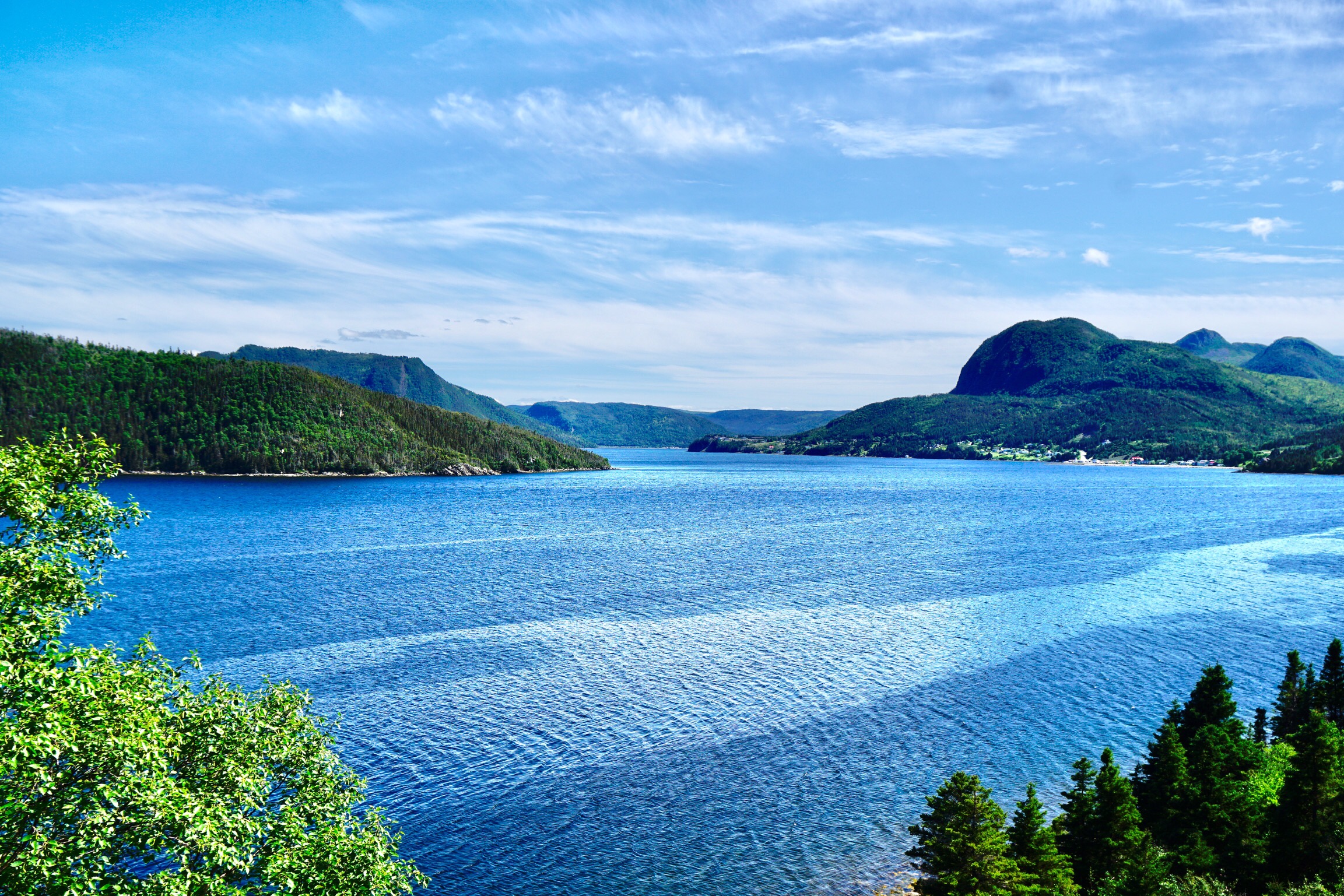
Located on the sea with deep valleys carved by glacier forces, the park also features both saltwater and freshwater fjords.
This is a region which in years past had a significant logging economy, and still supports a fishing industry.
Today we head north 250 miles to the upper tip of Newfoundland’s western peninsula. We hope to see the remnants of a Viking village that dates to the year 900, and perhaps even an iceberg or two.
We will than return to Gros Morne, camping for 2 days near the seashore and, weather permitting, taking a day excursion on the waters of an inland fjord.
After 3 years of COVID delay, we have finally set foot on the soil of the Canadian Province of Newfoundland and Labrador.
It’s a big place, slightly larger than California, with Newfoundland ranked the 16th largest island in the world. Except by air, getting here is not easy, There is an overland route from Quebec across Labrador through hundreds of miles of wilderness with part of the highway being gravel. It is so remote that at either end one is encouraged to rent a satellite phone that will be turned back in at the end of the crossing.
The alternative is the super-ferry from North Sydney, Nova Scotia.
There are two possible destination, either 17 hours to Argentia, or 7 hours to Channel Port aux Basques. We opted for Port aux Basques (@ pop. 5,000}, which leaves us a drive of nearly 600 miles to the main population center and Provincial Capital, St. John’s.
The ferry is not cheap, especially when one is pulling a trailer.
The cost is based upon length, and we total 35 feet, just under US $600.00. This did not include a state room, all of which were already taken, but did include reserved seats which are similar to upgraded economy seats on an airplane. They were ok for sitting, not so much for sleeping, which is preferred since the crossing starts at 11:15 p.m., with an early morning arrival.
The 100 million dollar ship is immense. 650 feet long (that’s over two football fields), 90 feet wide, and able to accommodate 1,000 passengers, 425 cars, nearly 200 commercial trailers, and nearly 100 tractor-trailer combos.
Because of the area it serves it also has some icebreaking capability. There is a bar, restaurant, and some shops aboard. However, this was no cruise ship.
We arrived in Port aux Basques excited, but exhausted. Fortunately, J. T. Cheeseman Provincial Park was only a 10 minute drive from the ferry dock. Officially, check-in is 2 p.m., and we were at the park at 8 a.m.. Since our site was unoccupied we were allowed to set up immediately.
The campground is clean, well organized, and there is wifi outside of the admin building, but no cell service. I am afraid that communications will be a challenge as we proceed.
The surrounding land is reminiscent to us of Iceland, rugged with many rock outcrops. For the most part there is little real forest, the park being an exception.
We are near the seashore and its long sandy beach.
Not far from the park is the Cape Ray Lighthouse.
These waters have been served by a lighthouse at this location since 1871. It is also the location where an underwater telegraph cable was laid in 1856, thus completing the first leg of the Trans-Atlantic cable.
This area has also been identified as hunting grounds for the ancient Dorset people, Who seasonally inhabited these shores from 2000 until 1200 years ago. The area derives its name from the Basque peoples of northern Spain who established camps here, seasonally fishing and hunting whales in these waters in the early 1500’s, some believing they did so before Columbus “discovered” America.
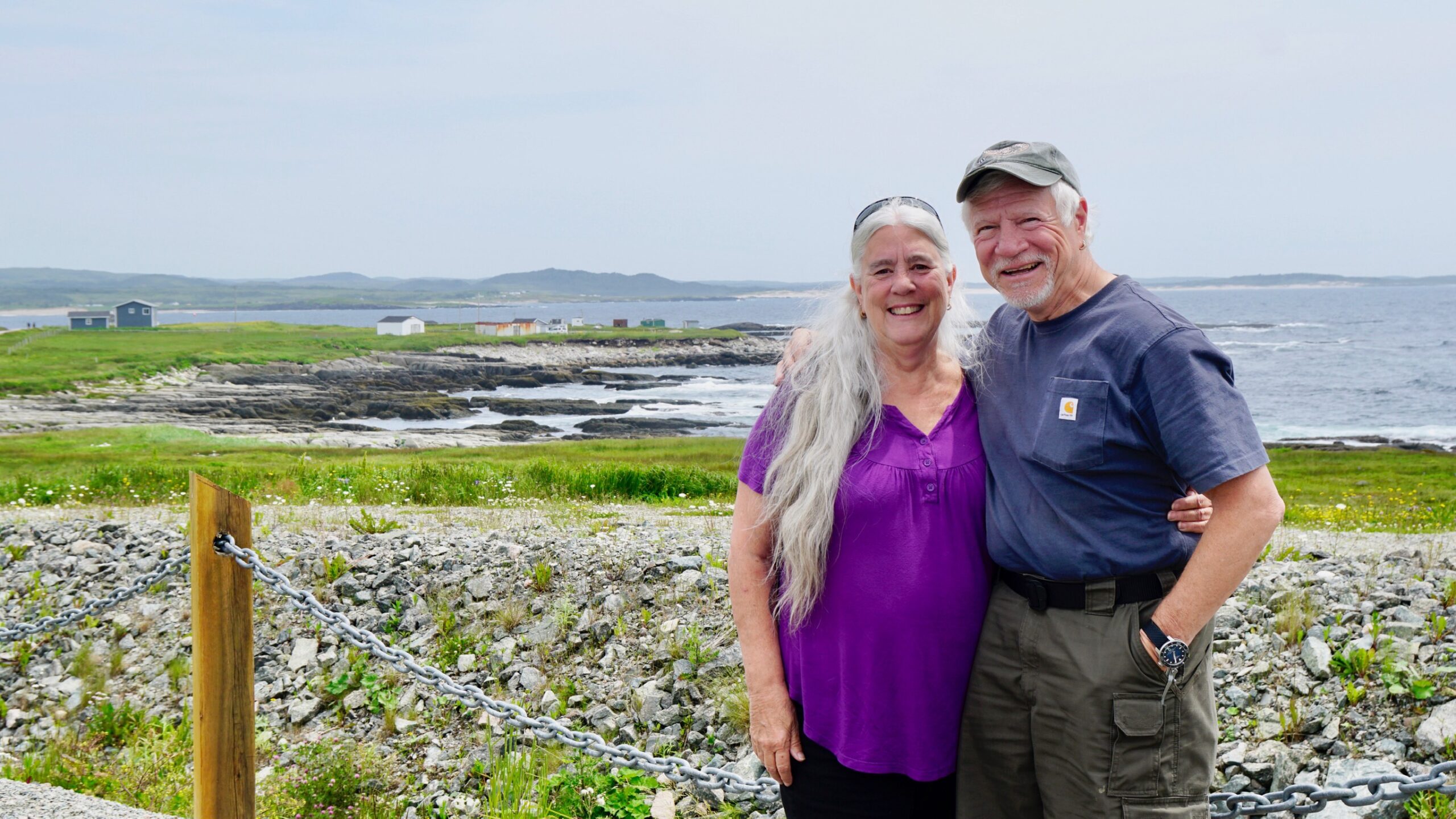
The lighthouse is not open to visitors, but we spoke with the lighthouse keeper, Dale, who was mowing the grass. She kindly posed with Christine for a picture, but apologized that she was in her “mowing” clothes and not in her uniform.
She serves opposite another keeper, in alternating 2 week shifts.
Although it is mid-July, it is spring here because of the climate delay occasioned by the ocean currents. Wildflowers are in bloom.
Temperatures are mild, 60’s by day and 50’s by night., it can be rainy. It is our good fortune to be here in a dry spell which favors campfires and outdoor cooking. Rain is predicted for tomorrow which is when we have a 4 hour drive to our next stoop, Gros Morne National Park.
Peace Everyone. Pete
PS. We went to dinner this evening in a small seaside village about 15 minutes from camp. this was a “locals only“ restaurant as it is off the beaten tourist path. I spied on the menu, “cod tongues“. I had to try them. Cod don’t actually have tongues. This is a small cut of meat taken from the underside of the fishes throat. A delicacy in Newfoundland, not likely found many other places. Not bad!
Later this morning we will break camp from the two days we have enjoyed at Porter’s Lake Provincial Park, located 30 minutes drive from Halifax. Ahead of us is a 5+ hour drive to North Sydney, Nova Scotia, where we will board an ocean ferry at 11:15 p.m. for a 7 hour sail to Port aux Basques in Canada’s Province of Newfoundland and Labrador (NL).
The highlight of this stay has been our day spent yesterday at Halifax’s charming Harbourwalk tourist district.
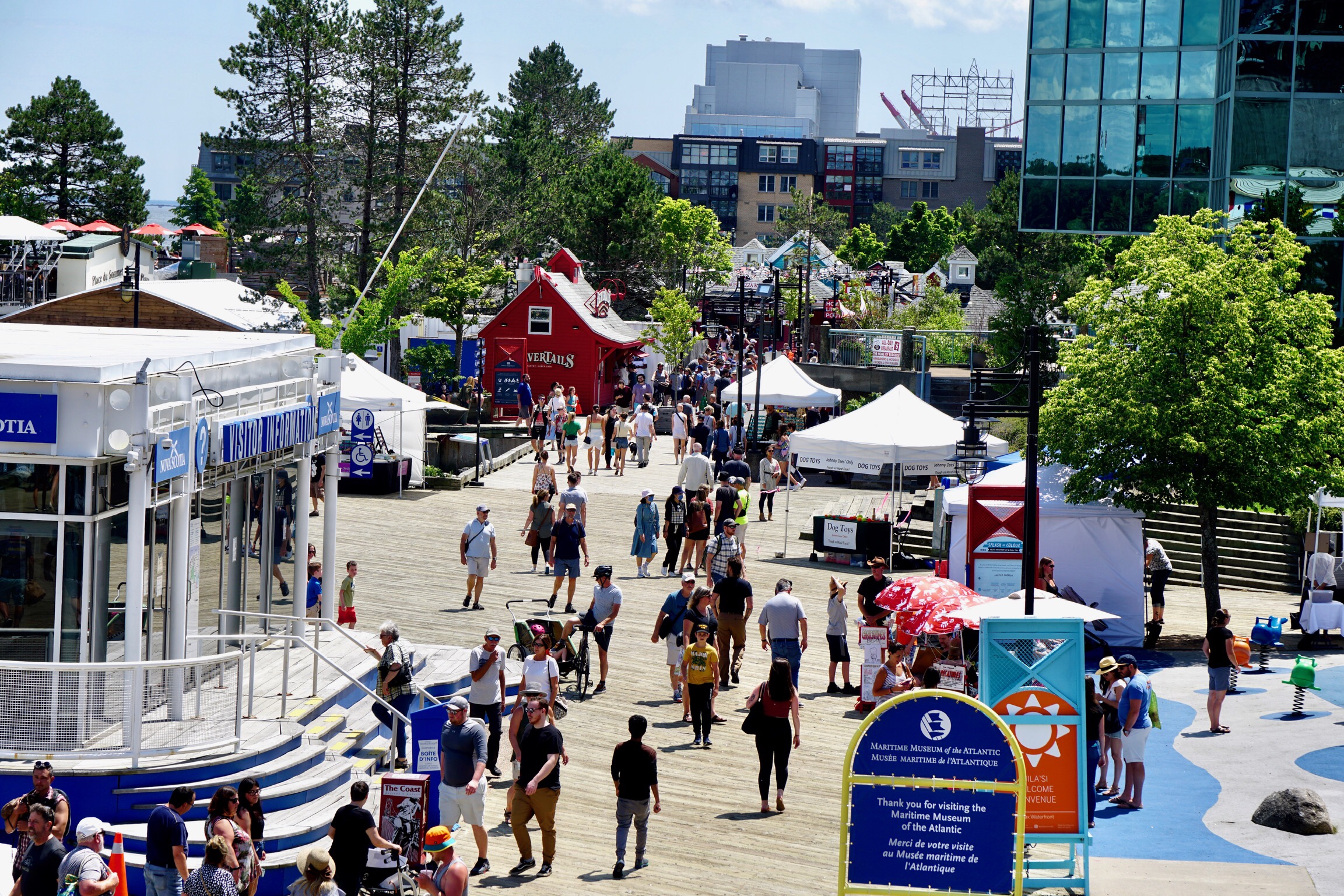
This boardwalk, nearly 2 miles long, fronts Halifax Harbor where there are restaurants, hotels, shops, kiosk vendors, and street performers aplenty. Fortune gifted us the perfect Saturday for the visit.
Halifax Harbor is the second largest of its kind in the world. With a population of nearly 450,000, Halifax it the largest city in Atlantic Canada. It is a center of culture, commerce, and education. Over a million souls have immigrated into Canada through Halifax. It’s Pier 21 operated from 1928 to 1971 as a major immigration processing station, comparable to Ellis Island in the United States. Today, Pier 21 is Canada’s National Museum of Immigration.
There is far too much to see in Halifax in just a day, so we limited ourselves to the Harbourwalk, and there to just a couple of the featured activities.
We spent pleasant minutes visiting with Glenna at Halifax Harbour Tours before purchasing tickets.
The one hour tour was conducted aboard a delightful vessel built by her husband. He also served as captain on the electric powered boat.
Many of the pictures in this post were taken from aboard the tiny ship that we shared with 7 others, including a couple and their two little ones from Germany. I enjoyed conversation with them in that country’s language. (Thank you Duo Lingo!)
Among the sites observed were:
The harbor lighthouse, which is the oldest in North America.
The historic Canadian research vessel, CSS Acadia, which was active from 1913 to 1969. This ship is the last one afloat in the world that actively served in both World Wars.
The Canada Naval Base at Halifax which had in port vessels that included a submarine.
And of course views of activity along the Harbourwalk itself.
Christine and I toured the World War 2 “Flower Class” Corvette, HMCS Sackville, the last of its kind in existence.
We also toured the extensive galleries of The Maritime Museum of the Atlantic. This museum had significant exhibits dedicated to the Titanic (the world’s largest collection of wood artifacts from that vessel), a remarkable collection of large scale ship models, underwater archeology, shipwrecks, and the Halifax Harbor Disaster of 1917.
A Mark V deep sea diving suit and helmet were among the displays. Manufactured from 1942 to this day, this is the classic piece of commercial and military deep sea diving equipment.
When equipped for use with special gasses, divers could descend over 1,000 feet below the surface. Among the grave risks associated with deep sea “hard hat” dives is that of an air valve failure. In order to operate at depth, air is forced down to the diving suit at pressure equal to that at the diver’s depth, often hundreds of pounds per square inch. If the air return valve fails the diver will immediately and fatally be subjected to that force upon his body. In extreme cases this has literally forced the diver’s body into the helmet, thus being “buried in his helmet”.
On December 6, 1917 two ships collided in Halifax Harbor. One was ladened with nearly 6 million pounds of high explosives which were being directed to the war effort in Europe. At 9:04 a.m. the cargo exploded, the precise moment recorded and frozen in time on the watches of the victims.
Over 1,700 people were confirmed to have died, with nearly 10,000 more injured. Tens of thousands were rendered homeless. Until the first nuclear bomb was detonated, this was the largest man made explosion ever. All buildings within a half mile radius in Halifax and Dartmouth (located across the harbor) were leveled.
The Coroner at the time, Arthur Barnstead (1873-1967) faced the monumental task of identifying, cataloging, and directing burial of the dead. He was aided by employing the systems developed by his father, John Barnstead (1845-1939) who faced the same gruesome task in 1912 with regard to the more than 1,500 victims from the sinking of the Titanic.
There are memories to the 1917 disaster throughout Halifax, the most prominent being the Town Clock on Citadel Hill.
The clock has kept time at that location since 1803. However the 1917 explosion stopped it, precisely at 9:04:35. The north clock face has remained thus fixed, while operation of the other 3 dials facing east, west, and south was restored.
As we neared the end of our day on the harbor I came upon a statue erected in honor of the Lebanese settlers who came to Canada over 130 years ago.
This was especially meaningful to me as both of my maternal grandparents immigrated to America in the early 1900’s from Beirut, Lebanon.
Peace Everyone. Pete
PS. We arrived at the ferry dock in North Sydney, Nova Scotia, too early for check-in. Parked in an abandoned gas station parking lot, we searched online for restaurant options. The only thing that came up for us was pizza and Chinese, neither of which were appealing. Soon, a car pulled up with four older adults who asked if we knew the way to “The Lobster Pound”. They explained that it was a small but well regarded seafood restaurant where reservations were required. Christine looked up the address and was able to provide directions. Thanking her profusely, the couples drove off.
After a brief discussion we decided to call the restaurant just in case a reservation was available. “Yes, but only for 5:30 p.m..”
The timing was perfect, as was Christine’s steak, the salads, ocean chowder, and my remarkable Lobster Thermidor! The Universe continues to smile upon us.
It is hard to imagine a greater contrast in two days than between yesterday and the day before. Nature traded in the cold, rain, and fog of Wednesday for sun-filled blue skies and balmy temps in the low 70’s. A steady breeze held off any lurking mosquitoes.
It was a good day for outdoor cooking which included baked blueberry muffins at breakfast. We invited Vermont campers Paul and Barb to dinner for Dutch Oven baked lasagna, salad, adult beverages, wonderful fellowship and delightful conversation. We hope that our paths cross again some day.
As Christine was assembling ingredients from our pantry for the lasagna she called out, “I only have one jar of Italian tomato sauce!” Thinking of options, I replied that we had a jar of medium-hot Mexican salsa, “Use the salsa. It’s made with tomatoes.”
Christine was dubious, but didn’t have a better idea. The Italian-Mex lasagna was EXCELLENT!
The day was also excellent for a 4+ mile hike through the woods and along the cliffs overlooking the Bay of Fundy.
This was topped off by a pleasant visit to the tidal flats at low tide.
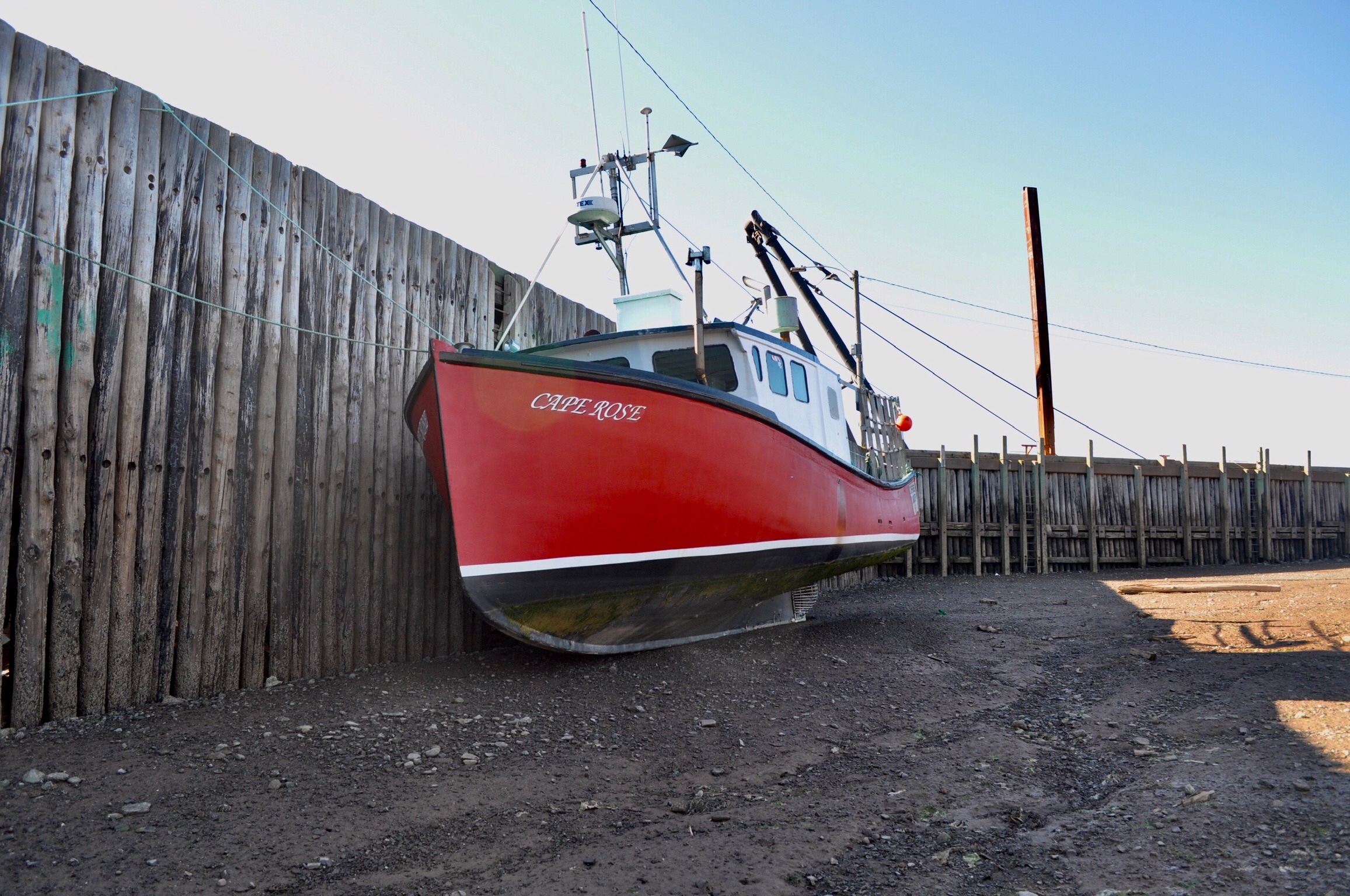
A small nearby fishing dock also illustrated the effects of the local tide.
The Bay of Fundy features the highest tides in the world. Far up the Bay the range can exceed 50 feet.
Here, mid-way up the Bay, the range approaches 40 feet.
At one location in the Bay the ebb tide creates a waterfall while the incoming tide responds by making fast-water rapids.
Approximately every 6 hours the tidal forces surge or ebb, thus bringing 4 alternating high and low tides each day. This has been referred to as the Earth’s heartbeat. Tides are produced by three forces: the gravitational pull of the Sun and Moon, and the centripetal force generated by the Earth’s rotation. Of these three the pull of the Moon’s gravity has the greatest influence on Earth’s oceans.
The geography of the Bay of Fundy, with its wide mouth and long narrowing channel, further magnifies the effect. More water flows either into or out of the Bay each 6 hours than flows in all the combined freshwater rivers of the world. Here is a link to a brief time-lapse video of the tidal swing at one dock on the Bay of Fundy.
Aside from being a marvel to observe, tides can be dangerous to the unwary. In 2004, Chinese immigrants collecting cockles were caught far out on the broad tidal flats of England’s Morecambe Bay. That bay’s 30+ foot tidal range overtook them, drowning 23.
In 2017 Christine and I were camped further up the Bay of Fundy on the New Brunswick side. Tides there ranged to 47 feet. We enjoyed walking out on the sea floor with the waters having receded out of sight, miles into the distance. However, park rangers provided us with a timetable and the warning, “If you are not back by this time, you will drown.” These three remarkable images are from that 2017 trip.
A fishing dock at low tide.Christine standing on the sea floor, the waters having receded miles ito the distance. In 6 hours the waters will be many feet deep where she is standing.
We are on the road again today headed to Porter’s Lake Provincial Park for a 2 night stay near the city of Halifax. This will be our final camp in Nova Scotia as we board the ferry on Sunday for Newfoundland.
We broke camp in the rain, we drove in the rain, we set up camp in the rain. Driving rain that all but defeated our windshield wipers. Fog at times so disorienting that it made me feel as if I was inside of a ping-pong ball. Over three hours of this on two lane roads and an hour after our arrival at camp my knuckles were still white. A damp relentless cold (thankfully!) made the mosquitos take cover, I care not where because it wasn’t around me.
Thinking about those little bastards I wondered how fast their wings must beat to make that infernal hum. The answer: 300 to 600 beats per SECOND! To put that into perspective, hummingbird wings clock at about 80 per second. Supposedly a mosquito can only fly about 1.5 miles per hour. They must set up a relay once they’ve set their sights on me.
Skies intermittently cleared of rain not long after we made camp at Blomidon Provincial Park located high on cliffs overlooking the Bay of Fundy.
However, temps continued to fall to just over 50 degrees. The winds picked up into the 30’s.
Blomidon PP is a pleasant surprise. Very basic campsites, but such a variety of settings. We are near the cliffside, somewhat sheltered by trees and scrub.
A short walk from us the campsites are in a broad open pasture.
There we spoke with Barb and Paul, campers from Vermont. We plan on sharing a campfire tomorrow provided that the winds subside.
On the way to Blomidon we stopped in the charming community of Kentville to do laundry. We plan on a longer visit when we again drive through on Friday as we head to Halifax.
Braving the elements this evening I pulled out the smaller of two Dutch Ovens to bake, or should I say over-bake, cornbread as a compliment to Christine’s split pea and ham soup.
We were able to enjoy both outside during a lull in the climatic action. Tomorrow is forecast to be pleasantly sunny with a high in the mid-60’s, mid-50’s at night.
In a moment of clarity at dinner “my muse” spoke to Christine. “I love what we are doing. It helps me to appreciate but not miss Kansas City. I love our life in Kansas City, yet while we are there I find gratitude for our life on the road. I look forward to our “next thing”, but not at the expense of embracing the moment.”
Earlier in the day at the laundromat I read an essay shared by a friend. The essay was written by a woman facing terminal brain cancer. In the “prime of her life” she was struggling to understand and accept her lot. During counseling she was presented with the question, “Are you running from death, or are you running toward life?” The question gives me pause, just as it did her.
Death is a destination we all will share. At 70 I see more and more acquaintances, friends, and relatives “exit”. Running from death is not only folly but the energy thus spent could be directed toward embracing the experience of life.
What is running toward life? One man’s answer:
“Sing like no one is listening, love like you’ve never been hurt, dance like no one is watching and live like it’s heaven on earth.” -Mark Twain
To this I will add: Don’t put off until tomorrow the things that you may find you are then unable to do.
Peace Everyone. Have Fun, Do Good, and for the sake of those who love you Be Safe. Pete