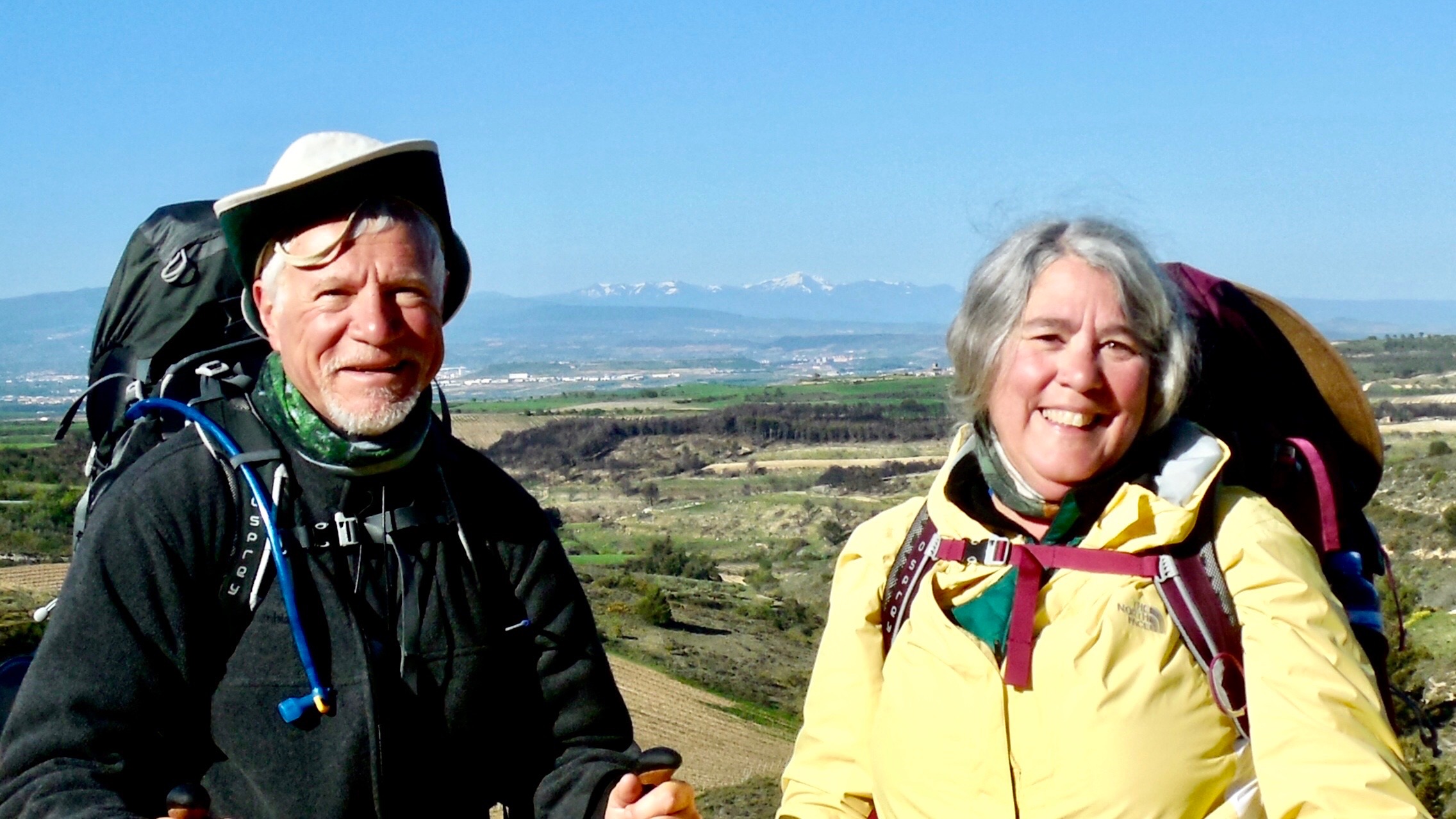
May 9, 2013. Astorga to Rabanal.

Our hopes were high that with our departure from Astorga we were also leaving behind the drama of the past two days.

The steel gray sky released a near constant drizzle that kept the puddles filled and shoes laminated with mud. At times the humidity was such that if felt like the mist formed under rather than over our rain gear.

In spite of these morning conditions the fact that we shared the path with like-minded souls made for a spirit of camaraderie more than equal to the elements.

Rabanal was 22km ahead, but more importantly we were now only 264km and 13 days from Santiago. Whether measured in days or in miles we were approximately two-thirds of the way to our final destination. This was not the home stretch, but I could sense its presence over the horizon.

It is often said that the Camino presents itself to the Pilgrim as three distinct experiences: first as a physical challenge, next as an emotional encounter, and finally as a spiritual awakening. It occurred to me that ours was thus far a textbook example of those words transformed into reality. I understood and expected the physical aspects that we had experienced. My still evolving focus upon self, others within the orbit of my life, and most of all my relationship with Christine was unanticipated and emotional. Spirituality? Speaking for myself, this was still more bucket list than pilgrimage. I was not looking for a spiritual experience.

The path that day avoided main roads and was almost exclusively a meandering walk through open countryside.

We would pass through 4 small villages before reaching Rabanal: Murias, Castrillo de Los Polvazares, Santa Catalina de Somoza, and El Ganso. The largest of these “Maragato” villages is home to fewer than 300, and most were suffering the ravages of time.

La Maragateria is a small and ancient historical region, with a distinct ethnic and cultural community, the Maragatos. Homes and buildings are of stone construction. Efforts to preserve the unique traditions seem linked to the failing efforts at preservation of the equally unique structures.

In the tiny and crumbling village of El Ganso stands the almost absurd “Cowboy Bar”.

We were greeted at the door by Ramiro, its owner and ”bartender”. It seemed that his total command of English was loudly calling out the words, “Whiskey! Whiskey! Whiskey!”, as if it was our responsibility to order up a shot or two.

However, when Christine replied, “Si!”, his smile and zeal slumped, and he politely shook his head, “no”. There were strong libations behind the bar, but perhaps it was too early, or possibly he did not wish to become the temptation that derailed her Camino that day. In any case we ordered non-alcoholic drinks which he cheerfully served, I took pictures, and we enjoyed the unique experience of “The Cowboy Bar”.

Spirits lifted, but not by alcohol, we continued our pleasant and picturesque hike through the countryside, arriving in Rabanal shortly after 2 p.m..

The tiny village (pop. 50) offered a surprising variety of lodging options capable of tripling the hamlet’s population. Among the alternatives were a 34 bed municipal albergue, a Hosteria, a small upscale hotel, two private albergues, and for up to 10 pilgrims willing to spend at least 2 nights, the Monastery of San Salvador del Monte Irago offered beds in its retreat house. We registered at the popular 76 bed Albergue Nuestra Senora del Pilar.

To say that this was a unique experience would be an understatement. First the good: The albergue offered a pleasant courtyard, bar, and restaurant. The staff was friendly, attentive, and the price was right.

The not-so-great parts centered upon the bedroom accommodations and lavatory facilities. 76 beds were tightly situated into two large dormitory rooms. The unisex bathroom contained only 2 water closets, 2 showers, and 2 sinks.

Except along the walls where single two-high bunks were reserved for unaccompanied females, 4 bunks were secured together in tandem, two up and two down. There was little room to stow our wet clothing and gear.

We had grown accustomed to sacrificed privacy, but Nuestra Senora del Pilar rose (descended?) to a new level. The feet in the toilet or shower stall adjoining the one you used could be male or female. The two sinks were so close to each other that bumping elbows while brushing ones teeth was almost unavoidable. Lines of Peregrinos “in need” formed before each toilet, shower, and sink. In the beds next to ours a young couple hung up their sheets so that we could not see the passion that we could not avoid hearing. In total the stay was an “interesting” experience that still brings a smile when recounted.

At the center of the town is the 12th Century Iglesia de Santa Maria.

This tiny church, cave like in its interior, was open for pilgrims to attend. 7 p.m. Vespers and 9:30 p.m. night prayers presented by the Benedictine Monks of the adjacent Monastery of San Salvador del Monte Irago.

Four of these monks, each originating from Germany, offered prayer in Gregorian Chant at Vespers. This moving ceremony was attended by us and perhaps 25 other pilgrims who filled the chapel to near its capacity. At the conclusion of Vespers one of the monks addressed the gathering saying that a monk would remain to speak with any Peregrino who wished to visit.

Christine and I exited the church to dusk falling on the small outdoor courtyard. It troubled me that no pilgrim had remained to accept the offer of the solitary monk who remained within. I hesitated. Christine turned to me, “You want to go back, don’t you?” After a pause I replied that it saddened me that no one had stayed to accept the monk’s offer. Christine encouraged me to return to the church. She promised to wait for me outside.

I entered the chapel’s dark and now silent interior. Barely visible in the flickering light of the votive candles was a bent and aging figure seated in one of the six ancient choir seats aligned along one wall. As I approached he made no acknowledgement of my presence other than to slightly move his hand, indicating that I should sit at his side…

To be continued. Peace Everyone and Buen Camino. Pete


May 8, 2013

“Sorry that I can’t finger type all the details, but keep in mind that the sculptures, manuscripts, paintings, and robes date to between the 13th and 16th Centuries. There are a few really bizarre paintings which are presentations of someone’s medieval idea of hell, and which gender is the source of temptation. Perhaps the alchemists knew how to cook LSD in the 1200’s.” Written at Astorga, Spain, May 8, 2013.

We arrived at the Renfe train station just outside of Astorga in mid-afternoon. The “adventure” that resulted in our transport by train is recounted in the previous post.

Astorga’s size (pop. 12,000) is less than a tenth that of other major population centers on the Camino such as Pamplona, Burgos, and Leon, yet its historical footprint is just as significant.

The region in which Astorga is located was home over 200,000 years ago to the earliest hominids known to inhabit the Iberian Peninsula. Archaeologists have found evidence and artifacts of metal tool making at Astorga dating to 2,750 BCE. Celtic cultures inhabited the area in the 3rd Century BCE, and the location was an important Roman military outpost beginning in the 2nd Century BCE. The civilian town was established by the Romans in 14 BCE and featured elaborate baths, a thriving mercantile center, and significant fortifications. Roman ruins still dot Astorga, and portions of Astorga’s present day sewer system were constructed by the Romans 2,000 years ago.

Astorga was at the crossroads of Rome’s important gold, silver, and commercial transportation arteries. It also remained an important military stronghold. Pliny the Elder called Astorga a “Magnificent City” in CE 73 as he wrote about the 560 mile long Via de la Plata (“Silver Road”).

In the Middle Ages, as today, Astorga was at the crossroads of two major Camino routes, the French route and the Via de la Plata. In Medieval times over 20 pilgrim hospitals were located in Astorga. One of Spain’s oldest and largest dioceses was established here in the year 747.

The city and its imposing fortification walls were immediately impressive as we approached on foot from the train station. The Cathedral and Gaudi’s Palacio Espiscopal (“Bishop’s Palace) were visible above the ramparts that date to the Romans.

The 3 star Hotel Gaudi would be our home for the night and was conveniently located across the square from the Cathedral and Palace.

Regrettably, we did not plan an additional day to explore the town’s other museums, 9 plazas, and Roman excavations. There was just enough time to enjoy visits to the Cathedral, Cathedral Museum, and the Palace.

Catedral de Santa Maria de Astorga was magnificent although not rising to the scale, grandeur,  or significance of the cathedrals in Burgos, Leon, or Santiago.

Construction of the Gothic cathedral began in 1471 and extended over a period of 300 years. Thus, it features a mixture of other design elements, Baroque, Renaissance, and neo-classical among them.

The interior vaulting is magnificent,

as are the 97 hand carved chairs in the choir.

Especially noteworthy is the High Altar and statuary created in 1558 by artist and sculptor Gaspar Becerra, a former student of Michelangelo.

It seems that every church and museum along the Camino has its own version of an image of Santiago (St. James).

The Cathedral Museum presented a treasury of ancient texts,

religious vestments,

remarkable statuary,

and works of religious art. Some truly bizarre, 

and others more conventional.

The crush of time and our desire to yet tour Gaudi’s Palace required us to hasten our visits through the Cathedral and Museum.

The Palacio Episcopal is  one of  only three buildings designed by Antoni Gaudi outside of Catalonia.

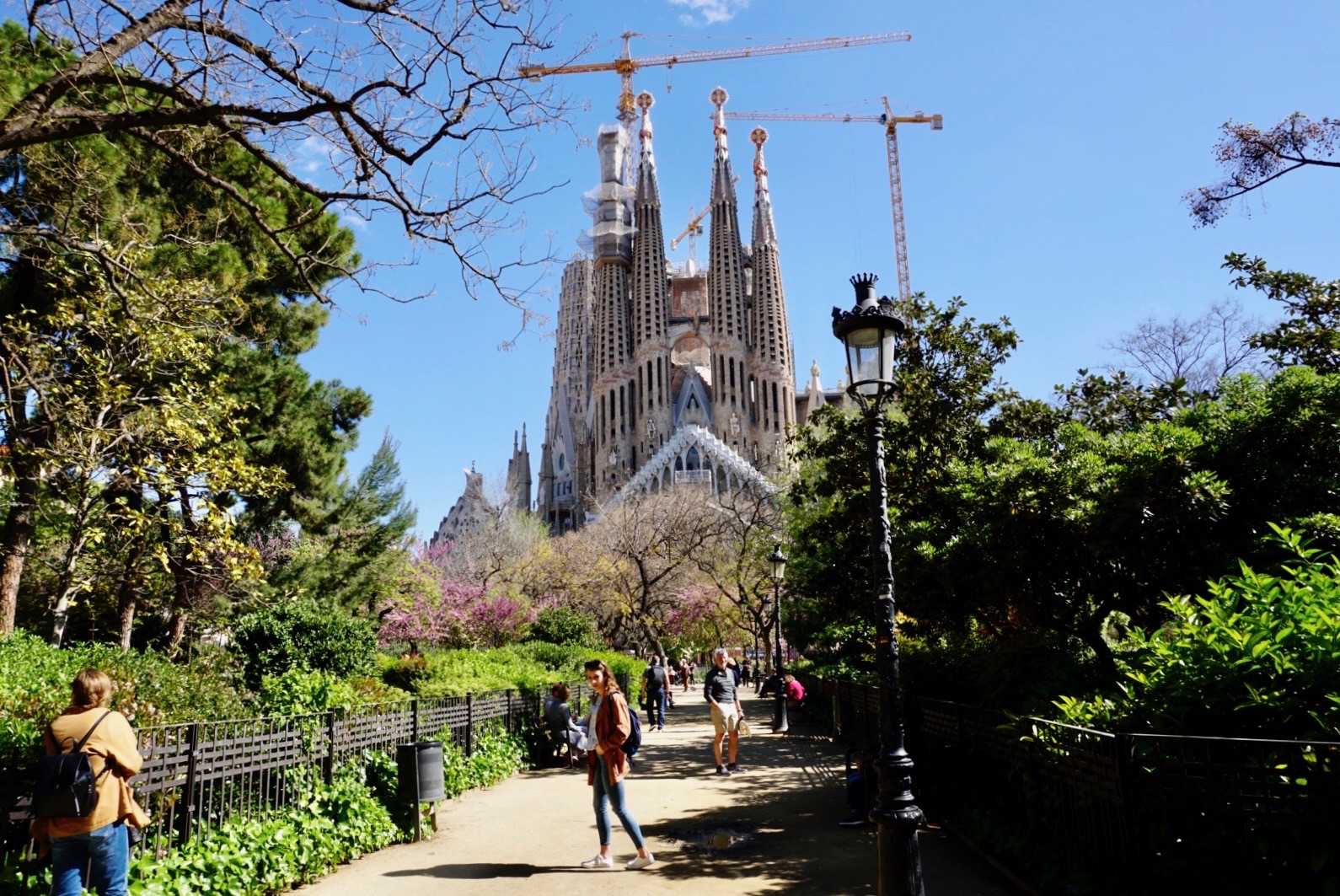
Gaudi agreed to undertake the project at the request of his friend Juan Bautista Grau, Bishop of Astorga. Construction began 1889 but was suspended shortly after Bishop Grau’s death in 1893. Disagreements arose between Gaudi and a committee appointed to oversee the continuation of Palace construction. Gaudi then permanently left the project in favor of dedicating the remainder of his life to the construction of the Sagrada Familia Basilica in Barcelona.  Construction of the Palace did not resume again until 1907. Management of the project was undertaken from that time to its completion in 1913 by Architect Ricardo Garcia-Guereta.

The building has served as a military headquarters during the Spanish Civil War, and since 1964 has been purposed as a museum dedicated to the Camino de Santiago. According to the Palace website it has never served its original purpose as residence for the Diocesan Bishop.

The Palace consists of 4 floors, including the basement. The collection of art objects deserves at least an afternoon’s visit. The Palace itself is remarkable art, worthy of focused examination. These few images that follow merely hint at the experience:

The chapel as seen from below and from the balcony above.

The throne room.

A dining/reception room.

A bust and statue of Mary, the bust dating to 1520.

Two sculptures of Santiago (St. James).

and the original Cruz de Ferro (CE 1000).

This iron cross was once mounted for veneration atop the highest point of the Camino. Today its place has been taken by a replacement where Peregrinos still stop to deposit a stone and perhaps pause for thoughtful reflection.

Peace Everyone, and Buen Camino! Pete


Man makes plans… and God laughs. (Proverbs 19:21.)

“Tomorrow I plan to bus out of Leon’s central city and 12km on to the end of the urban/industrial sprawl. I will then continue on foot from Hospital de Orbigo, site of a Medieval pilgrim hospital. It is also the site of an ancient bridge, portions of which date to Roman times. The bridge is 670 feet long and consists of 20 arches. My goal is to meet Christine in Astorga.”  -Written May 7, 2013 at Leon, Spain

May 7, 2013. Question: What could possibly go wrong? 

May 8, 2013. Answer: Everything.

What ALSA can go wrong!?! Leon to Astorga.

ALSA (Automóviles Luarca, S.A.) is Spain’s major bus and coach company).

6:30 a.m. I wake and pack for bus ride to Hospital de Orbigo to be followed by an 18km hike to Astorga.

Breakfast with Christine at the hotel. Goodbye kisses are exchanged. “See you this afternoon in Astorga!”

8 a.m. I arrive at the bus station and confirm at Passenger Information that the ALSA bus to Hospital de Orbigo departs at 8:30 a.m. from space #3.

8:30 a.m. The driver says he is not stopping at Hospital de Orbigo. He says that I want the 9:30 bus, space #3, which stops there.

8:45 a.m. I again “confirm” bus time, destination and space number at the ticket window. 9:30am, Hospital de Orbigo, space #3. Check!

9:45 a.m. No bus!!

10 a.m. Christine shows up to take the 10:15am bus to Astorga. She has her ticket. The lady at the (mis)Information counter says, “No problem, the driver sells tickets. I and a few other Peregrinos decide to take this bus.

10:15 a.m. Bus arrives, I place my pack in the luggage hold of the bus. The driver DOES NOT sell tickets! I and the other pilgrims make a mad scramble to the ticket window where the (not-so) helpful ALSA lady says that it is too close to the time of departure for her to sell us tickets. We need to get tickets at the ticket machine. A short walk follows and  THE TICKET MACHINE IS BROKEN. Christine rescues my pack from the hold of the bus just as the driver is closing the luggage door. Damn close call that! The bus leaves without Christine since she is waiting for me to return from the non-functioning ticket machine. After an “animated discussion” with the lady at the ticket counter Christine gets a refund.

11:15 a.m. We walk to the train station, buy tickets for the 1:53 p.m. train to Astorga.

So much for the peaceful 18km walk on the Camino. St. James may have attended Mass regularly, but he never had to deal with Mass Transit.

Epilogue: In less than an hour the high speed train deposits us at the station in Astorga. With 53km of the Camino thus “erased” we have time to check-in to the Hotel Gaudi,

and do justice to visits to the local Cathedral, Museum, and a Palace designed by Antoni Gaudi.

A 7 p.m. Peregrino Mass and dinner follow, all shared with my wife. The day’s cloud has a silver lining.

May 8th. Astorga. The Silver Lining on a “Cloudy” Day.

“Getting to Astorga from Leon was a grand “Cluster F***”! However, the afternoon was a wonderful surprise. Astorga is a town of 12,000, with world-class art, a 13th century cathedral, and a palace designed by Antoni Gaudi.” Written at Astorga, Spain, May 8, 2013.

Peace Everyone, and Buen Camino! Pete

PS. Pictures and narrative from the extraordinary sites seen in Astorga will follow in the next post.


May 6-7, 2013. Leon,  Spain.

The afternoon bus ride from Mansilla de las Mulas to Leon avoided an 18km slog through the industrial suburbs of Leon (pop.130,000) and further reunited me with Christine. Those gifts were not without cost. I lost the company of two dear Camino friends, Bernard (France), and Henk (Netherlands). I would again see Christine (Canary Islands), and Gabi (Germany) in Leon.

The trip into the central city was just long enough to process my thoughts from who I had left to who awaited my arrival.

The bus deposited me at Plaza Santo Domingo in the heart of the city’s tony shopping district.

A walk of less than 1km in the direction of the Cathedral took me to the remarkable three star Hotel Paris, just off from the Cathedral square. Christine had registered here on the 5th for two nights. Once in her room she had emailed me the name and address of the hotel along with the cryptic, “Wait till you see the hotel I found!” With some trepidation, I imagined her “find” might be setting a new upper limit on our expenditures.

As it turned out, 50€ per night bought us a pleasant room, breakfast, and best of all unlimited access to the heated indoor swimming pool and spa! It was indeed a marvelous find mere steps from the Cathedral. But I am getting ahead of myself.

Just before I reached the hotel a male and female voice called out to me from a sidewalk café. My eye was immediately drawn to Christine as she ran from an outdoor table to embrace me. The male voice belonged to our Camino friend, Brent, the former Los Angeles District Attorney who made his home in retirement with his wife in Barcelona. He beamed a huge smile, and I knew that before my pack hit the ground he would be ordering a beer to put in my hand.

It was a wonderful reunion, tarnished only by a stabbing pain in my left ankle. The pain had been with me in varying intensity since shortly after Pamplona. However, this was by far the worst it had been. After I sat for a bit I became concerned that I would have difficulty walking to the hotel. Christine and Brent were able to communicate my distress to our waiter. He returned with a plastic bag of ice. With shoe off, ice on, and a dose of heavy duty acetaminophen (“paracetamol” in Spain) I was afforded welcome relief. A beer or two also did their part.

When the celebration of friendship concluded Christine and I adjourned to the hotel where I took advantage of the spa and a long hot shower. Dinner followed with a further exploration of the many regional flavors of Morcilla (blood sausage). So far the variety served in Leon was the “soupiest” once the knife and fork broke the casing. Christine couldn’t watch, let alone taste.

Before we turned in for the night we enjoyed a quiet stroll and the ghostly apparition of the Cathedral by moonlight. Tomorrow we would explore the wonders within.

May 7, 2013.

“What the Burgos Cathedral was to stone, the Leon Cathedral is to light. Huge expanses of ancient stained glass are suspended in “heaven”. The artistic use of flying buttresses, vaults, and “stretched” columns of stone, conspire to join this world to the next. It is impossible to keep the eye from wandering (and wondering) skyward.”  -Written May 7, 2013 at Leon, Spain

Built between 1205 and 1301 the roots of Leon Cathedral’s foundations trace their origin to a huge 2nd Century Roman Bath whose footprint was larger than that of the Cathedral. Excavations beneath the Cathedral have exposed the 1,800 year old Roman stonework for study by historians and archaeologists.

Leon’s Cathedral is one of Spain’s three great “old world” religious edifices, the others being the Cathedral in Burgos, and the Cathedral in Santiago de Compostela. Like beads on a rosary, these great churches along with hundreds of smaller ones line the route of the Camino.

Leon’s Cathedral is of Gothic design, incorporating 125 windows and 57 oculi framing over 19,000 sq. ft. of well-preserved medieval stained glass into its structure. The exterior is spectacular.

The interior is majestic. Here is the most extensive and best preserved intact ancient stained glass collection in Europe, and possibly in the world.

The glass draws the eye skyward with its jaw-dropping height.

The Cathedral’s stained glass rosettes are not only a tribute to the art of the glaziers, but also to the stonemasons who constructed the intricate framing.

If the fine stonework and light airiness make the Cathedral appear fragile, it is because it is. Portions of the building suffered collapses in the 17th and 19th Centuries. Parts of the downed structure are displayed in the Cathedral courtyard. 

The Cathedral’s Museum houses a collection of over 1,500 precious objects from antiquity, both religious and secular.

Beneath the main altar is a large silver reliquary urn that contains the earthly remains of Saint Froilan (832-905), Bishop and  Patron Saint of Leon.

The Cathedral abounds with not less than 14 striking side chapels, among them one housing the remains of Bishop Martin Rodriguez (d. 1242), who initiated the construction of the Cathedral.

The Chapel of Carmen contains the tomb of Bishop Rodrigo Alvarez (d.1232)

Another chapel contains the remains of King Ordono II (873-924), ruler of Galicia and Leon, who fought successful campaigns against the Moors.

There is the  Chapel of the White Virgin, the oldest chapel in the Cathedral,

and the Chapel of the Virgin of Hope. The polychrome on stone statue dates to the late 13th Century and portrays the Virgin as pregnant.

Leon, founded in 24 BC as a Roman military outposts, is certainly an international tourist  destination that has so much more to offer than the Cathedral. I regret that we could not take in more of the city. This is an omission that I hope someday to remedy on a future Camino.

The cool afternoon and clear skies drew fellow Peregrinos to gather at one of the sidewalk cafés.

It had been my habit on the Camino to wear two hats. While walking I sported a wide brimmed “Tilley Hat” favored by sailors and of Canadian origin. My symbol of post-hiking relaxation was an exchange of the “Tilley” for a proper Basque Beret that I had purchased in St. Jean Pied de Port. So popular was the look that a small group of pilgrim men impulsively walked to a nearby store and purchased berets for themselves. I am seen here with Brent and his USA Camino companion, Mickey, each wearing their new acquisitions.

Other familiar pilgrim faces that day included the Germans, Christine and Gabi (sadly, without Henk),

my Christine,

and the delightful Irish couple, Tony and Geraldine Linehan.

It was a very good day and I expected nothing less from the one to follow!

Peace Everyone, and Buen Camino. Pete

PS. Man makes plans… and God laughs. (Proverbs 19:21.)

“Tomorrow I plan to bus out of the central city and 12km to the end of the urban/industrial sprawl. I will then continue on foot from Hospital de Orbigo, site of a medieval pilgrim hospital. It is also the site of an ancient bridge, portions of which date to Roman times. The bridge is 670 feet long and consists of 20 arches. My goal is to meet Christine in Astorga.”  -Written May 7, 2013 at Leon, Spain

Question: What could possibly go wrong? 


May 5-6, 2013. Sahagun, Calzadilla de los Hermanillos, and Leon.

“Saint” (noun), A very virtuous, kind, or patient person…”

The Camino teems with pilgrims who by the above non-ecclesiastical definition are “saints”. As I came to better know one such Peregrino, his claim to “sainthood” was exceptional. I am confident that Dr. Bernard De Geeter would deny this mantle of “sainthood”. That would be just another proof of his entitlement to the accolade.

I was formally introduced to Bernard by Maggie on May 2nd in Carrion de los Condes. I recall first seeing him on April 25th in Belorado where he joined a group of us at a café. He appears that day within these posts as a “face on the Camino”.

Dr. Bernard De Geeter

Bernard was amiable, well dressed for a Peregrino, and appeared more fit than the average man approaching 70 years of age. He was quiet, but not unsocial or withdrawn. I really took notice of him when in the course of being introduced I learned that his Camino had begun on February 13, 2013, in snow covered Strasbourg, France, over 2,300km from Santiago. At the time we met he had already walked nearly 3 months and covered 1,900km. In my mind this did not qualify him for “sainthood”, but it was a pretty good start.

On the evening of May 4th Christine and I decided that the following morning she would leave by bus and skip ahead to Leon. I would resume walking solo, overnighting in Calzadilla de los Hermanillos on the 5th, then catch up to  her in Leon on the 6th.

Setting off at dawn it was my good fortune to run into Bernard about 1km out of Sahagun at the Puente Canto bridge. Sunrise provided excellent lighting for pictures. The bridge crossed the River Cea and was originally constructed by the Romans. It was given to later restorations in the 11th and 16th Centuries.

Shortly after meeting we encountered our mutual friend, Maggie. The three of us seemed to hold to similar paces, so  we walked in loose company on to our next destination.

Our goal for the day was the tiny village of  Calzadilla de los Hermanillos, (pop. 140) 14km distant.

No doubt we would have walked further except that the next village with any accommodations was another 25km beyond Calzadilla. Over the course of the next two days we would be walking one of the most open and rural regions of Spain’s Meseta.

Bernard and I got along well. He spoke English fluently and shared my willingness to exchange our “stories”. He explained that he was a pediatric cardiac surgeon. Digging deeper with my questions (and later with Google) I learned that he was internationally known for his pioneering work in the field that included the development of surgical procedures for children still in the womb. Another point in favor of “sainthood”.

As pilgrims do, we shared our reasons for walking the Camino. I was still “seeking adventure and adding to my bucket list”. I became embarrassed as Bernard revealed the following:

Bernard and a team of physicians spent 3-4 months each year traveling to various third world countries, volunteering their skills and providing free medical care to the poor in those nations. In Bernard’s case he had conducted thousands of lifesaving operations on children. (Yep, sainthood.)

What came next stunned me.  Bernard explained that he walked the Camino seeking the intercession of St. James, for relief from an emotional burden that he carried. Over the years thousands of poverty stricken parents walked hundreds of kilometers with their children seeking Bernard’s aid. Among them were those to whom he had to say, “I am sorry, but your child’s condition is beyond my ability to help.” With those parents he shares tears.

Then there were the other parents whose children he could help. “Peter, I feel so helpless that what I do for them does not change the poverty, hunger, and danger that they return to. I remember the faces of every mother, father, and child, those I cannot help and those that I can, but helpless to change the life that they are returning to.”

The pain in Bernard’s voice was palpable and drew from me both silence and tears. Above us were wisps of clouds that seemed to take the form of angels. I found that I walked with one.

We arrived in Calzadilla de los Hermanillos shortly after noon.

The town provided two options for the night, a humble 16 bed municipal Albergue, and a delightful private one, the 20 bed Via Trajana where private rooms were available.

Bernard and I elected to share one that featured twin beds and a private bath.

Via Trajana was also  known for its intimate dining and excellent wine cellar. We joined other Peregrinos, taking advantage of both food and drink that evening.

After dinner I took the opportunity to wander a bit and gather my thoughts.

Natalie, a pilgrim from France, made use of some extra butter left over from dinner to dress and waterproof the leather of her boots.

May 6th.

Up early the next morning, the near endless horizon drew me outside to witness the break of dawn.

On this day we would walk the finest section of extant Roman road in Spain of which our prior night’s accommodation was its namesake, the Via Trajana. The pristine condition of the 2,000 year old road speaks well of Roman engineering prowess.

It was once a main east-west corridor of commerce linking the gold fields of Gallaecia in the west, east through Astorga and eventually on to Rome. It was also a favored military artery for Caesar Augustus and in later centuries for the warring Moors and Christians, Charlemagne included.

In spite of its historical connection to centuries of commerce and violence the Via Trajana only presented us with peace and relaxing solitude.

I parted ways with Bernard as we neared the town of Mansilla de las Mulas where he intended to spend the night. On the other hand, I sought the bus depot in a different part of town where I could catch one of the frequent departures for an 18km ride into Leon’s city center. Christine had already been there since May 5th, staying in a hotel near the Cathedral and waiting my arrival. I would miss Bernard, but I would be joining my wife and missing a 4 hour slog through the industry and suburbs of Leon. Bernard and I continued to exchange emails over the remainder of the Camino. He even sharing a photo of the May 22nd reunion with his wife Catherine in Santiago and Catherine meeting Maggie.

My detour took me to the village of Reliegos (pop. 200) and through a neighborhood of curious “Hobbit Houses” which were built into the hillside. While some of these may have served as homes, most were “Bodegas”, where wine was stored at near constant temperature, protected from the scorching heat and sun of the Meseta.

As I neared Mansilla I saw in the distance a large pilgrim with a distinctive walk. I immediately knew it to be Henk. Rushing to catch up to him I saw that he had stopped to talk on his cell phone. This was not unusual for Henk as he maintained very close contact with his wife Alice back in the Netherlands. It was curious to me that the Germans, Gaby and Christine, were nowhere to be seen. The three of them usually traveled together.

Just before I reached him he clicked his phone shut and turned to face me. “Peeeter!” he exclaimed with his north European accent. “Henk, you saw me… where are Gaby and Christine?” “But of course I saw you. They are ahead waiting for us in the garden at the Albergue. I have just asked them to order our beers.”

A few minutes later Henk and I arrived at the Albergue, the ladies and two cold beers were waiting for us. Once more I enjoyed the company of, and a beer with, these dear Camino friends.

I didn’t know it at the moment, but this was to be the last time that I would see Henk in person. We remain in touch to this day. I am reminded that on the Camino “Buen Camino” is exchanged not only as a greeting, but also as an acknowledgement at parting that both the journey ahead and the future are unknown.

Peace Everyone. Pete

PS. During the 8 years that I attended Catholic grade school I was taught that there were only two ways of attaining Church recognized sainthood, being a martyr for the Faith, and being a Confessor (promoter) for the Faith, also called a “Soldier of Christ”.

As we walked across Spain I was occasionally reminded of the horrors of the Spanish Inquisition, the persecution of Jews, and the burning of alleged witches, all victims of religious persecutions at the hands of the Church.

It has been estimated that during its 350 year history (1478-1834), the Inquisition alone accounted for over 150,000 prosecuted and 5,000 executed.

In my adult years I am left to wonder whether those martyred “by the Faith” should not also have been declared saints.