Written April 26, 2013 at Villafranca Montes de Oca, Spain.

You may read this note literally, but please feel free to imagine this as any metaphor that your heart embraces.

In the months leading to our departure for Spain my thoughts were consumed with preparations for the Camino. The questions focused upon the selection of the best shoes, the proper sleeping bag, the finest backpack, but each choice involved the acquisition of property. Juxtaposed to this “preparation” is the reality that everything that I acquire becomes a burden that I must bear.

One example occurred during a visit to Moose Jaw, a backpacking store located in Kansas City.

Madison Avenue made its fortune by not only selling to the public’s needs, but by creating “needs” through marketing, and then selling those “needs” thus created.

As I wandered through Moose Jaw looking for “needs” that I was not yet aware of, I saw The Spork. It was a clever hybrid fork/spoon. Not only was the design brilliant, but it was executed in titanium! It weighed only a fifth of an ounce, virtually nothing. What a wonderful thing to have, “just in case”.

I bought the Spork, included it in my kit, and I have now carried it nearly 300 kilometers. I’m still waiting for that “just in case” moment to occur.

It seemed like such a good idea back in Kansas City, but so silly today. When I weighed my pack before departure I proudly noted that my “needs” for 2 months weighed only 23 pounds. When I set out on the Camino I was astounded to find that many Peregrinos carried packs weighing 15 pounds or less. I have yet to hear anyone complain that they didn’t bring enough “stuff”.

It is not that my Spork weighs too much, but that my pack (and my life) is FULL of “Sporks”.

Considering just the one Spork and doing a bit of math: Each step that I take on the Camino (and there are literally one million steps) involves the suspension and transport of that one-fifth ounce. In 5 steps I have moved an ounce; in 80 steps a pound. Over the course of my Camino the “ultralight Spork” has grown to become a burden weighing 12,500 pounds. My “ultralight-necessity” has turned out to be neither light nor necessary.

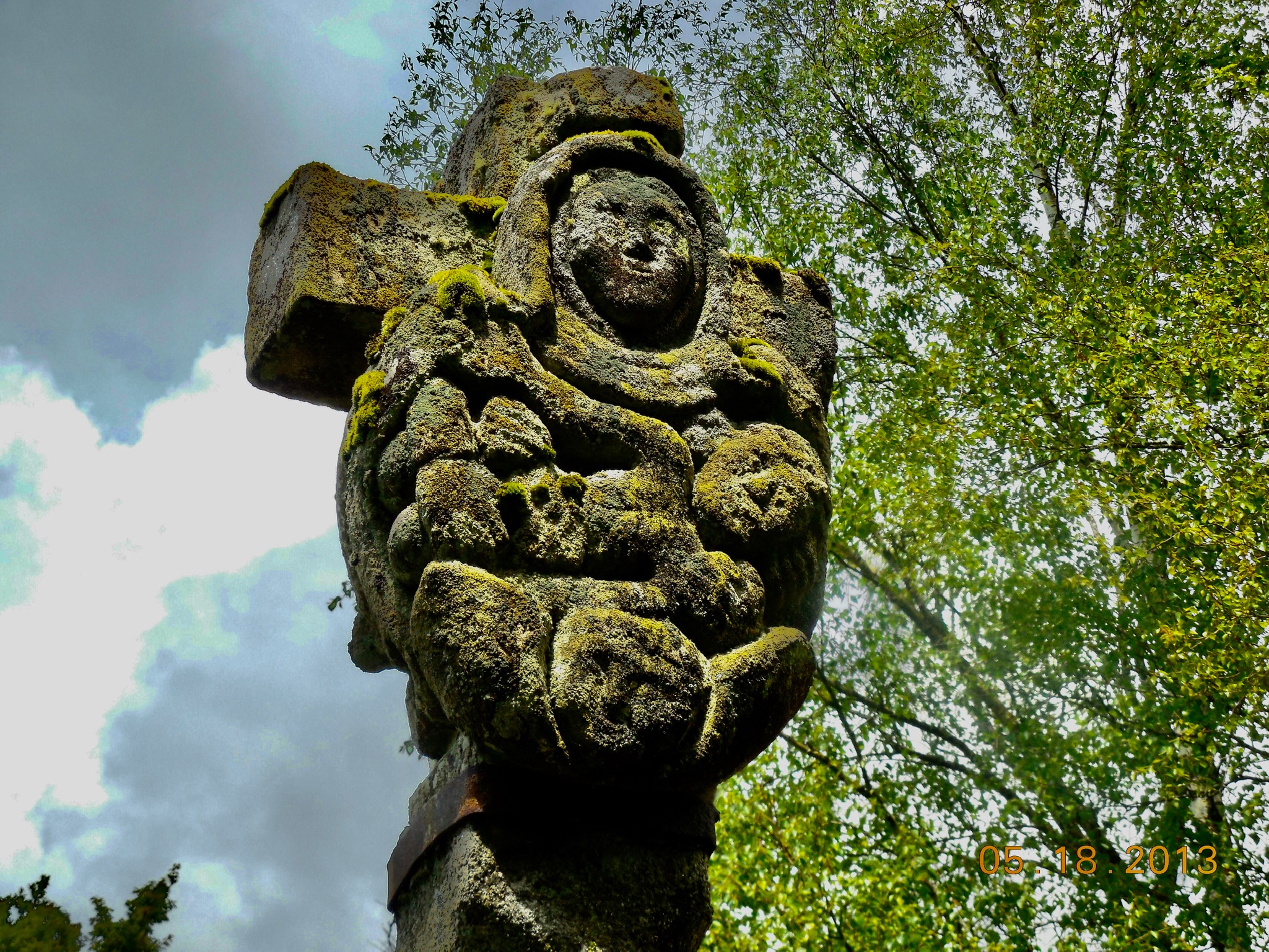
It is an ancient tradition on The Camino for a pilgrim to carry a stone on the journey. I have mine, brought from Kansas City. The Peregrino is called upon to deposit the stone, releasing their burden at the foot of the Cruz de Ferro (“Cross of Iron”) which stands at the highest point of the Camino (elev. 4950ft – 1500m). Tradition also holds that the pilgrim recite the following prayer:

“Lord, may this stone, a symbol of my efforts on the Pilgrimage that I lay at the foot of the Savior’s cross, one day weigh the balance in favor of my good deeds when the deeds of my life are judged. Let it be so, Amen.”

Centuries from now archeologists may puzzle over the origin and meaning of a mound of stones found high in the mountains of Spain. They may be further confused that in the rubble there is buried a curious eating utensil, not quite fork and not quite spoon, made of titanium.

Love to all. Have Fun, Do Good, and Be Safe. Buen Camino. Pete (and Chris).


April 26-27, 2013. Belorado to Villafranca and on to Burgos.

 We traded yesterday’s heat and sweat for a day of cooler rain threatening skies. I suspected that any pilgrims suffering from arthritis were reaching for pain relievers.

Our ponchos were made ready for deployment and gaiters were securely fastened to prevent any annoying trail mud from finding its way into our boots.

Villafranca Montes de Oca (pop. 200) was a mere 12km down the trail. However, there was reason for our abbreviated day. We had learned that the little community featured a private Albergue, San Anton Abad, that was meant to be experienced. More on that later.

We crossed the Tiron River via a footbridge that paralleled the Highway N-12 bridge that replaced the one built centuries ago by Santo Domingo.

The path was shared by creatures more adapted to the damp earth. In some cultures these giant mollusks would be welcome guests for dinner.

800 years ago in the tiny village of Tosantos (pop. 60) a woman known as La Ermita lived in a cave above the town. She spent her life ministering to passing Peregrinos. In her honor the town built a church into the cliff and still holds an annual procession in her honor to the cave.

Our way wandered through the pleasant square and fountain of even smaller Villambistia (pop. 45).

These micro villages as well as the yet smaller Espinosa del Camino (pop. 36) each featured small Albergues.

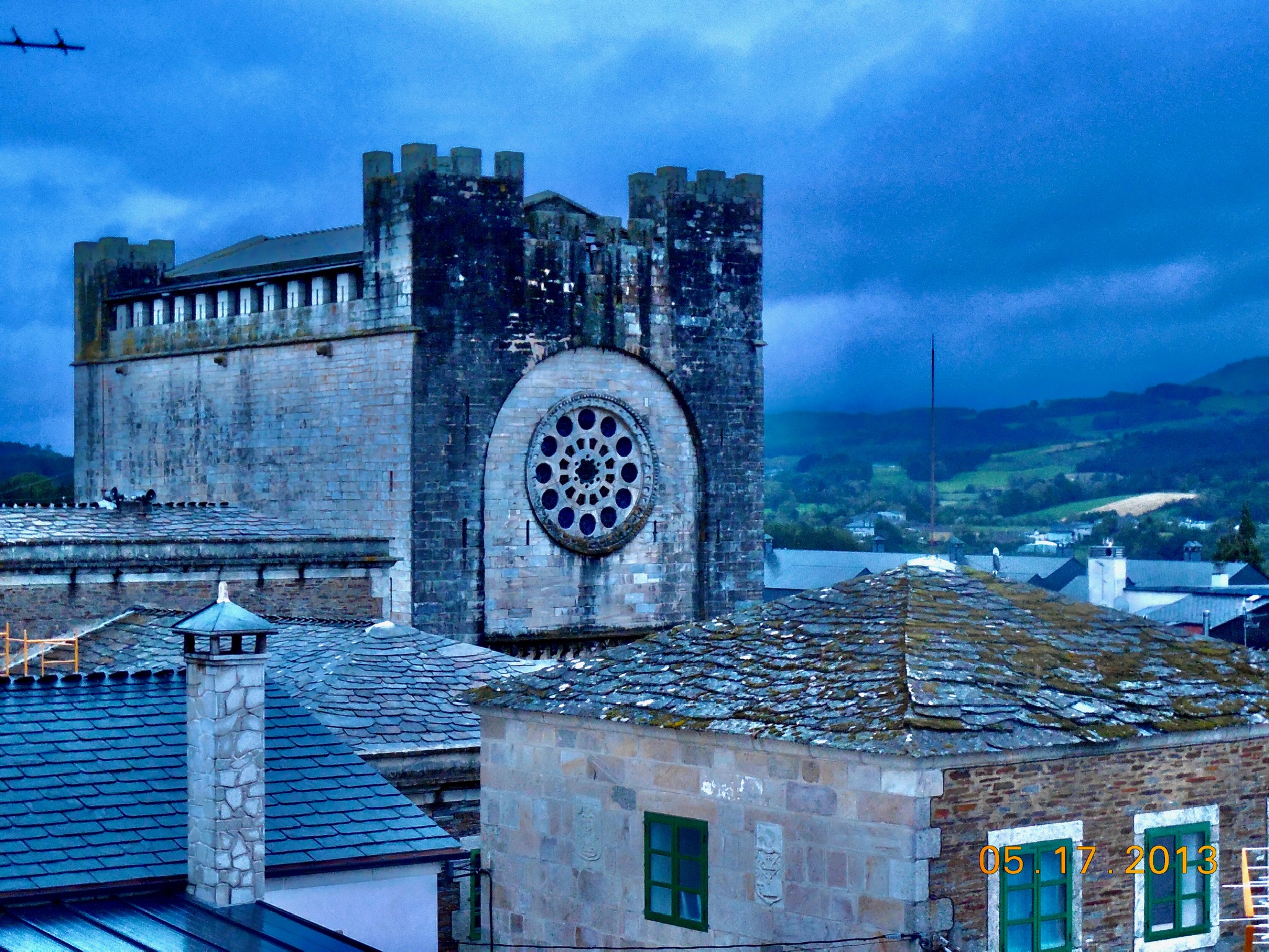
Shortly before reaching our destination for the day we passed the ruins of the 6th-9th Century Monastery of San Felix de Oca. Originally built on the site of a Roman Villa, it is believed that the founder of the City of Burgos, Count Diego Rodriguez Porcelos (died 885) was buried here. The archway and ruins though sparce, were a moving testament to the ancient history of the path that we walked.

Having strolled a leisurely pace we arrived at the Hotel*** San Anton Abad shortly after noon. While not quite up to the standards of a Parador (a series of nearly 100 ultra-luxurious hotels in Spain built in castles, palaces, and other historical structures), San Anton Abad represented high quality for its full pay guests. For we Peregrinos it was palatial.


The owner, once a pilgrim walking the Camino, generously dedicated a wing of the Hotel to the hosting of Peregrinos. For only 12 Euros we were furnished with single tier semi-private accommodations set out in two dormitory style rooms.

Pristine bath facilities provided us with unlimited hot showers, towels and linens furnished.

The real joy was that we were welcome to join the “full pay” guests in the bar and restaurant. We were served  with the same grace and aplomb and even acquired a bit of celebrity due to the nature of our journey.

There was an incident that darkened our stay. Christine and I slept in neighboring twin beds. Late into the night I was awakened by the yells of a woman. She stood over Christine, on the verge of reaching down to grab her. I leapt to my feet and thrust myself between her and my wife’s bed. She kept repeating in broken English, “She Snores!… and She Coughs!” In turn I began responding with competing volume, “LEAVE HER ALONE!!!” Eventually the woman, who appeared mentally unstable, relented and left to sleep in the adjoining dorm room. I was shaken. What chance would I have had in a foreign country to defend myself from a charge of assault had the confrontation become physical.

Christine does snore, but no more so than the average adult. She also coughed that night. But in that room there were a few world class snorers. Among them Christine was hardly a medal contender.

What a change 48 hours made! We had gone from the dusty heat of the 25th to the cool threat of rain on the 26th to snow and near freezing temperatures on the 27th.

Burgos was nearly 40km distant, and Christine was not feeling well. She had never fully shaken the breathing issues and it seemed that her difficulties were flaring up in the form of a nagging cough. Whether it was the incident in the middle of the night or the lingering bronchitis, I felt it best that we make it to that large city rather than proceed by foot with an overnight in another small town. The snow and cold provided just enough justification that we proceeded with our packs to the nearby inter-village bus stop. We were not alone.

Instead of feeling a sense of failure at having to seek transportation the atmosphere among the waiting pilgrims became quite festive.

The bus ride itself was very pleasant and the more so as we were insulated from the frigid countryside by the bus’s huge windows. An outside temperature display in the cabin further reminded us of what we were avoiding.

The entire ride, including stops, took less than an hour. Humbling, considering that we would otherwise have been 2 days afoot.

Burgos (pop. 170,000) is a destination city that features one of the three great Cathedrals on the French Route of the Camino.

We had planned to spend two nights in the city which negated the use of an Albergue since they generally only permit single night stays. That and Christine’s health bid us to seek the services of a hotel. For the next two nights we once again gloriously assumed the roles of “Pampered Pilgrims”, this time at Burgos’ Hotel Norte Y Londres.

What I did not know was that dark and ominous clouds lay just over the horizon of our Camino.

Peace Everyone, and Buen Camino. Pete


April 25, 2013. Santa Domingo de la Calzada to Belorado.

As days go on the Camino this one was fairly straightforward. 23km uphill across largely open country.

Leaving Santo Domingo we crossed the Puente del Santo (Saint’s Bridge, built by the town’s namesake) over the Oja River.

A few unpleasant kilometers followed the track of a dusty gravel frontage road along the busy (and noisy) Highway N-120. The heat of the day was building and with it glistening sweat that annoyingly bound road grime to the skin.

As if to provide us with some compensation for the inconvenience, markers appeared each kilometer to remind us of our progress.

Tantalizing visions of snowcapped mountains appeared to the north, hinting that there was cool fresh air to be found somewhere. The highest of these is Pena Vieja at 8,500 feet.

We came upon an unusual iron cross. It was large and unlike most monuments along the Camino, modern. I later learned that it was erected as a representation of a much older “Cross of the Brave” one that could once be found about a kilometer south off of the route.

Hundreds of years ago landowners from Santo Domingo and nearby Granon made conflicting claims to the same land. As a way to resolve the dispute short of war they submitted the matter to “divine judgment”, each community selecting a champion who would represent them in trial by unarmed combat (a wrestling match). It was believed that God would decide the matter by empowering one over the other. Allegedly, the champion from Santo Domingo arrived with his entire body slathered in grease. Granon’s resourceful champion, Martin Garcia, nevertheless prevailed by cleverly sticking his finger up the opponent’s ass and thus throwing him to the ground. Indeed, the Lord does work in mysterious ways.

  A few kilometers down the road we entered Spain’s largest autonomous region, Castilla Y Leon. It is 11 times larger than the region of Madrid yet has a population of only 2.5 million. Nearly 400km of our entire Camino would be spent in this region.

The three-quarter point of our day brought welcome relief in the form of a pleasant park and fountain in the tiny town of Viloria de Rioja (pop. 70). This village was the birthplace of Santo Domingo in 1019. The Park is alleged to be the place of his baptism. Today a fountain provides a constant supply of natural spring water for thirsty road weary Peregrinos, such as us.

We found such fountains along the route of the Camino to be ubiquitous. Virtually all provide potable water, and those few that are not safe to drink from are posted with signs to that effect.

Belorado (pop. 2,000) capped a 23km day made longer by the heat and the long uphill 1,000 foot climb in elevation. A café/bar in the town plaza drew Peregrinos like moths to a flame.

Of course there was a ancient church to visit. Here it was the 16th Century Church of Santa Maria. It was built into the face of a cliff where ancient caves that once housed hermits are still visible.

We registered at the popular Albergue Cuatro Cantones where hiking boots and trekking poles must remain at the entrance. There was little chance of mistakenly taking another pilgrim’s boots, but the same could not be said for the poles.

With pride, the Albergue featured a restaurant that served the pilgrims a dinner one could have expected at a finer restaurant.

Faces on the Camino:

“Eyes are windows to the Soul” is a phrase that has been variously attributed to a host of poets and philosophers, William Shakespeare, Leonardo da Vinci, Cicero, and St. Matthew among them. But what then if the soul is so overflowing with emotion that the eyes cannot contain it?

At the end of our day in Belorado I and a host of other Peregrinos found relaxation in the town’s peaceful Plaza. As I looked from pilgrim to pilgrim I was struck by the joy that radiated from each face. Joy and contentment which were infectious.

With permission from each pilgrim I took a series of portraits seeking to capture and preserve the moment. Among the faces I have selected are several whose names and origins I no longer recall: Perhaps there are Peregrinos from that time who may read this post and remember.

Christine, my wife of 44 years.
Carole Jacquemin, France
Dr. Bernard De Geeter, France

Christine Lecher, German from the Canary Islands
Henk Kaspers, Netherlands.
Gaby Pfauth, Germany.

 Martin from Ireland.

Even our Chef at the Albergue, Fernando.

Peace Everyone, and Buen Camino. Pete


 Written April 24, 2013, at Santo Domingo de la Calzada, Spain.

There is a phrase that has periodically bubbled to the surface of my thoughts on the Camino. “Life is a journey”… “Life is a journey”… “Life is a journey”…

Why does this trouble and even annoy me. The conclusion that I reached is that Life is not a journey. Life is a destination. Living is the journey.

We all share birth and death, our personal Alpha and Omega. That is life. What distinguishes each of us is how we live our journey.

The Camino is not the act of arriving in Santiago, it is “The Way” to Santiago. One may walk 820km while listening to an audiobook, then arrive in Santiago entirely oblivious to the experience. This person has technically earned a certificate (the Compostela) for having completed the Pilgrimage, but what was gained that could not have been accomplished on a treadmill at the local gym?

Another person may have only walked the Camino for a few days, a passage insufficient for the Compostela. However, with mindful awareness of each footfall, each moment, each thought, and each breath, that person experienced a genuine pilgrimage rich in its impact both within and without. It is the journey of living and not the destination of life that matters most.

As our children grew and grandchildren grow, it has been important to me that at every parting I convey a message which is the distillation of things that I hold important. Perhaps this is my attempt at a formula for living:

“Have Fun”. Living should feed your passions and make your soul smile.

“Do Good”. There are two benedictions here: Do your best and also do what is right.

And finally: “Be Safe”, for the sake of those who love you, and also because senselessly jeopardizing your life diminishes the gift of living.

I don’t claim perfect adherence to this formula, but then I am just a Peregrino both here on the Camino, and as I live my Journey.

Have Fun, Do Good, and Be Safe. Buen Camino. Pete


April 23, 2013. Navarrete to Najera

Exiting Navarrete in the morning we approached and passed by the Municipal Cemetery.

As noted in a prior post, the ornate arched entry to the cemetery was appropriated from the 12th Century ruins of the Monastery of San Juan de Acre.

Atop the arch and just beneath the crucifix is a carved depiction of the legendary battle between Charlemagne’s heroic knight Roldan and the Saracen giant, Farragut. The 10th Century battle between the two warriors was reputed to have spanned nearly 4 days without rest. Finally, Roldan slew the giant with a powerful throw of a well-aimed rock. (Shades of the biblical story of David vs. Goliath)

The battle is commemorated along the Camino through statues, relief carvings, and inscriptions, most dating to around the 12th Century. The killing of Farragut allegedly liberated the region from his tyranny and freed a host of Charlemagne’s imprisoned knights.

High on a hilltop we encountered a restored “beehive” watchtower. Legend says that this is the place where the epic battle occurred and is still known as Poyo de Roldan (Roldan’s Hill).

Passing by the tiny village of Ventosa (pop. 150) we encountered one of the countless images of Santiago (St. James). This one was noteworthy as being “cute”.

Most often Santiago is either represented as a wandering pilgrim dressed in medieval attire with his staff, water gourd, and scallop shell…

…or more ominously as the legendary “Matamoros” (Slayer of the Moors). In recent years these historic statues have generated much controversy for their anti-Muslim theme. (Shades of the current controversy over Confederate monuments in the United States)

At Najera (pop. 7,000) we reached our 16km day’s destination. Prominent in the town is the fortress-like church de Santa Maria la Real.

The impression is no accident. For over 300 years Najera was the bastion and capital of the ancient kingdom of Navarre. The church holds the earthly remains of kings and queens from the 10th through 13th Centuries.

Legend has it that in 1044 Don Garcia, son of King Sancho the Great, was hunting with his favorite falcon. The falcon flew into a cave but did not return. Garcia, entering the cave to retrieve his falcon, miraculously came upon a hidden statue of the Virgin Mary. Honoring the miracle of the “Virgen de la Cueva” (Virgin of the Cave) he and King Sancho initiated the construction of the church in 1052.

Najera provided me with my first samplings of two cephalopod delicacies that I would seek whenever possible: “Pulpo” (Octopus), and Squid prepared in its own ink.

Either of these set before me on the table were an incentive for Christine to move to another table. In the years that have followed I learned of the remarkable intelligence of octopi and their related species. They are one of the few life forms on our planet that display complex problem solving abilities, tool utilization, communication skills, learning by observation, and  are perhaps even self-aware. All of this is even more remarkable given that they have a lifespan of only 2 years. Dining on these invertebrate wonders now produces a feeling of guilt in me.

April 24th was another spectacular day on the Camino.

Clear skies and a feeling of community with those who also walked.

Our spirits were elevated for the 21km ahead and further boosted by a waymark that “announced” Santiago de Compostella to be 582km ahead. We had completed 240km since leaving St. Jean Pied de Port in southern France.

I will display a few more pictures of the day at the end of this post but continuing the theme of “legends” takes me to the end of the day and the town of Santo Domingo de la Calzada (Saint Dominic of the Road). Saint Dominic was born Domingo Garcia in 1019. Legend says that his application to become a Benedictine cleric was twice rejected because he was illiterate. For a time he lived as a hermit in the nearby forests. A bishop from Rome learned of Dominic and became interested in his devout dedication to the Faith. He ordained Dominic to the priesthood in 1039 whereupon Dominic is credited with undertaking the construction of a significant pilgrim bridge, a hospital for Peregrinos, the Cathedral, and otherwise elevating the town from obscurity into a major waypoint on the Camino. He died in 1109 at the age of 90 and is buried in a beautiful vault within the Cathedral. He is deemed Spain’s patron saint of Civil Engineers.

Near the plaza of the Cathedral of Santo Domingo is the large Albergue, Casa del Santo, which contains 210 beds for those walking the Camino. It also features a large chicken coop where roosters and hens are kept and cared for. The reason for the coop and fowl:

Legend has it that in the 1300’s an 18 year old German Pilgrim and his parents walked the Camino. The Pilgrim, named Hugonell, rejected the sexual advances of a Spanish girl who was staying at the same inn as the young man. Jilted, the girl hid a silver cup among Hugonell’s personal effects and then alerted the local authorities that he was a thief. Hugonell was tried and sentenced to hang. After his execution his parents mourned his fate, the body still hanging from the gallows. Hugonell then spoke to them from the gallows and said that his life had been spared through the miraculous intervention of Saint Dominic. The parents rushed to seek aid from the local Magistrate to release their son. The Magistrate who was eating dinner laughed saying, “Your son is as alive as this rooster and chicken that I was feasting on before you interrupted me.” In that moment the two roasted birds jumped up from the plate and begin to happily sing and crow! Hugonell was immediately released from the gallows and pardoned.

For 700 years in tribute to the legend an ornate chicken coop is still kept at the rear of the Cathedral, occupied by a live chicken and rooster. The white plumed birds, which are furnished by the nearby Albergue, spend 30 days in the coop before being replaced by another pair.

I am left to wonder at the fate of the birds after their 30 days in the Cathedral’s pen. Perhaps they go from the “Friar’s Pen into the Frier”. (My bad! Just a pun that I couldn’t resist sharing.)

Peace Everyone, and Buen Camino. Pete

PS. More images from the day:
A virtually abandoned golf village of empty apartments. The golf course and condominiums having fallen victim to an economic downturn.

The spectacular Spring countryside…

…and apparently this has been a problem.