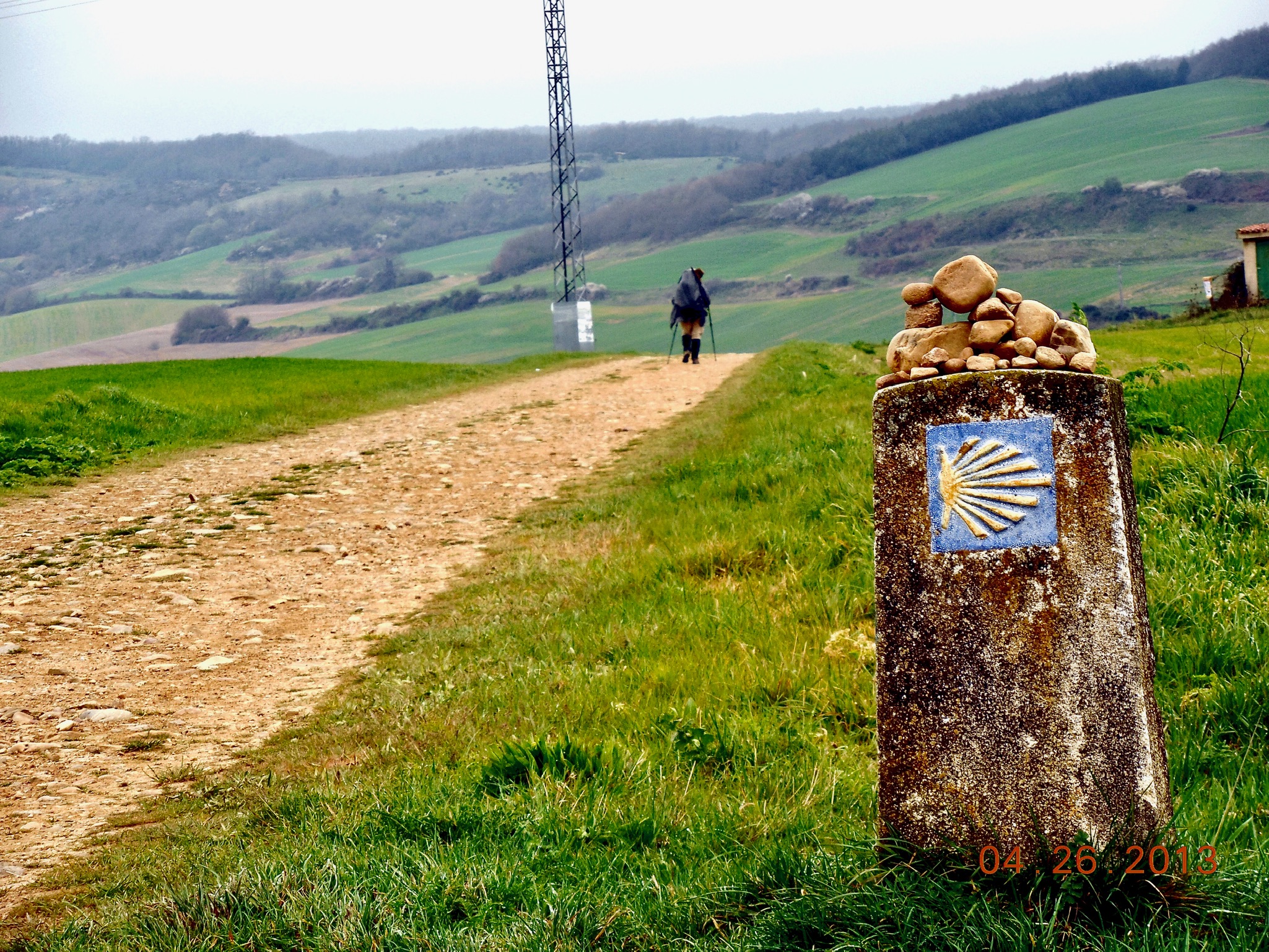
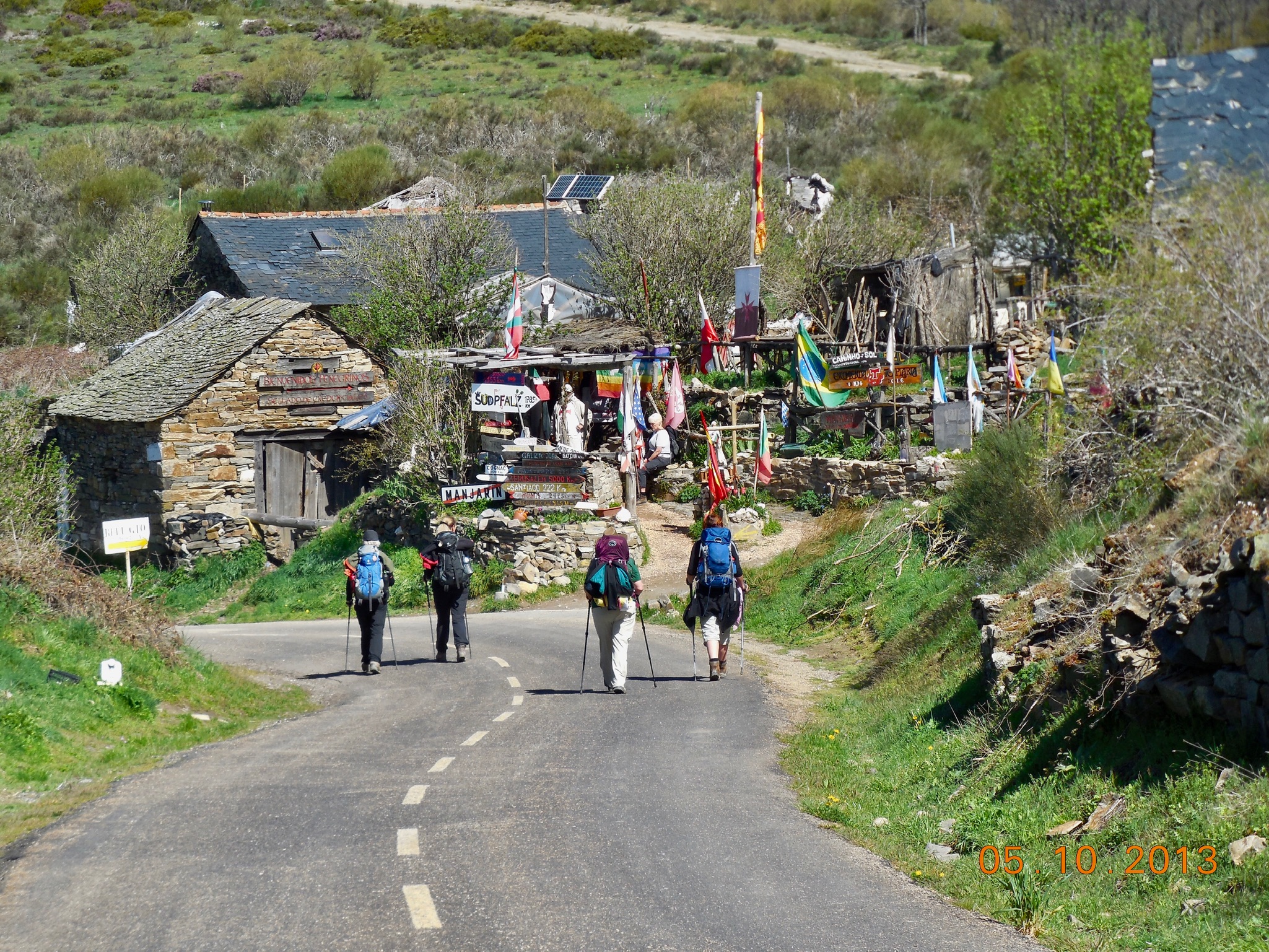
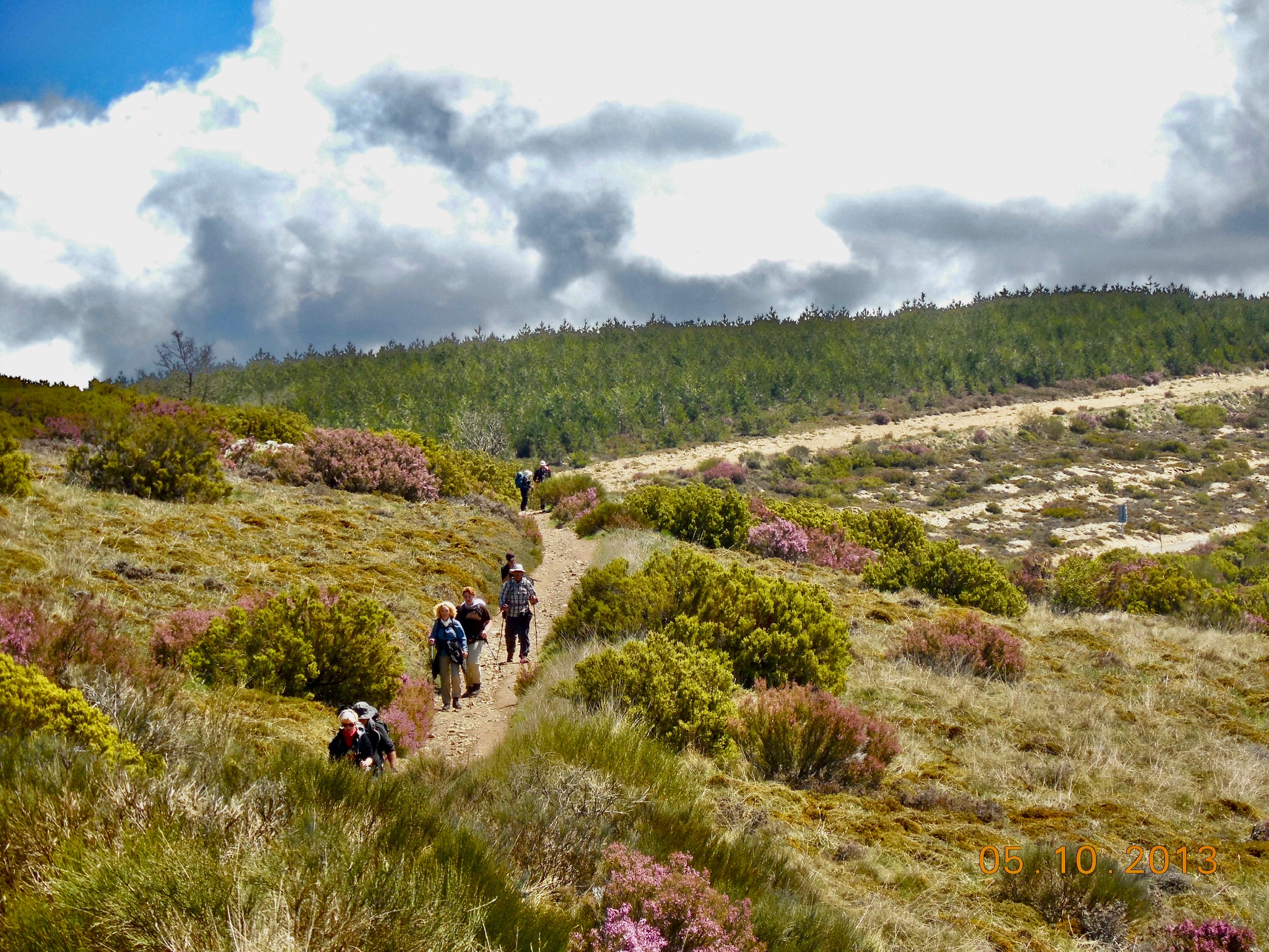
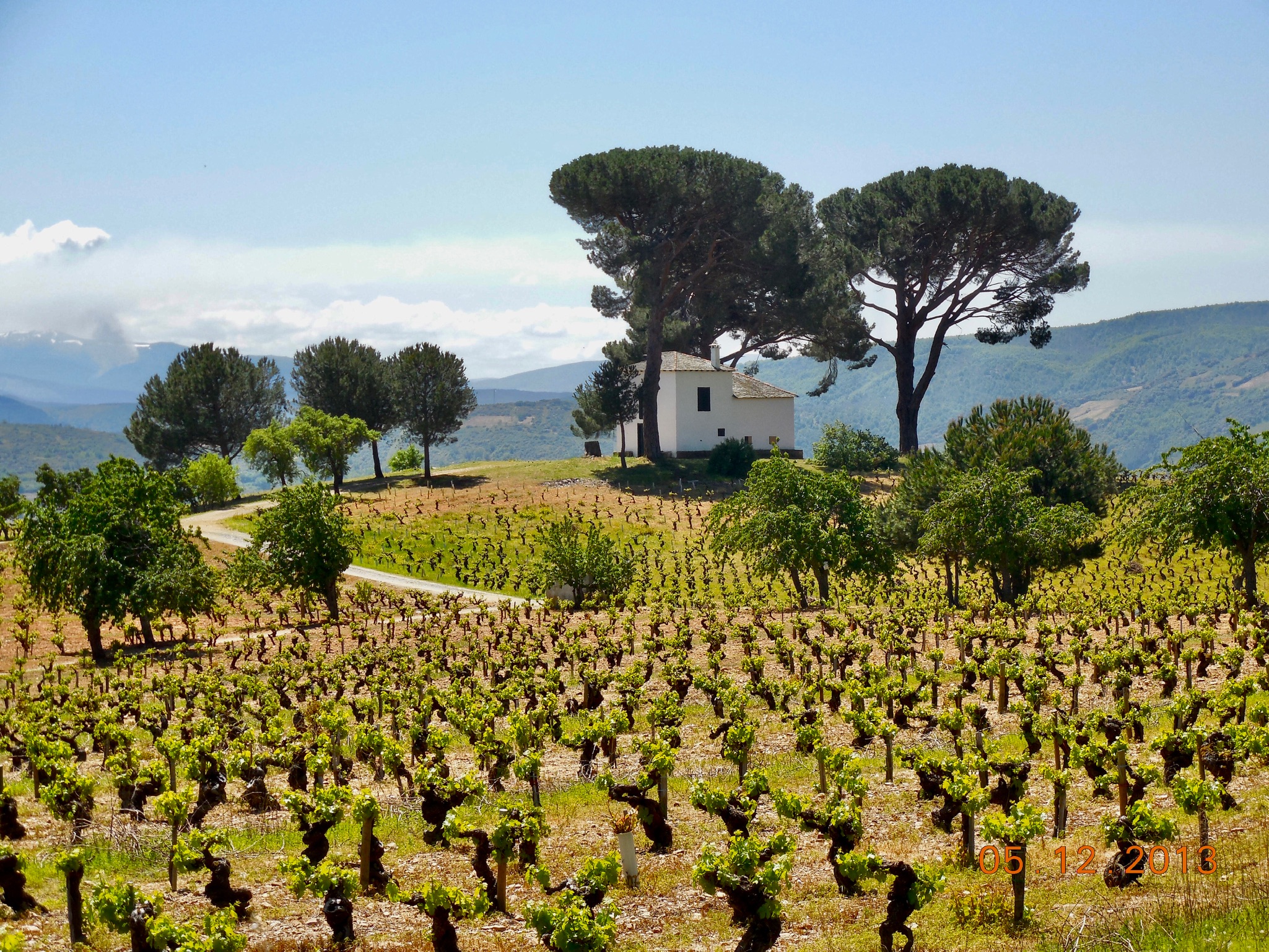
Written April 23, 2013 at Najera, Spain.

The common lodging for a Peregrino is known as an Albergue. Some are sponsored by the municipality, others by religious organizations, and still others are private-for-profit facilities. The Municipal Albergues tend to be the simplest and least expensive. Cost for a night in an Albergue varies from a donation to from 7 to 15 Euros per person.

An Albergue is a shelter, nothing less, but sometimes more. You are guaranteed a bed. It may be single tiered (rare), two tiered (common), or three tiered, which we have only encountered in Viana. You may or may not have a pillow, sheets, or a blanket. The sleeping room may have as few as 4 people, or over 40. The rooms are usually shared by men and women, with space at a premium. Privacy is the gift that your neighbor gives you as she turns her head while you change your clothes. Etiquette calls upon you to reciprocate. All Albergues promise a sink, toilet, and shower. What constitutes “hot” water may be a bit ambiguous. The better Albergues provide at least one toilet and shower for each 6 Peregrinos, but we have “enjoyed” sharing a toilet with as many as 20 other Pilgrims.

As with the sleeping rooms, bathrooms may be unisex. The feet in the stall next to you may belong to a woman or a man. I have learned that the “fairer sex” can empty a bladder much quicker than a 61 year old man! (Too much information?)

While all of this may sound a bit Spartan, we have come to enjoy the camaraderie, sense of family, and shared sacrifice. One does appreciate the special “luxuries” of fewer bedfellows, larger bathroom facilities, adequate heat, no snoring, no bedbugs…

Life is Good, and my Wife is Great. Love to you all. Have Fun, Do Good, and Be Safe. Buen Camino. Pete (and Chris)


June 8, 2021 at Kansas City.

I thought to draw upon a few images to highlight the stark differences that one may encounter at various albergues.

This first images are of the sleeping room at Villafranca Montes de Oca. The owner of the exclusive Hotel San Anton Abad has walked the Camino. In order to “give something back” to fellow Peregrinos he set aside a wing with 24 beds and ultra-modern facilities for Pilgrim accommodations. The price was 12 Euros per person for the night. We were welcome in the sumptuous bar/lounge and dining room where we were treated by those guests paying hundreds of Euros per night as something of celebrities.

At the other end of the spectrum our albergue in Rabanal del Camino although clean, stretched tolerance by providing a dormitory room with 38 closely spaced bunkbeds. A unisex bathroom with two showers, two toilets, and two sinks made for challenged personal hygiene.

Australian Pilgrim, Jack Webster related to me that as he was showering in a stall in the unisex bath of an albergue he happened to gaze down onto the dark wet polished stone floor. His eyes drew focus on the reflection of a woman who in turn was gazing at his reflection in the floor from the adjoining shower stall. The reality of the situation seemed to strike each of them simultaneously. Jack, being unflappably pragmatic, smiled and waved to the image at his feet. She took the cue, grinned and waved back. They each then went about the task of finishing their showers.

Peace Everyone, and Buen Camino! Pete


April 22, 2013, Viana to Navarrete.

We were well on our way out of Viana before the first rays of sun lit the western side of the village. At 23km this would be a Christine’s longest day, particularly challenging since she was carrying her pack.

Not far down the trail we said goodbye to the mountainous region of Navarra and hello to the autonomous region of La Rioja. Sandwiched between Navarra and the plains of the Meseta (think western Kansas), this region has been famous for producing excellent wines for centuries.

Shortly after crossing the “border” into La Rioja we encountered an older woman standing in the doorway of her humble cottage. Short, sturdy, and weatherworn, with a smile that radiated a rich inner kindness, she motioned for us to enter.

This was Maria, daughter of the modern Camino’s famous Felisa (1910-2002) who for most of her adult life “stood guard”, just as Maria was continuing to do, greeting pilgrims entering La Rioja. Felisa, and now Maria, laid out a small plate with figs and offered water. Speaking virtually no English she accepted donations. However, this was no money making venture. The kindness Felisa and Maria showed was driven solely by love for those walking the Camino.

The “Felisa Stamp” in a Pilgrim’s credencial was highly sought by knowledgeable Peregrinos. In Spanish it reads, “Figs, Water, and Love.” All of these things freely offered by Felisa and Maria, nothing expected in return.

We entered Logrono, a modern city of 130,000, and capital of the La Rioja region.

Like most of Spain’s population centers, whether large or small, it featured a remarkable church that dates back hundreds of years. Catedral de Santa Maria de la Redonda was built on the foundation of an earlier 12th Century Romanesque Church. The current edifice dates to the 15th Century.

The altar and apse (surround) are stunning. The church also prides itself on being the owner of a small original painting by Michelangelo, “Christ on the Cross”. The small but priceless painting is kept secured in its own vault. When open for viewing a few coins are needed to illuminate the work.


Continuing out of Logrono on our way to Navarrete we passed the ruins of the 12th Century Monastery of San Juan de Acre which was founded to offer care to passing Peregrinos.

The huge Don Jacobo Winery looms large in the distance behind the ruins. Many years ago the Monastery’s ornate stone archway was relocated to the Municipal Cemetery situated just west of the city where it now serves as that facility’s entrance.

13km later we entered Navarrete (pop. 2,200). Though a fraction of the size of Logrono, Navarrete’s 16th Century Church of the Assumption is even more opulent than Logrono’s Cathedral.


One wonders at the wealth and time dedicated to this architectural competition that dates back hundreds of years.

Christine and I joined a number of our new Camino friends for drinks and pleasant conversation in the inviting central plaza. Over the course of the days and weeks to follow we developed deep personal connections with a number of these good people. Among them are (left to right) New Zealander Jennifer Dillner, Christine Lecher a German living in the Canary Islands,…

Gaby Pfauth of Germany, and Henk Kaspers of the Netherlands (far right).

We treasure their continuing friendships to this day.

It was a long day for Christine and me. She had outdone herself by hiking 23km with pack, and my feet were a painful mess.

For the first time we embraced the luxury of a real hotel room with private bath. We had earned it.

Peace Everyone, and Buen Camino. Pete

PS. Sadly, Maria passed away on March 15, 2021. The Camino has lost one of its Angels. In 2009 a film crew from Scotland produced this brief video about a day in this good woman’s life: Maria Tedora Medivalia Rodriguez (1933-2021).

 
April 20-21, 2013. Villamayor de Monjardin to Torres del Rio, and Viana

We had abandoned the Brierley Guide’s recommended “stages” for two reasons; virtually every English speaking pilgrim used the guide and Christine’s tolerance was better suited to a 12-18km day, rather than the 20-30km often favored in the guide. This meant that we typically stayed in villages and albergues a few kilometers either side of the Guide’s suggested stops. We walked the same path, but the albergues where we lodged were usually less congested.

The 20th saw us walking 21km to Torres del Rio. Christine arranged for the transport of her pack to our destination and seemed up for the longer walk on a beautiful spring day through the open countryside.


Farmers were preparing their fields, the path was wide and kind to our feet. In this region the decades old grape vines had not yet begun to leaf out.


We passed before the ruins of Cugullo, site of an ancient pilgrim’s hospital. There were trailside cairns left over the years by passing pilgrims and even a rough stone shelter of unknown age.


Bicyclists passed us on the path, politely signaling their approach.


In order to receive one’s Compostela in Santiago (certificate of completion of the Camino) a pilgrim must walk the final 100km as a continuous journey. It is also permitted to do so by bicycle (or even horse), but it that case it must be the final 200km.

It was an idyllic day.


We walked through the peaceful town of Los Arcos (pop. 1,300), originally founded by the Romans.


Los Arcos, though small, was a recommended overnight stop and featured no less than 4 albergues. Instead we continued on to Torres del Rio.

What a pleasant surprise awaited us there! The tiny village of fewer than 150 showcased an extraordinary church erected in the 1100’s by the Knights Templar.


Santo Sepulchro was modeled after the Church of the Holy Sepulcher in Jerusalem. The church was octagonal in form with the domed ceiling supported by a remarkable web of arches.


The interior was simple, even sparse,, but anything more ornate would have depreciated the visual impact of the small altar and unsettling 13th century crucifix.


Our albergue was a delight.


An enclosed terrace with bar and restaurant was just the place to settle back with fellow pilgrims. There was even a shallow pool in which to dangle ones hot and tired feet, glass of wine in hand.


As with most albergues the rooms were simple, clean, and not very private. I found the communal dining and sleeping arrangements a refreshing reminder of happy childhood days in summer camp where friendships sprouted like mushrooms.

The following morning we set off on a short 12km stage to Viana (pop. 3,600). In light of the shorter distance Christine carried her pack. Her bronchial issues had seemed mostly resolved.

Early on that day we encountered a pilgrim, Kris Ashton of Denver Colorado. A few pleasant words and we were walking in lockstep for the next hour.

Little did we know at the time how interwoven our lives would become. We frequently encountered Kris in the days that followed and nearing Santiago began sharing private accommodations. Back in the States we continued our friendship, often as guests of her and her husband Dennis in Colorado and reciprocating with them in our home in Kansas City.


In 2018 we were in Amsterdam, having just departed Scotland where Kris and Dennis happened to be hiking. Dennis tragically fell to his death from a mountain path on the Isle of Skye. Our friendship with Kris became more tightly joined and in 2019 she accompanied us aboard our canalboat in England. Inspired by our Casita travels she purchased a Casita in early 2021 and that Spring spent 9 days caravanning with us in New Mexico and southwestern Colorado.

Adding to the mystery of friendship, yesterday (June 5,  2021) we spent an afternoon in Kansas City with friends Ron and Lena Meck of Salt Lake City, Utah. They were passing through Kansas City while following the route of Lewis and Clark. We first met them in 2017 on Sitka Island in Alaska, then accidentally encountered them in 2018 in Madrid, Spain. Later this year they plan to be traveling south on the Pacific Coast Highway about the same time that we will be traveling north on the same road, perhaps another chance encounter is ahead of us. By the way, they have walked the Camino and are friends with Kris Ashton. Coincidence? A gentleman in Puerto Rico once counseled me, “Peter, in life there are no coincidences.”

In 1995-96 our son Peter lived the school year as an AFS high school foreign exchange student with a family in Bilbao, Spain. Rafael Mendia Gallardo, his wife Begonia, and their son Arkaitz made Peter a real member of their family that year and thus bonded themselves to us as a part of our extended family. Rafael was following our Camino journey through Facebook and reached out to suggest a meeting in Viana for dinner. It was a 2 hour drive for them and their good friends Rev. and Ms. Javier Aguirregabiria Aguirre. Rafael and Begonia spoke only a little English and we very little Spanish. Javier acted as our interpreter and added much to our afternoon with his grace and good humor.


Our Spanish friends arranged for an excellent private dining experience at an exceptional restaurant in Viana.


They also hosted our walking tour of the town center and the nearby 13th Century church of Santa Maria where in 1507 Cesare Borgia was buried. Borgia died from treachery at the hands of his enemies shortly after his successful siege and conquest of Viana. More about this fascinating historical figure in the postscript.


As the poet said, parting from these dear friends was “such sweet sorrow.” However return to the Camino we did, which included the night in Viana’s 54 bed municipal albergue with beds stacked 3 high.


Pilgrimage is often cast in terms of what one experiences through the senses and what touches one spiritually. I was finding that the Camino was becoming ever richer with personal connections, a path to people. How easy it is for us to make friends as children and how sad that for many adults that gift is lost.

Peace Everyone, and Buen Camino!

 PS. Cesare Borgia (1475-1507) was the acknowledged illegitimate son of Pope Alexander VI (then Cardinal Rodrigo Borgia). The Pope ordained him as a Cardinal at his election to the papacy in 1492. Cesare was only 18 years old at the time. 6 years later Cesare resigned his cardinalate, the first person in history to do so. Instead he became Commander of the Papal Army and served capably in that role until he was deposed shortly after his father’s death in 1503.

Cesare engaged Leonardo da Vinci as his chief military architect and Borgia is believed to be the inspiration in Niccolo Machiavelli’s “The Prince”. Cesare Borgia is also believed to be the model for da Vinci’s famous portrait of Jesus Christ, “Salvator Mundi” (Savior of the World).


Written at Villamayor de Monjardin, Spain, April 20, 2013.

Yesterday morning in Estella as the Peregrinos in our Albergue began to stir for the dawn departure onto the Camino, I became aware of the voice of frustration. The words were German, but the exasperation behind those words needed no translation.  I regret that I never learned his name, but the young man from Germany and I had exchanged greetings on a number of occasions. He spoke a little English, and I a little German. He is a big man… actually, a VERY big man. At more than 6′ 6″ tall, and well over 300 pounds he reminded me of a downsized version of Andre The Giant. For this note I will refer to him as “Andre”.

Andre sat at the edge of his bed in a losing effort to zip the leg onto his convertible pants. His frustration was many faceted as his fingers were too large, the zipper pull too small, and his knee too swollen. The pain in his knee and his frustration were clearly visible in the horizontal set of his brow, eyes, and lips. Christine moved to his aid and in short order had secured the miscreant pant leg.

Andre’s look of frustration quickly transformed to one of relief as he smiled at my wife and said, “Danke, Mutter!” (Thanks, Mother). Continuing in German he went on to say that he was leaving the Camino for home. Pointing to his knee (which I had observed to bear the scars of surgery), the pain in his eyes migrated from physical to emotional.

Our Albergue dorm room was shared by 15 other Peregrinos who were in various stages of pre-departure preparation. Motion stopped as Andre’s sadness spread through the room. This became personal for each of us.

Throughout the day Andre’s departure from the Camino was on the lips of the Pilgrims and weighed heavily on our hearts. I know that there have been and will be others to prematurely leave the Camino, but actually seeing the moment of despair is different. I hope for Andre that the Camino continues in his heart, just as he is remembered in ours.

Love to you all. Have fun, Do good, and Be safe. Buen Camino.
Pete (and Chris)


April 19, 2013. Estella to Villamayor de Monjardin

There was a threat of rain in the early morning clouds. Covering my pack and having my rain poncho at the ready seemed prudent as I set off for the day.

The recommended stage that day was 21km to Los Arcos with services available in between only at Villamayor de Monjardin (pop. 150), 10km distant. Christine had not been feeling well and was fighting an annoying cough that threatened to deepen. We decided that she would taxi to Villamayor and secure our beds for the night at one of the small village’s two albergues.

On my way out of Estella I stopped at a charming courtyard café where I and many other pilgrims found coffee and breakfast.

The threat of rain hung in the air most of that morning but never materialized. The alternating light and shadow of the passing clouds played beautifully over the verdant spring countryside. It was a good day for a less strenuous hike and my early arrival in Villamayor was assured.

About 2km down the road I came to the Bodegas Irache and its famous wine fountain. Over the years the winery has generously furnished passing pilgrims with two taps in a burnished stainless steel facade mounted on the side of the winery. One tap fresh water, and remarkably the other providing delicious red wine at no cost.

Pilgrims lined up at the wine tap, early morning be damned. I swear that the water tap had cobwebs. Here was a place that pilgrims could congregate and toast their good fortune. I was among them. One could fill a water bottle to the brim with the deep purple stuff (I mixed half water and half wine in mine). However, the accepted tradition was to take a drink using one’s scallop shell as a shallow wine cup, much as pilgrims have done since the Middle Ages.

Here I became acquainted with Lene Frydenlund of Denmark, and Roberto Del Pino Guzman, originally from Spain but decades a citizen of the United Kingdom. We have maintained contact with both over the years.

I learned later that day that Roberto had met Christine at the albergue in Pamplona. She gave him instructions on how to operate the front loading wash machines there.

I spent that morning walking to Villamayor with Roberto and his friend John. Our conversation quickly went deep into the mysteries of life, love, faith, and fate. With Roberto I found a kindred spirit. Were we not separated by an ocean I believe we would have been best friends.

Other than the scenery, there was little between Estella and Villamayor save a few hundred yards from our destination we came upon the Fuente de los Moros (Fountain of the Moors).

It is a curious name since the fountain, constructed in the 1100’s after the expulsion of the Moors, was built as a welcoming rest stop for passing pilgrims. Here a pilgrim could cool off, wash, and replenish their water.

I arrived in town with a number of other pilgrims long before either albergue allowed entrance. Where was Christine? At the sound of my voice the door to the Albergue Santa Cruz opened and there she stood alongside of the facility’s smiling matron.

Christine explained: She had arrived early by taxi and went to the door of the albergue to place us on their list for beds that night. The woman who answered the door spoke little English, but accommodated Christine’s request. Chris noticed that the woman was fully occupied with the task of washing a mountain of bed linens and towels for the 28 bed albergue. Christine managed to communicate her willingness to help. The woman, first surprised and then beaming with gratitude, turned to her husband who was seated at a table reading his newspaper. Pointing at him and the then at Chris she made an exclamation that Christine believes translated to “See!!!”. The man returned to his paper. The women spent the next hours side by side sharing smiles and toil.

Christine neither asked for nor expected a reward. However, once the laundry was finished the woman took her by the hand to a door on the second floor. She unlocked to door and ushering Chris into the small room, managing to communicate that Chris and I would be granted the private room for the night. Still bunkbeds but glorious privacy and with our own private bath and shower no less!

After the albergue had granted pilgrims entrance we secured our things inside. All of us then adjourned to the nearby restaurant/bar just up the hill.

Outside the bar was a small courtyard overlooking the town. It featured the bronze bust of King Sancho I (860-925) who reigned over the Kingdom of Pamplona from 905 to his death in 925.

The bust cast eyes upward to castle ruins that loomed 700 feet above the town.

Castillo de San Esteban (Castle of St. Stephen) held prominence over the entire region since the time of the Romans who laid the fortification’s original foundations. Given the commanding presence of the mountain upon which it stood it is likely that it had been a place of tribal defense since the time of ancient paleo inhabitants.

Sancho successfully captured the castle from the Moors in the 10th Century, they in turn had captured it from the Visigoths, who had taken it from the Romans. Successions spanning millennia.

Inside of the bar we were confronted with one man’s tribute to Elvis Presley and life on America’s Route 66. The walls were covered with memorabilia. The bar owner spoke excellent English and quickly served our beverages. I asked him about the castle… Can one tour it? “Yes when its open”. Now? “Yes, if you have the key to open it”. A key? “Yes, locks open best that way”. I was becoming aware that the gentleman was having some fun at my expense. Snickers from the other pilgrims confirmed this.

How does one get the key? “Well, you must ask for it.” (Me growing frustrated) And who do you ask? “Me, of course!” YOU HAVE THE KEY TO THE CASTLE? “Didn’t I just say that?” (grrrr!) Well then, may I borrow your key? “Certainly, provided that you bring it back”. With that he reached behind the bar and retrieved a ring with a large brass key. How do I get to the castle? “Walking works”. Yes, but which way? “If you keep walking uphill you will get to the castle. (Pilgrims are now on the verge of outright laughter). Finally he relented and directed me to a small avenue behind the bar. “Follow it, it is a steep 2km to the top and enjoy the view.”

45 minutes later I stood alone at the gate to the abandoned castle, keys in hand. Locks do work best with a proper key and this one was no exception. I entered.

The castle walls are largely intact, but most of the castle’s keep and interior stonework had been looted in the 1600’s to build a nearby hermitage. It was reputed that the remains of Sancho were entombed and hidden somewhere within the castle walls. I stood with Sancho’s ghost.

Sancho and I were not alone. I provided eyes for the spirits of long forgotten paleo tribal leaders, dead Roman generals, ancient Visigoth chiefs, invisible Moors, and Sancho, all of whom had gazed upon the surrounding plains as I now did.

It was eerie and invigorating. I took my pictures, embraced silence that was broken only by the wind whistling through the fortifications… (were those voices?), and finally with regret I made my way back to the village below.

We gloried in yet another communal dinner with our new friends that included Deb, along with Kalina and Ramona, pilgrims from Germany. There was no laughter, only rapt attention as I spun my tale of the castle above.


Peace Everyone, and Buen Camino. Pete