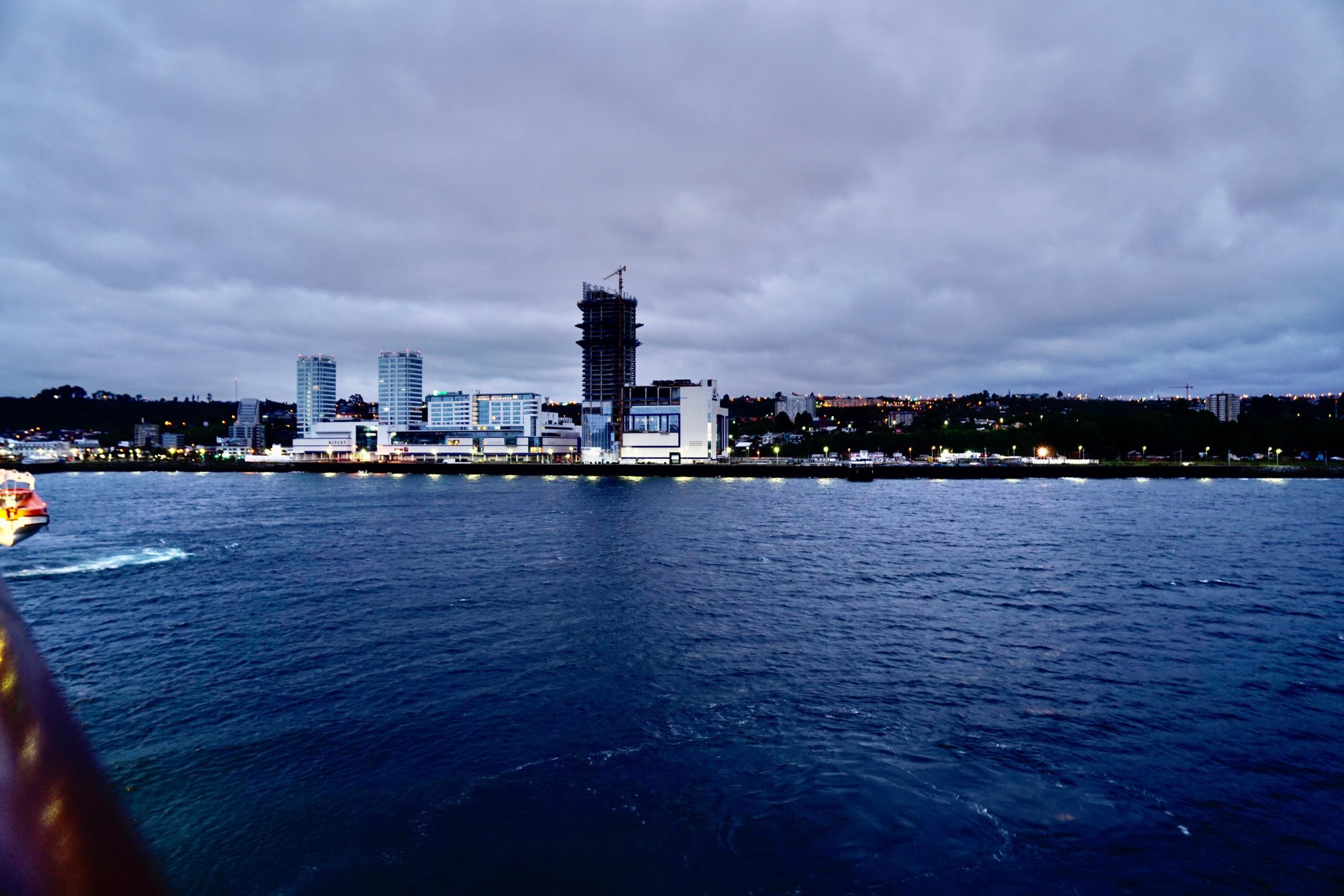
Imagine for a moment that for the last 22 days you have been a player in a game. There aren’t many players, but they are all like you and they like you. The host of the game provides a staff to grant your every want, need, whim, and even whimsy. The rules of the game are clear, familiar, and designed for your success.

Now imagine voluntarily choosing to leave that game for a different one. The new game has over 15 million players, 7 million of which are in your immediate vicinity. Very few are like you, and you really don’t matter to them, or the host. You have the barest understanding of the rules, and you have to define your success in terms of just making it from one day to the next. Oh, and virtually none of the players speak your language.

That pretty much describes what we have done in departing the Viking Sun and traveling solo into the heart of Santiago, the capital of Chile.

Most Viking passengers who departed ship yesterday were heading straight to the airport to board planes for home. We had elected to spend a few days on our own in Santiago. The first challenge was to make our way from Valparaiso to Santiago, which is about a 2 hour drive into the interior.

Uber operates in both Valparaiso and Santiago. What could be simpler?! We scheduled an Uber to pick us up. The fare would be half what the port tour operator quoted, $100 US instead of $200 US for the transport. Unfortunately, one of the new “rules” came into play as I received notice that our Uber was arriving. Unfortunately, Uber is not allowed into the drive at the passenger cruise terminal. It seems that only the port tour operator and a few select taxi companies are. What’s more, we are not allowed to simply walk out of the terminal. It is required that we be shuttled from the terminal into the city proper. We lost our Uber.

The shuttle driver who spoke virtually no English nevertheless understood our situation. Outside the entrance to the terminal drive he pulled over in a spot where a few taxis were parked. The drivers were milling about in casual conversation with one another. He hailed one of the drivers and spoke to him in Spanish. The taxi driver in turn smiled at us and in broken but serviceable English said that he would drive us to Santiago. He quoted a fare on par with Uber, but cash only. Our decision was based upon the “bird in the hand” philosophy liberally seasoned with trust. We were to learn that this kind gentleman was Alex Calquin. I helped Alex put our bags into the trunk.

The 90 mile drive was indeed 2 hours long. It included a stop for gas which was a great relief for us as I was not sure that I could make it without a “Baño break” (bathroom). The Shell station also had a McDonalds, and wonder of wonders an ATM where we could supplement our barely sufficient cash to pay the fare.

Alex was wonderful! He gave us a running commentary on the drive, highlighting the sights, giving insight into the current events and speaking with great pride about his sons and 13 year old daughter, Francesca. He was apologetic about his combination English/Spanish, which was infinitely better than my Spanish. I was able to decode most of what he said.

The topic of family came up because I asked about a cute pencil drawing that he had stuck on the dash of his car. A gift from his daughter that keeps her near to his thoughts. Daughters are like that, even in their 30’s and 40’s… I am finding the same applies to granddaughters as well.

As we approached Santiago the traffic grew brutal. Alex avoided portions of the gridlock by detouring down neighborhood streets that I would not have chosen to walk, day or night.

Alex delivered us to our lodgings and himself into our hearts.

The “San Martin Downtown Hotel”, where I had booked 3 nights on “booking dot com” was not a hotel. The exterior is stark with a decidedly Eastern European Communist era flavor to it.

There was no marquee other than the address. The front desk was really a security station with a large screen TV simultaneously displaying at least 30 camera feeds. The man at the counter looked at the confirmation documents that I presented and then began to text to me with Google Translate. He would have to call for someone.

30 minutes later Juan arrived. In his 40’s and with a bubbly personality he ushered us through the security doors and onto the elevator. As we ascended to the 6th floor of the 17 floor building he explained in passable English that it was not a hotel, but an apartment building in which he managed a number of flats as guest rooms. I guess “Booking” did not have a box for that category of lodging. For $75.00 US a night I shouldn’t complain.

Fortunately the small unit was pleasant, clean, and serviceable. It includes a kitchenette and balcony. The balcony looks out upon a similar grey concrete apartment building where we are able to quickly identify the age, gender, and girth of the occupants by the laundry hanging to dry on their balconies.

6 stories below us a non-stop symphony of blaring horns, shouting drivers, and general road noise guaranties that the glass door to the balcony of this non-air conditioned flat will remain closed. Temps are in the upper 80’s, but the humidity is low and there is a fan in the bedroom. It just gets better and better.

We unpacked and took a stress nap. Businesses are typically open in the morning until around noon and then close for the afternoon, reopening around 4 p.m.. This is the still honored custom of the siesta that is found throughout Central and South America and also in portions of the Mediterranean. We like it, and as we wander through our retired 60’s are adopting it more and more often.

At 4 p.m. we struck out to explore the neighborhood. We are a few short blocks from the historical quarter where there are government buildings, the President’s residence, the Cathedral, Cathedral Square, and a very long pedestrian shopping district with wall-to-wall people and vendors.

There is a significant police presence, perhaps because of the recent violence. The “Carabineros de Chile” as they are called, look no nonsense and very professional. Nevertheless, there are few of “them” when compared to crowds of “the others”. Street theft is a problem in this city as in so many others.

We walked in search of food, drink, and an opportunity to process the flood of new experiences. A little restaurant provided all of those things to us in a street side setting. Again, ordering was a bit of a crapshoot as there was no English on the menu or our waitresses lips. Cerveze (beer) was easy, pizza, salad, and fries, were a little more challenging. They tasted great and the prices were a little better than what we would pay back home.

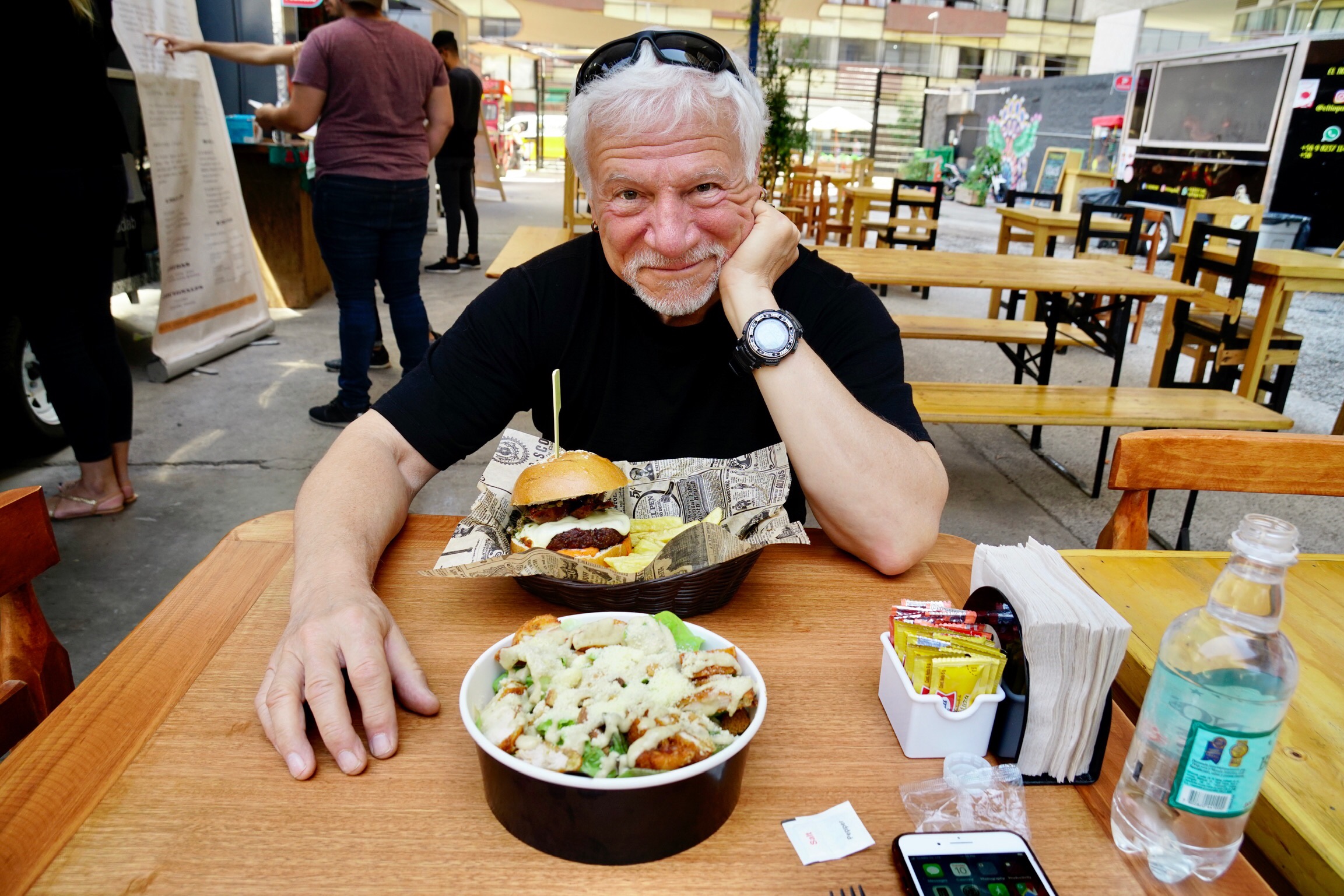
Continuing our walk our curiosity drew us into what appeared to be a vacant lot now occupied by a number of colorful food trucks displaying beverages, Arabic food, Pizza, BBQ and the like. Just as we were exchanging thoughts of regret at not seeing this venue earlier, we were approached by Francisco.

In good English he welcomed us and explained that this was his operation. “Food Park Tepeyak”, Rescatando Espacios Para Ti (Rescuing Spaces for You).He had secured and decorated the vacant lot for this use, installing electrical and water connections for the vendors, tables and toilets for the customers. He welcomed us to his creation. We explained that we had just eaten but promised to return. He is open from noon to 11 p.m. every day. We will be back.

In our wandering we did not see another American tourist. I know that they must be out there somewhere, but then we are not searching. We have two days to take in this new experience and perhaps learn more of the rules to this unfamiliar game.

Peace Everyone. Pete

PS. December 11th: We returned to Food Park Tepeyak today, found ourselves surrounded by a couple of large protests, and were wowed by the Precolombino Museo. Details next post… Stay tuned.

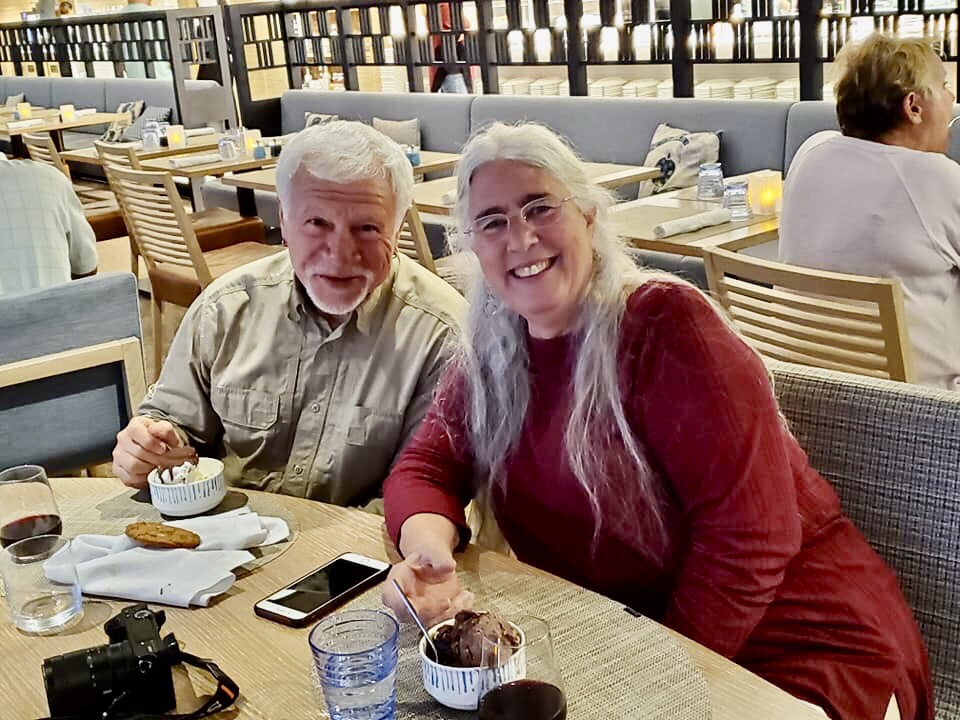
22 days… of luxury, pampering, new friendships, and excess have come to an end.

I heard it said in (partial) jest that a passenger who awoke in the middle of the night for a trip to the bathroom returned to bed a few minutes later only to find that the bed had been made. That pretty much summarizes the level of daily attention that we received at the hands of our personal cabin stewards.

We will miss the friends… friendships forged with both passengers and crew. Reality dictates that most of our paths will never again cross. That does not mean that we will lose touch. It had been our nature to maintain contact with those with whom we have bonded, if they are willing. In this, technology has been our ally. Our home remains open to those who wish to pass through Kansas City and we are energized by the prospect of those reunions.

I wander further down the path of partings In a subsequent post. Here is a summary of our day in the port of Valparaiso.

Valparaiso is a metropolitan community of about 500,000 that is spread across 42 hills. Over 30 rickety looking funiculars once aided access to the hills. They date to the late 19th and early 20th Centuries. Today only 10 remain operational, but efforts are underway to preserve these treasures, much in the way that San Francisco has preserved their cable cars. (The image is from Wikipedia).

The port takes the form of a horseshoe as the hillsides drop precipitously into the sea. There are a couple of attractive beaches, but they can be treacherous. The Humboldt Current is the Southern Hemisphere’s answer to the Atlantic Gulf Stream. However, where the Gulf Stream is a “river” of warm gulf water channeling north, the Humboldt is a “river” of Antarctic chilled waters that travel north along the western shores of South America. The waters at Valparaiso never warm above 50 degrees. Swimmers must not only brave the cold and currents, but the lack of a wading area. Only 60 feet offshore the waters are over 30 feet deep and dropping rapidly.

Valparaiso’s golden era was from 1885 to 1914. During those years merchant trade found this to be the west coast port of preference before and after passages around “The Horn”. Furthermore, nitrite was discovered in the region, a crucial component in the manufacture of explosives. During that time 90% of the world supply of the mineral was exported from Valparaiso. 80 major ships a day called in this port.

All of that changed in 1914. The Panama Canal opened and German chemists were able to manufacture nitrate on a commercial scale. Overnight Valparaiso descended from the wealthiest city in South America to a near ghost town. It’s recovery was slow but steady. Today, virtually all of Chile’s wine and agricultural exports exit through this port. It also hosts a thriving artist community. In 2003 the historic quarter was declared a World Heritage site.

Chile is the longest “skinny” country in the world. It is over 3,000 miles long with an average width of only 90 miles. It’s Navy is the strongest institution within the country… a necessity given the extensive shore it must defend. In the central Plaza Sotomayor stands the monument given to honor the Nation’s fallen sailors in the 1879 Battle of Iquique which was fought in its war against Peru and Bolivia.

Our visit to Valparaiso was largely uninspiring. Recent political unrest and longer term economic difficulties reveal themselves in extensive graffiti and the derelict buildings of the port area.

There were some bright spots. Among these were visits to a cultural museum that had an excellent section dedicated to Easter Island, and a visit to the attractive cliffs located near the city cemetery.

Outside of the museum stands one of the Easter Island figures that was taken from its home.

Inside were artifacts, including a piece of wood that bears native writing that has yet to be deciphered.

In fairness to the city, it is a major center for higher education with 14 universities and one-fourth of the urban population engaged in higher education. It is a cultural center as well that attracted immigrants from across Europe. Many neighborhoods still mirror the architecture of their original settlers.

I regret that I do not have more images to share, but the 2 hour bus ride had only 3 stops and barely touched the surface of what a longer stay might have revealed.

The end of the day and the day that followed will be featured in my next post.

Peace Everyone. Pete

Today we were scheduled for a port of call in Puerto Montt, Chile. Christine and I were looking forward to a special excursion. We had arranged a four hour horseback ride through a Chilean rainforest. This promised wonderful photographic opportunities. We had also planned to spend the afternoon in the well developed port city which has a population of approximately 200,000 people.

The city was founded in1853 when the Chilean government sponsored immigration to bring in German nationals to populate this remote region. Coincidentally, I enjoyed a brief conversation last night in that language with one of our German passengers. It never ceases to amaze me (and Christine) how quickly the language comes back to me. Someday I hope to spend enough time in that country to develop actual fluency.

Unfortunately, conditions in the bay were unfavorable. Although the ship made anchor and sent crew in for initial contact by tender, the seas were such that many of the passengers who are more physically challenged would have been unable to safely board and exit the tenders. The captain found it necessary to cancel the port of call.

Apparently, a group of sea lions found nothing to complain about as they seemed to happily dance alongside the ship.

I am taking advantage of the situation to get a quick load of laundry done. Each deck has two laundries, one on portside and one on starboard. Each laundry has four washers and four dryers. They are self-service, but there is no cost. Great minds think alike! I was fortunate to snag the last available washer as a line of people began forming down the hallway with the same idea. My exercise gear is in the wash machine so Christine and I are also taking advantage of the moment for a leisurely room service delivered breakfast in bed. Even the darker things have a silver lining, sometimes you have to throw them in the wash machine to find it.

Yesterday was a day at sea, it appears today will be a day at sea, and finally, tomorrow is a day at sea. We make port Valparaiso, Chile, on Sunday. Christine and I then travel by land to Santiago for three days of touring on our own. We board the big jet for our flight home to Kansas City on Sunday. We look forward to everything before us, especially the homecoming.

Christine has convinced me to schedule a 90 minute massage tomorrow. I am not a an “massage person“, but I’ve had a few and enjoyed every one of them. The masseuse will be Nadine from Newfoundland Canada. She is a delight and has led a number of mindfulness/meditative exercises that I have participated in here on shipboard.

We have also been invited by one of the passengers to a cocktail party in her suite tomorrow evening. Our state room is quite nice and more than adequate for our needs. The host, Bobbie, is a retired software designer who was in management at QUALCOMM for the last 15 years of her career. She and her husband are among those who are doing the full circumnavigation of the world on the ship. Viking Sun has been and will be their home for nearly 300 days. Their accommodations are a true suite of rooms with a private deck and Jacuzzi. We are very honored to be among her guests.

I know that some passengers took today’s news badly, but I just have to say… “Ship happens“.

Peace Everyone! Pete

I couldn’t resist the pun, but in truth of fact every journey finds its harmony not in the major “Fjords”, but in the minor ones. What we expect brings with it the risk of disappointment. However, the little joys that we don’t expect become magnified in the encounter.

We arrived for a day in port at Puerto Chacabuco, Chile. The population (1,250) of this village was more than doubled by our arrival. It is an entry point into the interior of Southern Patagonian and the location of the 1817 Battle of Chacabuco where national hero San Martin and his Army of the Andes defeated the royalist in the struggle for independence.

I participated in a bus tour that visited the Rio Simpson Nature Preserve which was located an hours drive into the interior. The drive presented us with wonderful vistas that I wish we could have stopped to enjoy. I was able to secure some usable images that were shot through the bus window.

The passenger seated next to me happened to be Alister Miller, who for the last 7 years has been Vikings photographer. He has traveled the world-over preserving “Viking moments”. His wife is also the daughter of Vietnam’s former Vice President. She and her family were part of the boat people exodus from that country. She settled in Norway where she became a renowned dress designer. For a number of years she was the personal designer for Norway’s Queen. A joyfully unexpected meeting and conversation with a master of his craft.

The preserve was well kept and provided a delightful walk through fields of flowers along the Simpson River. The brilliant purple flowers are Lupin. The giant leafed plants are Gunnera tinctoria, also known as “giant rhubarb”, although it is not a related species. Perhaps one of my friends can help with the identification of the small yellow flowers.

At the park I met jewelry artists Claudia Munoz and her husband. I purchased a pair of Claudia’s earrings as a surprise for Christine. A little joy in the encounter, in the purchase, and in the subsequent giving.

On our return we stopped at Chile’s longest suspension bridge.

I saw a giant Andean Conor in flight. These are the largest flying birds in the world in combined weight and wingspan, weighing over 30 pounds and with a span of over 10 feet. They are among the longest lived birds, having a lifespan of over 70 years. The species is threatened and numbers are in decline. It is believed that only 6,000 remain in the wild.

Christine had passed on the outing to get over a minor upset stomach. We rejoined at dock and then walked the (few) streets of Puerto Chacabuco in search of lunch.

We have always considered “eating with the locals” as one of the little joys to embrace. We have rarely been disappointed with our off-the beaten-track finds, and today was no exception.

“Restaurante Y Cocinaria” didn’t look like much from the outside, but it was superbly charming inside. Good beer, a steak (real, not ground) sandwich as big as my head and a charming waitress who spoke no English made this another of the day’s little joys.

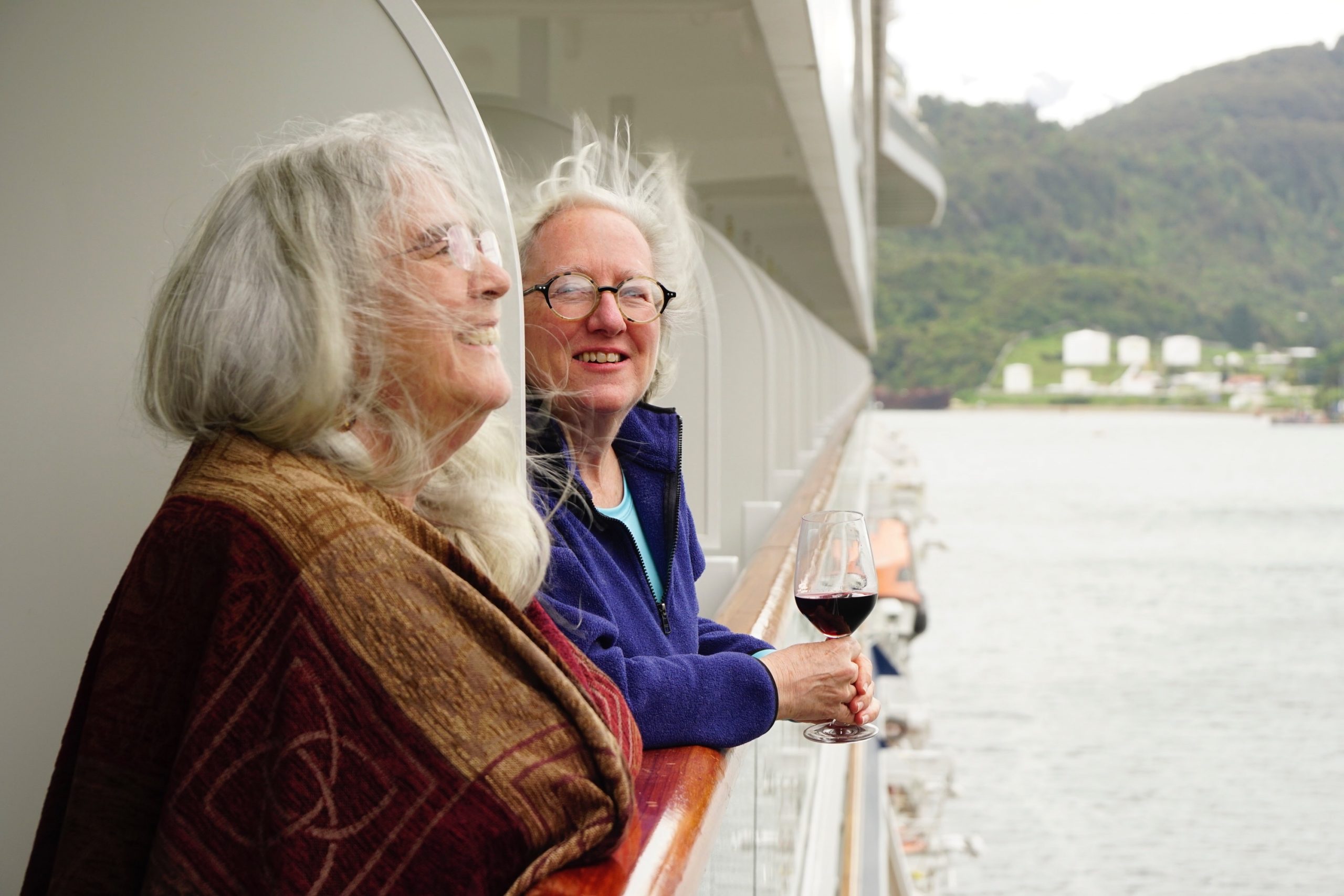
There were other “little joys”, but the one that I will leave you with was enjoying our veranda, drinks in hand. I was playing songs of our generation through my Bluetooth speaker. Like the Pied Piper it called our neighbor, Polly, to look over with a glass of wine in her hand. She and Christine bear a passing resemblance. Their banter, silver hair dancing in the wind, made for another joy that I was fortunate enough to preserve with my camera.

Peace… and little joys Everyone. Pete

PS. As I was finishing the above my background music began playing one of my favorite songs, Procol Harum’s “A Salty Dog”. Like most of their music the lyrics present a mystery of interpretation. Nevertheless, I found something resonant as we near our final port of call:

A Salty Dog

‘All hands on deck, we’ve run afloat!’ I heard the captain cry

‘Explore the ship, replace the cook: let no one leave alive!’

Across the straits, around the Horn: how far can sailors fly?

A twisted path, our tortured course, and no one left alive

We sailed for parts unknown to man, where ships come home to die

No lofty peak, nor fortress bold, could match our captain’s eye

Upon the seventh seasick day we made our port of call

A sand so white, and sea so blue, no mortal place at all

We fired the gun, and burnt the mast, and rowed from ship to shore

The captain cried, we sailors wept: our tears were tears of joy

Now many moons and many Junes have passed since we made land

A salty dog, this seaman’s log: your witness my own hand…

We are into our third and final week aboard the Viking Sun. As wonderful as this has been I confess that there are just a few aspects of this style of voyaging that do not suit my personality well. Making the final port will be welcome.

The service and amenities on Viking Sun are second to none. The staff are drawn from all over the world. What they have in common is an endearing quality that just makes you want to make them members of your family.

However, I am still somewhat constrained to a group schedule. The duration that I linger in a community is limited. There are few opportunities to meaningfully engage with locals.

Food and drink aboard are excellent and plentiful, to my detriment. I have stuck to my exercise routine, but there is a lot of sedentary time on our hands. The human body is like a battery and for the last 2+ weeks I’ve been taking in more calories than I can burn. The Piper will have to be paid once I’m home.

On November 30th I learned that the automated system that sends out email notifications when I make a post had ceased operating. I have spent the last few days in frustration trying to rectify this. I can still manually post to Facebook, but many of the subscribers are not on Facebook. In the meantime we have continued to marvel at the sights and experiences that are unfolding for us.

On the evening of November 30th we arrived in Punta Arenas, Chile, a city of 127,000 residents. This is the southernmost city in the country, and is to Chile what Ushuaia was to Argentina. Punta Arenas was founded in 1843, and like Ushuaia it began as a penal colony. Both cities are common starting points for expeditions to Antarctica. We shared the pier with two such ships.

The Laurence M. Gould is an American flagged icebreaker. It is distinctive for its unusually blunt orange bow. The design allows it to ride up upon the ice where the weight of the vessel is transmitted to the ice through the reinforced bow, thus breaking through the ice with the downward pressure.

Docked just ahead of the Gould was the RSS Discovery, a world class oceanographic research vessel from the United Kingdom. It is operated by the National Oceanography Centre and features a host of state of the art instruments and devices, including remotely operated deep water submersibles.

In the distance the hulk of a four masted windjammer was visible. It presented a poetic counterpoint to vessels at the wharf. A ghost of an earlier era of exploration and commerce. This was the 1875 vessel, County of Peebles, that plied the Atlantic, Pacific, and Cape Horn over 100 years ago.

We enjoyed a 3 hour walking tour of Punta Arenas that was quite revealing if not picturesque. The city endures some of the harshest climate conditions of any city in the world. There are pedestrian “grab-rails” strategically situated to assist walkers during straight line winds that can top 100 miles per hours. Winter combines cold temperatures and driving winds with relentless snow. The city is not connected to the rest of the country by road (except through Argentina), yet retains some limited attraction as a tourist port destination. There is a humble (by Rocky Mountain standards) ski lift and downhill skiing during the season.

The city has the largest urban Croatian population outside of Croatia, due to this being a point of Croatian immigration in the 19th Century. Today, approximately 50% of the city’s inhabitants trace their ancestry to that country.

During the first half of the 20th Century this area became one of the most important in the world for wool production. Sheep-raising continues to be one of the main economic drivers, along with petroleum and tourism. However, there is a threat to tourism at present.

The streets were largely deserted because it was Sunday. However, broken windows, boarded up businesses, and graffiti were everywhere.

Our guide informed us that a few days ago the city was accosted by protestors. These were destructive groups from elsewhere in the country who simultaneously descended upon at least 3 other cities in addition to the capital, Santiago, where protests have been in the news for the last month. The troubles have been simmering because of deteriorating economic conditions. The “straw that broke the camels back” is said to be an increase in public transportation fares. Also, the country’s public pension fund is managed under a private contract. There are claims that the private entity and private interests have looted the fund and are causing a devaluation of the pension benefits. These are serious issues for a middle class that is suffering the loss of its financial security.

The town center features a still attractive park and monument to Ferdinand Magellan.

2020 will be the 500th anniversary of his circumnavigation of the world. The waterway that passes before the city is the Straights of Magellan where the explorer navigated from the Atlantic to the Pacific Oceans in 1520.

Magellan is credited with being the first person to circumnavigate the world, but only because between 1505 and 1511 he had been part of an another expedition that traveled east into Southeast Asia. He was killed in 1521 in the spice islands but that westward passage had crossed the easternmost extend of his earlier voyage.

Magellan’s voyage began in 1519. He was from Portugal but sailed for Spain, heading a fleet of 5 ships and about 270 men. Only one ship and 19 of the original crew survived to see Spanish soil when they concluded the journey in September of 1522.

Approximately 7 km from the town center of Punta Arenas there is a museum, of sorts. It is called the Museo Nao Victoria. Here in a very humble open space along the shore of the Straits of Magellan are found full size replicas of Magellan’s flagship, and the HMS Beagle of Charles Darwin fame. There were other vessels, completed and under construction.

The carrack Victoria impresses as a large, barely seaworthy, tub. There is nothing graceful or even remotely comfortable in her 65 foot length and 85 tons displacement. Yet she was home to 55 sailors (most of whom perished) and successfully covered 42,000 miles as she circled the globe between 1519 and 1522.

The Beagle was much more akin to my idea of a sailing vessel and showed how shipbuilding technology had advanced in the interceding 300 years. She was launched in 1820 as a 10 gun sloop of the Royal Navy. Her 90 foot length and 242 ton displacement carried a compliment of 120 sailors. She was used as a vessel of exploration. Her second, and most famous, voyage between 1831 and 1836 explored South America and is chronicled in Darwin’s famous book, “The Voyage of the Beagle”.

Our visit to the Museo Nao Victoria was a bit of an adventure in itself. We and another couple hailed a taxi in the city center and were dropped off at the museum. The remoteness of site gave me a little pause to consider how we would return to port. Nevertheless we toured the vessels… there was no actual building that was part of the exhibits. When it came time to leave there were a couple of tour busses exiting, but no cabs. We were not part of the tour groups and the one employee that we could find suggested that I walk to the highway that was about a quarter mile away and flag down a cab. That was what I determined to do until a kind man at the main gate offered to phone for a cab. We waited in the drizzle and were happy to recognize the driver who arrived as the one who first delivered us to the Museum.

All is well that ends well! Peace Everyone. Pete

PS. I hope to remedy the problem with the email notices. However, Christine is rightly encouraging me to just give it a rest. I don’t have my computer here and all the work that I am doing is on my iPad and iPhone.

PPS. December 4th. Automated email notices went out shortly after this published. However, not all of the images are visible. Some further efforts will be required.