Tonight my post will be short on narrative and long on images.

We toured Ottawa’s “Mosaiculture Gatineau 2018” an outdoor garden spectacle that presents 45 larger than life sculptures formed from wire and metal underframes that support plants that are arranged to complete each art piece. The exhibit covers acres of ground and is accessed by walking a 1km long path. Over 5.5 Million plants from over 200 separate species are involved in the endeavor. Last year over a million visitors toured the exhibit, a number certain to be eclipsed this year.

Among the works was a 100 ton “tree” that presents 56 endangered species of birds in flora art.

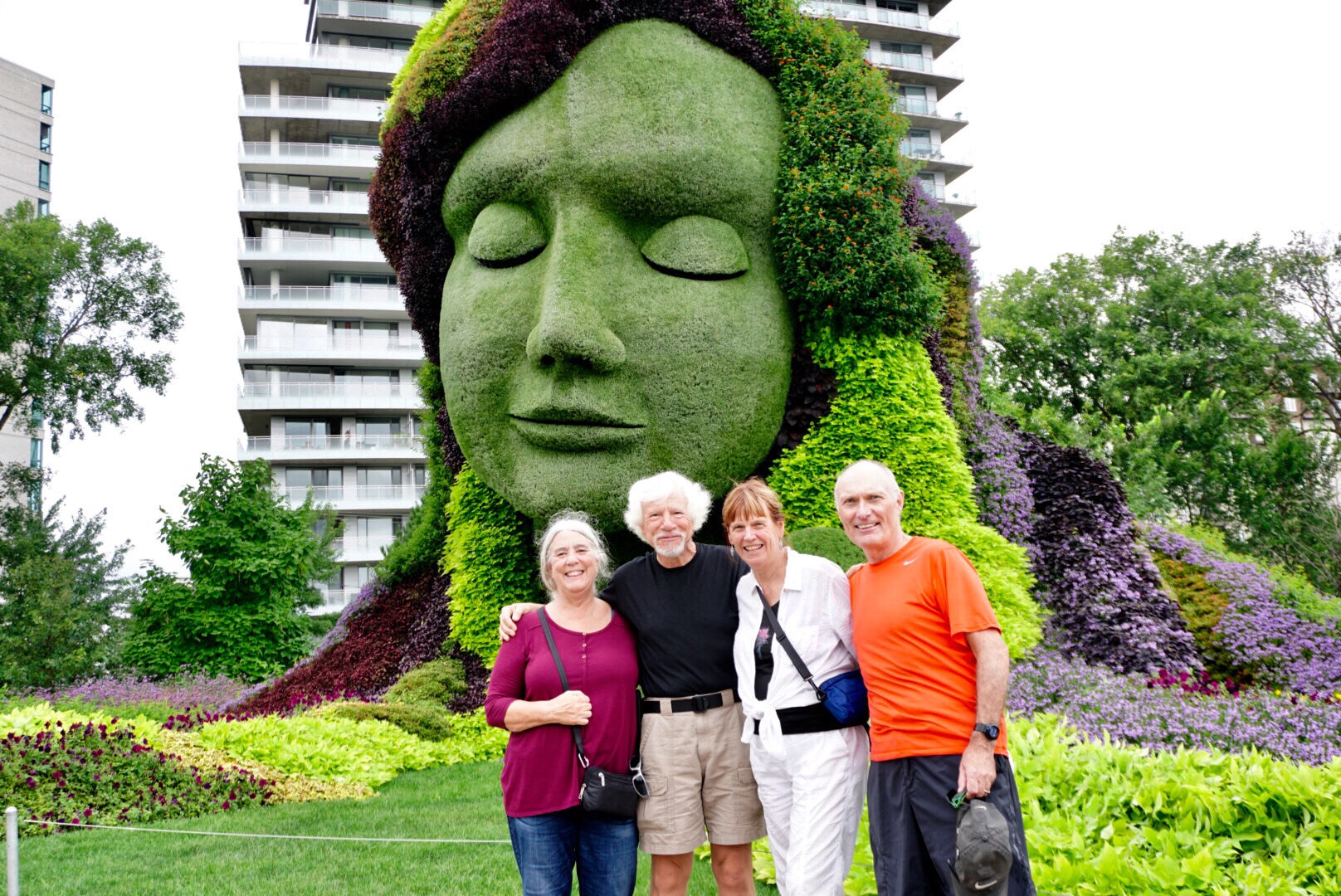
A huge head of a woman who’s extended arms present a waterfall on her right and a calf on the left was the show’s favorite.

Other images include a Voyager,

Eskimo,

An array of various animals of the North,

A First People trapper,

And a particularly charming man planting a tree as art imitates life.

Other images are presented at the end of this post.

Another feature of Mosaiculture today were First Nation dances, one of which included audience participation (me and Nanci included).

Finally, the glory of the day was celebrated at Oree du bois Chelsea, a world class dining experience in the forests overlooking Ottawa. The leisurely dinner extended to nearly 3 hours with each minute being a savored memory!

More tomorrow, and of course…

Peace Everyone. Pete

Have I said how much we like Canada? I have fond recollections of visiting as a child with my parents, our small camping trailer in tow behind a 1958 Buick. I have fond recollections of tent camping in Canada with our children in the early 1980’s. Before we entered at Thunder Bay I tuned the radio to a French Canadian radio station and told the children that upon entering Canada we must drink Canadian water in order to “understand Canadian”. At the tourist information office we entered and I immediately shuffled them off to a drinking fountain. After they had each had some “Canadian water” we approached the information counter and I asked the young attendant if she would say something to our children. She asked, “What do you want me to say?!?” The children exclaimed in a virtual chorus, “Dad, WE UNDERSTAND CANADIANS!!!” (I only wish our President did)

In those days all that was necessary to cross between the United States and Canada was a driver’s license and a smile. Unfortunately, the current political climate has made it a bit more stressful for Americans to both leave and return to the United States from Canada. It should come as no surprise that treating a best friend with mistrust will engender a reciprocal response. It is the same with nations.

Canada shares the longest international border in the world with the US. We share language and culture… We share the same aspirations for democracy, freedom, and the preservation of human rights. We have fought side by side in two World Wars, Korea, and Iraq. Canada is our number one trading partner. Christine and I support our friendship with this good nation and its people.

On July 1, 2017 we were in Whitehorse, the capital of Canada’s Yukon Territory, for the National Canada Day Celebration. It was also the 150th anniversary of Canadian Confederation. It was a memorable day for us as we witnessed ceremonies that celebrated not only Canada’s founding, but the heritage of the First Nation Peoples, the admission to citizenship of 55 people from over 15 different countries, and the expressions of inclusion for all Canadians regardless of prior national origin, religion, gender, race or sexual orientation.

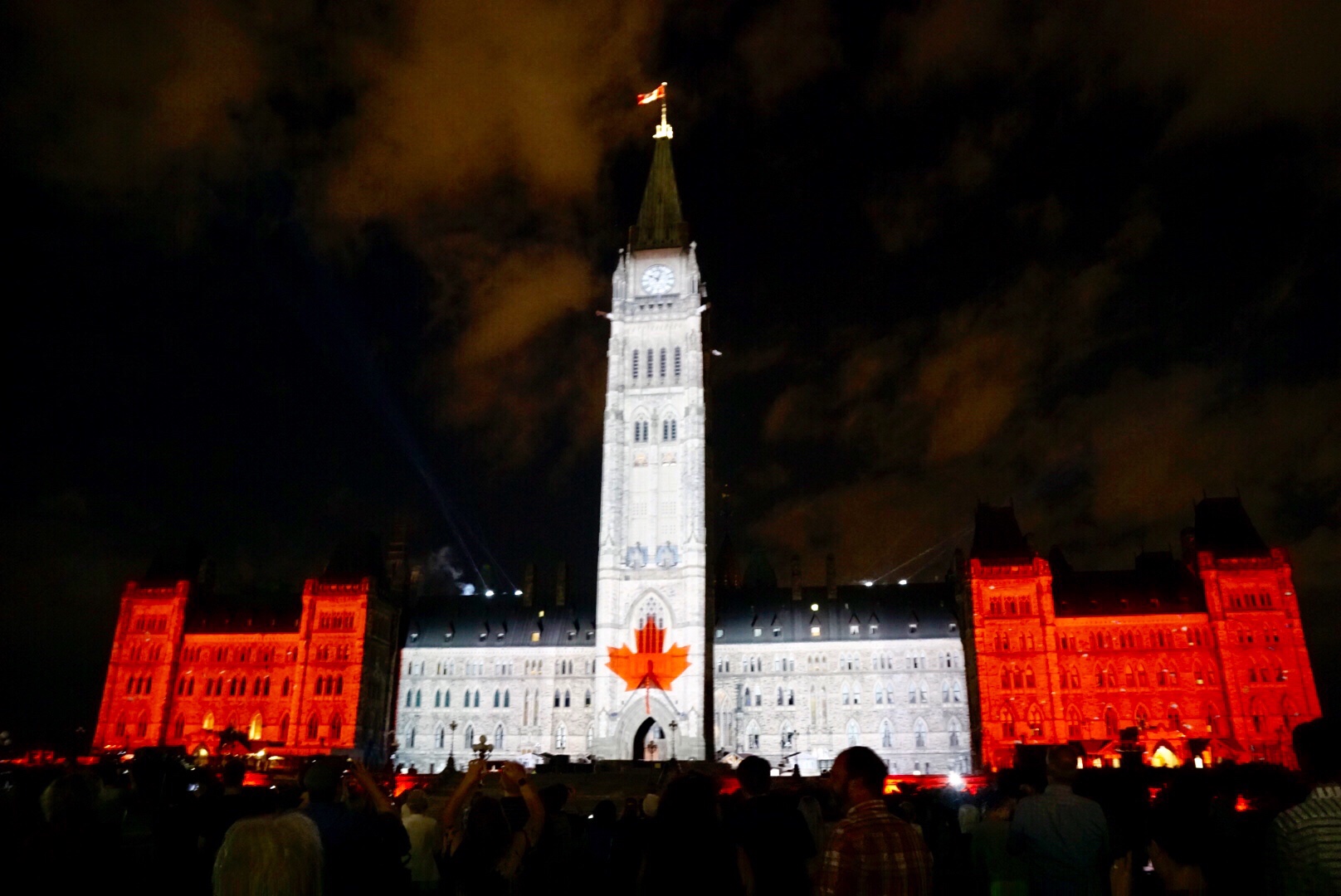
We arrived today in Ottawa, this nation’s capital, where our friends Tom and Nanci are treating us to the hospitality of their home. We joined with them this evening for a spectacular multi-media presentation on Parliament Hill. In words (English and French) and laser images projected upon the Parliament building. A “Cliff Notes” recitation of Canada’s history played out to the delight of hundreds of spectators. As citizens of the United States Christine and I were proud to stand shoulder to shoulder with our Canadian friends as the strains of “Oh Canada” concluded the festivities.

Peace Everyone. Pete

Canada’s Eternal Flame.

The buildings that comprise Parliament Hill, the first being Parliament.

The offices of the Prime Minister.

Selected images from the multi-media presentation.

We are again spending the night on the shores of Lake Huron, this time in Michigan’s Port Crescent State Park.

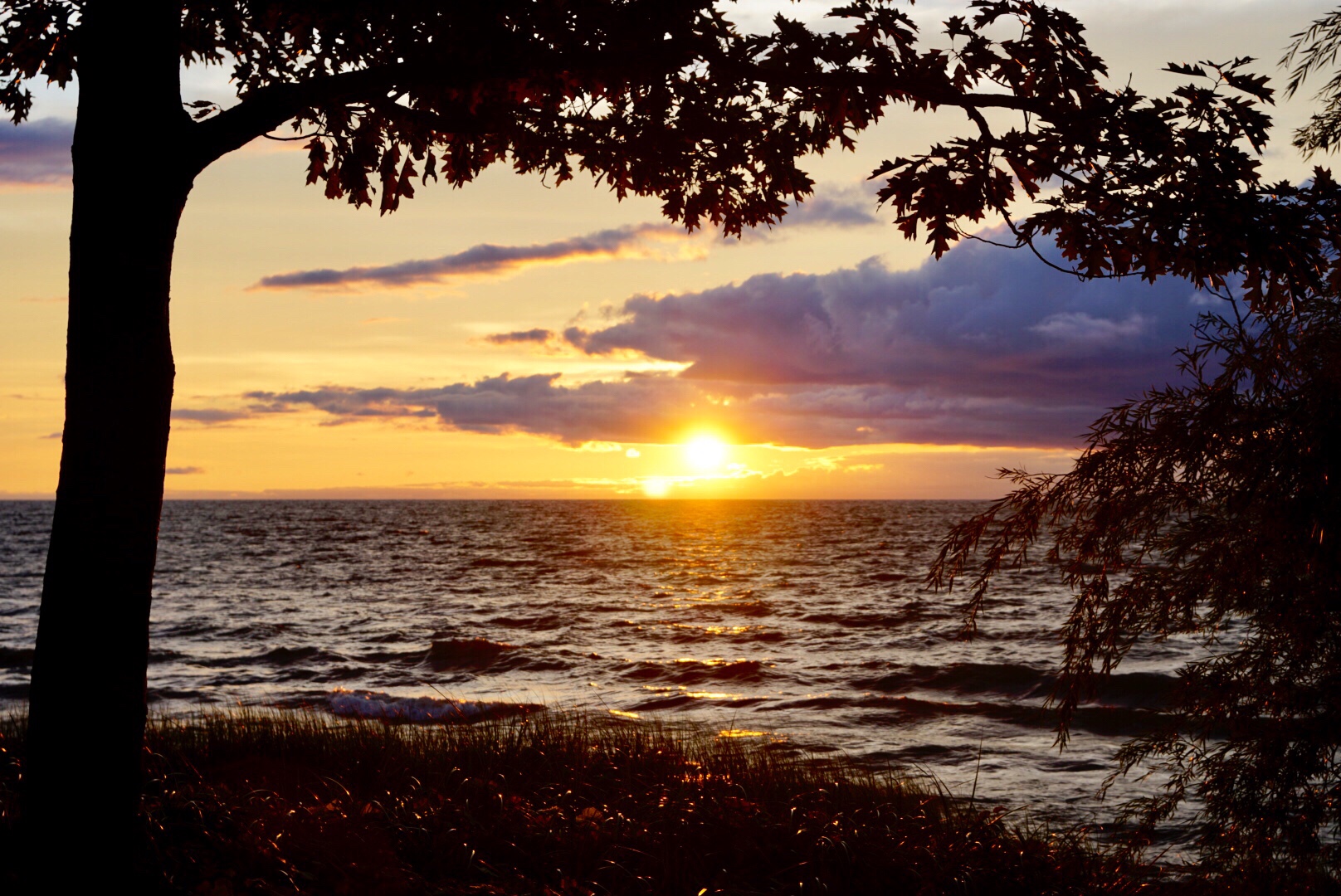
It is hard to beat the view of waves breaking a matter of feet out the front door of our trailer, accentuated by the gentle sound of the surf. The cool off-shore breeze guarantees a good nights sleep in this dark sky park. Fingers are crossed for a cloudless evening.

Port Crescent recalls the memory of the thriving logging community that once occupied this spot in the mid to late 19th Century. The shores were believed to hold an inexhaustible supply of timber. As with most things ecological, the capacity of humans to exhaust the inexhaustible was gravely underestimated. The decades long accumulation of “slash” (discarded remnants of logging and milling operations) on Michigan’s “Thumb” Peninsula were a recipe for disaster.

A major forest fire in 1871 was a “treetop fire” that burned the tree crowns but largely left the remaining trees to die as they stood. Another fire was sparked in 1881 and became one of the worst conflagrations in US history. The tinder dry conditions, high winds, and the abundant fuel in the forests resulted in a flash fire that consumed over a million acres of the Peninsula’s towns and forests in the first 24 hours! This was to be known as the Great Thumb Fire. Few area residents were spared as the fire consumed oxygen, asphyxiating some, literally boiling others to death in the rivers, wells, and lakes where they sought refuge, and ending the lives of hundreds. Most of those who survived were left homeless by the onslaught. It was essentially the end of the town of Port Crescent. Here at the Park stands the base of a 120 foot tall smokestack, a legacy of one of the sawmills and the sole remnant of the town.

Switching gears… Today we stopped for breakfast at a local diner. In the men’s room was a sign that struck me as funny enough to warrent a picture.

Further along I found the message of the sign resonating with me and bringing me to contemplate the concept of “friendship”.

The friendships that we enjoy in our places of work and our communities are familiar to all of us. Those friendships are certainly valued, but easily taken for granted.

In our journeys we have become acquainted with hundreds of travelers (and Camino Pilgrims). Those friendships are built upon the foundations of our common undertakings. Those friendships are known from the start to have only a brief opportunity to flourish and to be enjoyed. Appreciation of the comradeship is left for one’s memory as there are no guarantees that paths will ever cross again.

Flowers on the arctic Tundra have a very limited time within which to fulfill their life cycle. They compress an entire season into a few weeks. Far flung friendships flourish (say that fast 10 times!!) in much the same way, igniting and maturing in the shortest of times… and then suffering a parting with no promise of renewal.

We are grateful for each of these encounters. We are fortunate that there are occasions that our life path again intersects with that of far flung friends. An encounter at a dump station in Texas with a reunion in Alaska… An shared campfire in Alaska followed by a chance encounter in Madrid Spain… Friendships forged on the Camino that continue to flourish in Kansas City or are renewed in Colorado, Canada, the Netherlands… Friendships sparked by email or Facebook communications that are later treasured in person in Wales, California, New Hampshire, or upstate New York…

We do not take these friendships for granted. Whenever the prospect for renewal occurs it is cause for celebration whether it is a friend from school days, or a visitor from New Zealand. Each is a blessing and an affirmation that life is good.

Peace Everyone. Pete

Tawas Point State Park is a birder’s paradise. It lies on a primary migratory flyway and thus provides respite for many avian species, not the least of which are Whip-poor-wills, Redheaded Woodpeckers, Trumpeter Swans, and migrating Warblers. It is reported that over 280 separate bird species have been sighted on Tawas Point.

On a good day I might be able to distinguish a Bald Eagle (saw one today) from a Crow (saw more than one today). But I will leave it to the “birders” to identify the bird in this picture as a Heron or a Crain.

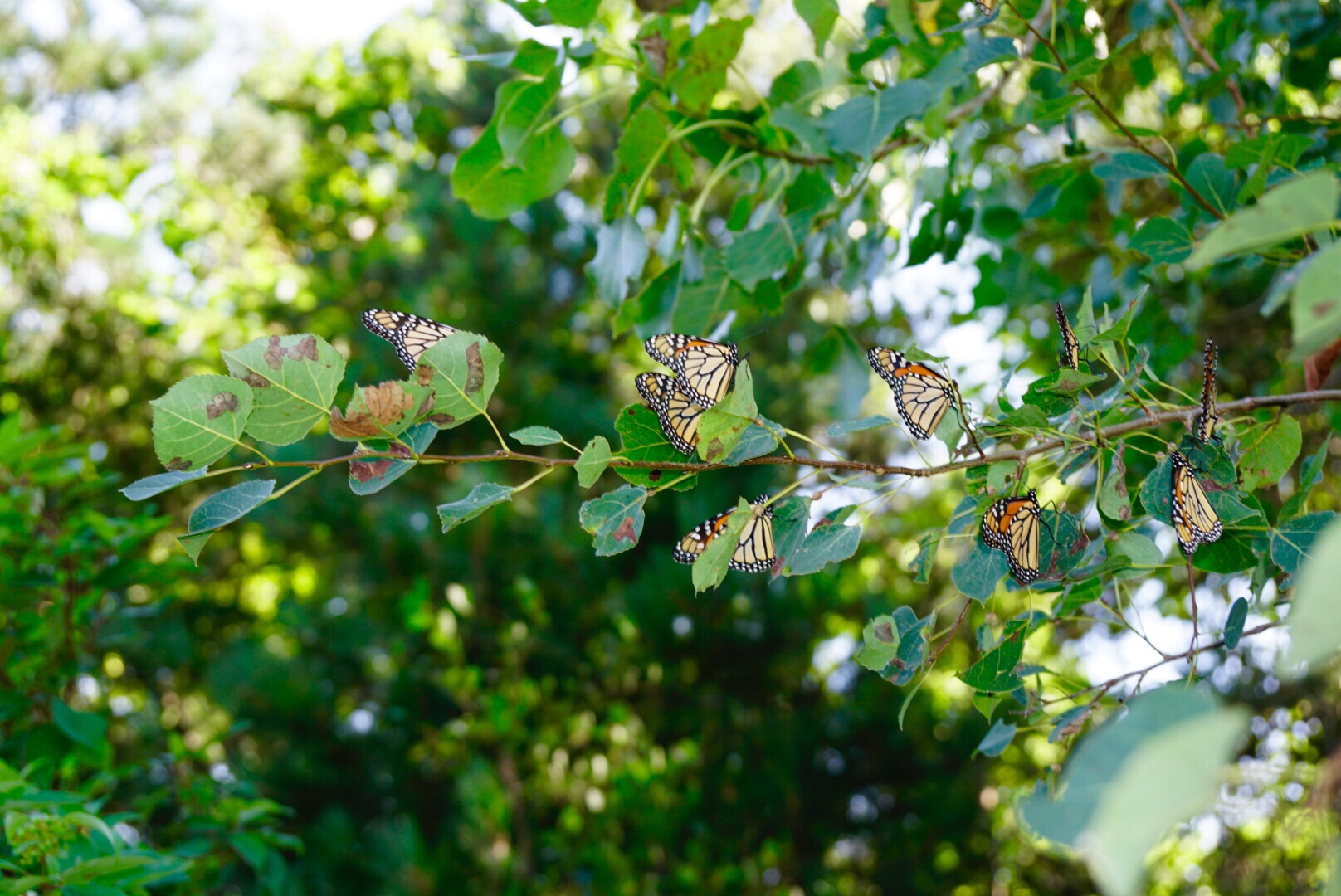
The eye candy of the day were the flocks of Monarch Butterflies. They too are a migratory species that passes through Tawas Point flying thousands of miles south to Florida and Mexico. It amazes me that these seemingly fragile creatures are capable of such a feat.

The Monarch feeds on the ubiquitous Milkweed, the sap of which is poisonous to most other wildlife. The consumption of the sap by the Monarch renders them very unappetizing to erstwhile predators. The brilliant black and orange markings of the Monarch give an unambiguous warning that better eating can be found elsewhere.

Butterflies may be the only insect that brings a smile to human observers… although I am rather fond of the Preying Mantis. One large one once spent the better part of an hour watching me work on our house. He/she would cock its head and repeatedly focus from my task to my face in a fashion that mimicked curiosity.

Today was also a good day for a swim in Lake Huron…

For observing the relatively rare Black Squirrel (at first I thought one was a strange cat when it scampered by)…

Walking the beach…

Watching an unusual Kite-Surfer from Austria expertly maneuver and levitate his flying wing board upon and above the water…

And finally to contrast the utilitarian features of the modern navigational light station and fog-horn with those of the more romantic Lighthouse of the past.

At dusk the darkening sky to the west warned of the approach of thunderstorms. We secured our campsite just in time before the downpour.

Here inside our fiberglass Casita we thought we were being pelted by hail… but it was only hundreds of acorns being shake loose from the Oaks towering above us. I wonder how the Monarchs are fairing?

Peace Everyone. Pete

PS. We are off in the morning south to Port Crescent State Park for another night as guests of the Michigan State Parks. Thursday will see us crossing into Canada.

The majority of our time “on the road” is spent together. However as I have previously observed, Christine and I have “travel libidos” that are slightly out of sync. She is often ready to return home a week or two before me and I am usually ready to leave home a week or two sooner than her. To address this I typically take a couple of short (7-10 day) solo outings each year. Such was the case a few weeks ago when I spent a week at Stockton Lake in Missouri.

Solo camping has its virtues. I find that I am more aware of my thoughts, I tend to be more focused on relaxing, and my appreciation for Christine becomes heightened. Absence does make the heart grow fonder.

Solo camping rarely turns out to be solitary camping. While at Stockton Lake I was visited by a camper Kathleen, and a sailboater, Craig. Each of those encounters was memorable. I detailed those meetings in my posts which were published at that time. However, I neglected to include another of those camping friendships.

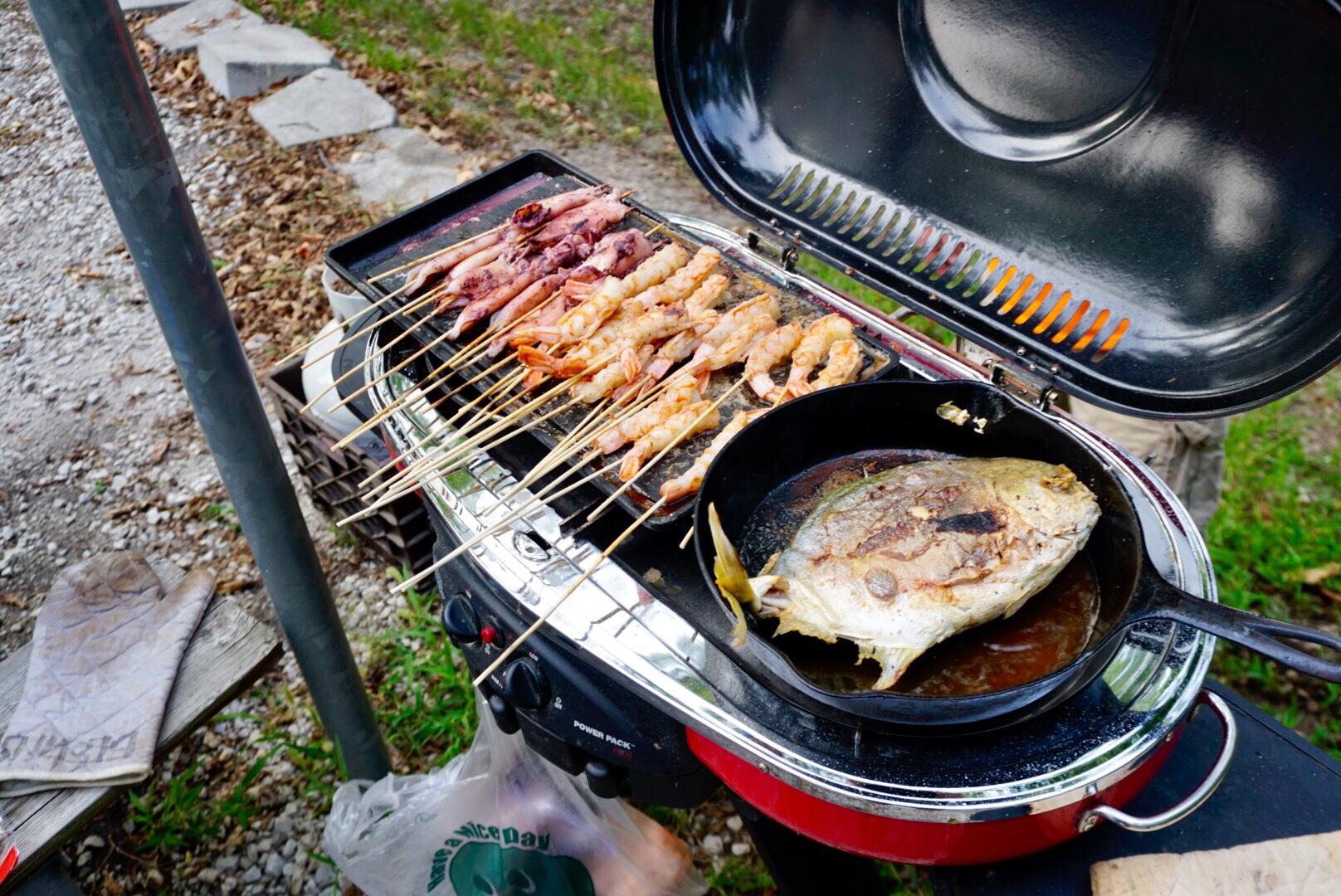
Another Casita pulled into the campground. Casita owners often seek one another out, so it was not unexpected that the owner would wander my way to say “Hi”. It was a bit unusual that he and his wife would invite me to dinner. It was totally unexpected that dinner would include sautéed squid on a stick, huge sautéed prawns on a stick, and a large Pacific Ocean fish that was roughly the size and shape of a 14” cast iron skillet.

David and his wife Badeth spend 4 months of the year at their home in Missouri and the remaining 8 months of each year at their beautiful beach home in the Philippines. David was born and raised in the States and Badeth is a native of the islands. They were joined at camp by her sister Josephine and nephew Ian. David could not have known of my love of squid, shrimp, and eating “the unknown”. The women presented a feast and I was the beneficiary. The women also cooked a large inviting steak… it seems that in spite of his extensive time spent in the Philippines, David is not particularly fond of squid, shrimp, or eating “the unknown”.

This wonderful family also included me in their breakfast plans for the following morning. Their hospitality and friendship were extraordinary, but perhaps understandable as they explained the welcoming nature of the Philippine people and the fact that David was retired from over 40 years of being the talented handyman, construction coordinator, chauffeur, mechanic… and all around “Swiss Army” assistant to a convent of nuns! Even when camping solo one meets the nicest and most interesting people.

Peace Everyone! Pete