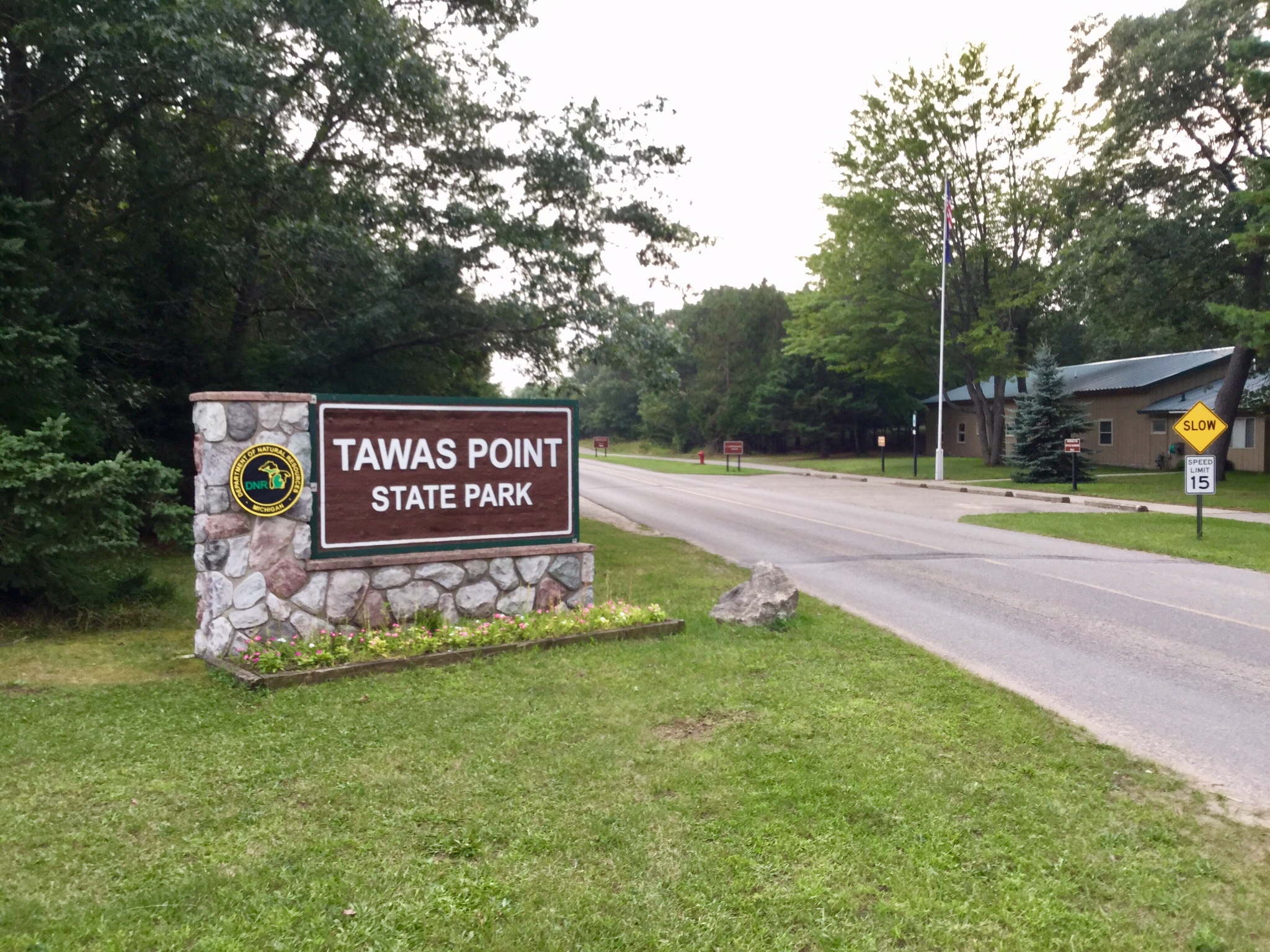
This is our second night in Michigan on the western shores of Lake Huron. Our first night was at Bay City State Park, and we will be spending the next 3 nights in Tawas Point State Park. Both parks are well kept and very family friendly (lots of kids having lots of fun!). As nice as Bay City was, Tawas is spectacular. We were fortunate to reserve one of the shore side camping spots.

A nice bathhouse is a short walk away, and we find ourselves sheltered beneath established Oak and Maple trees. 75 feet out of our door is Lake Huron. Since the park is located on a sandy spit the entire shoreline is gently sloping prime swimable beach front.

A short walk from our campsite is the Tawas Point Lighthouse.

The original light station was built in 1852, but quickly became irrelevant as accumulating sands “moved” the lighthouse inland. The replacement light station, built in 1876 was also constructed on an island, but as you can see it is an island no longer. It was decommissioned in 2014 and replaced with modern optics and a solar powered foghorn, both located on the current point.

The 1876 lighthouse is in excellent condition and gives a wonderful insight into the life of a lighthouse keeper and family.

The lighthouse still houses its original 4th order Fresnel optics. The Fresnel lens was an early 19th Century French invention that was able to compress and focus an ordinary kerosene lamp flame into a searing beam of light. The 4th order lens could project to a distance of 16 miles. These lenses used a complex assembly of precision cut and mounted glass rings to gather and focus the light. The largest 1st order lenses stood nearly 12 feet tall and were able to reach 25 miles into the darkness!

Lighthouses are identifiable in daylight by the patterns painted on the towers, each in a region being unique. At night they could each be distinguished by the duration and pattern of light and dark, Tawas Point’s being 4 seconds “on” followed by 2 seconds “off”. Since kerosene flames could not be turned “on and off” in rapid succession, clockwork devises rotated the light or a shield is such a manner as to create the flashing effect. These day and night patterns were noted in the navigation charts. The clockwork was powered by weights on chains or cables that descended the tower as the mechanism “unwound”. It was the light keepers duty to maintain the house, tower (inside and out), the kerosene lantern, and the clockwork mechanism, keeping it wound throughout the night. The lighthouse keeper shouldered an incredible responsibility as sailers entrusted their lives, the lives of their passengers, and the safety of ships and cargoes in reliance on the lighthouses and signal horns to warn of unseen perils.

Peace Everyone. Pete

PS. Our evolving “plan” will see us spending 3 nights at Tawas Point and then one night at Port Crescent State Park to the south. We will then enter Canada on Thursday and we plant to visit our Camino friends, Tom and Nanci in Ottawa. From there we will head toward Québec City and eventually return to the States through New England.

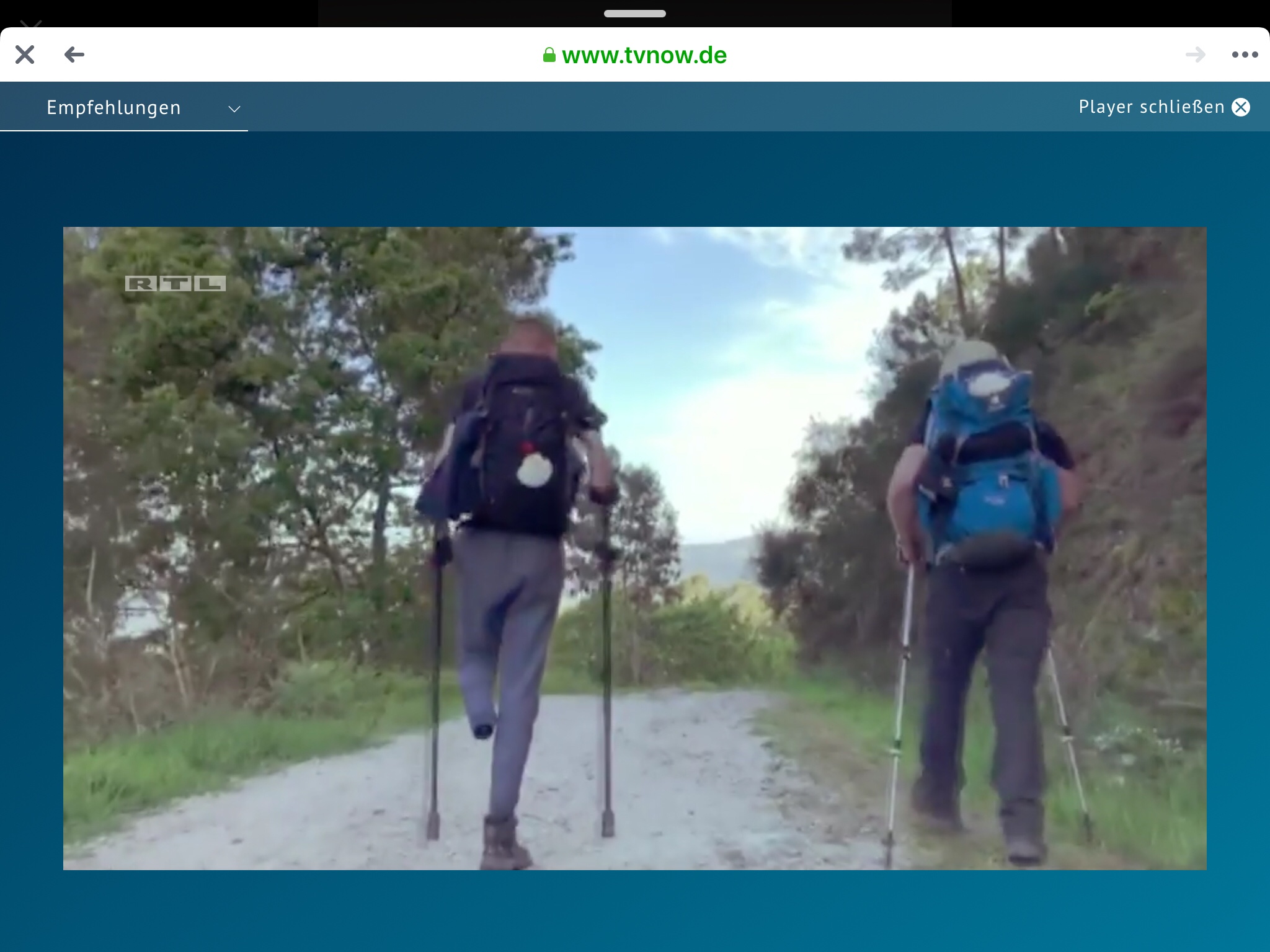
Many of you are aware that this last Spring Christine and I spent 3 months in Europe. That journey included an eleven day 250km hike from Porto Portugal to Santiago Spain. This was the Portuguese route of the Camino de Santiago. On April 27th we encountered a number of memorable German pilgrims who were also walking the Camino. There was physician Reiner Vogt and his wife Ina Massing. Ina manages a firm specializing in manufacturing and fitting prosthetic limbs. Faris Abu-Naaj is an internet expert who had rescued his health by losing nearly 200 pounds. A month after we met Faris he would lead a group of people struggling with obesity on a 100km Camino pilgrimage. Stanislaw Mowinski is a German citizen originally from Poland. Each of these good people became dear to us in the span of an afternoon.

We were joined later that evening by Grzegorz Polakiewicz from Poland. “Greg”, an intensely spiritual young man and a stranger to all of us, spoke no German. He is an amputee who was walking his second Camino with one leg, carrying his backpack, assisted only by his two crutches. Discussions at table that evening, interpreted by “Stanley”, resulted in a proposal for Greg to travel to Germany where Ina and Reiner would arrange for him to receive a prosthetic leg and the physical therapy necessary to use it. I would have called this encounter an amazing coincidence, but I was continually reminded during our journey, “In life there are no coincidences”.

“The Rest of the Story”: I have remained in contact with all of these folks through Facebook. Last week I received a link from Ina to a story broadcast on a German television program, something like our “60 Minutes”. Initially, the link would not work until I redirected my browser to a German IP address. As the program played out it featured Greg’s arrival in Germany, his fitting of a prosthetic leg, courtesy of Ina and Reiner, and the physical therapy necessary for its use. I captured some screenshots from the program that I share with you.

It is worth remembering that every miracle has two parts… that it occurred, and more importantly that it was noticed. “Greg” noticed, and so did I.

Peace Everyone. Pete

PS: Christine and I are back on the road again. We will be traveling to Canada and the New England States over the course of the next 5 weeks.

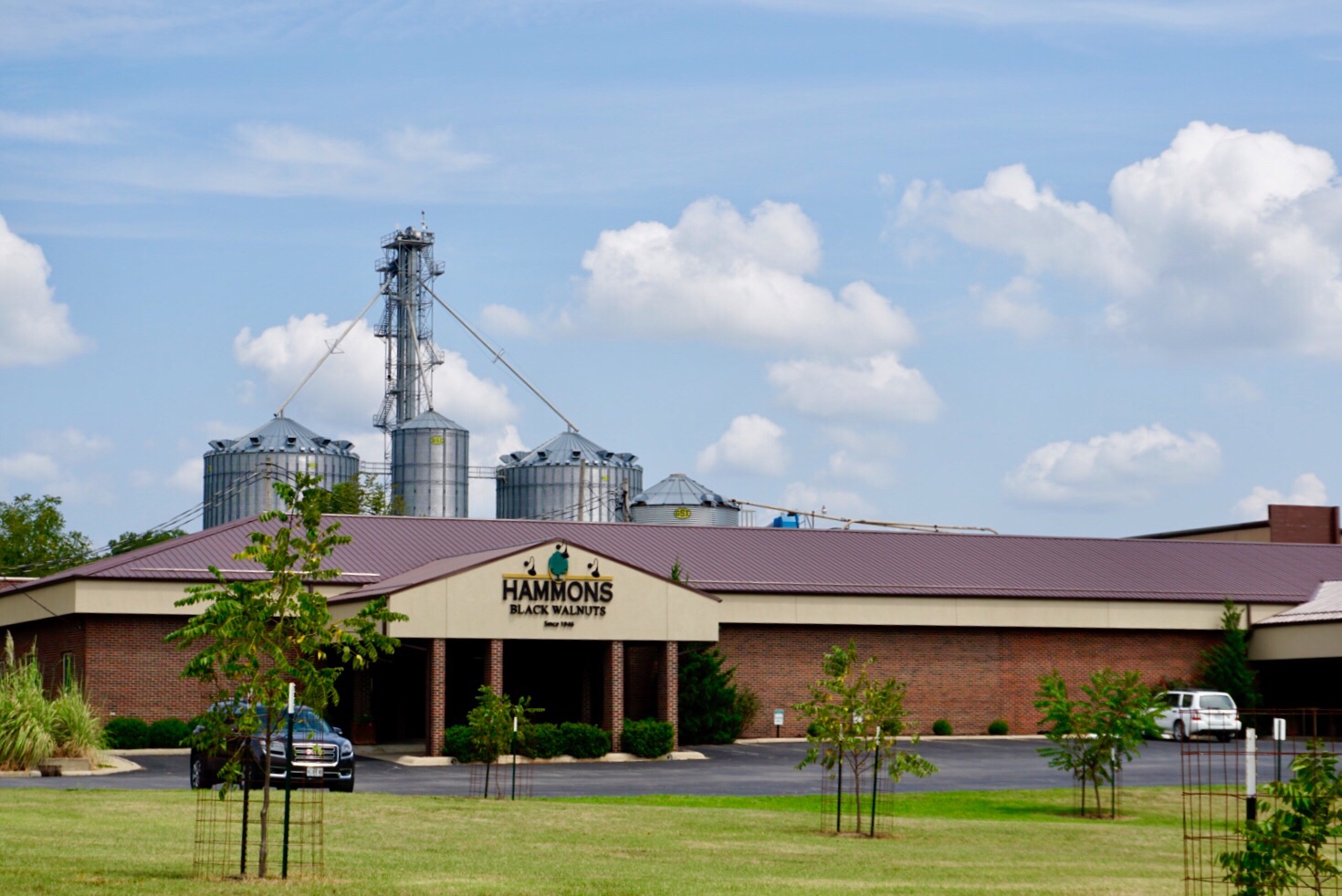
A fellow camper at Stockton Lake mentioned in passing that the nearby town of Stockton was the world’s largest producer of Black Walnuts. I was somewhat skeptical since Stockton has fewer than 2,000 residents and is remote from any major highway system. With some free time on my hands and the promise of air conditioning in my SUV on a humid 90+ degree day I went into town to explore.

It did not take me long to find the tall silos that marked the location of the Hammons Products Company. Founded in 1946 by grocer Ralph Hammons, the firm is now operated by his grandson, Brian Hammons.

I entered the company offices which were clearly purposed for business and not itinerant campers like me. I was disappointed to learn that tours are available only once each year in September. However, the receptionist invited me to view a brief promotional video in their company conference room. I eagerly accepted. At the conclusion of the 5 minute video the Company’s President, Brian Hammons entered the room and introduce himself. He graciously took time from his day to tell me more about Black Walnuts and the Hammons story. Brian Hammons is center in this image from the Company’s website, https://black-walnuts.com

Indeed, the Hammons Company is the worlds largest producer of Black Walnuts, processing over 25 million pounds each year! Brian was quick to point out that English Walnuts are distinctly different and that production of the English variety exceeds 500,000 TONS annually! He then went on to distinguish the two varieties and highlight the virtues of the American Black Walnut:

1. Black Walnuts are thicker shelled and only 7% of the fruit is edible nut while 45 % of the thinner shelled English variety is edible nut.

2. Most Black Walnuts are sustainably harvested in the wild unlike the plantation grown English Walnuts.

3. Black Walnuts are universally acclaimed as superior for their deep, rich, and bold flavor. They are also nutritionally superior to their English cousin.

While only 7% of the walnut seed finds its way into the mouths of hungry consumers, the other 93% is processed into environmentally friendly abrasive products that are sought commercially for such varied purposes such as polishing delicate musical instruments, water filtration media, surface “sand” blasting , and oil field machinery maintenance.

Most remarkable for me was the method of harvest. Each year in the Fall, over 200 gathering stations are set up across 15 States. Thousands of gatherers comb the forests and hand harvest the wild Black Walnuts, delivering them to the gathering stations where the green outer covering is hulled. The remaining intact nut is then delivered to the Hammons factory in Stockton Missouri for further processing.

While Black Walnut production is firmly tied to its early American roots, the Hammons Company has reached out into the 21st Century. Improvements in processing methods have increased efficiency. Selective improvements in Black Walnut plant varieties are creating trees that bear fruit with thinner shells and proportionally greater nut meat to shell ratios while retaining the unique taste profile. Thus the potential for enhanced profitability is attracting landowners who are seeing financial rewards in planting these improved cultivars.

I really appreciate the time that Brian took today to educate this wandering (and wondering!) camper.

Peace Everyone. Pete

PS: Here are a few of the products that are supplied by the Hammons Company. If you look closely you will see one of my favorites from Kansas City’s own Boulevard Brewing Company!

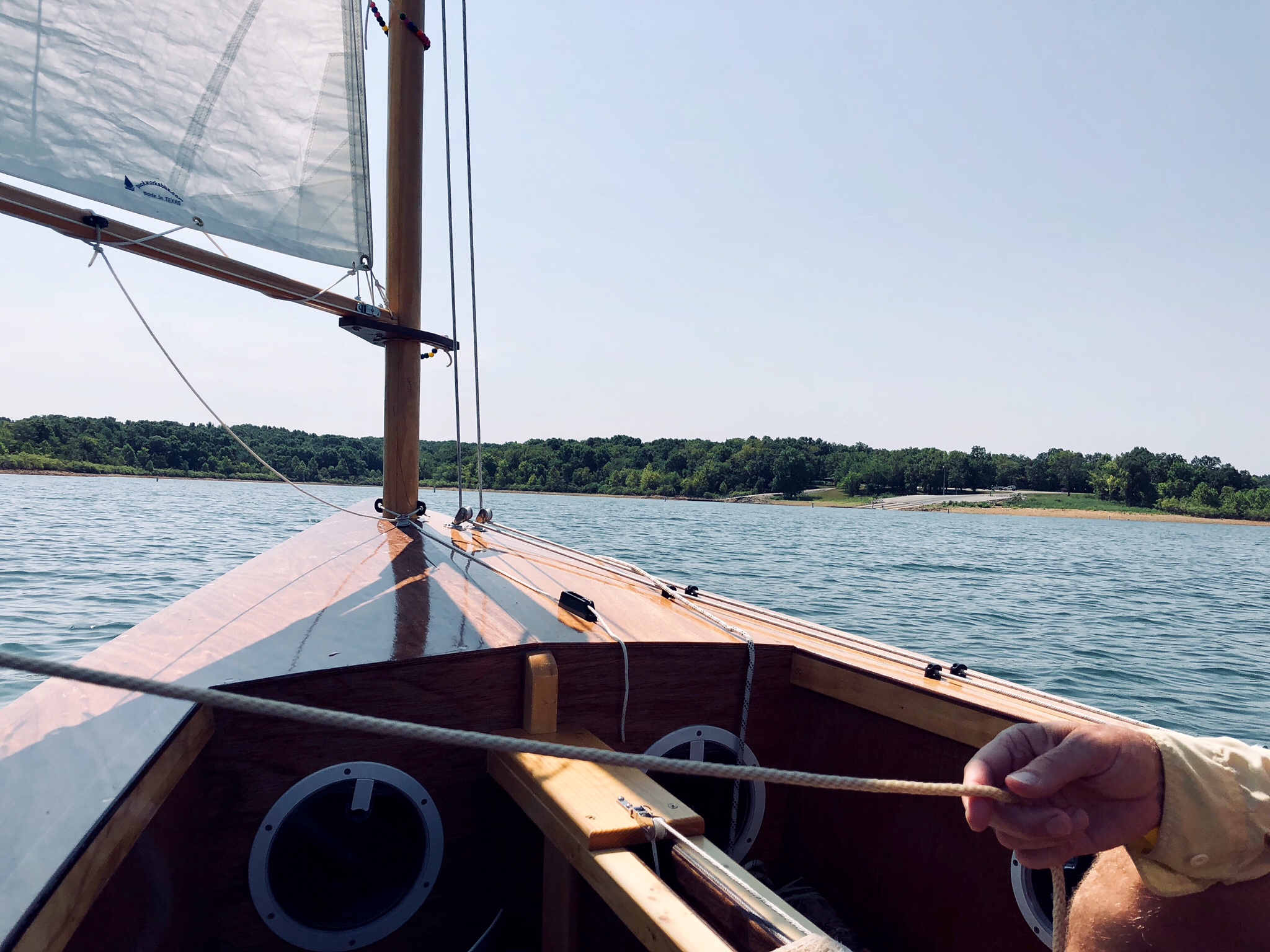
It has been nearly 10 years since I last held a sailboat’s tiller or adjusted a main sheet. Today Craig from the nearby town of Stockton took me out on the lake in his homemade 14 foot gaff-rigged catboat.

It was a dangerous passage, not in the sense of sailing conditions or personal risk, but because I felt perilously close to being once again bit by the urge to sail. My thoughts processed through the possibilities… we have an empty garage bay… a small sailboat would be easy to take out when the whim strikes… Christine’s Highlander has a hitch and tow package… is it legal to tow a camper that in turn is towing a boat? OK, that last one is a bit over the top, but I have actually seen it done… most recently while traveling from Kansas City to this campground.

The idea of another sailboat is appealing but not practical, especially with the evolving plans that we have for the rest of this year and 2019. There may come a day for another sailboat, but not right now.

Before I get to next year: Once the celebration of Christine’s father’s 100th Birthday is in the books we will be packing “Rigel” for a 5 week outing that will take us to Michigan and the shores of Lake Huron, Ottawa Canada, and then on to New England. Highlights will be a visit with my mother as we pass near Chicago, camping on Huron’s western shore, and then on to visit our Canadian friends Tom and Nanci who we met while walking from Porto Portugal to Santiago Spain last April. Of course, New England is its own special highlight. We camped there in 2016 and knew that return trips would be a must.

Later in 2019 we hope to travel back to Canada and camp in the remote Province of Labrador and Newfoundland. Nanci and Tom have expressed an interest in a one-week Fall cruise from Montreal to Les Îles de la Madeleine. It is an idea that intrigues us. The “cruise ship” is actually an ocean going ferry with spartan accommodations by typical cruise ship standard. The destination is an island archipelago located where the Atlantic Ocean meets the St. Lawrence seaway. These small islands sit upon an ancient salt dome. European explorer Jacques Cartier landed there in 1534, hundreds of years after the Mi’kmaq First Nation people had made the islands a seasonal hunting ground. Some modern inhabitants trace their ancestry to sailors marooned as the result of the hundreds of shipwrecks that have occurred on the islands shores.

Here is a link to the cruise company website:

https://www.croisieresctma.ca/en/

Well, I have danced around and thus avoided talking about what I consider the most captivating “Next Thing”. It will take place in April, 2019 and it deserves a separate post. However, I will leave off with a picture that more than hints at what is coming.

Peace Everyone! Pete

Yesterday I mentioned my challenges with relaxation and solitude. That remark drew thoughtful comments from good friends. Before I delve further into that… first about today.

Within a radius of 5 miles my bicycle carried me to a number of remarkable (and memorable) sights. The Stockton Dam, constructed in 1963, featured a state of the art hydroelectric turbine. The original turbine now stands on display. In 2009 one of its huge blades failed, breaking off from the unit and then discharged into the lake. It was retrieved, welded back in place, and the turbine was restored to service in 2010. However, the handwriting was on the wall and a new more efficient turbine was installed in 2013.

Near the sight of the turbine monument are huge rock cores that were excavated at the time of the dam’s construction. These cores provided engineers with valuable information regarding the stability of the underlying strata to support the dam structure. Moreover, the cores gave geologists a remarkable window into Earth’s past. The cores exposed layers of rock that date back 450 million years, a time before vascular plants and vertebrate life forms existed. The cores could not only be examined on the surface, but the holes that the cores left were large enough in diameter to allow geologists to descend the 200 foot depth and closely examine the strata in-situ.

Perhaps the most unexpected encounter on my exploration was a small out of the way cemetery founded by Issac Lyons Hembree (1796-1865). He had settled 1600 acres of Missouri wilderness in 1852 and determined to be buried in a place where he could watch over the work in his fields below. His gravestone is weather worn, but a bronze emblem gives testament to his service in the War of 1812. Other monuments to his descendants speak to service in the “Indian Wars”, and most poignantly to the service of Thomas Wilson Hembree, USN, who died on December 7th, 1941… “a date which will live in infamy”.

I had the good fortune at camp to meet Katherine, a retired educator originally from Kansas City. She and her partner moved to Stockton Lake, attracted to the natural beauty of the area and the favorable cost of living. Initially there was some concern whether they would find acceptance in the rural society. Those concerns were quickly forgotten as they not only were embraced by their neighbors, but Katherine’s partner was elected Mayor of their town.

Katherine introduced me to her neighbor Craig, a 59 year old retired hydrologist. Craig found a new passion in retirement, hand building wooden boats. He brought to camp a kayak and a gaff-rigged catboat. They are both sea-worthy works of art. Tomorrow, weather willing, Craig and I are going to sail the catboat together.

Back to my starting reflection: My friend of 50 years, Maxine, suggested that I sit beneath a large tree and with the aid of a magnifying glass (or bifocals) engross myself with the close examination of the wonders to be found in a square foot of the ground. She touts this as a meditative exercise to embrace both solitude and relaxation. I intend to take her up on this suggestion. However, my first impulse was the thought of what others might think of a 66 year old white haired guy playing detective with blades of grass. Mind you, as an adult I have hugged trees in order to “feel” the life of those stately creatures… I have laid upon the grass to contemplate the endless universe above and the 8,000 miles beneath that separates me from those on the other side of the world. In these and other similar actions I have found a tension between my proper “adult self”, and the childlike wonder that occasionally motivates me.

Childlike wonder reveals what adult propriety suppresses. We knowingly smile at a child’s play with imaginary friends. We gently discourage a child’s “overactive” imagination… and eventually we drive that free spirit into compliance with the norms that we ourselves were taught to observe as the price of our adulthood. What if the unfettered imaginations of a child or an adult nearing the end of life, are able to perceive what we have become blind to? “And those who were seen dancing were thought to be insane by those who could not hear the music.” (attributed to Friedrich Nietzsche among others)

Today was a journey not measured in distance but certainly as experienced in its depth.

Peace Everyone. Pete

PS. Perhaps tomorrow will be about “The Next Thing”.