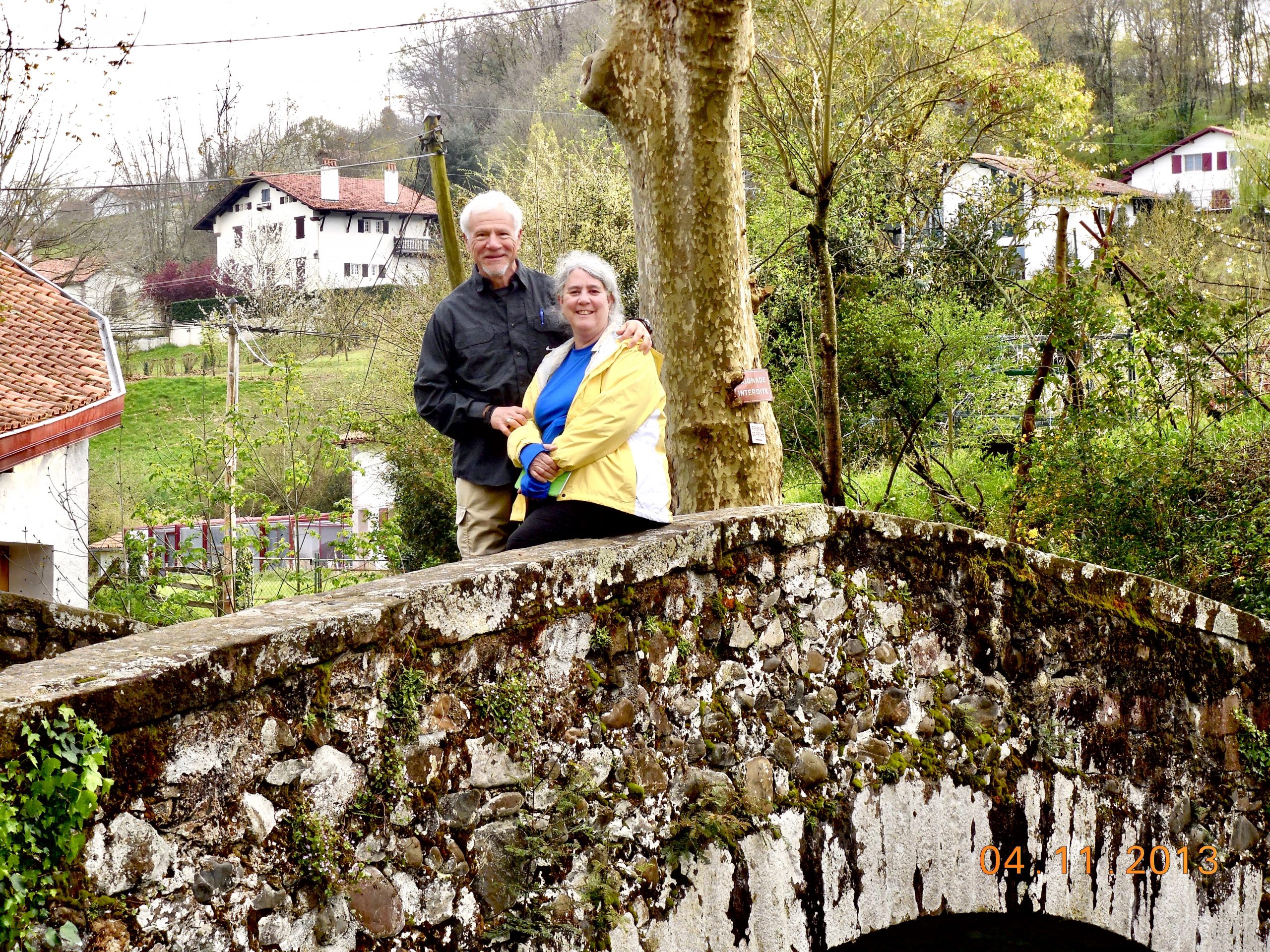
Written at the Refuge at Orisson, Spain, April 13, 2013.

My Wife and I share a good marriage. She is a good person, but I will not self-proclaim my own character. A good marriage is not dependent upon whether or not the partners are good people, but rather upon the people being good partners. In this I am doubly blessed to have married a good person who is a good partner.

This coming June we will take our marriage off of the shelf, admire and polish it for the 36th time.

We do not cast responsibility upon each other for our individual happiness, but we do find our relationship is a source of happiness. It is also a place where we each find support in the other’s strengths and talents, and refuge from our own weaknesses and shortcomings. One cannot seek such support or sanctuary if there is fear of criticism or judgment. Ours is a good marriage.

Many Pilgrims walk the Camino alone in order to examine their thoughts without distraction. With a good partner one can also examine one’s thoughts through dialogue. Two heads are better than one but only when there is trust that the exchanges are free from criticism and Judgment. With a good partner It is more important to listen than to talk. To know one’s own thoughts listen to the thoughts of others.

In our “real” life, the depth of sharing is challenged by the distractions of work, finances, current events, and all things that comprise the background noise of life. I find that we shared today unburdened of those distractions. Drawing upon our partnership we found both physical and emotional strength and support. We were living our love.

Because I lived with my Wife today, I will admire our marriage just a bit longer and polish it with a bit more care before placing it back on the shelf for the 37th time.

Peace Everyone, Have Fun, Do Good, and Be Safe! Buen Camino. Pete


 April 14, 2013. The excitement and exertions of the prior day earned Christine and me a welcomed sleep. My night was occasionally interrupted by a deep resonant cough from a young South Korean pilgrim. Regina was one of the 10 sharing the cabin. A few days later there was a spreading bronchial contagion. We were not spared.

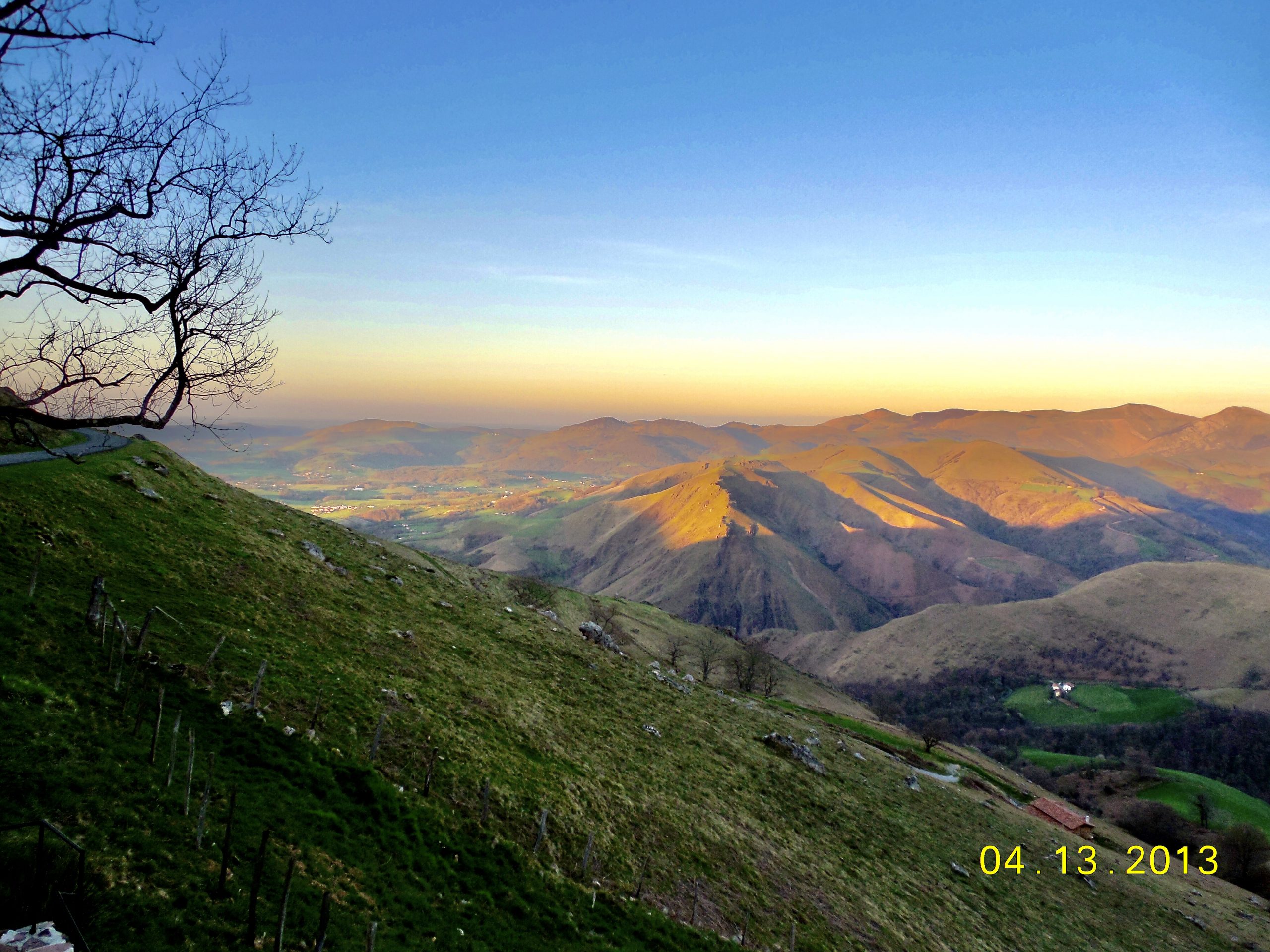
Up before dawn I dressed and with camera in hand I hoped to catch sunrise. I was not alone. On the first day I had met a pilgrim from New York laden with perhaps 20 pounds of photography gear. He had already staked out a prime location to erect his tripod and await the anticipated glory of the first rays breaking the horizon.

Photos taken, I returned to the cabin and was greeted by another blaze of light as the morning rays brilliantly played upon Christine’s silver white hair.

The Orisson refuge provided a breakfast of coffee, tea, juices, pastries, breads, fruits, cold meats and cheeses, typical for the Camino and typically European. Afterwards Christine and I assembled our gear and emotionally prepared for the day ahead.

I thought that we had anticipated every eventuality. Rain, cold, heat, blisters, but we never expected to be apart. It is often said that each Peregrino walks their own Camino. I was learning the truth of those words. Over the next 35 walking days there would be many times that due to our different abilities and tolerances Christine and I took separate paths. Due to illness there would be 11 nights we would sleep apart. That came later of a “difficult conversation” in the city of Burgos that saved our Camino(s). For now I will only say that Christine’s insistence won out.

Outside of the albergue I waited for Christine’s pre-arranged departure. The delivery van would return to St. Jean before proceeding on to Roncesvalles. Two other pilgrims had heard of Christine‘s plans and arranged to join her. Other pilgrims were present when one woman, Patricia with a group from New York, remarked that “real pilgrims” carried their packs and walked every step of “The Way”. Most but not all pilgrims are pleasant and polite. Patricia was neither pleasant nor polite. We would encounter her again weeks later.

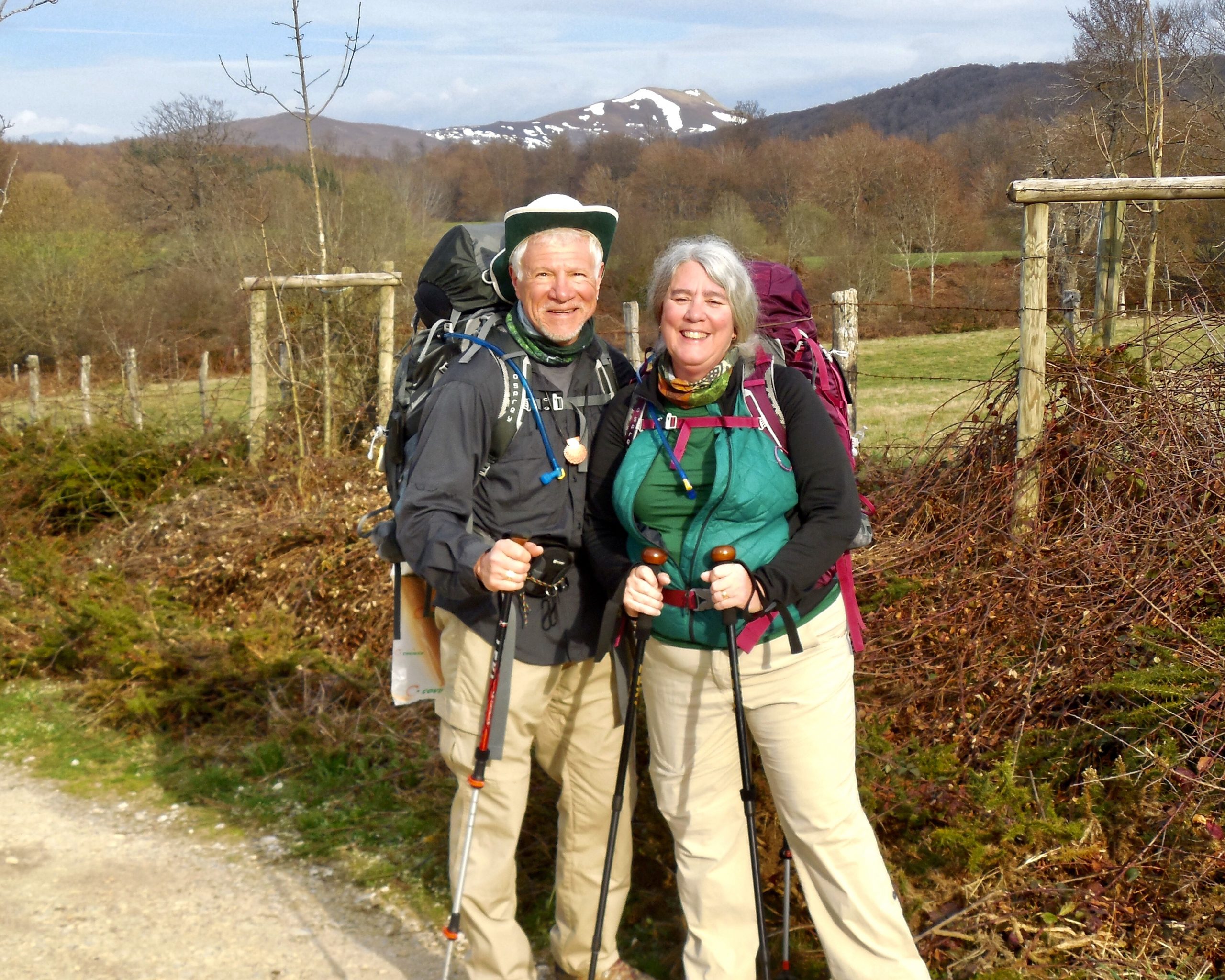
Parting with a kiss we each began our individual Caminos.

It was not long before I found myself with a variety of companions including Heika from Germany and Brent Ledford, an expatriate California District Attorney who had retired with his wife to Barcelona, Spain.

Brent found that his pension could provide an enhanced standard of living while allowing them to enjoy the culture and environment of a beautiful European city.

As promised, the hike was difficult and made more so by a raging mountain wind conservatively estimated to be over 50 miles an hour. I witnessed a pilgrim chasing his pack as it rolled end over end like a tumbleweed, threatening to plummet off a cliff.

I encountered here, and at various other locations along the Camino, monuments to pilgrims who had died on The Way.

Deaths were typically the result of illness, infirmity, or injury. None to my knowledge were from violence. Poignant was a monument to a Brazilian pilgrim who weeks before had lost his way on the pass during a snowstorm, falling to his death.

The fountain of Roland is reputed to be the place where Charlemagne‘s cousin and chief knight met defeat and death at the battle of Roncesvalles in the year 778.

Charlemagne, who had been at war with the Muslims in Iberia, was withdrawing to France over the Roncesvalles Pass. Roland commanded the rear guard. At a point in the pass that was narrow and bordered by forest he and his troops were ambushed by Basque soldiers.

Roland’s struggle became the story of legend told in the oldest surviving piece of French literature, the 11th Century epic poem, “The Song of Roland”.

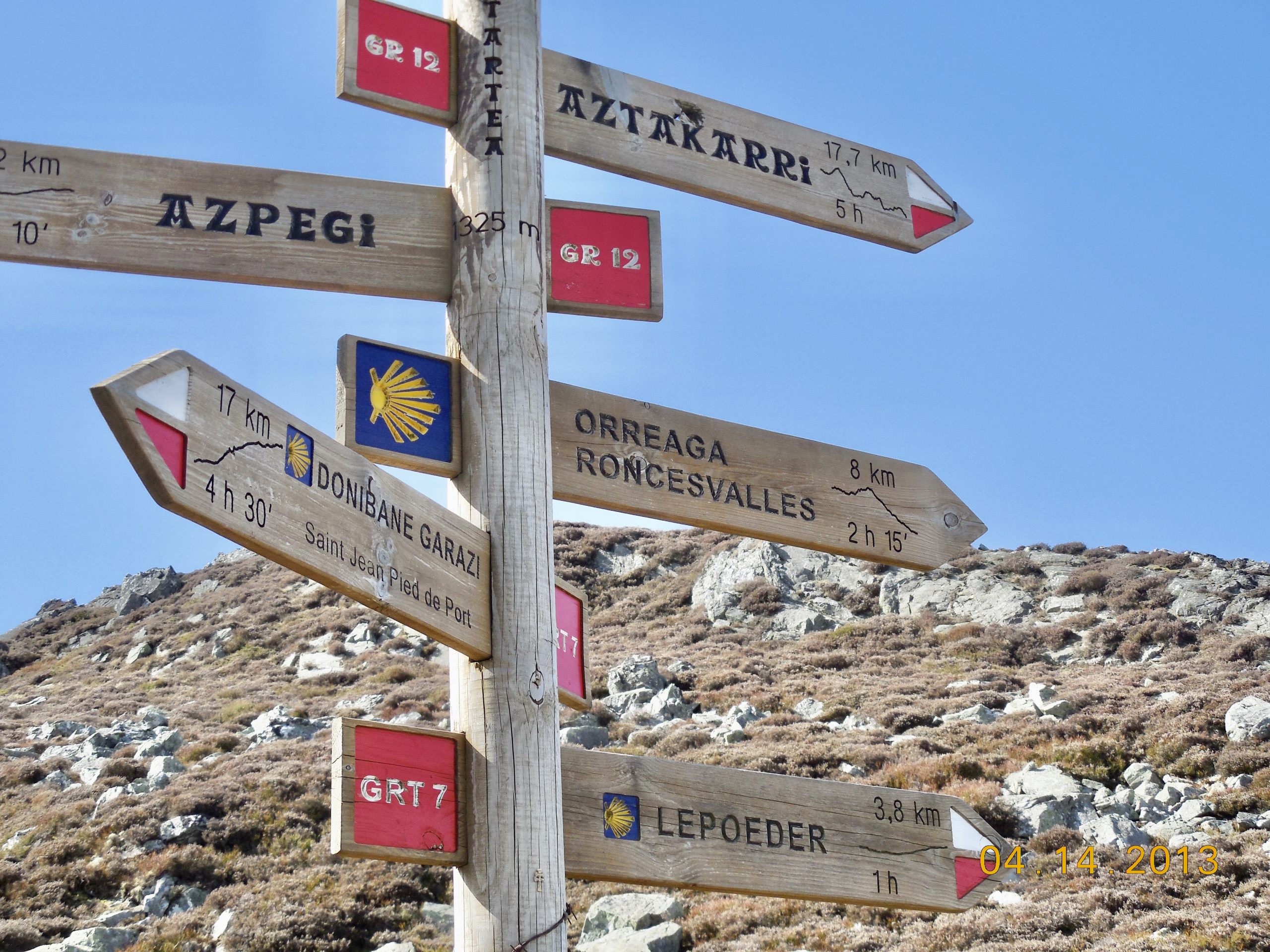
Snow remained evident in the higher elevations and the border between France and Spain was marked by an ancient stone monument.

The vistas, fresh air, and brilliant sunlight made for a remarkable experience, a sensory banquet.

Roncesvalles came into view at the top of the pass. It was a welcome sight.

The descent was steep and remained challenging. I was met by Christine with open arms.

We registered at the Albergue and were assigned adjoining bunks in the clean and well-maintained facility. While still a hostel, there was a welcome nod to privacy. Next came a tour.

The Catholic Collegiate at Roncesvalles was originally established as a hospital built at the end of the 12th century. Today it primarily serves as a waypoint and hostel for Pilgrims on the Camino. Our tour of the grounds and buildings was conducted by one of the priests.

He spoke to our group in English, French, and Spanish. We viewed the wonderful church from its choir and visited the tomb of King Sancho VII of Navarre who was reputed to be nearly 7 feet tall and fought against the Muslims in the battle of Las Navas in 1212. The stained glass above his crypt is dedicated to the battle. There were also chains reputed to be from the 778 battle of Roncesvalles where Roland lost his life. The image of those chains is central to the crest of Spain’s Navarre province.

At the end of the tour the priest asked which of us spoke English. We raised our hands and he asked us to step aside for a moment. When the rest of the group had left he asked us if we would be willing to deliver the liturgical readings at evening mass. We agreed.

Beer with new friends and later a communal dinner were afternoon celebrations of a good day.

Most evenings on the Camino featured an opportunity for a pilgrims blessing, a brief prayer service, or Mass. We came to enjoy those moments as times to spiritually contemplate in the company of other Peregrinos. That evening I executed my reading with heartfelt emotion before perhaps 100 pilgrims. For some in attendance it was memorable enough that over the next 34 days I was occasionally asked, “Didn’t you speak at Mass in Roncesvalles?” To this day my spirits are lifted to recall, “Yes I did”.

Buen Camino. Peace Everyone. Pete


(Note: As we crossed Spain I regularly communicated with friends and family through email and social media. A now defunct service known as “Eye-Fi” allowed me to send links with my messages by which access was given to the pictures that I uploaded whenever there was sufficient Wi-Fi. Some messages were brief, conveying  where we were, that we were safe, or just providing the day’s link to photos. Other messages were longer reflective essays, typed in the middle of the night, one finger-touch at a time on the tiny screen of my iPhone. As a part of this project I will be periodically sharing some of those missives.)

Written April 12, 2013, at St. Jean Pied de Port, France.

The images which we have posted convey what sight presented to our eyes, but we are finding growing mindfulness of a sixth sense.

Photographs do not communicate  the crispness of the mountain air, The swirling fragrances of wildflowers, and the kiss of a fresh breeze. You are denied the symphony of songbirds, and the chorus of school children at play. There is a bittersweet marriage of malt and hops in the local beer, and deep leathery tannins in the near onyx red wine. The ancient carved stones of the fortress walls are cool and moist to the touch… Granite hard, but velvet-like when covered with moss.

The photographs tantalize the sense of sight, but more importantly they awaken a sixth sense, the sense of “Childlike Wonder”. Perhaps this is our first discovery on the Camino.

Love to you all. Have Fun, Do Good, and Be Safe. Buen Camino, Pete and Chris.


“The Way”, presented an idealized Hollywood portrait of life on the Camino. There were a few dramatic scenes, but for the most parts it was a pleasant countryside stroll. We thought that we were prepared for the reality. Having read the Brierley Guide’s cautions we knew that the transit over the mountains could be difficult and even dangerous.

We had decided not to hazard the entire 25km passage to Roncesvalles, Spain in one day. Instead, the refuge at Orisson, a private albergue, was situated half the way to the pass and would split the climb over two days. This seemed prudent given Christine’s untested tolerance for walking laden with her pack. A recent snowstorm had closed the Route Napoleon the prior week. It had reopened that morning, so given the warming conditions an extra day seemed like a good idea.

We were up at dawn and greeted by Marie Josee with the breakfast table set.

She encouraged us to take some fruit and cheese with us “for the road” and saw us to the door for a warm sendoff.

Returning to the start of the Route Napoleon the sky was clear, the rising sun had burned off the morning dew, and the temperature was warming. It promised to be an excellent day for a hike.

The Route Napoleon is one of two paths to the Monastery at Roncesvalles (“Valley of Thorns”). It is the more difficult of the two but presents spectacular views as one ascends to the pass.

However, it is prone to rapid changes of weather and pop-up storms. It can be dangerous for the unprepared. It is also deemed the most strenuous segment of the entire Camino Frances.

The alternate route, Via Valcarlos, is preferred in the winter months and whenever there is a threat of deteriorating weather. It mostly follows roads where the main challenges for pilgrims are traffic and noise. There was never a question for us, we would take the Route Napoleon if at all possible.

The Route Napoleon was Napoleon Bonaparte’s favored track for moving his troops into and out of Spain during the Peninsular Wars of 1808-1814.

Adrenaline and high spirits carried us up and through the first few kilometers. There is a limit to the relief that excitement can give to tiring legs and winded lungs. I was doing well and felt in my element. Christine began struggling.

A few kilometers later and I was growing concerned for her physical and emotional state. Given what we were experiencing, any attempt to have covered the entire 25km to Roncesvalles was unthinkable.

We took our time, made frequent stops, and took in the spectacular views.

I encouraged Christine while she put a brave face on her pain. It was a good thing that the Camino had been her idea since with “ownership” comes responsibility.

Hours into the climb we arrived at the Orisson Refuge.

What a pleasant surprise! The albergue was crawling with pilgrims of every age and stripe. All were just beginning their journeys. Backpacks lay scattered everywhere, and one could overhear conversations in a multitude of languages. Best of all, there was an outdoor deck with an amazing view of the mountain range, and a waitress bringing beers to the tables. Our spirits again soared.

We registered and were given bunks in one of the three shared cabins.

With about 30 Peregrinos assigned beds the refuge was at its capacity. Dinner was an excellent communal affair that included wine and good company.

After we had eaten, our host rose and spoke to us in French, Spanish, and English. He asked for volunteers who could translate for any unable to speak those languages.

He insisted that each of us stand to introduce ourselves to the group. We were to give our names, country of origin, and offer the reason that brought us to walk the Camino. It was marvelous!

The room erupted in laughter when I pointed to Christine and with a deadpan expression said, “I’m here because this was her idea”.

One young man stood and while looking at his companion announced that he was on the Camino to ask for her hand in marriage. First there was stunned silence, then loud applause and even a few tears, more than a few from his bride to be.

As we began making our way out of the dining room Christine said that she would catch up to me in a few minutes. She wanted to speak to the hostess. She had a serious expression that concerned me. Anxiety building, I waited outside for 15 minutes that felt more like 2 hours.

Christine returned and said, “Well, that is taken care of. I’m not going to continue over the pass.” Our Camino that had barely begun was over… or so I thought. She caught my expression and correctly read my thoughts. “No, we aren’t done. You are going to continue in the morning, and I will meet you at Roncesvalles.” A delivery service was scheduled to transport supplies between Orrison, St. Jean, and Roncesvalles the next morning. The hostess called the service and arranged for Chris to ride along. Our Camino would extend to 35 walking days. this would be the first of many days that we did not walk together. There were 11 nights we would spend apart. In our 35 day journey across Spain we found that we often traveled different paths and embraced different experiences.

I thought that I had planned for the foreseeable. I was wrong. Life presents each of us with unique paths. So it is on the Camino.

Peace Everyone. Pete

PS. Before departing Kansas City, Christine bought a colorful piece of lightweight fabric. It measured roughly 5 feet by 6 feet was attractive, fast drying, and packed very small. It’s general utility was marvelous. In this image she wears it as a modest wrap after having taken a shower. Her “sarong” (as she would call it) became the envy of many women on the Camino.


The Camino is not a single route, but a vast network of routes that start in virtually every major European city.


When we neared Santiago we even encountered an Austrian pilgrim dressed as a 10th Century Monk. He had begun his trek in Jerusalem, 3,500 miles (5,700km) to the east.

St. Jean Pied de Port (“St. John at the foot of the pass”) is a delightful 12th Century medieval village (pop. 1,500) situated in the Nive River Valley at the foot of the Pyrenees Mountains.

Lying 5 miles north of the border with Spain, it is a point where many European Camino routes converge for the ascent over the mountains. In modern times St. Jean Pied de Port (SJPdP) has come to be known by many as the “official” starting point of the 810km long French Route. It is second only to Sarria (located 100km from Santiago) as a starting point for Peregrinos seeking their Compostela. When one is asked if they walked the “entire Camino” it usually means did they start in St. Jean.

St. Jean is not easily reached from Barcelona. In 2013 there were no flights, trains, or buses connecting the 350 miles that separated them. We had to cover the distance creatively in two segments. First we caught a train from Barcelona to Pamplona. We were up at 5:30 (actually I lay in bed, eyes open, from 3 a.m.). We ate a quick breakfast, checked that our packs were in order, and were in a taxi to the train station at 6:30 a.m.. The Station was more like a modern airport, including security and luggage scan.

The transit to Pamplona took 4 hours, including stops, by a high speed (+120 mph) train.

Departure and arrival were on time to the minute. Seating was similar to business class on an airline, complete with headphones, a movie, and music channels.

We had reserved a taxi from Pamplona to St. Jean. The two hour cab ride took us on narrow winding roads across the Pyrenees mountains to the door of our B&B.

In 5 days we would return to Pamplona on foot via the Camino.

From the comfort of the train and cab we enjoyed vistas of rolling green hills, orchards, terraced vineyards, and villas that appeared hundreds of years old. Sights little changed over two millennia when Julius Caesar’s 10th Legion called this home.

We had 2 nights reserved in SJPdP at a small B&B. Maison Ziberoa was situated just outside of the town’s intact fortification walls.

Our hostess was Marie Josee Lagord. Her establishment began life as a small hospital built in 1778. Marie Josee was a joy and a gourmet cook. Breakfast was included in the 70 Euro daily tariff.

For an additional 40€ she prepared us a private Basque dinner on our second night.

After a late lunch we strolled through town in the rain, did laundry, and concluded with a warmup at the fire.

During our stay Marie Josee brought out maps and shared valuable local knowledge of the town plus information about the  route and terrain that we would soon experience.

For a town of barely one square mile there was quite a lot to see. We were grateful to have planned 2 days in St. Jean. We could have elected to spend the night in the local Albergue (hostel) for about 10€ each, however Peregrinos are limited to a single night and must vacate by 8 a.m. the next morning.

We visited the Camino Pilgrim Office where we learned that recent snows had temporary closed the Route Napoleon, but it would reopen the following day.

Historical points of interest included:

The 15th Century Porte St. Jacques (a UNESCO World Heritage site), through which over the centuries Pilgrims have arrived from northern France and Europe.

A walk along the battlements that encircle the city.

The “Citadel”. Now a private school, this military fortification is reached by climbing 269 steps and provides a commanding view of St. Jean.

The 16th Century Prison des Eveques (aka the Prison of the Bishops), now an excellent museum.

The 14th Century church, Notre Dame du Bout du Pont.

A pleasant walk along the River Nive and across a Roman Empire era bridge.

We reconnoitered the start of the “Route de Napoleon” by which we would begin our Camino with a strenuous 19km, 4,000 foot ascent to the mountain pass above the town.

…and of course we wandered the cobblestoned streets, visiting various shops and restaurants.

It was here that I purchased a Basque beret which was to become my identifying trademark on the Camino.

We remained “Pampered Pilgrims”, but that would change in the morning.
Peace Everyone. Pete
Next: Part 6. Our Camino Begins and Nearly Ends.