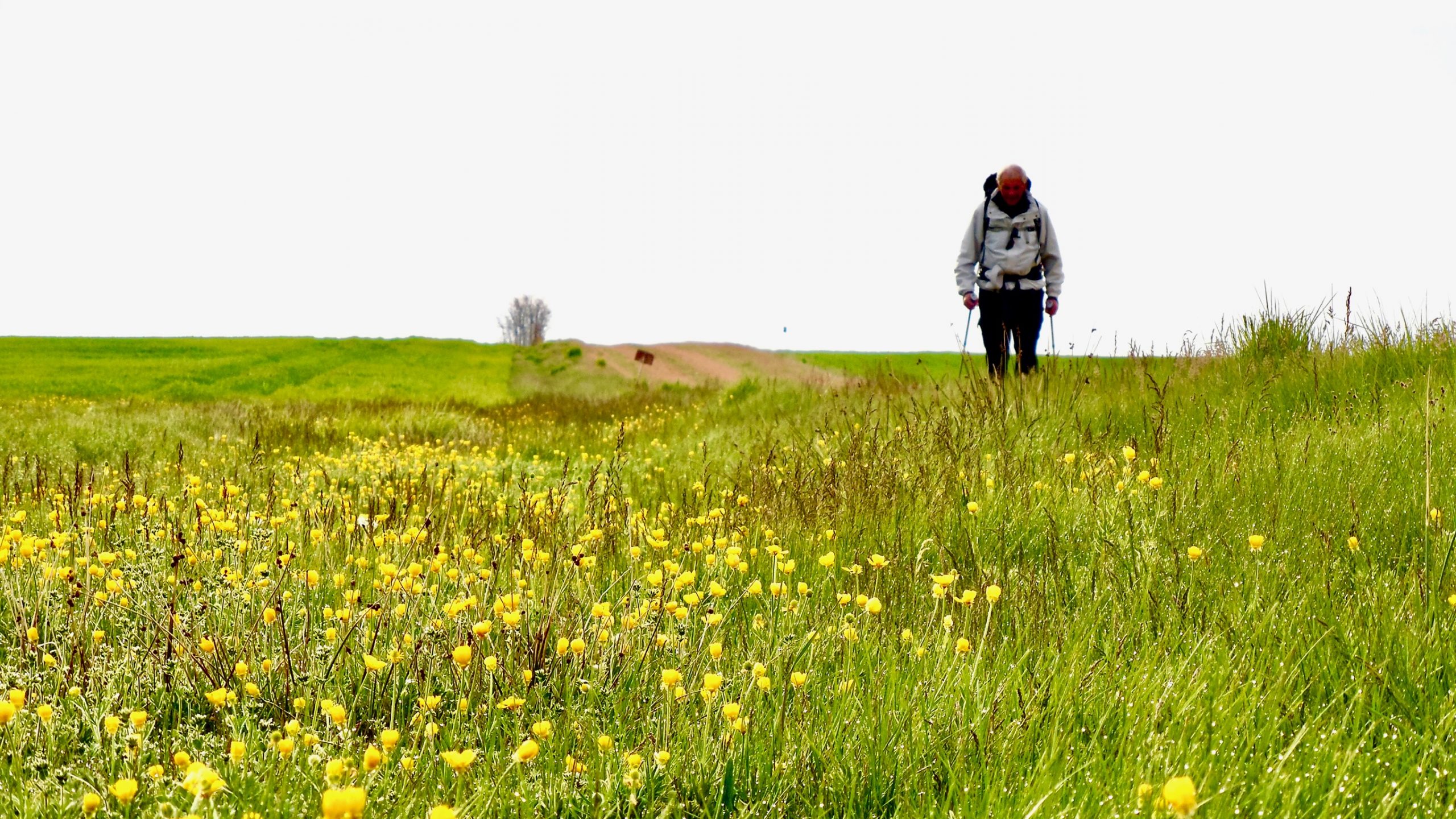
May 4, 2013. Sahagun, Spain.

Sahagun, Spain is not known as a destination city by those of us from North America. With a population of 170,000 it is large enough to be considered a tourist destination. Weighing in its favor: It was once the seat of religious and civil power in the region. It has a place in history dating to before the time of Charlemagne, and it has long been an important waypoint for pilgrims on the Camino. At one time Sahagun bristled with pilgrim hospitals, churches, and monasteries that might have been a draw for tourism, but not today. One reason for its shortage of ancient monumental structures is the lack of quarriable stone in the region. Large buildings were therefore constructed of brick and mortar in a style known as “Mudejar” that does not stand up to time as well as granite or limestone.

Nevertheless, we found May 4th in Sahagun to be charming. Pleasant weather, lovely company, and a relaxed pace made for a memorable honeymoon like day “off the Camino”.

Or were we really “off the Camino”? The Camino is a pilgrimage which may be defined as an intentional journey to a destination. Both a journey and a destination that are focused upon something or someone important to the pilgrim. It can be religious, or it can be a journey of self-discovery. Why then not a journey that explores the most important of interpersonal relationships, that of spouses. On the Camino it is the physical, emotional, and spiritual journey that matters more than the destination. Destination, although literally “the goal”, is merely the means to attain the enlightenment that is the fundamental purpose of pilgrimage.

Some “hard core” Peregrinos may take exception to my views, but many of those same pilgrims are more focused upon things pedestrian, such as shoes, packs, sleeping bags, and bed bugs than upon introspection and self-discovery. It is like two parishioners who leave a church service, one contemplating the message of the minister’s sermon and the other  fixated upon the minister’s failure to adequately shine his shoes and straighten his collar.

From the beginning of our Camino I found myself looking at my wife with fresh eyes and a deeper appreciation for my good fortune in marriage. May 4th was a day that we focused upon each other while sharing the backdrop of what the city of Sahagun had to offer.

We again visited the Arco San Benito on our way to to the 12th Century Iglesia San Lorenzo and the Plaza Mayor where vendors were selling their wares.

At the Plaza we encountered a Camino friend, Paul Sommers from Australia, another “face on the Camino”.

Across the central city to the south and high upon a prominence we visited the Monasterio de la Peregrina. This 13th Century Franciscan Convent has served as a monastery, church, pilgrim hospital, and is now restored as a museum.

It provided interesting telephoto views across town to the Cantabrian mountains in the north.

It also featured an open crypt with mummified remains and a couple of skulls. These were found during the restoration embedded in a wall near the main altar. It is believed that these remains date to the 15th Century.

An unexpected highlight for us was an overview of the principal sites of Sahagun, done in miniature. A man whose identity was unknown to us dedicated a piece of his life to the creation of these incredibly detailed models. These places were each constructed as they would have appeared at their zenith. I took the interior images through the doors and windows of the miniatures.

Of course there was a “Roman bridge” to wander by, after all we were in Spain.

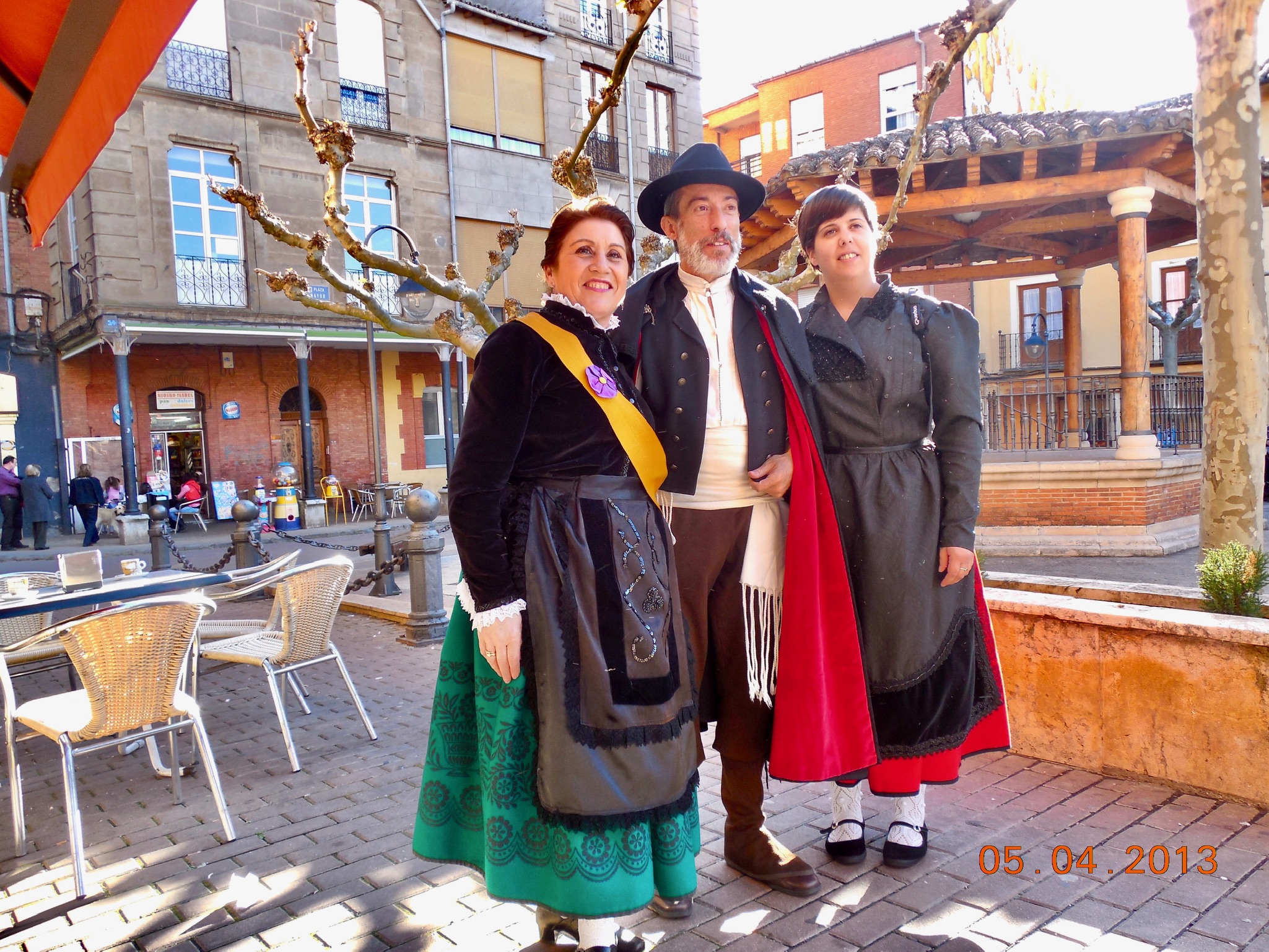
On the way back to our hotel we again passed through the Plaza Mayor. This time instead of vendors we encountered a group of folks dressed in their national costume finery. Those who gathered celebrated a pair of newlyweds and the first steps of their love and life together.

Ours was not the only “Honeymoon in Sahagun” celebrated that day.

Peace Everyone. Pete


Written at Fromista, Spain. May 2, 2013.

Before we left the States for the Camino I had embraced an expectation that I would walk each and every kilometer, pack on my back. I have since learned that such an expectation is an endurance hike, and not a Camino. We have seen many Peregrinos take one or more days off from the journey for reasons ranging from health to a wish to better experience a community. Today we watched a group of 20 Peregrinos leave by bus for Leon, “skipping” over 100km of the route and thus avoiding most of the Meseta (think western Kansas). Among the common refrains that are recited is that “One does not plan the Camino”, and, “Everyone’s Camino is their own.”

Being forced off the Camino for a few days because of health concerns, mine and Christine’s, has created a disappointment that has distracted me from the rich experiences we have encountered. I have found myself focused upon one difficult day to the exclusion of a score of extraordinary ones. This is the hazard of developing expectations. There can be no disappointments if one sheds all expectations.

I have wondered how this might have played out in the 11th Century:

Expectations and Disappointment, a Parable.

Somewhere on the Camino in the year of Our Lord 1013, a weary and travel worn Peregrino surrenders the burro which he has ridden into town to a shopkeeper. The Pilgrim slowly hobbles across the village square, entering the imposing cut granite church that is the axis of the community. Confessions are being heard. Our Peregrino, adorned in his tatters, enters the confessional booth and begins to recite the prescribed formula:

Peregrino: Bless me Father, for I have sinned. It has been one day since my last confession (Note: The sacrament of Confession was more popular in the 11th Century) and these are my sins. I have had impure thoughts, and I have broken my sacred vows to the Blessed Virgin and to St. James.

Priest: The breaking of a vow is a very serious matter! Explain yourself.

Peregrino: Father, I am a Pilgrim walking the Camino. I made my vows to Our Lady and to St. James that I would walk the entire Journey assisted only by my own two feet. Earlier today I stumbled upon a rock and found that I was unable to continue. A farmer, taking pity upon me, gave me the use of a burro upon which I traveled the rest of this day. I have now surrendered the animal to the farmer’s brother, a shopkeeper on the square.

Priest: My son, your sin is not the breaking of a vow, but in possessing such arrogance as to presume to tell our Lord what your Camino would be. God in his infinite Knowledge and Mercy provided you with a burro to continue your journey. However, your disappointment, fathered by your expectations, has blinded you from appreciating God’s Grace. My son, this is a serious sin indeed.

Peregrino: For my sin I am heartily sorry Padre, and I willingly embrace your penance.

Priest: My son, for your penance you shall go to the river and divesting yourself of your robes, you will bathe and clean yourself of all expectations for your Camino.

Peregrino: Excuse me Padre, but is it not more common to just require that I recite 3 “Our Fathers” and 5 “Hail Marys”? Besides Father, I bathed earlier this year.

Priest: So Peregrino, do you now also impose your expectations upon the penances that I give you!?! By the way, I almost forgot, tell me more about those impure thoughts.

Peregrino: Well Father, I don’t really know. I have always given 2 sins, and since my parents are both dead I can no longer use “disobedience”.

Priest: I see. Then for the impure thoughts you could have had, you get 3 “Our Fathers” and 5 “Hail Marys”. And after you bathe, wash your robes and line your cod-piece with fresh herbs. Your odor is strong enough to delay the Second Coming of Christ!

The Pilgrim was true to his word. He devoutly recited 3 “Our Fathers” and 5 “Hail Marys”. He bathed, and thoroughly washed his robes and cod-piece. Unfortunately, some habits are not easily broken. As the Peregrino was searching for fresh herbs to line his cod-piece, he could be heard to declare, “I swear by the Blessed Mother and by St. James that I WILL complete the rest of my Camino without further interruption!”

Soon thereafter the Pilgrim chose an innocent looking, vine-like, three leafed plant to line his cod-piece.

Love to you all. Have Fun, Do Good, and Be Safe! Buen Camino. Pete


Written April 26, 2013 at Villafranca Montes de Oca, Spain.

You may read this note literally, but please feel free to imagine this as any metaphor that your heart embraces.

In the months leading to our departure for Spain my thoughts were consumed with preparations for the Camino. The questions focused upon the selection of the best shoes, the proper sleeping bag, the finest backpack, but each choice involved the acquisition of property. Juxtaposed to this “preparation” is the reality that everything that I acquire becomes a burden that I must bear.

One example occurred during a visit to Moose Jaw, a backpacking store located in Kansas City.

Madison Avenue made its fortune by not only selling to the public’s needs, but by creating “needs” through marketing, and then selling those “needs” thus created.

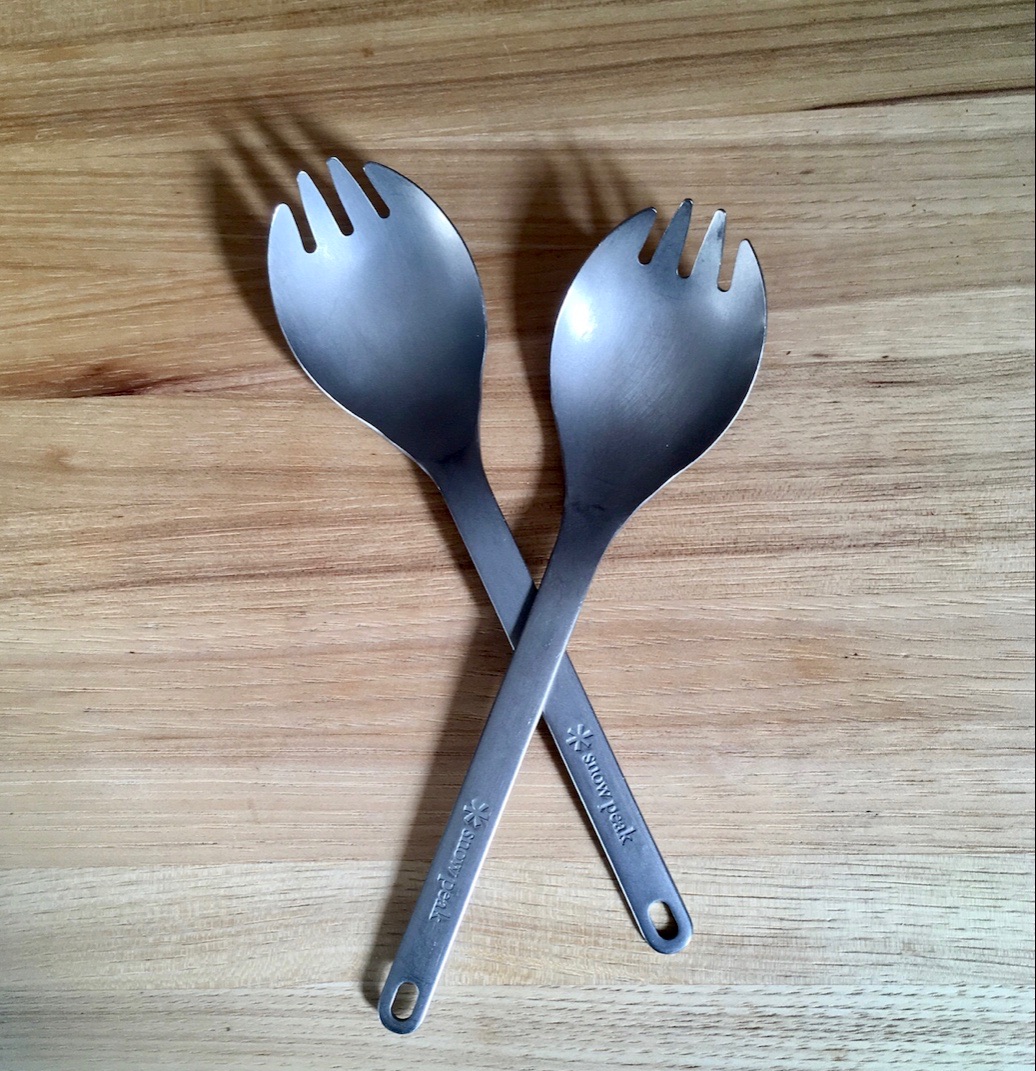
As I wandered through Moose Jaw looking for “needs” that I was not yet aware of, I saw The Spork. It was a clever hybrid fork/spoon. Not only was the design brilliant, but it was executed in titanium! It weighed only a fifth of an ounce, virtually nothing. What a wonderful thing to have, “just in case”.

I bought the Spork, included it in my kit, and I have now carried it nearly 300 kilometers. I’m still waiting for that “just in case” moment to occur.

It seemed like such a good idea back in Kansas City, but so silly today. When I weighed my pack before departure I proudly noted that my “needs” for 2 months weighed only 23 pounds. When I set out on the Camino I was astounded to find that many Peregrinos carried packs weighing 15 pounds or less. I have yet to hear anyone complain that they didn’t bring enough “stuff”.

It is not that my Spork weighs too much, but that my pack (and my life) is FULL of “Sporks”.

Considering just the one Spork and doing a bit of math: Each step that I take on the Camino (and there are literally one million steps) involves the suspension and transport of that one-fifth ounce. In 5 steps I have moved an ounce; in 80 steps a pound. Over the course of my Camino the “ultralight Spork” has grown to become a burden weighing 12,500 pounds. My “ultralight-necessity” has turned out to be neither light nor necessary.

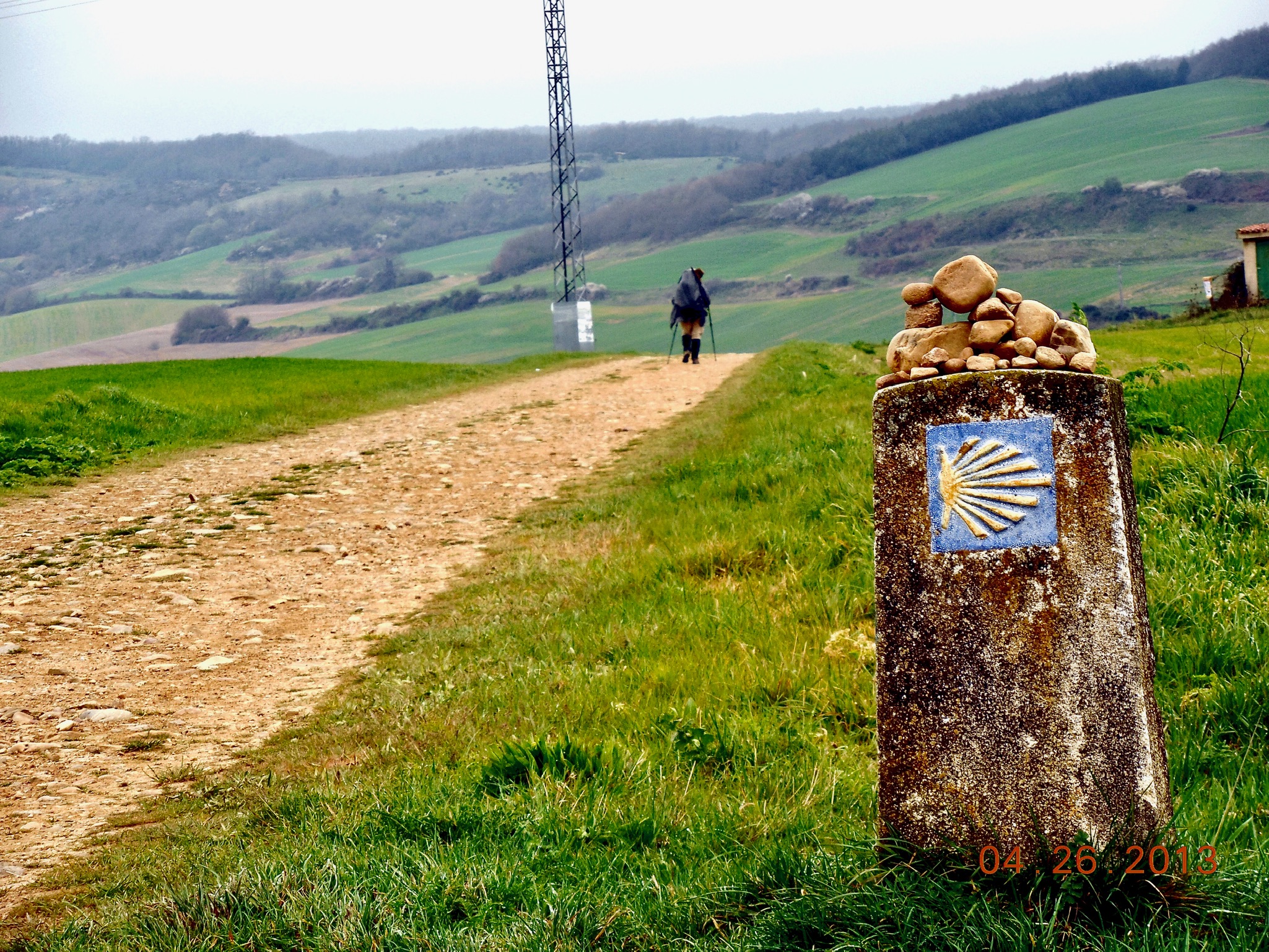
It is an ancient tradition on The Camino for a pilgrim to carry a stone on the journey. I have mine, brought from Kansas City. The Peregrino is called upon to deposit the stone, releasing their burden at the foot of the Cruz de Ferro (“Cross of Iron”) which stands at the highest point of the Camino (elev. 4950ft – 1500m). Tradition also holds that the pilgrim recite the following prayer:

“Lord, may this stone, a symbol of my efforts on the Pilgrimage that I lay at the foot of the Savior’s cross, one day weigh the balance in favor of my good deeds when the deeds of my life are judged. Let it be so, Amen.”

Centuries from now archeologists may puzzle over the origin and meaning of a mound of stones found high in the mountains of Spain. They may be further confused that in the rubble there is buried a curious eating utensil, not quite fork and not quite spoon, made of titanium.

Love to all. Have Fun, Do Good, and Be Safe. Buen Camino. Pete (and Chris).


 Written April 24, 2013, at Santo Domingo de la Calzada, Spain.

There is a phrase that has periodically bubbled to the surface of my thoughts on the Camino. “Life is a journey”… “Life is a journey”… “Life is a journey”…

Why does this trouble and even annoy me. The conclusion that I reached is that Life is not a journey. Life is a destination. Living is the journey.

We all share birth and death, our personal Alpha and Omega. That is life. What distinguishes each of us is how we live our journey.

The Camino is not the act of arriving in Santiago, it is “The Way” to Santiago. One may walk 820km while listening to an audiobook, then arrive in Santiago entirely oblivious to the experience. This person has technically earned a certificate (the Compostela) for having completed the Pilgrimage, but what was gained that could not have been accomplished on a treadmill at the local gym?

Another person may have only walked the Camino for a few days, a passage insufficient for the Compostela. However, with mindful awareness of each footfall, each moment, each thought, and each breath, that person experienced a genuine pilgrimage rich in its impact both within and without. It is the journey of living and not the destination of life that matters most.

As our children grew and grandchildren grow, it has been important to me that at every parting I convey a message which is the distillation of things that I hold important. Perhaps this is my attempt at a formula for living:

“Have Fun”. Living should feed your passions and make your soul smile.

“Do Good”. There are two benedictions here: Do your best and also do what is right.

And finally: “Be Safe”, for the sake of those who love you, and also because senselessly jeopardizing your life diminishes the gift of living.

I don’t claim perfect adherence to this formula, but then I am just a Peregrino both here on the Camino, and as I live my Journey.

Have Fun, Do Good, and Be Safe. Buen Camino. Pete


April 20-21, 2013. Villamayor de Monjardin to Torres del Rio, and Viana

We had abandoned the Brierley Guide’s recommended “stages” for two reasons; virtually every English speaking pilgrim used the guide and Christine’s tolerance was better suited to a 12-18km day, rather than the 20-30km often favored in the guide. This meant that we typically stayed in villages and albergues a few kilometers either side of the Guide’s suggested stops. We walked the same path, but the albergues where we lodged were usually less congested.

The 20th saw us walking 21km to Torres del Rio. Christine arranged for the transport of her pack to our destination and seemed up for the longer walk on a beautiful spring day through the open countryside.


Farmers were preparing their fields, the path was wide and kind to our feet. In this region the decades old grape vines had not yet begun to leaf out.


We passed before the ruins of Cugullo, site of an ancient pilgrim’s hospital. There were trailside cairns left over the years by passing pilgrims and even a rough stone shelter of unknown age.


Bicyclists passed us on the path, politely signaling their approach.


In order to receive one’s Compostela in Santiago (certificate of completion of the Camino) a pilgrim must walk the final 100km as a continuous journey. It is also permitted to do so by bicycle (or even horse), but it that case it must be the final 200km.

It was an idyllic day.


We walked through the peaceful town of Los Arcos (pop. 1,300), originally founded by the Romans.


Los Arcos, though small, was a recommended overnight stop and featured no less than 4 albergues. Instead we continued on to Torres del Rio.

What a pleasant surprise awaited us there! The tiny village of fewer than 150 showcased an extraordinary church erected in the 1100’s by the Knights Templar.


Santo Sepulchro was modeled after the Church of the Holy Sepulcher in Jerusalem. The church was octagonal in form with the domed ceiling supported by a remarkable web of arches.


The interior was simple, even sparse,, but anything more ornate would have depreciated the visual impact of the small altar and unsettling 13th century crucifix.


Our albergue was a delight.


An enclosed terrace with bar and restaurant was just the place to settle back with fellow pilgrims. There was even a shallow pool in which to dangle ones hot and tired feet, glass of wine in hand.


As with most albergues the rooms were simple, clean, and not very private. I found the communal dining and sleeping arrangements a refreshing reminder of happy childhood days in summer camp where friendships sprouted like mushrooms.

The following morning we set off on a short 12km stage to Viana (pop. 3,600). In light of the shorter distance Christine carried her pack. Her bronchial issues had seemed mostly resolved.

Early on that day we encountered a pilgrim, Kris Ashton of Denver Colorado. A few pleasant words and we were walking in lockstep for the next hour.

Little did we know at the time how interwoven our lives would become. We frequently encountered Kris in the days that followed and nearing Santiago began sharing private accommodations. Back in the States we continued our friendship, often as guests of her and her husband Dennis in Colorado and reciprocating with them in our home in Kansas City.


In 2018 we were in Amsterdam, having just departed Scotland where Kris and Dennis happened to be hiking. Dennis tragically fell to his death from a mountain path on the Isle of Skye. Our friendship with Kris became more tightly joined and in 2019 she accompanied us aboard our canalboat in England. Inspired by our Casita travels she purchased a Casita in early 2021 and that Spring spent 9 days caravanning with us in New Mexico and southwestern Colorado.

Adding to the mystery of friendship, yesterday (June 5,  2021) we spent an afternoon in Kansas City with friends Ron and Lena Meck of Salt Lake City, Utah. They were passing through Kansas City while following the route of Lewis and Clark. We first met them in 2017 on Sitka Island in Alaska, then accidentally encountered them in 2018 in Madrid, Spain. Later this year they plan to be traveling south on the Pacific Coast Highway about the same time that we will be traveling north on the same road, perhaps another chance encounter is ahead of us. By the way, they have walked the Camino and are friends with Kris Ashton. Coincidence? A gentleman in Puerto Rico once counseled me, “Peter, in life there are no coincidences.”

In 1995-96 our son Peter lived the school year as an AFS high school foreign exchange student with a family in Bilbao, Spain. Rafael Mendia Gallardo, his wife Begonia, and their son Arkaitz made Peter a real member of their family that year and thus bonded themselves to us as a part of our extended family. Rafael was following our Camino journey through Facebook and reached out to suggest a meeting in Viana for dinner. It was a 2 hour drive for them and their good friends Rev. and Ms. Javier Aguirregabiria Aguirre. Rafael and Begonia spoke only a little English and we very little Spanish. Javier acted as our interpreter and added much to our afternoon with his grace and good humor.


Our Spanish friends arranged for an excellent private dining experience at an exceptional restaurant in Viana.


They also hosted our walking tour of the town center and the nearby 13th Century church of Santa Maria where in 1507 Cesare Borgia was buried. Borgia died from treachery at the hands of his enemies shortly after his successful siege and conquest of Viana. More about this fascinating historical figure in the postscript.


As the poet said, parting from these dear friends was “such sweet sorrow.” However return to the Camino we did, which included the night in Viana’s 54 bed municipal albergue with beds stacked 3 high.


Pilgrimage is often cast in terms of what one experiences through the senses and what touches one spiritually. I was finding that the Camino was becoming ever richer with personal connections, a path to people. How easy it is for us to make friends as children and how sad that for many adults that gift is lost.

Peace Everyone, and Buen Camino!

 PS. Cesare Borgia (1475-1507) was the acknowledged illegitimate son of Pope Alexander VI (then Cardinal Rodrigo Borgia). The Pope ordained him as a Cardinal at his election to the papacy in 1492. Cesare was only 18 years old at the time. 6 years later Cesare resigned his cardinalate, the first person in history to do so. Instead he became Commander of the Papal Army and served capably in that role until he was deposed shortly after his father’s death in 1503.

Cesare engaged Leonardo da Vinci as his chief military architect and Borgia is believed to be the inspiration in Niccolo Machiavelli’s “The Prince”. Cesare Borgia is also believed to be the model for da Vinci’s famous portrait of Jesus Christ, “Salvator Mundi” (Savior of the World).