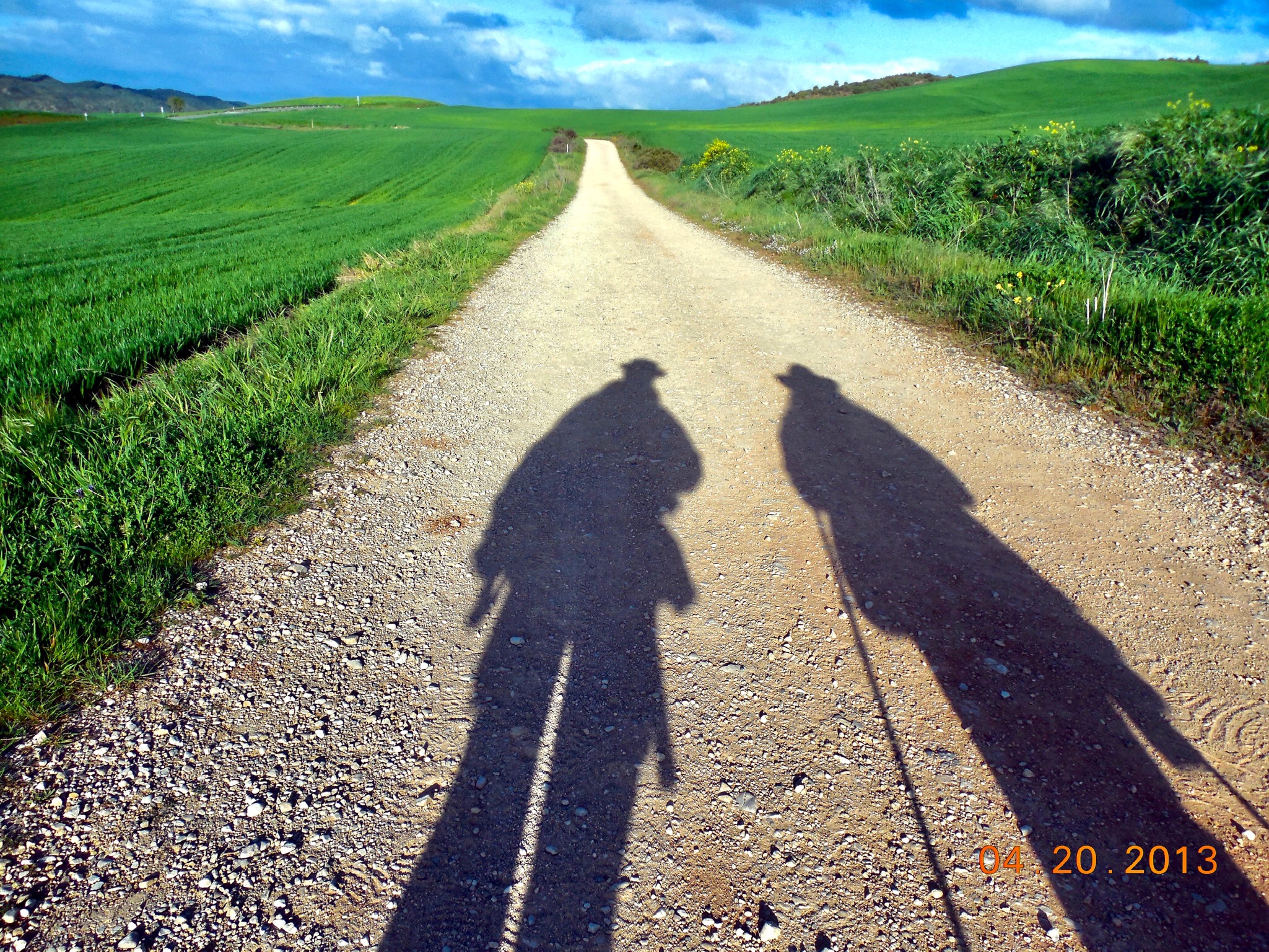
April 15-16, 2013 Roncesvalles, Zubiri and Pamplona.

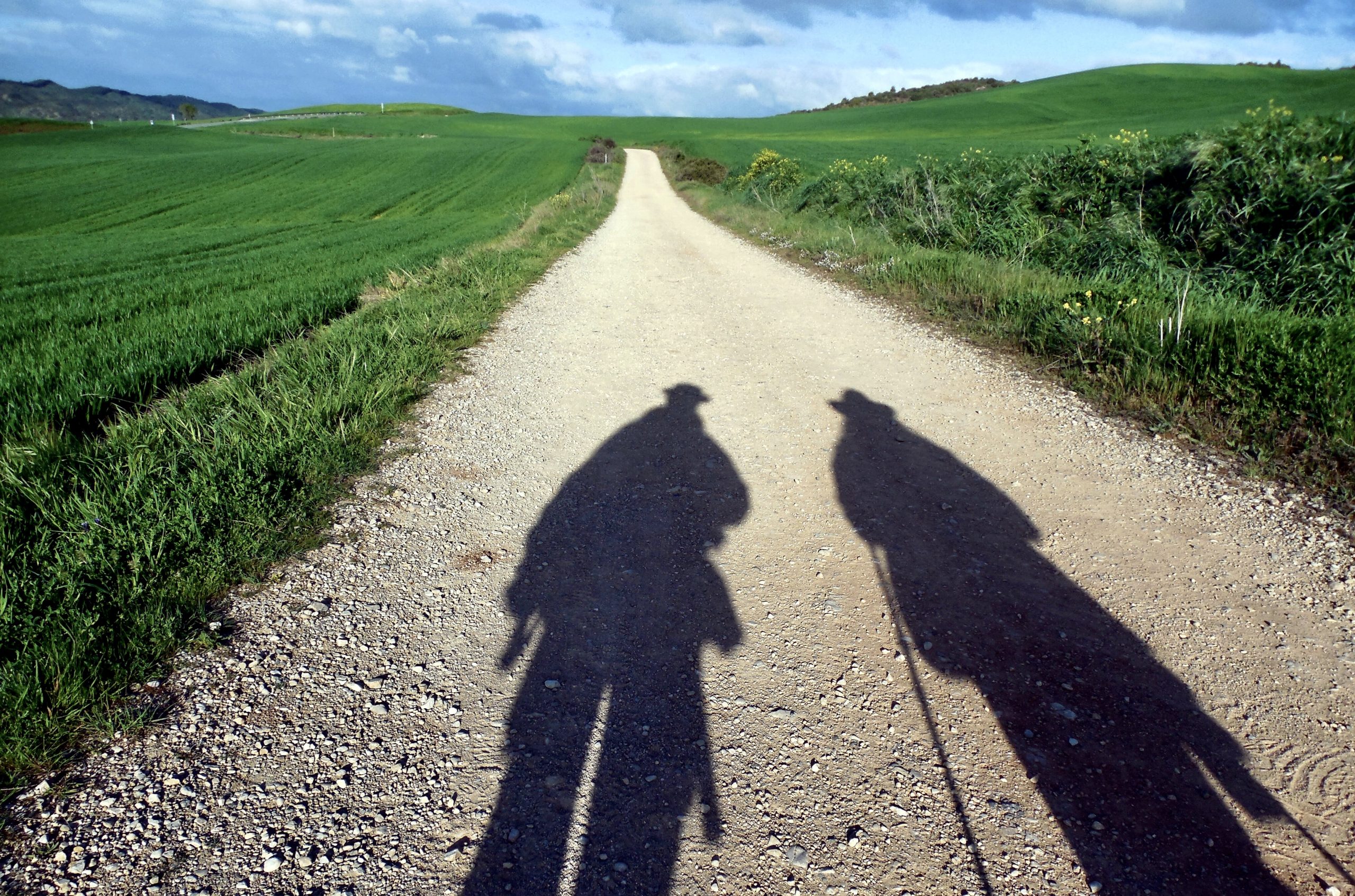
The day broke at Roncesvalles with a clear sky and these two pilgrims well rested. An American volunteer at the albergue greeted us warmly and shared a few minutes of conversation. She escorted us to the door and with a “Buen Camino!”, sent us on our way suffused with optimism for what lay ahead.

For reasons that still escape me this felt like the real start of our pilgrimage. Not a quarter mile down the road was an iconic road sign, “Santiago de Compostela, 790 km. We stood beneath the sign for a picture just as hundreds of thousands of modern day pilgrims had.

Later we learned that a week earlier a high school classmate of our children, Jed Brown in the company of his fiancé Sarah, shared that same spot during a snowstorm as they made their way to Santiago.

790 kilometers! It should have been intimidating, instead it was invigorating. 790 kilometers is over a million steps. I have heard it said that a woman forgets the pains that she endured in labor at the first sight of the new life that she brought into the world. Perhaps in a small way the sight of that sign put to rest the struggles that I had endured the prior day.

While we embraced hope and optimism, we did our best not to hold onto expectations. I had long ago learned an important life lesson that without expectations there can be no disappointments. So far, so good.

A short way down a track through a wooded path we encountered a carved stone cross. It was a modern reproduction of a 17th Century cross that was damaged by lightning.

“Bucket lists” are individual and personal. That cross was the first of many symbols that reminded me that we were pursuing something more significant than an 825 km hike. We journeyed in the footsteps of countless pilgrims who over the centuries had walked to seek God’s grace, or as penance for the forgiveness of sin, or as punishment for crimes they had committed. I still walked because it was there.

3km down the road we paused for coffee and a light breakfast in the quaint village of Burguete, a favorite of Ernest Hemingway.

Its small hotel is reputed to have a piano on which the author carved his name and the date, July 25, 1923. The small village square where we sat was a place where suspected witches were burned at the stake in the 1500’s.

5km further and we made one of the many river crossings those first two days, this one on stepping stones.

We were still descending from the mountains as Roncesvalles sits at 3,000 feet, Zubiri at 1,600, and Pamplona at a little over 1,200.

At times the path was irregular, and in wet weather could even be treacherous. We passed a spot where 11 years earlier a 64 year old pilgrim lost his life.

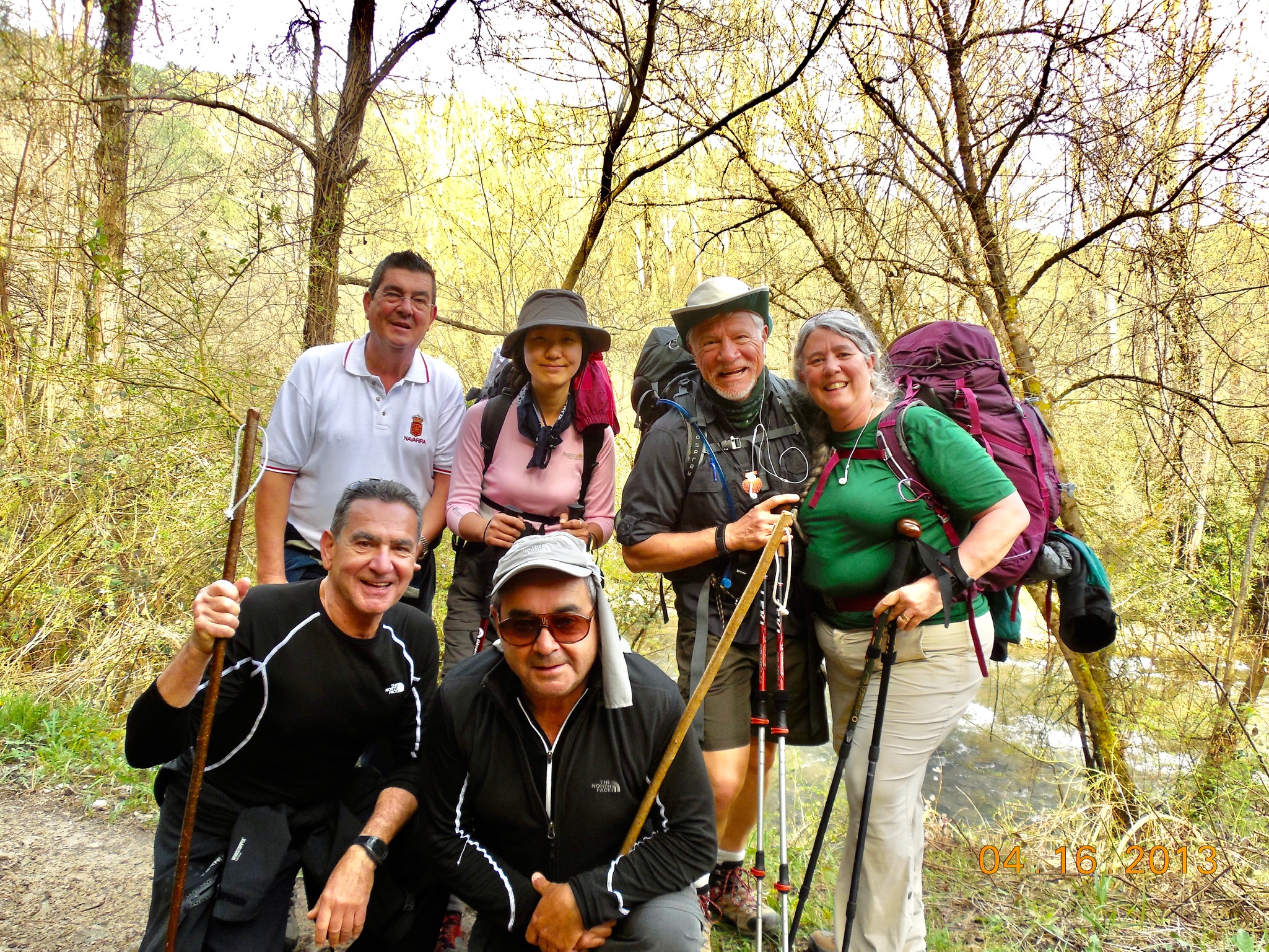
We shared the beauty of the day with each other and the scores of other pilgrims on the path. Scarcely a kilometer went by that we did not exchange the ubiquitous salutation, “Buen Camino!”, with another pilgrim.

It remains on the Camino a universal declaration of hello, goodbye, good luck, and safe journey, one’s native language notwithstanding. Christine soldiered on with pack on her back. At day’s end Roncesvalles was 22 km behind us and Pamplona 22 km ahead of us. I was tired, Christine was beat.

Saying anything of substance to another on the path did require a shared language. Fortunately, English was spoken by most pilgrims, at least as a second language. Friendships grew from nothing more than “Buen Camino”. We had little more in common with most than that we faced the same journey, challenges, fears, and hopes. In a few steps we shared our stories. In a few kilometers we shared our souls. By day’s end we were as familiar with each other as brothers and sisters. Among family members many “indispensable” social conventions of personal privacy are ignored. So it is on the Camino where many conventions are cast aside in favor of a less restrained sharing among our instant friends. We were each like separate threads with different languages, cultures, origins, and futures, woven together on that one day to briefly become a unique human tapestry.

Years later I overheard a person pass on an opportunity to join others in a friendly conversation, “I don’t have anything in common with those people.” That comment referred to work, politics, socioeconomics, community… things perceived as important to making connections with other people. What we frequently ignore is that we share a journey in life that includes many of the same hopes, dreams, fears, successes, and failures. A few kind words and we find that we have more in common with the “stranger” than we were willing to acknowledge.

Evening in Zubiri brought us a communal dinner, welcome companionship, and beds. Good medicine for the exhaustion that we both felt. Pamplona would be our destination 22 km distant the next day.

April 16th.

Over the course of the 44 kilometers that separated Roncesvalles from Pamplona we crossed many bridges, most dating to the Middle Ages, some to the time of the Romans. I found each bridge fascinating for the human labor invested in its creation, and the ingenuity that produced an ancient structure that still served its original purpose.

One bridge was once thought to cure any animal of rabies by walking it around the central arch three times.

A bridge that crossed the river Ulzama featured an albergue at one end. The bridge and albergue, formerly a pilgrim hospital, have stood and served the needs of those on pilgrimage for over 1,000 years.

The next day continued much as the day before. There were encounters with pilgrims, a delightful outdoor lunch, beer included, and more bridges.

With about 8 kilometers left to reach Pamplona, Christine was done. It is one thing to walk 22km in a day but entirely another thing to do it day after day, especially for one unaccustomed to it. She prudently decided to take a taxi those last kilometers and secure our night’s lodging at the 114 bed albergue built into the side naves of the former Jesuit Church of Jesus and Mary.

We arrived in Pamplona with enough afternoon left to take in some sights of the city of 200,000, famously known for its “Running of the Bulls”.

Peace Everyone, and Buen Camino. Pete

PS. Christine’s mantra was and is, “Listen to your body”. Walking into Pamplona, much to my later regret, I disregarded my body in favor of an opportunity to see how fast I could walk those last kilometers.

My unnecessary effort set off tendinitis in my left ankle that never fully resolved over the weeks that followed. My imprudence and failure to “listen to my body” would eventually gift me a permanent reminder of that temporary impulse, a 12” surgical scar. My left posterior tibial tendon fully ruptured 5 days after we returned to America. How and why the rupture waited for my return to the States is just one of many “Camino mysteries” that I am left to ponder.


Written at the Refuge at Orisson, Spain, April 13, 2013.

My Wife and I share a good marriage. She is a good person, but I will not self-proclaim my own character. A good marriage is not dependent upon whether or not the partners are good people, but rather upon the people being good partners. In this I am doubly blessed to have married a good person who is a good partner.

This coming June we will take our marriage off of the shelf, admire and polish it for the 36th time.

We do not cast responsibility upon each other for our individual happiness, but we do find our relationship is a source of happiness. It is also a place where we each find support in the other’s strengths and talents, and refuge from our own weaknesses and shortcomings. One cannot seek such support or sanctuary if there is fear of criticism or judgment. Ours is a good marriage.

Many Pilgrims walk the Camino alone in order to examine their thoughts without distraction. With a good partner one can also examine one’s thoughts through dialogue. Two heads are better than one but only when there is trust that the exchanges are free from criticism and Judgment. With a good partner It is more important to listen than to talk. To know one’s own thoughts listen to the thoughts of others.

In our “real” life, the depth of sharing is challenged by the distractions of work, finances, current events, and all things that comprise the background noise of life. I find that we shared today unburdened of those distractions. Drawing upon our partnership we found both physical and emotional strength and support. We were living our love.

Because I lived with my Wife today, I will admire our marriage just a bit longer and polish it with a bit more care before placing it back on the shelf for the 37th time.

Peace Everyone, Have Fun, Do Good, and Be Safe! Buen Camino. Pete

(… before it’s too late)

In early 1991 my interest was piqued by a newspaper column penned by Humberto Cruz. It was a new column that began running weekly titled “The Savings Game”.

Mr. Cruz planned to retire a millionaire in spite of a very ordinary middle-class income. It sounded audacious until I delved further into his commonsense advice. Cruz and Georgina (who he would later marry) were immigrants, having escaped Fidel Castro’s Cuba as teenagers in 1960 along with their parents.**

Fast forward to December of 2010 and Humberto signed off on his (final) 1,028th edition of “The Savings Game”. He and his wife were retiring having amassed a net worth of over 2 million dollars. In 2019 they were enjoying a Holland America Cruise around the world.

I read Mr. Cruz’s column religiously. It is impossible for me to recount every piece of advice that he gave over the decades, but there are some fundamentals, supplemented by other knowledge that I acquired over the years, that may serve to bring financial security to our children, grandchildren… and perhaps you as well.

Mr. Cruz’s last article offered the following:

“Over the course of 1,028 weekly columns… I have emphasized basic principles for financial success. They all entail personal responsibility:

    • Spend less than you make.
    • Save and invest the difference wisely for the goals most important to you.
    • Identify those goals clearly. Calculate how much you have to save, and the investment returns you need so you don’t take more risks than necessary.
    • Never forget that money is only a tool. True happiness comes from commitment and relationships, not material wealth.

All this is very simple but not necessarily easy to accomplish.”

Humberto Cruz. December 27, 2010

Over the years I subscribed to the magazine, “Better Investing”. It provided advice and tools for the average investor. Nothing exotic, just identify sound companies with long term stable histories of growth and invest in those companies, only selling when there was a sound financial reason. BI counseled that it was folly to try and time the market. Investing is not gambling. Invest in what you understand and understand why you invest. Invest for the long haul. A basic tenet was that a well selected portfolio of 5 stocks will typically have one loser, 3 average performers, and one overachiever. And that it is not unreasonable to set 15% as an average annual growth goal.

If one chooses not to be an active investor and “merely” invests in a mutual fund that tracks the Standard and Poor’s 500 index the average annual rate of return from 1950 to 2020 (roughly my lifetime) was 12.96%.

Moreover, index funds as are available from brokerage firms such as Fidelity Investments and Vanguard, offer “no-load” funds (there is no upfront cost to invest), and the annual expense ratio (fees) can be very low, two tenths of a percent (.2%) or less. (Caveat: No actual investment advice is intended here, UNDERSTAND and INVESTIGATE before you INVEST!!)    

It is reputed that Albert Einstein once said, “Compound interest is the Eighth Wonder of the World”. To this he reportedly added, “…He who understands it, earns it… he who doesn’t, pays it.”

One may calculate how many years it takes for a sum of money to double based upon the compound interest rate. It is a simple formula; Divide 72 by the interest rate, the result is the answer in years. Applying this bit of information to the average annual growth of the stock market (S&P 500) from 1950 to 2020: 72 ÷ 12.96 = 5.5.

In other words, over those 70 years money in an investment that tracked the S&P 500 doubled every 5.5 years. Put in more concrete terms:

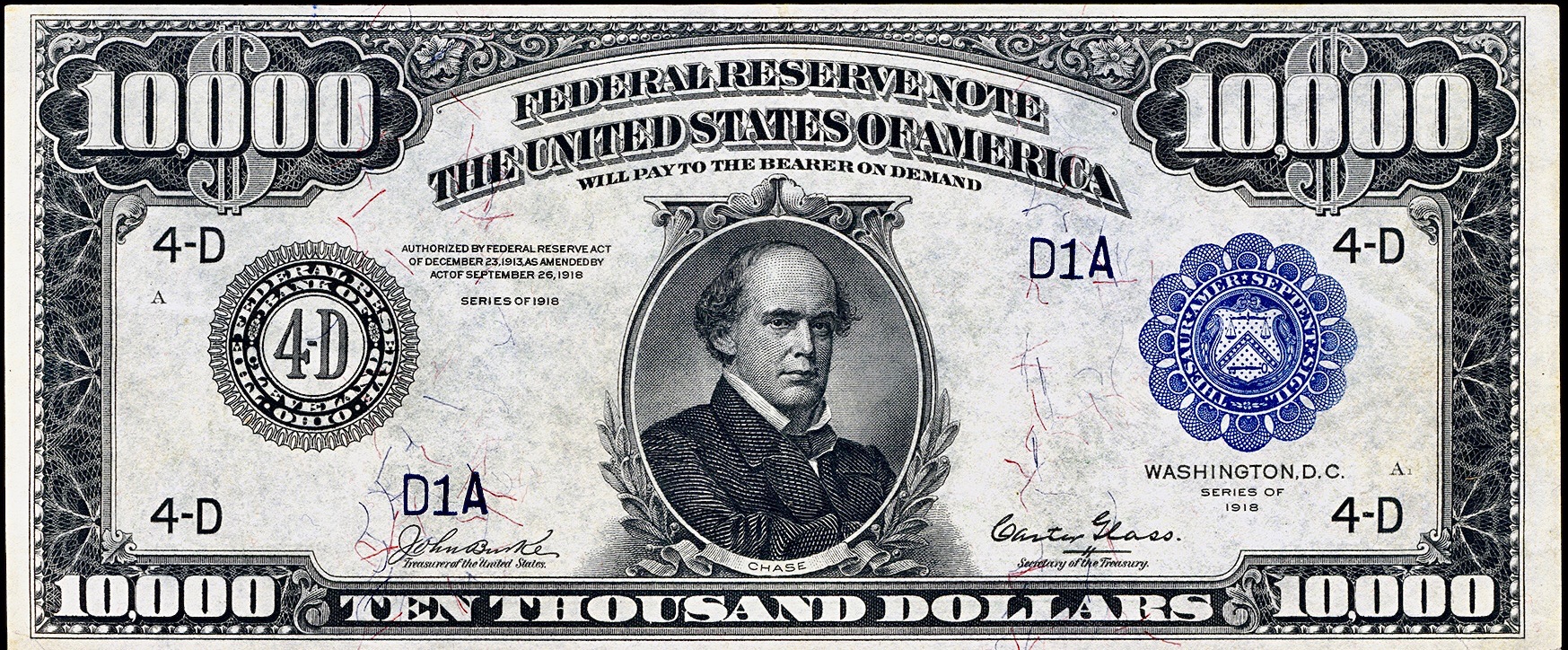
Imagine that a 15-year-old made a single investment of $1,000 and “let it ride” in an IRA (Roth or standard) until she was 65 years old. The money would double 10 times over the course of those 50 years. Simplifying this example to a “double” every 5 year: $1,000 at age 15 becomes $2,000 at age 20, $4,000 at 25, $8,000 at 30, $16,000 at 35, $32,000 at 40, $64,000 at 45, $128,000 at 50, $256,000 at 55, $512,000 at 60 and finally $1,024,000 at age 65! However, a delay of just 5 years at the start would reduce this portfolio by over half a million dollars.

The lessons are to start taking care of one’s 65-year-old self when one is as young as possible. Also, don’t rely upon a single investment deposit, but make a habit of saving. Pay “Uncle Sam” first, then pay your 65-year-old future self, and only then address current needs and “wants”. Investment planners often counsel that one should dedicate 15% of after-tax income to that long term horizon.

Of course, there are no guarantees. The market can swing wildly with years that are up and years that are down. Financial counselors warn to diversify one’s portfolio, include stocks, bonds, CD’s, etc.. My point is that we do our children and grandchildren a service by teaching the habits of saving and frugality at an early age. My oversimplification has ignored the basics that as one approaches retirement one’s investments should become increasingly more conservative. I do however want to make a few other points:

Do not save so obsessively that one sacrifices enjoying reasonable current rewards from the fruits of one’s labors. Saving for near-term goals is also important for mental health and personal satisfaction.

Work to achieve a shared financial partnership with your spouse. Talk about money and goals. Engage in shared decision making. Money disputes destroy more marriages than infidelity.  

Don’t “react to the market”. This only encourages impulsive actions. I recall a friend sharing that when the market took a sudden downturn, more than 25% in a short period of time, he transferred his retirement account holdings from a stock mutual fund into a cash investment. He not only missed the near immediate market correction that followed but also the longer-term surge into a memorable stock market rally. He got “hit” twice, losing on the downturn and impulsively “choosing” to miss out on the rally.

Don’t pay too much attention to one’s portfolio balance. Train yourself to look at monthly and quarterly statements as if the bottom line is only a presentation of “numbers on a piece of paper”. As your portfolio grows seeing a swing in value of tens of thousands of dollars can feed panic or (just as bad), unwarranted exuberance. Panic can result in impulsive decisions as detailed above. Exuberance can cause one to (falsely) believe one has the expertise to “time” or “out-think” the market with consequences that can be equally disastrous.

Finally, convince yourself that the savings are not yours to spend, yet. With the success that disciplined saving achieves there will come a point where the account can deliver a shiny new car (or some other current “want”) that has become an obsession. Succumbing to the urge one will not only pay the price of the car, but the price of losing financial security later in life.

So, what brought all of these thoughts together and drove me to write this post? One of our children asked if there was information about investing that I could recommend for her to share with her children. Christine and I went online and bought copies of the book, “Investing for Kids” (by Redling and Tom, available on Amazon) for each family, along with a one-year subscription to Better Investing Magazine. We gifted those items to each family for Valentine’s Day.

In presenting these we engaged the 9 grandchildren who with the exception of a 3-year-old are all between the ages of 11 and 13 in a discussion. We shared our thoughts about money, saving, investing, and the future. It was a pleasant surprise that they paused television, put aside the electronics, and were interested, attentive, and engaged. It bodes well for their financial future and our peace of mind.

Peace Everyone. Pete


PS. A reality check. My “editor” (that would be my wife, Christine) asked me to consider the results if there were regular savings over 50 years without the 15-year-old having an initial $1,000 deposit. What would be the result if the deposits were much smaller but made consistently over time?

     Here are just 2 scenarios that involve $100 per month (less than a pack of cigarettes or a Starbuck’s caffe latte a day) invested over those same 50 years:

  1. $100 per month over 50 years beginning at age 15 with interest growth at 12.96% (remember, the average growth of the S&P 500 from 1950 to 2020) grows to $4,312,833.00 at age 65! That’s over 4 million dollars!
  2. $100 per month over 50 years beginning at age 15 with a more conservative 9% annual rate of return still results in $1,025,254.00 at age 65. Over one million dollars.

It is human nature is forego saving for the distant future. After all, the challenge of today is what we face. Mine is an effort to express that today may offer us the best or only opportunities with which to provide for the welfare and security of the 65-year-old we will one day become.

Peace Everyone. Pete

**Note: In 1960 when Mr. Cruz arrived as a teenager in the United States, he spoke only Spanish. His family settled here in Kansas City Missouri where he attended Westport High School. In his December 10, 2010 column he expressed gratitude for teachers John Ploesser, Inez Pletcher and Thomas Sickling, each of whom he believed contributed to his adjustment and future success.


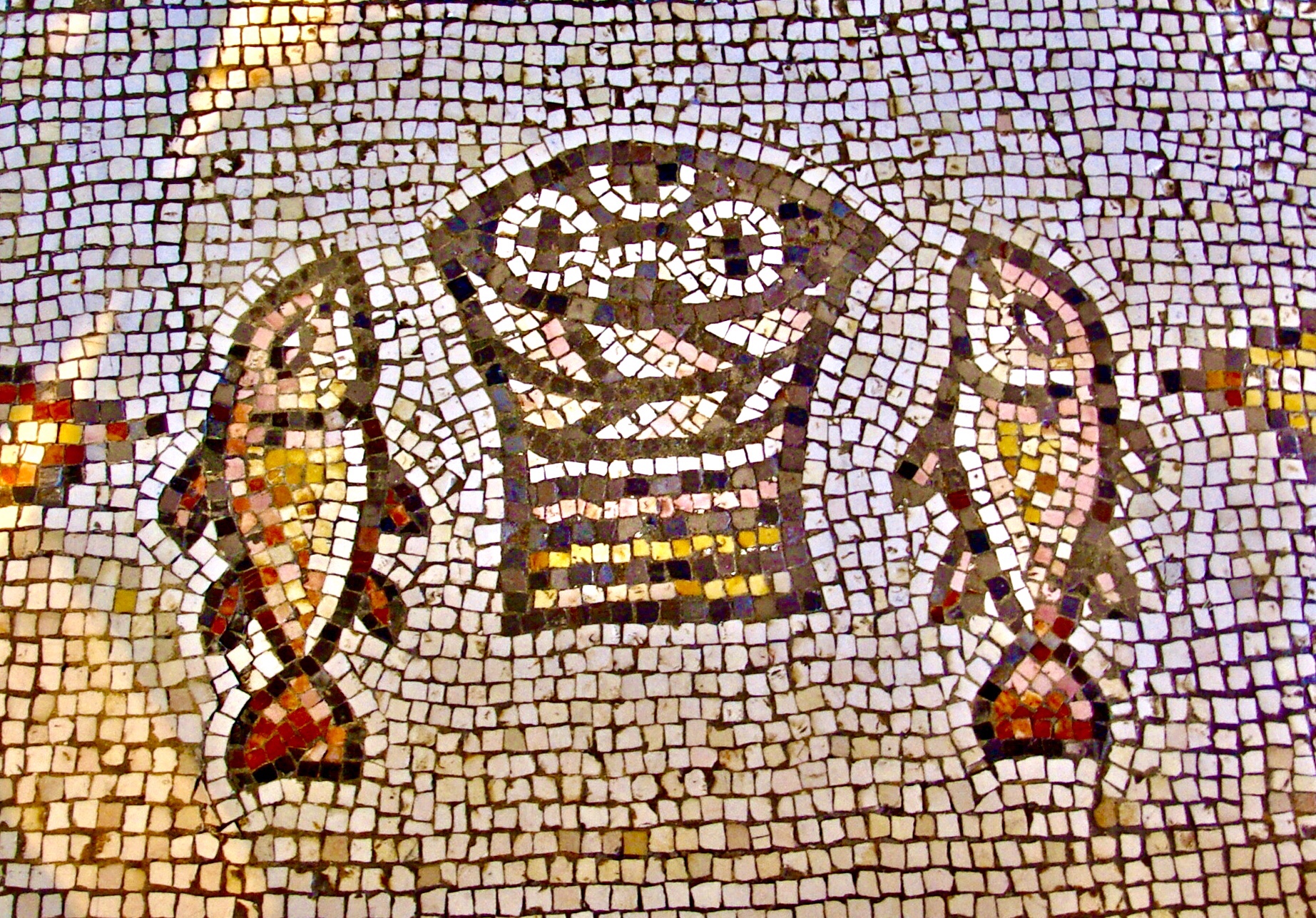
     The only miracle attributed to Jesus Christ that appears in all four Gospels is that of the “Loaves and Fishes”. Simply recounted, Christ had been preaching to a multitude of followers. His disciples became concerned that in the lateness of the day they did not have the means to feed thousands of people. The disciples urged Christ to send the crowd away to fend for themselves. Instead, Christ instructed the disciples to have the throng seat themselves in smaller groups. Obtaining a few loaves and fish from a passing boy, Jesus publicly broke the bread and fish, instructing his disciples to distribute the few pieces among the people for them to eat. When the thousands had finished eating the leftovers filled many baskets… an amount vastly beyond what had first been distributed.

     Years ago I heard a sermon that provided an alternate take upon the “Miracle of the Loaves and Fishes”: The homilist reflected that in the time of Christ it was customary for people to carry food with them when away from their homes. “Rations” in case they should find themselves hungry without the means to find food. He suggested that Christ’s public act of sharing the little that he had brought the people to draw upon the food that many had with them, in turn sharing within their groups. The minister then concluded his sermon by suggested that perhaps the loaves and fish did not “miraculously” multiply. Instead he offered the question: Is it not a greater miracle that one act of charity can infect acts of charity in others?

     The COVID pandemic has profoundly impacted people the world over. Not only through illness and death, but by the impact upon economies resulting in rampant unemployment and people becoming unable to meet their basic needs of food and shelter.

     As a part of its plan to address these challenges, the United States government has issued relief payments to those identified as in need, $1,800.00 per person thus far, with more expected. The test of need is based upon personal income. Eligibility for the payments has been limited to those earning less than $75,000.00 per year. The income test is efficient but imperfect. Among us are some who are technically eligible for the relief payments but are not food or housing insecure… people fortunate to be less impacted by the pandemic.

     If you count yourself among the fortunate, consider giving some (or all) of any stimulus relief payment you receive to a well vetted charity whose mission is to provide food, shelter or similar support assistance to those in need. Charity Navigator (www.charitynavigator.org) is one organization that examines charitable giving, rating their transparency and efficiency in delivering the most “bang for the buck”.

In Kansas City two highly regarded charities that target these populations and are particularly skilled at delivering the most impact for each dollar donated are:

Harvesters – The Community Food Network (www.harvesters.org/)

and

Operation Breakthrough (https://operationbreakthrough.org/)


Peace Everyone. Pete


There is a saying, “He can’t see the forest for the trees!” It implies that one is unable to see the importance of the “big picture” because of a focus on the (less important) details. Applying that as a metaphor to the challenges in our COVID economy I offer that there is no “forest” (economy) without the “trees” (small business).

We have been at our vacation home in Colorado since shortly after Christmas attending to a myriad of projects while embracing “real winter” at 10,300 feet above sea level. 2 miles to the north of us is the town of Alma with Breckenridge a 20 minute drive over Hoosier Pass. 5 miles south of us lies Fairplay where the nearest services are found. Gas, Prather’s Grocery, Ace Hardware, Fairplay Auto Supply, just to name a few.

Fairplay (pop. 800) is the Park County seat of government, a geographically large county (2,211 sq mi) with a population of about 19,000.

As such this surprisingly small county seat features a surprising array of dining and beverage purveyors… some 20 in all. Among our favorites are South Park Brewing (of course!), Java Moose Coffee House and Deli, and Millonzi’s Restaurant.

A couple of nights ago I stopped by Millonzi’s to purchase a gift certificate. For reasons of COVID safety and our focus upon home projects Christine and I have been absent from the dine-in scene during our current stay. Groceries, outside coffee (32°f with still air and a bright sun is very pleasant!) and a near daily visit to Ace Hardware has defined us.

As I waited for the gift certificates I was struck by the adjustments made in Millonzi’s since we were here during warmer weather. The outside dining option that we had enjoyed was of course gone.

A bar that could have seated at least a dozen was arranged for 2 sets of distanced couples.

The tables were well spaced, easily reducing seating to less than a third of former capacity.

We elected to return the following night for an early drink and dinner.

Upon our return we were greeted as old friends and quickly learned that the meticulous attention to detail, the topflight service, and excellent food remained unchanged. No wonder that a film crew was on sight in September to film for a feature of “Restaurant Impossible” which will air on Discovery Plus on January 22nd, and the Food Network in February.

Frank at the bar made an exceptional Manhattan garnished with a candied Hibiscus for me and a perfect G&T for Christine. Dakota, who was to wait upon us later at table, shared her joy and expectation of coming motherhood while Krishna looked on and added to the natural feeling of a family reunion.

Inevitably, conversation turned to the impact of COVID upon them and Millonzi’s. The temperature of discourse became more serious by degrees. They were all making it, but the difficulties are very real. Millonzi’s has a good carryout trade, but the bread and butter for any restaurant and its staff are patrons at the bar and at table.

In addition to presenting us with an  excellent dining experience our evening gave us an insight into the economic pain of the pandemic at full magnification. We were staring at one “tree” instead of just hearing about the “forest” as part of a 2 minute national news update.

The trees are everywhere. They are favorite diversions for us in Kansas City such as Aixois, a neighborhood French restaurant, and the upscale modern American “Restaurant At 1900”.

Most folks have such favorites that are locally owned. These establishments do not have the same resources as regional and national “corporate” dining to weather this COVID storm. The storm will pass, however if our favorite “trees” are to survive it is incumbent upon us to care for them as we are able.

We left Millonzi’s with the warm glow of having enjoyed excellent food, drink, and a very satisfying evening attended to by a staff that cares. We also left with carryout dinners for the next day… got to take care of the trees.

Peace Everyone. Pete