In the very early hours of October 13, 2021, I received a text message from an Australian, Dan Mullins. I was soon to learn that Dan is a well-regarded singer-songwriter and for nearly 20 years a top radio show producer based in Sydney.

Dan has been following my twice weekly “blogs” and asked if I would be willing to sit as a guest on his weekly show, “My Camino, the Podcast”. I agreed.

Friday evening, October 15th, 5:30 p.m. my time, and 9:30 a.m. Saturday his time, we engaged in a wide ranging one hour “chat”. I don’t think that one hour of my life has ever passed so quickly. The interview aired on Tuesday, October 19, 2021.

Regarding the interview, Dan wrote:

“Peter Schloss is compiling his Camino journals for his grandchildren and great-grandchildren. They’ll come to know and love the spirit of adventure with which Peter and his wife Christine have lived their lives… You’re going to love this episode.”

Here is the link to our conversation on Dan’s podcast which opens first with Dan’s tribute to Phil Volker who passed away earlier in the week:

“My Camino, the Podcast”, interviewing Peter Schloss
Peace Everyone, and of course, Buen Camino! Pete


Over the course of the weeks that we walked the Camino in 2013 I kept notes which I  “wrote” one finger stroke at a time on my tiny iPod-touch. Some notes were lengthy essays, some just short memos, and others merely providing links to photographs taken that day. I shared these missives with friends and relatives by email and on Facebook. Fortunately, I archived these notes. They have proven to be a trove of long forgotten information, valuable in the creation of these detailed posts. The preceding post and what follows below are two of these essays. They are presented verbatim in order to provide further insight into my thoughts and our experiences.  

“What is a Peregrino.” Written May 14, 2013 at Alto do Poio, Spain.

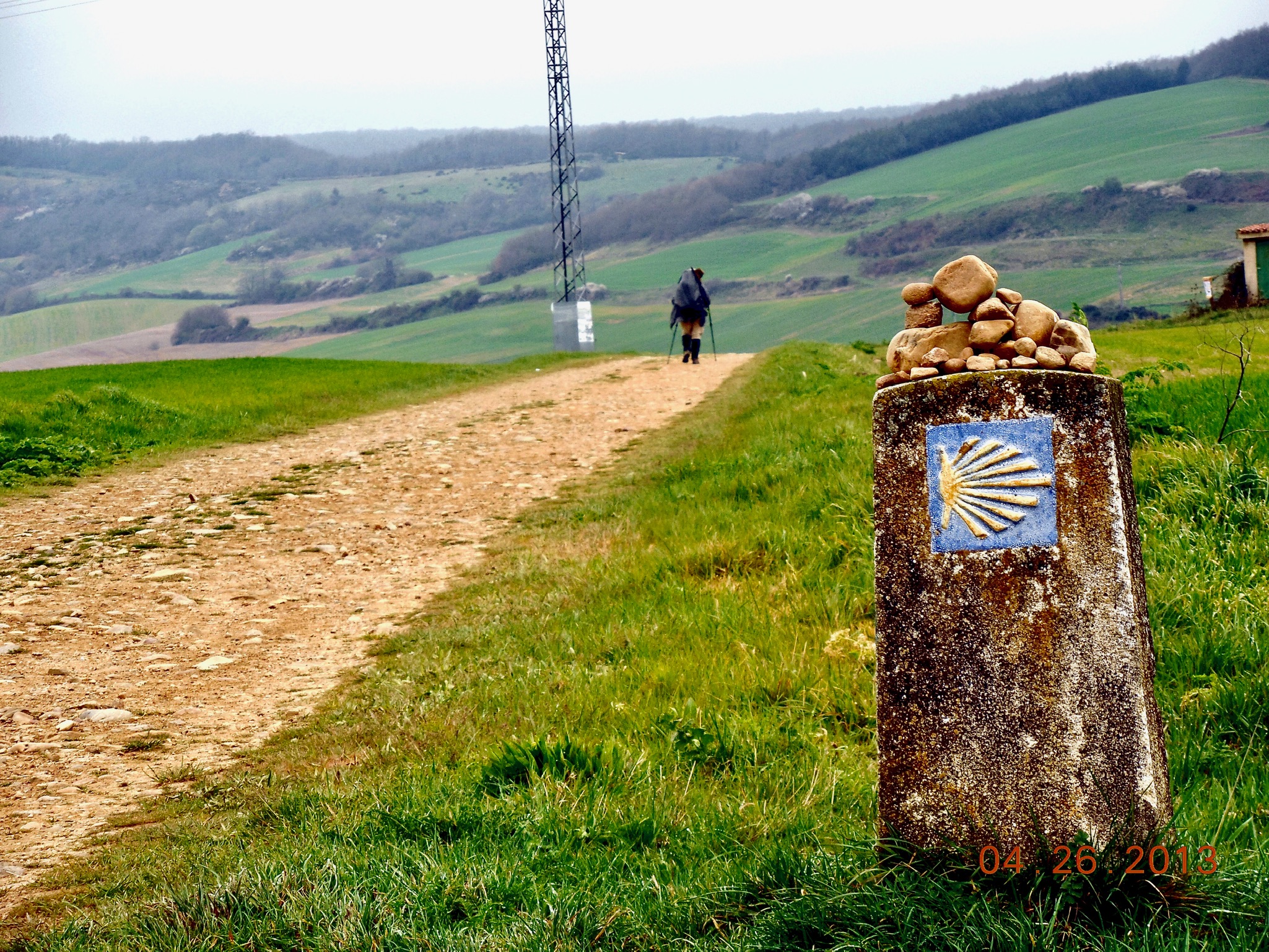
On the Camino, we are confronted each day with carved and painted images of St. James, the original Peregrino.

Even though these are often stylized portrayals, if he walked the Camino today there would be no mistake that he is a Pilgrim. Here is a quick summary of his “qualifications”:

  1. Practical Shoes. St. James is usually shown wearing sturdy leather boots, shoes, or sandals. Modern Pilgrims are no different, if you discount the “Crocs” that are worn by some in the evening.
  2. A wide brimmed hat. This important piece of equipment protects the head and eyes from the sun’s assault, the discomfort of rain, and also provides warmth in the morning and evening. Modern Peregrinos usually wear hats. Check!
  3. A weatherproof cape. This simple ankle length woolen cloak sheds rain, is vented, and doubles as a sleeping blanket. Today, we separate these functions among a poncho, windbreaker, and sleeping bag. For those focused on an ultralight pack, St. James may have had the better idea.
  4. A hiking stick. Modern Pilgrims seem equally divided in preference between going “stickless”, using St. James’ classic single walking stick, and employing twin trekking poles. St. James didn’t have the chance to evaluate the latter option.
  5. A water vessel. If the images are to be believed, St. James carried a hollow gourd to transport his drinking water, a simple and eco-friendly solution. He might have smiled upon the modern Camelbak, but I think he would have been appalled by the throwaway plastic bottles that dot the Camino.

These are the essentials for a Peregrino, then and now. The modern Pilgrim may stress over packs, socks, GPS, cell phones and Wi-Fi, but St. James might have seen such items as more a distraction rather than an aid to his journey. I admit that on these matters I often fell to the temptations of the “just in case” dark side.

A few days ago I was presented with another view of who is a Peregrino. During evening Vespers at a monastery, a Monk delivered a brief, but powerful message. He cautioned us to be mindful that Christ walked the Camino. He added that Jesus was disguised as a Pilgrim, and that Our Lord was careful not to announce His identity. I accepted the Monk’s admonition as a homilist’s metaphor. However, the message has been working on me as I find myself thinking as I pass Pilgrims on the Camino, “What if she…, or he…?”

I find that his words have caused me to be a bit more sincere and thoughtful when I say “Buen Camino”, perhaps a little kinder, maybe a little less inclined to judge, exercising more patience.

That Monk and the “disguised Peregrino” that he dedicates his life to serve are indeed intriguing.

Peace Everyone. Have Fun, Do Good, and Be Safe! And of course, Buen Camino! Pete


Over the course of the weeks that we walked the Camino in 2013 I kept notes which I  “wrote” one finger stroke at a time on my tiny iPod-touch. Some notes were lengthy essays, some just short memos, and others merely providing links to photographs taken that day. I shared these missives with friends and relatives by email and on Facebook. Fortunately, I archived these notes. They have proven to be a trove of long forgotten information, valuable in the creation of these detailed posts. What follows below and in the next post are two of these essays. They are presented verbatim in order to provide further insight into my thoughts and our experiences.  

“What is a Camino.” Written May 13, 2013 at Vega de Calcarce, Spain.

We have encountered some “interesting” notions of what constitutes a Camino, both from people on and off “The Way”. Officially, to earn a Compostela in Santiago, one must have walked or ridden by horseback the last 100km (60 miles) or bicycled the last 200km as a continuous journey. Those are the “rules”, plain and simple.

Nevertheless, we have encountered some “unofficial” takes on what constitutes a Camino. There was a young lady who zipped past me, hellbent on covering over 800km to Santiago in 20 days. In her mind there were grades of Pilgrims and Caminos, based upon speed. She even had a book, “Hiking the Camino in 20 Days”, and she was aiming to be among the fastest.

There was a couple that we encountered who had determined that “Real Pilgrims” carried their packs each and every step of The Way. (Note: There are services that transport your pack from place to place for from 5 to 7 euros a day). Their definition changed when one of them found it physically necessary to use the service.

Another pilgrim declared the journey must be 800km, and “unbroken”, even though it is common for Pilgrims to complete a Camino in increments over a series of years. That Peregrino also changed his view of a Camino when injury forced a hiatus.

Finally, there are those who decry the use of any alternative transportation in the course of the journey. I wondered if this disqualifies the use of elevators.

For most who are on the Camino, or who have completed a Camino, the understanding is that each Peregrino’s Camino is their own. Those who spend time and energy evaluating the journeys of other Pilgrims, miss the opportunity to appreciate their own journey.

The “original Peregrino” was St. James the Apostle, for whom Santiago is named, and in whose footsteps we follow. He traveled The Way to spread The Word. Is it possible that he spent an extra day here and there to deliver his message? Or that he accepted the occasional offer of a ride in an oxcart from a kind farmer or merchant?

We have had the good fortune to become friends with a fellow Pilgrim who is so comfortable with her Camino that it means more to her to enjoy the gifts of friendship along The Way than to focus upon reaching Santiago de Compostela and “earning a piece of paper”. Those are her words.

In life, as on the Camino, wouldn’t it be a blessing if each person focused on achieving their own best Journey, rather than policing and critiquing the Journeys of others?

Peace Everyone. Have Fun, Do Good, and Be Safe! And of course, Buen Camino! Pete


Note: Portions of this post have been variously penned by me in 2013, 2016, and 2018. The continuation of Part 32, “Destinations are Fixed, it is The Spirit that Moves” appears within this chapter, ***.

I have heard it said that there are no atheists in foxholes. Perhaps it is the same for one who sees that the horizon of life is limited by the approaching shores of mortality. My thoughts here expressed are not intended to change anyone’s mind about their own theology, or lack of theology. Indeed, it is precisely my intention not to convert anyone to any system of beliefs, but rather to encourage a pause for mindful contemplation of the beliefs already held. I have found that I better know my own mind when I listen to the thoughts of others. An obvious example of this is the visceral revulsion that I feel when I hear certain doctrines of coercive conversion that are preached in some quarters by those who claim to exclusively know the mind of God. As an example, “god” as expressed by the Westboro Baptist Church of Topeka, Kansas, is a bigot. It is not difficult for me to understand my own mind when I listen to that “theology of  hatred”.

A closer question arises when the thoughts of others are not a clear affront to my own. When the beliefs of others provide me with a moment to pause and consider my own beliefs it is a gift, an “ah ha” moment. Perhaps there is a small shift in my world view, or maybe I grow more comfortable in my beliefs, having had an opportunity to mindfully inventory them.

I was raised Catholic, however from the earliest days of my Catholic grade school education I found it difficult to understand how certain doctrines could be those created by a loving God. I accept that Catholicism is a man-created structure that seeks to understand God. It is a “language” that may assist in communicating our efforts to know God. However, as a child I could not understand how God would punish whole segments of humanity with damnation for not being Christian when the opportunities for being Christian did not universally exist. I wondered if God really was offended when I accidentally ate a “Chicken in a Biskit” cracker one Friday afternoon during Lent. What really did happen to all of those folks who had been hanging out in the waiting room called “Limbo” when it ceased to be in the lexicon of Catholicism. I choose Catholicism for my examples because it may be less offensive to others if I question the tenets of my own faith tradition.

Dogma is not a trivial thing. There was a time in the history of the Catholic Church that the failure to follow the dictates of dogma might have earned a person a turn on the rack, or worse. The same can be said for many religions. The same can even be said today for such transgressions as the drawing of a cartoon caricature of a long dead Arab man.

Sacramental Confession is an offering of the Catholic Church. My Lebanese grandmother went to confession weekly as many Catholics of her time did and some still do. I often wondered what that wonderful lady could have done each week that compelled her to stuff her prodigious frame into a tiny closet-like space and then struggle to bend her arthritic knees to begin her act of contrition. In Catholic grade school we had weekly confession. Once when I told my teacher that I didn’t have anything to confess, she reminded me that over the past week I had probably fought with my brother and disobeyed my parents. For many years of my childhood, fighting with my brother and disobeying my parents became standard sins of choice to “confess”, whether warranted or not.

I stopped the practice of Confession when I reached high school. However, there were two occasions that I chose to return to the confessional. They were both memorable and stand as an affirmation that there really is a voice of God. It is just up to me to listen.

In 1972 I travelled overseas for the summer as a part of a group of 22 students studying ancient history. I visited St. Peter’s Basilica in Rome and concluded that as a Catholic to not go to Confession and receive Communion there would be like going to Hawaii and not visiting the beach. The confessional booths each indicated the languages spoken by the priest within, primary language was in bold letters and any secondary languages were declared in smaller case. I found a priest who spoke English, but only as a language secondary to his native German. He sounded very old and I feared that I may have made a mistake, but I continued with the prescribed litany. When I came to the point of saying that it had been years since my last confession he stopped me and addressed me in a thickly accented conversational tone. He asked me why I chose to go to confession. We spoke for nearly an hour through the wood and cloth screen that separated us. I remained kneeling on the hard wooden kneeler throughout, but without discomfort. The distillation of his message to me was that he believed that I was a good person, a person of conscience. He said that I should be more guided by what I honestly believed in my heart to be right, and less by Church “rules”. I emerged from the booth with a “penance” to always do my best and listen to my conscience. I opened the door of the confessional to a line of little old ladies. Their expressions of near horror hinted at their belief that I must be some kind of an ax murderer, having been in the confessional booth for so long.

***The second occasion occurred in 2013 while Christine and I were walking the Camino de Santiago across Spain. We had arrived in Rabanal, which is the site of a German Benedictine Monastery. The monks presented an evening service for the Peregrinos (Pilgrims) in a cave-like chapel that was over 700 years old. The chants and prayers offered by candlelight were moving. At the conclusion, one of the four monks addressed the assembly of perhaps 25 pilgrims and indicated that one monk would remain should anyone wish to visit. Christine and I exited the church but not before I turned and saw the monk seated on an ancient wooden bench in prayerful repose. It was apparent that he would be alone in his contemplations.

Christine knows me well, so when I hesitated in the courtyard outside of the church she said to me, “You want to go back, don’t you.” It was more a statement than a question. I returned to the church and entered the dark and now silent interior. As I approached the monk he made no acknowledgement of my presence other than to slightly move his hand and indicate that I should sit at his side. I became uncomfortable with the silence and returning to the roots of my childhood I began, “Bless me Father…”. He again made a gesture that halted my words. There was the slightest hint of a smile and then this aged monk, a German monk, asked me what I did in life. I replied that I was an attorney and that I mediated divorces, seeking to assist people with resolution of the questions that they faced concerning their relationship, property, and the care of their children. He sat silent for a time and then slowly nodded, looked deeply into my eyes and said, “That is very important work… very difficult work.” He then asked me why I had started with words of confession. I felt the presence of that other old German priest from 41 years earlier. It was as if that priest, certainly long dead, had returned from the grave to ask how I was doing with the penance that he had issued to me.

We spoke for another 30 minutes during which time the monk encouraged me to listen to my heart and to be thus guided. He urged that “rules and rituals” of religion are secondary to following an honest conscience. At our parting he asked if I wished absolution which is the customary conclusion of Confession. I accepted but knew that with absolution there is typically a penance. He placed his hands upon my head and said that for my penance I must conduct myself in life as if God is always at my side, watching… that I must treat each pilgrim that I encounter on the Camino as if they were Christ in disguise.

I believe that miracles exist now and always have, it is just that our capacity to see them has dimmed. Is it a mere coincidence that on the two occasions that I returned to a faith practice from my childhood I received the same message, the same affirmation, and the same “penance” from priests from the same country? Calling this a coincidence would not change the reality of what occurred. It would however be closing my ears to the voice of the Spirit.

As rich in meaning to me as these two events were, it does not escape my notice that these men did not focus upon the rules and rituals that some might cling to as the path to God. I believe that when we place the rules above the search for a relationship with the Creator that we create a “god” in our image and likeness. We were imbued by creation with free will and a questing spirit. If that is the gift from our Creator then religion runs contrary to that gift when people seek to coercively convert others to their particular definition of “god”. The voice of the Creator as heard upon the wind by the First People is the same voice that was heard by Moses in a burning bush, and by those who gathered in an upper room breaking bread and drinking wine on a Passover night two thousand years ago. It is the voice of Christ, the Buddha, Vishnu, Mohamad, the words of Mormon, but only when the words advance the search for our humanity and are not misapplied for the subjugation of others. The challenge is to be mindfully aware of the difference between what we do in pursuit of a relationship with the Creator and what we do in the pursuit of mere earthborn advantage.

One of my grandchildren once asked me if magic is real. I replied that “magic” is whatever we know to be real but do not understand. I gave examples of magnetism and gravity as things that are real but not really understood. The quest for that knowledge continues and someday may be grasped in a way that renders them no longer “magical”.

If I change the focus of my grandchild’s question from magic to Spiritual and answer the question for myself, then Spirituality is what I know from experience yet do not understand. The quest continues because faith is a journey, not a destination.

Peace Everyone. Pete Schloss
PS. As I noted in the previous post, “It is often said that the Camino presents itself to the Pilgrim as three distinct experiences: first as a physical challenge, next as an emotional encounter, and finally as a spiritual awakening.” My Camino had become Spiritual.


May 9, 2013. Astorga to Rabanal.

Our hopes were high that with our departure from Astorga we were also leaving behind the drama of the past two days.

The steel gray sky released a near constant drizzle that kept the puddles filled and shoes laminated with mud. At times the humidity was such that if felt like the mist formed under rather than over our rain gear.

In spite of these morning conditions the fact that we shared the path with like-minded souls made for a spirit of camaraderie more than equal to the elements.

Rabanal was 22km ahead, but more importantly we were now only 264km and 13 days from Santiago. Whether measured in days or in miles we were approximately two-thirds of the way to our final destination. This was not the home stretch, but I could sense its presence over the horizon.

It is often said that the Camino presents itself to the Pilgrim as three distinct experiences: first as a physical challenge, next as an emotional encounter, and finally as a spiritual awakening. It occurred to me that ours was thus far a textbook example of those words transformed into reality. I understood and expected the physical aspects that we had experienced. My still evolving focus upon self, others within the orbit of my life, and most of all my relationship with Christine was unanticipated and emotional. Spirituality? Speaking for myself, this was still more bucket list than pilgrimage. I was not looking for a spiritual experience.

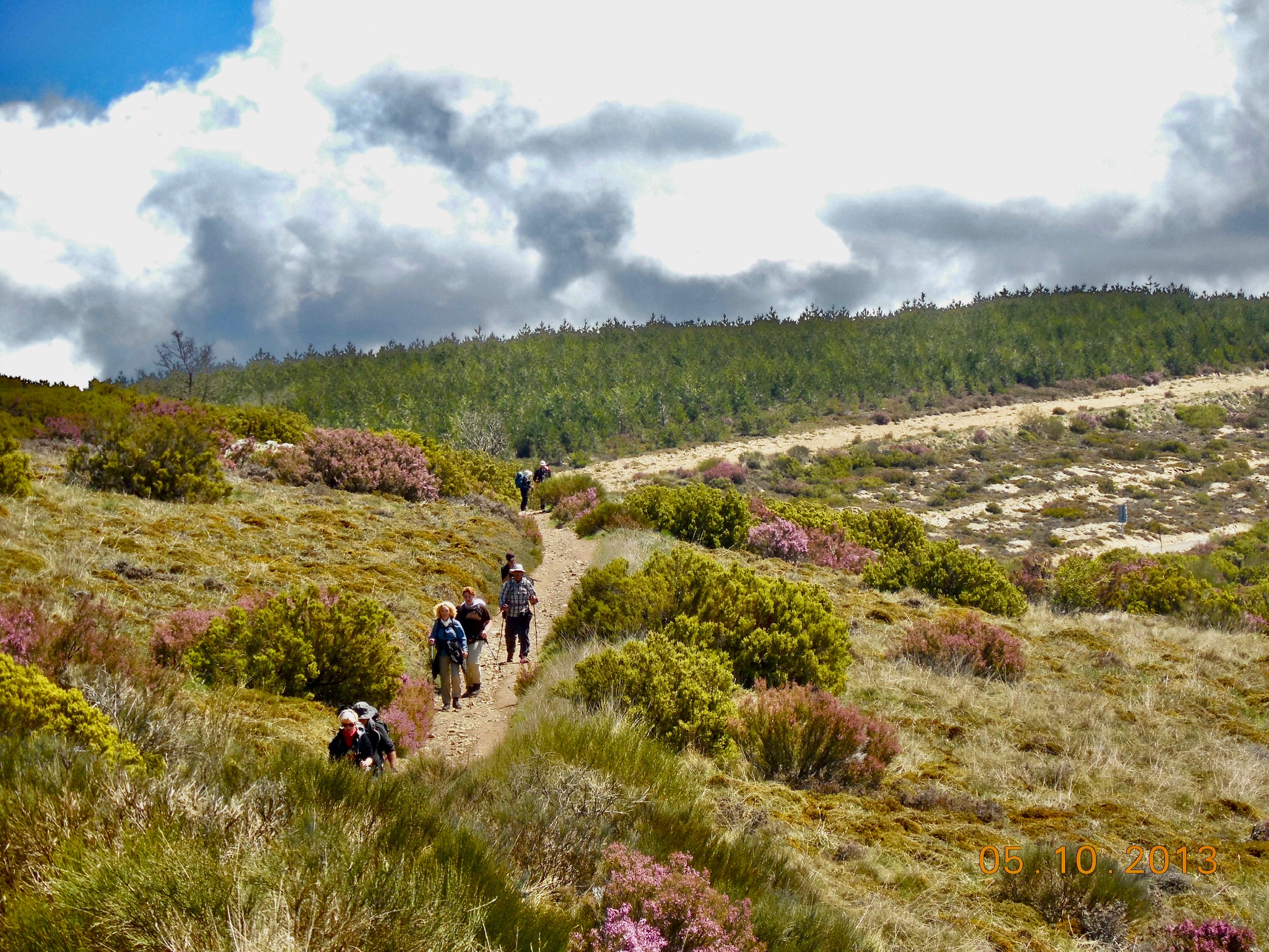
The path that day avoided main roads and was almost exclusively a meandering walk through open countryside.

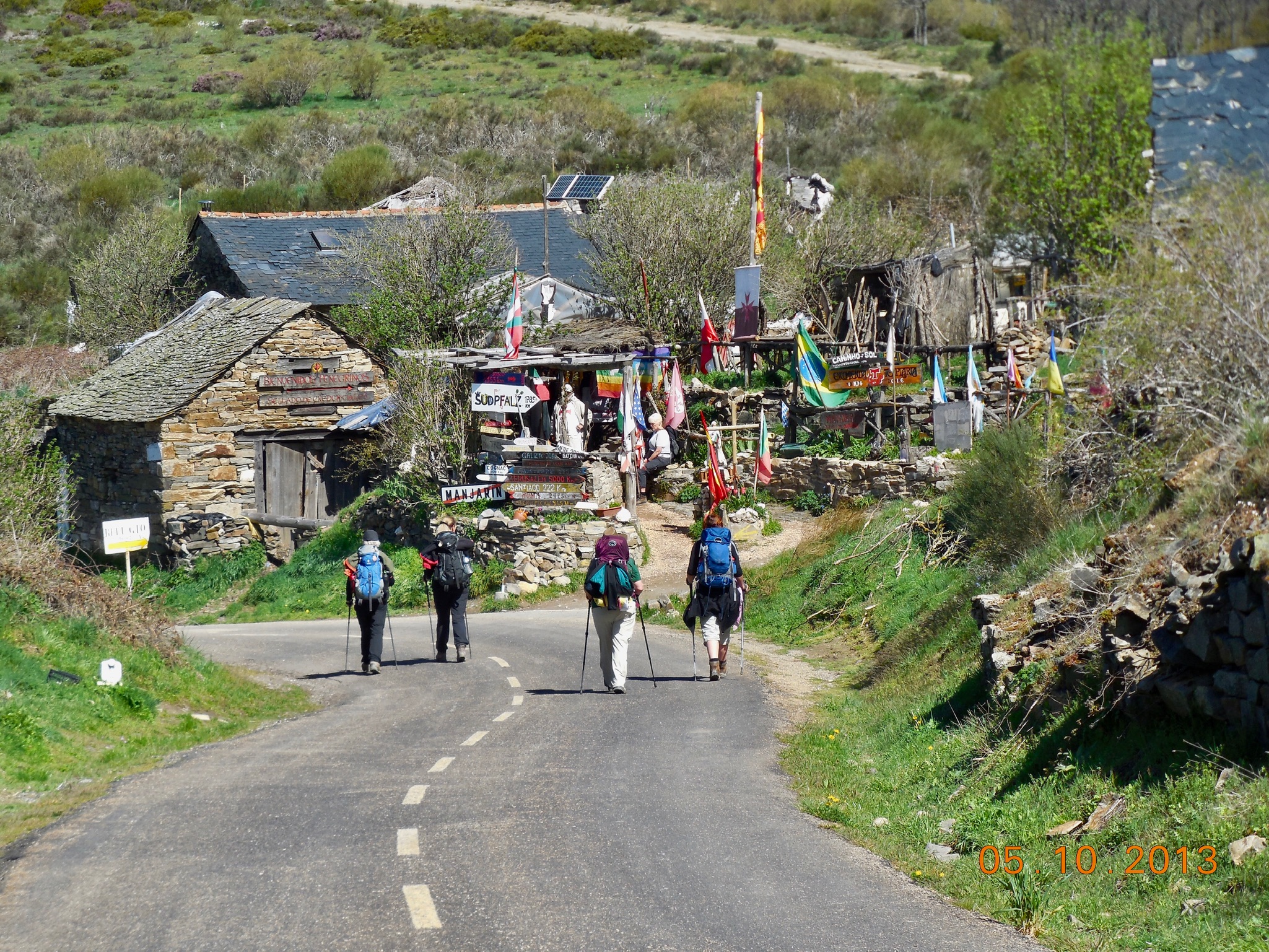
We would pass through 4 small villages before reaching Rabanal: Murias, Castrillo de Los Polvazares, Santa Catalina de Somoza, and El Ganso. The largest of these “Maragato” villages is home to fewer than 300, and most were suffering the ravages of time.

La Maragateria is a small and ancient historical region, with a distinct ethnic and cultural community, the Maragatos. Homes and buildings are of stone construction. Efforts to preserve the unique traditions seem linked to the failing efforts at preservation of the equally unique structures.

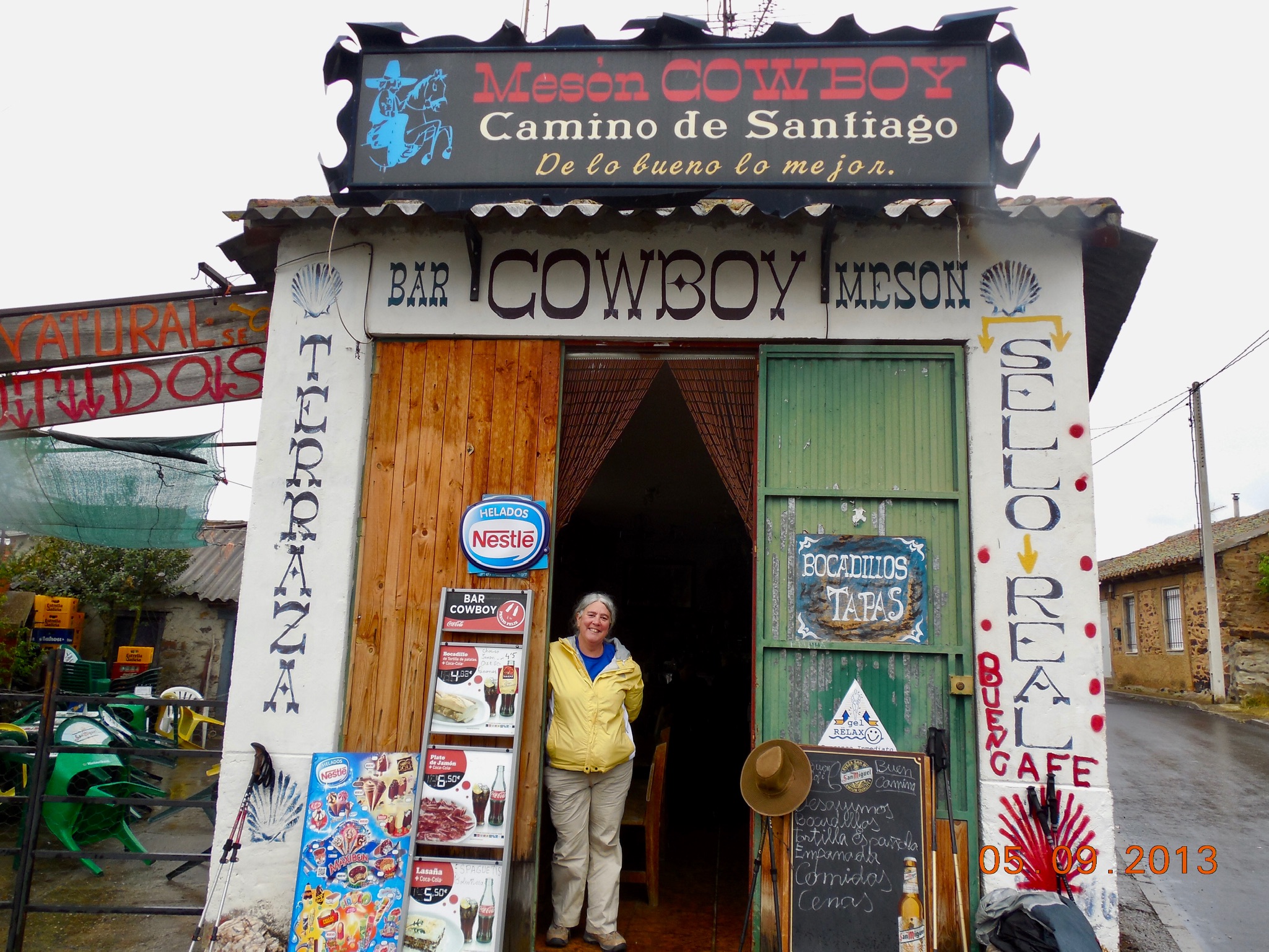
In the tiny and crumbling village of El Ganso stands the almost absurd “Cowboy Bar”.

We were greeted at the door by Ramiro, its owner and ”bartender”. It seemed that his total command of English was loudly calling out the words, “Whiskey! Whiskey! Whiskey!”, as if it was our responsibility to order up a shot or two.

However, when Christine replied, “Si!”, his smile and zeal slumped, and he politely shook his head, “no”. There were strong libations behind the bar, but perhaps it was too early, or possibly he did not wish to become the temptation that derailed her Camino that day. In any case we ordered non-alcoholic drinks which he cheerfully served, I took pictures, and we enjoyed the unique experience of “The Cowboy Bar”.

Spirits lifted, but not by alcohol, we continued our pleasant and picturesque hike through the countryside, arriving in Rabanal shortly after 2 p.m..

The tiny village (pop. 50) offered a surprising variety of lodging options capable of tripling the hamlet’s population. Among the alternatives were a 34 bed municipal albergue, a Hosteria, a small upscale hotel, two private albergues, and for up to 10 pilgrims willing to spend at least 2 nights, the Monastery of San Salvador del Monte Irago offered beds in its retreat house. We registered at the popular 76 bed Albergue Nuestra Senora del Pilar.

To say that this was a unique experience would be an understatement. First the good: The albergue offered a pleasant courtyard, bar, and restaurant. The staff was friendly, attentive, and the price was right.

The not-so-great parts centered upon the bedroom accommodations and lavatory facilities. 76 beds were tightly situated into two large dormitory rooms. The unisex bathroom contained only 2 water closets, 2 showers, and 2 sinks.

Except along the walls where single two-high bunks were reserved for unaccompanied females, 4 bunks were secured together in tandem, two up and two down. There was little room to stow our wet clothing and gear.

We had grown accustomed to sacrificed privacy, but Nuestra Senora del Pilar rose (descended?) to a new level. The feet in the toilet or shower stall adjoining the one you used could be male or female. The two sinks were so close to each other that bumping elbows while brushing ones teeth was almost unavoidable. Lines of Peregrinos “in need” formed before each toilet, shower, and sink. In the beds next to ours a young couple hung up their sheets so that we could not see the passion that we could not avoid hearing. In total the stay was an “interesting” experience that still brings a smile when recounted.

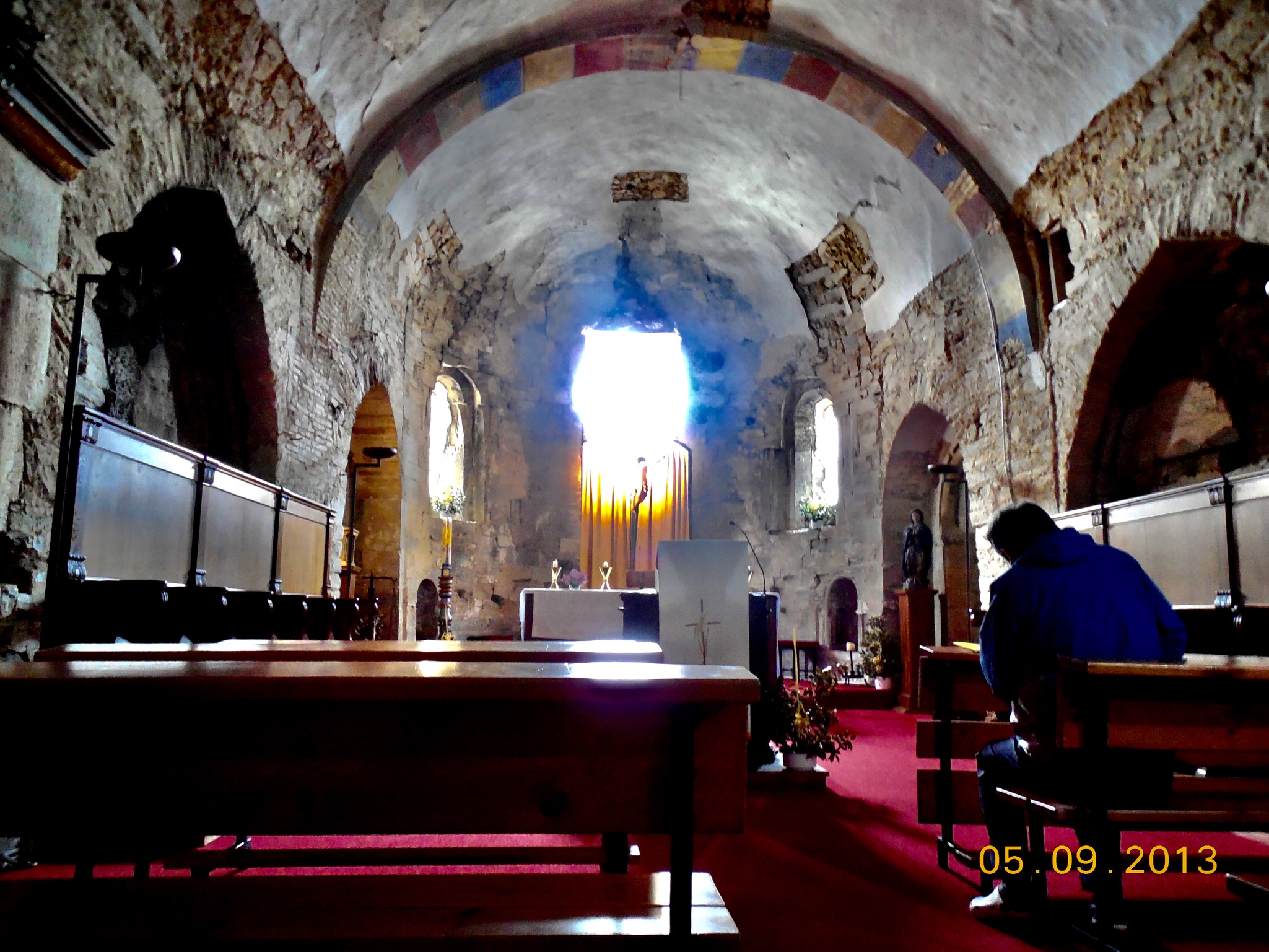
At the center of the town is the 12th Century Iglesia de Santa Maria.

This tiny church, cave like in its interior, was open for pilgrims to attend. 7 p.m. Vespers and 9:30 p.m. night prayers presented by the Benedictine Monks of the adjacent Monastery of San Salvador del Monte Irago.

Four of these monks, each originating from Germany, offered prayer in Gregorian Chant at Vespers. This moving ceremony was attended by us and perhaps 25 other pilgrims who filled the chapel to near its capacity. At the conclusion of Vespers one of the monks addressed the gathering saying that a monk would remain to speak with any Peregrino who wished to visit.

Christine and I exited the church to dusk falling on the small outdoor courtyard. It troubled me that no pilgrim had remained to accept the offer of the solitary monk who remained within. I hesitated. Christine turned to me, “You want to go back, don’t you?” After a pause I replied that it saddened me that no one had stayed to accept the monk’s offer. Christine encouraged me to return to the church. She promised to wait for me outside.

I entered the chapel’s dark and now silent interior. Barely visible in the flickering light of the votive candles was a bent and aging figure seated in one of the six ancient choir seats aligned along one wall. As I approached he made no acknowledgement of my presence other than to slightly move his hand, indicating that I should sit at his side…

To be continued. Peace Everyone and Buen Camino. Pete