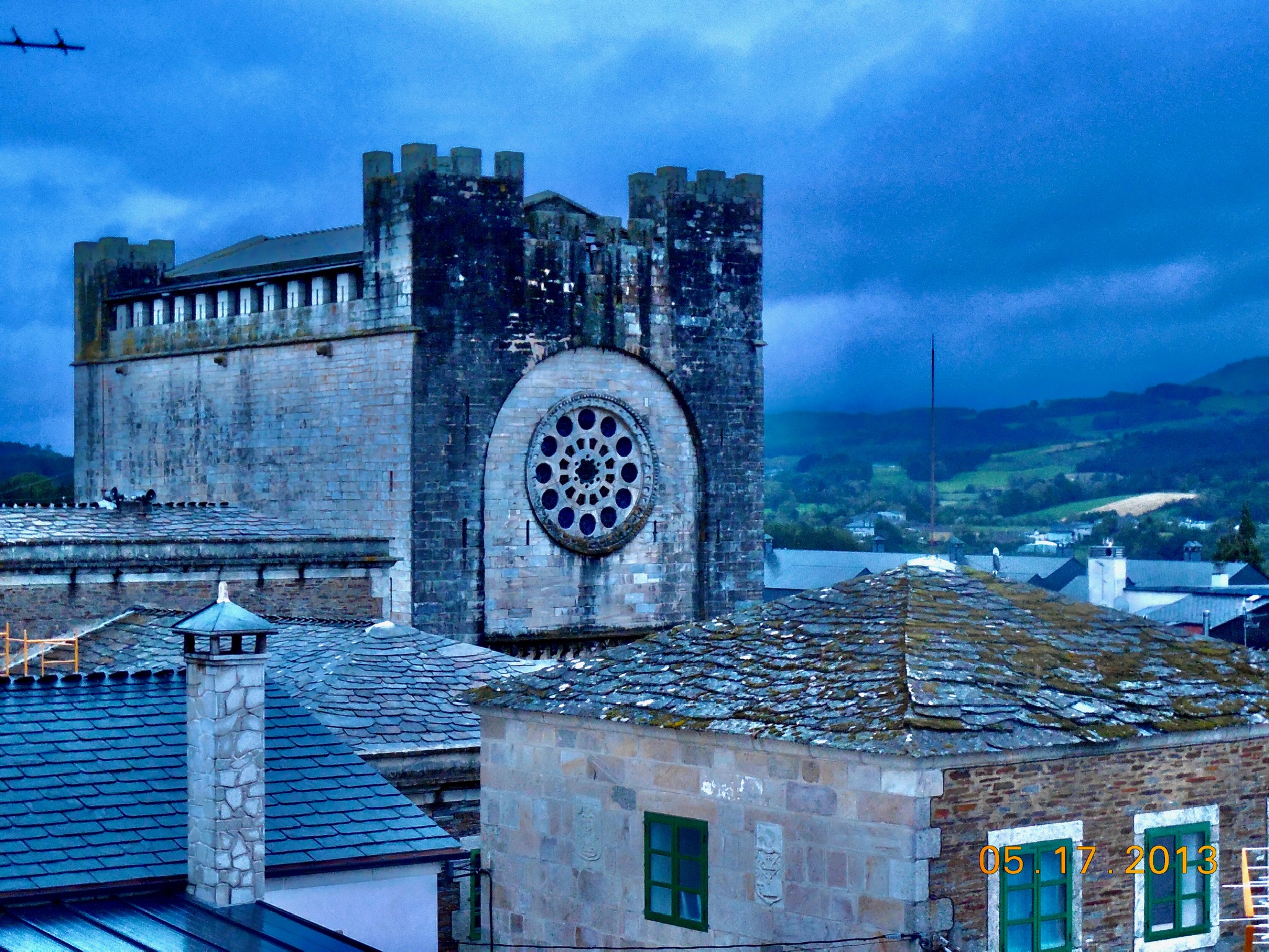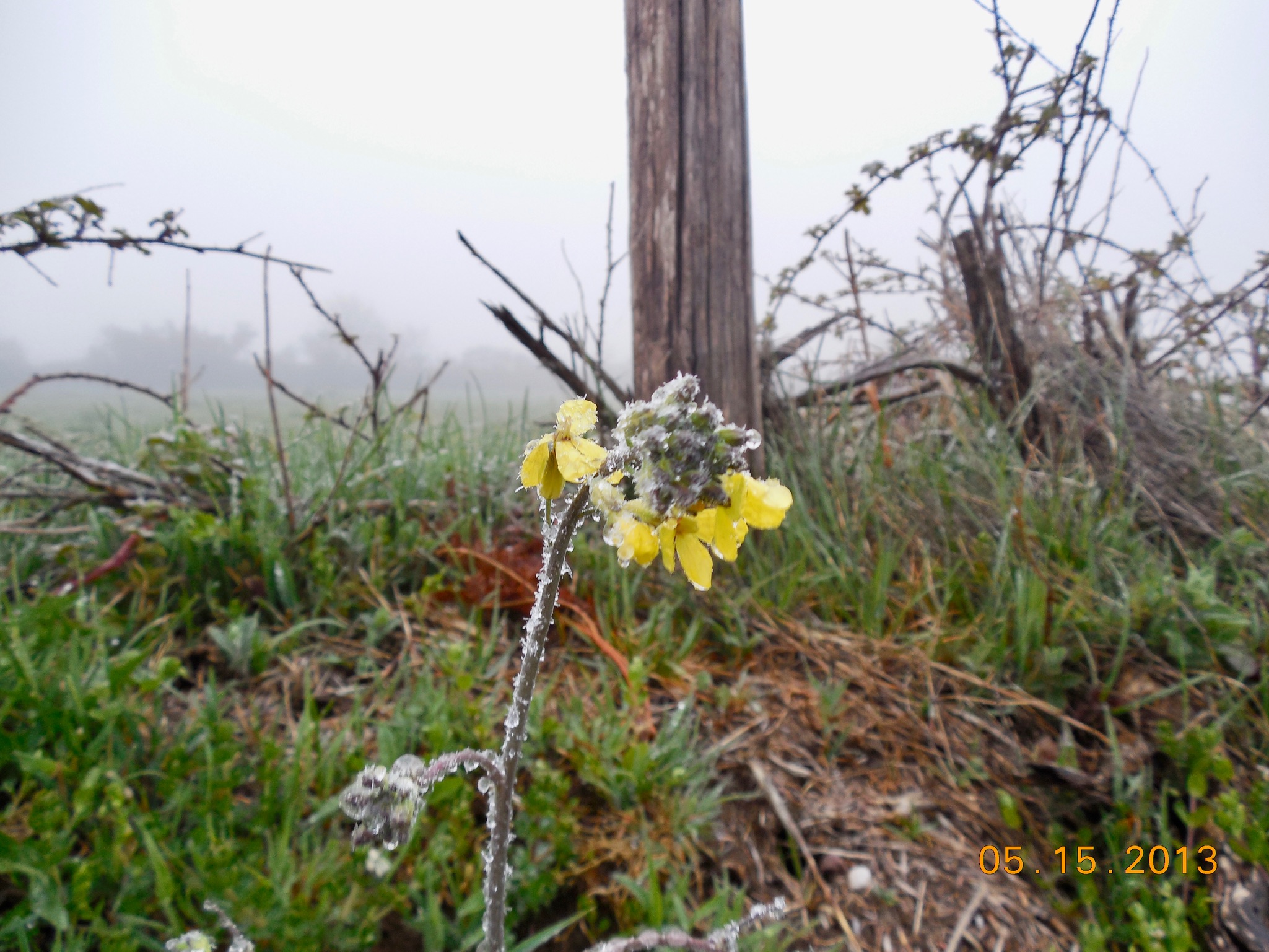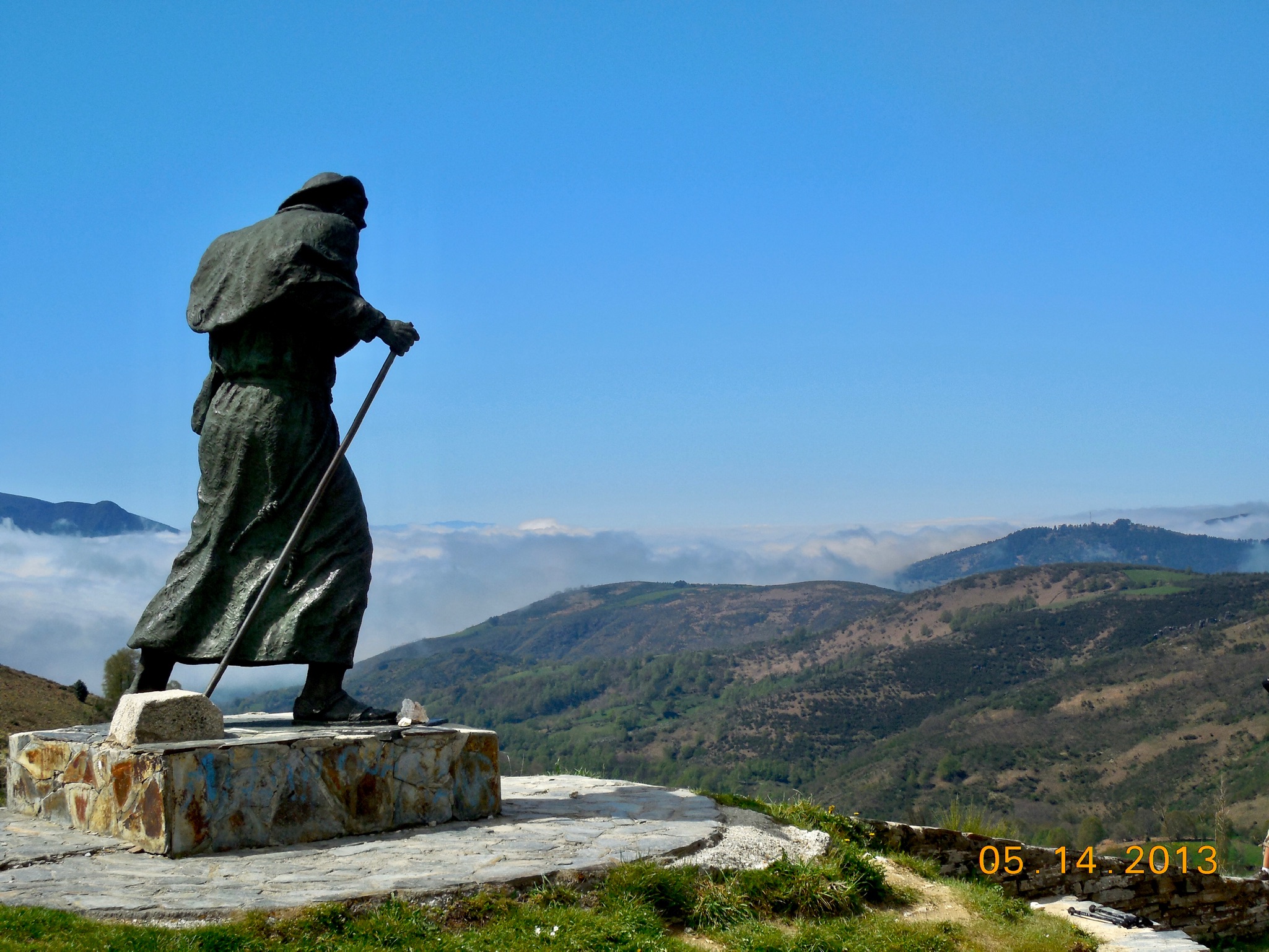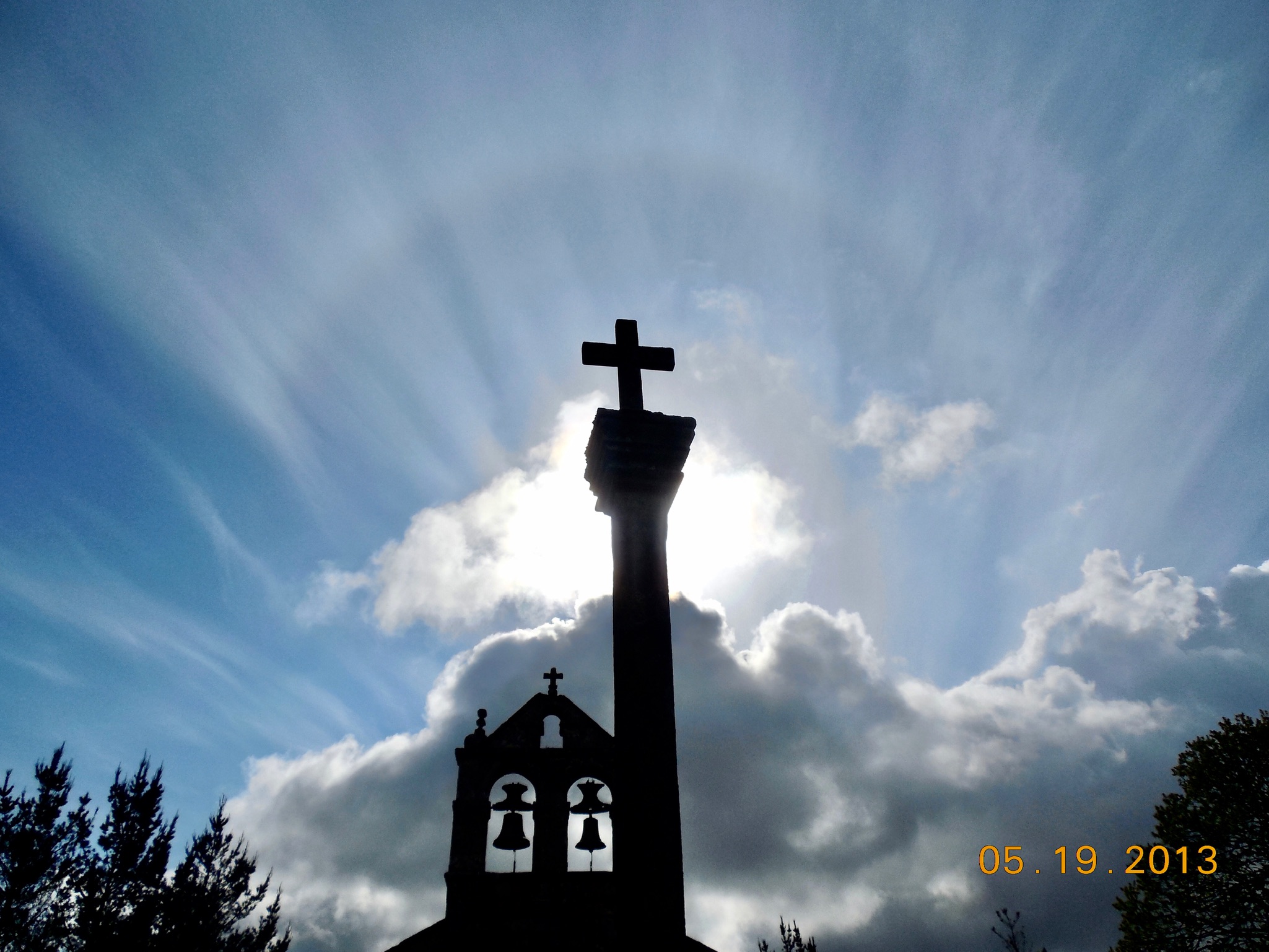
May 18, 2013. Portomarin to Eirexe

In 1958 a six year old boy sat cross-leg on the carpeted floor of his home, transfixed before a small-screen black and white console television. Haunting music played, composed by Norwegian Edvard Grieg (1843-1907), “In the Hall of the Mountain King” (from Peer Gynt Suite #1 Op. 46). The dashing American actor, Van Johnson (1916-2008) starred, dressed in medieval huntsman attire much in the fashion of Robin Hood of Locksley. Magic flute to his lips, his hypnotic melody drew thousands of rats from their hidden lairs. Down the avenues of the village of Hamelin they ran, out upon the town’s wharf where the rodents mindlessly cast themselves into the harbor waters and oblivion.

You might wonder what this has to do with our departure on May 18th from Portomarin, bound 17km for Eirexe. That  six year old boy was me. The image and music of that movie, so powerfully retained in my memory, was shaken into the present by the images I beheld that morning as we left Portomarin.

Peregrinos are not rats, and thankfully there was a bridge across the Belesar Reservoir, so no pilgrims were lost to its waters.

Each of us awoke that morning, responding to a call. It was not the call of a mysterious flautist, but rather it was the call of Santiago, 93km in the distance.

Our path that morning took us through lush woodlands.

We strolled down ancient stone walled lanes,

and past the occasional “horreo”, elevated grain storage structures designed to discourage thieving rodents. There was no Pied Piper otherwise available for duty. This one stone horreo, likely hundreds of years old, is located in the tiny village of Toxibo. It is in a state of excellent preservation. Note the decorative (and functional) rosette along with the cross and finial at opposite ends.

We passed through a few more minuscule settlements, Ventas de Naron being notable as the site of a historic and bloody 9th Century battle between the Christians and Moors. The Christians prevailed. Around the same time that the battle was fought, the bones of Santiago were said to have been discovered and the Camino was thus born.

Further down the road a surprise “pop-up” hailstorm made for some lively moments.

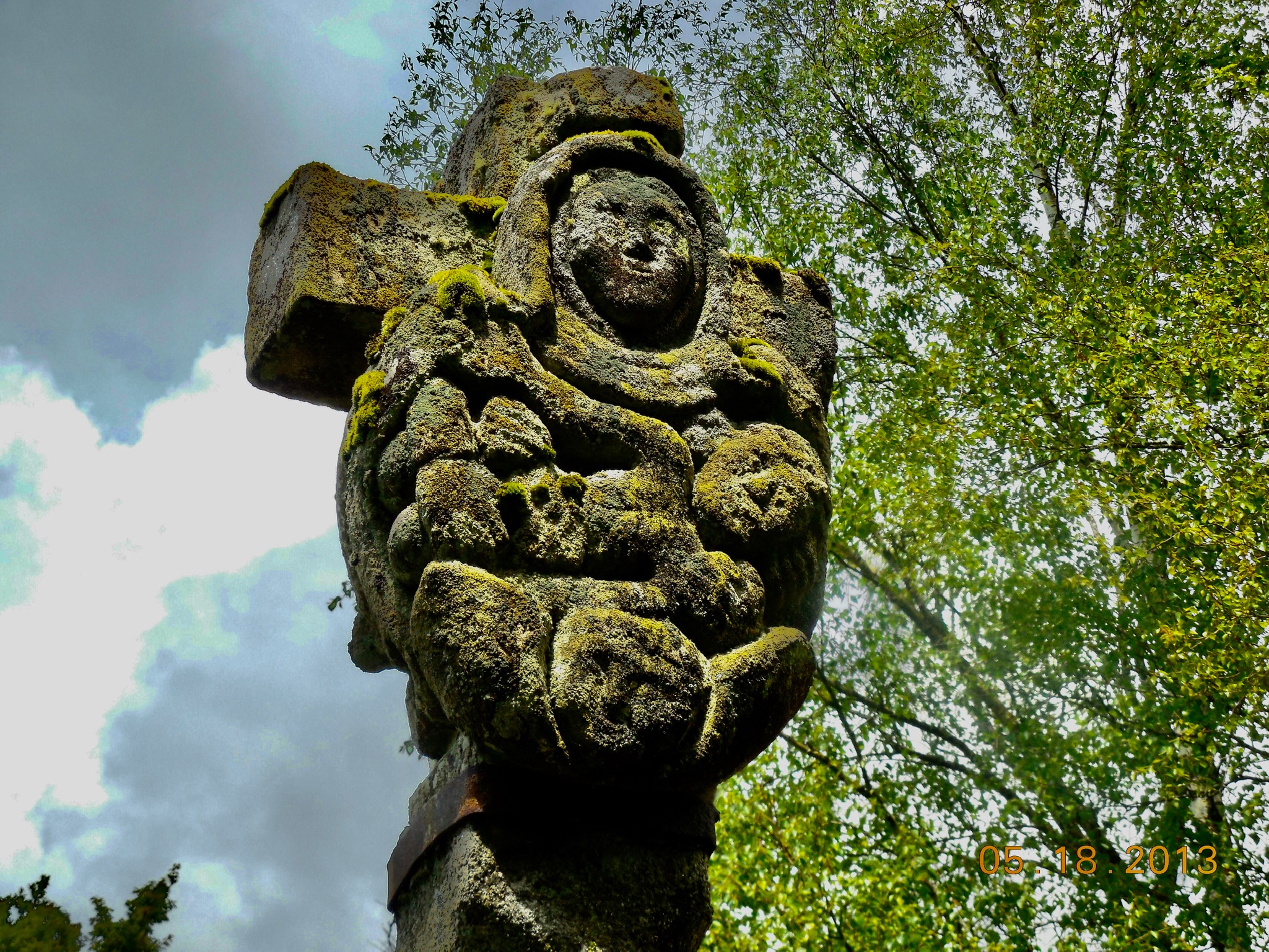
Nearing our destination for the day we came upon the remarkable 17th Century stone cross, “Cruceiro de Lameiros”. On one side is displayed the crucifixion of Christ and at the base a skull and crossbones.

On the opposite side the “Virgen de los Dolores” (Virgin of Sorrows) is carved and at the base on that side nails, a hammer, tongs, and a ladder are depicted, all symbols of Christ’s removal from the cross.

Another stone cross, this one atop a stone wall, marks the location of an ancient pilgrim cemetery.

Christine, Kris Ashton, and I chose Pension Eirexe for our lodging that night. This well appointed private facility had a room for 4, featuring two bunkbeds and a private bathroom with shower. The room was reserved for use by pilgrims. We decided to preserve some privacy by sharing the cost of securing the empty 4th bed.

A nice dinner, some wine, welcome companionship and hot showers closed out the day for each of us. I climbed up into one of the top bunks where I lay awake staring at the ceiling.

At 12:29 a.m. I wrote the following:

“Sleep is elusive tonight. The Camino is life compressed. Deep friendships that are forged upon the path may last but a day. I share The Way with countless pilgrims. Mostly we are unaffected by one another, barely aware of those like-minded souls who are seen within the horizon of a moment. Beyond that horizon of place and time are those born to the Camino a day, a lifetime,  or centuries before my first steps toward Santiago.

I am only a few days from the completion of this Journey. Past tense, which has been unconsciously creeping into conversations among Peregrinos, now becomes noticed. This is my 35th day on the Camino. The Camino carries each of us. Each step has become intensely personal, moving each pilgrim along with a few grains of sand. Grains of sand which have been moved countless times and which will again be moved by the millions of Pilgrims who follow. Over the course of a thousand years the accumulated result is a track worn deep enough that the trail creases the land, in places it is a trench that conceals those who walk within it.

A Peregrino friend, who has now returned to her home in the Netherlands, encouraged me to occasionally stop and look back to see where I have been. She explained that where you have been often looks different when viewed from where you now are. It is that way tonight. The excited optimism of earlier days is now colored by my reflections in the rear view mirror of this Journey. This is day 35 on my Camino, and year 61 of my life.

1:40 am. The Camino is life compressed.”

Peace Everyone, and Buen Camino. Pete


May 17, 2013. Barbadelo to Portomarin

The rain of May 16th continued into the 17th, thankfully with less energy. 18km separated us from our destination for the day, Portomarin. This was our 35th day on the Camino. We had whittled down 820km to just over 100km, one day and one step at a time. Our arrival day in Santiago looked to be May 22nd, only 5 more days.

First about our goal for the day, Portomarin:

With fewer than 2,000 inhabitants the town is certainly not a tourist destination. Yet, it has held a prominent place with pilgrims as an important waypoint since the inception of the Camino. It was founded in ancient times at the site of a 2nd Century Roman bridge that crossed the 340 km long Mino River. The “old” Portomarin featured the imposing 12th Century Romanesque church of San Nicolas, also called the church of San Xoan de Portomarin due to its association with the Knights of St. John. There were also the 10th Century Capela de San Pedro (Chapel of St. Peter), and the 52 “Spanish Steps” that were once part of the original Roman bridge that crossed the river to the village. These images are from the 1950’s.

In the 1950’s  Spain’s Francisco Franco sought to build a hydro-electric generating facility by erecting a dam 40km downstream from Portomarin. In 1963 the Belesar Reservoir project was established, threatening to submerge the entire community of Portomarin beneath the reservoir’s rising waters.

The townspeople responded by moving the two churches, the “Spanish Steps”, the main elements of the town square, and other selected historical buildings from their original locations to the bluffs overlooking the river valley. Stone by stone these buildings were disassembled, the stones numbered and transported up the hill where they were painstakingly re-assembled as part of the “new” Portomarin.

The waters of the reservoir are subject to significant changes of depth due to drought and drawdown of the impoundment for the generation of electricity. At times the level is so low as to reveal the old bridge and remnants of  the “old town”, a virtual Atlantis that can be explored with wonder.

Back to our day on the Camino:

There was some regret that we had to leave the very pleasant confines of Casa Barbadelo. More an economy resort than albergue, we enjoyed a leisurely breakfast and a departure that was later than allowed by most albergues. In spite of the light rain, our spirits were high.

Before leaving the tiny village we stopped to stroll through the 12th Century Romanesque church of Santiago de Barbadelo and its adjoining cemetery. This national historical monument was once the site of two monasteries that date to the 10th Century. Only traces of the monasteries remain.

While some humans may find the dampness of Galicia annoying, the flora and fauna flourish in the frequent rains. The change of climate is the result of the prevailing winds that have crossed the Atlantic Ocean. These breezes have absorbed moisture for thousands of miles only to release their damp burden in the lush green mountains of Galicia.

About an hour out of Barbadelo we came upon an interesting fountain surrounded by a wrought iron fence which was decorated with sculptures of scallop shells.

What drew my eye was an odd cartoonish creation that seemed to be a caricature of a Peregrino. I had seen this same “mascot” on other occasions. This one discharged water from its “mouth” into the large basin, being the worse for wear as algae beneath the spout gave the impression of green vomit.

This Camino ”mascot”, known affectionately by some and derisively by others as “Pelegrin” was created in 1993 as a modern commercial promotion of the Camino during that Holy Year. Designer Luis Carballo sought to use simple cubist shapes to make an image that he hoped would become long associated with the Pilgrimage.

This was much in keeping with similar cartoon “mascots” of the time, most notably “Curro of Expo 92 in Seville,

and Cobi, mascot of the 1992 Barcelona Olympics.

Pelegrin’s image could be found on t-shirts, caps, and a wide assortment of Camino souvenirs. Trying to further capitalize on this short-lived success, other “mascots” followed. There was Alberte Permuy’s “Xubi”, an odd multi-colored integration of a walking staff and gourd, conventional symbols of St. James and the Camino.

“Pingrino” was created in 2010 by Javier Iglesias as a cute penguin outfitted in Peregrino regalia.

Of course, how could Camino promoters possibly fail to bring COVID-19 into a memorable design.

I am left to wonder why the Camino, already rich with well-known images of Santiago, yellow arrows, and scallop shells, just to name a few, needed a cartoon mascot. Creations based upon other poplar images, not to mention human ones, already abound.

On our way to Portomarin we crossed the “magic” 100km countdown to Santiago. This would have been an excellent place for a celebration, but after a picture we soldiered on.

Beginning at Sarria, the path of the Camino acquired a significant influx of new Peregrinos. Many of these pilgrims new to the journey were easy to identify. Among the “tells” were items not often seen over the preceding 700 kilometers: blue jeans, tennis shoes, makeup, and clean clothes, just to name a few.

Tour buses also became prominent. On occasion we would observe these buses stop in a town, disgorge a score of passengers who then would charge into churches, restaurants, cafés, or government buildings in search of a stamp for their credencial. Once obtained they would stampede back to the bus which then headed down the road for their next scavenger hunt destination and “stamp”. As the black diesel smoke cleared I was left to wonder if any of those “busagrinos” would seek a Compostela in Santiago. Not my problem, not my concern.

As we neared Portomarin the Belesar Reservoir first came into view, followed by the town on the opposite side from us.

The reservoir was near capacity. Images seen of the bridge at low water in the years that followed were eye-opening.

Notice the old bridge at the base of the new one. 

The long walk on the bridge above the water led to the “Spanish Steps”, a tough climb at the end of a long day.

We walked through the center of town, taking in the restored business district and fortress like church of San Nicholas. The church was not open. The interior image is courtesy of the internet.

Our accommodations for the night were at El Caminante Pension, a private Albergue that featured “Pelegrin” on its marque.

It had an excellent restaurant and bar. It was our good fortune to be joined at table by other Camino friends for a dinner selected from the special Pilgrim’s Menu.

Typically, “pilgrim’s menus” provided a salad course, main course with protein and vegetable, and a dessert for around 10€ per person. Also included for the price was a choice of either bottled water or wine. Over the weeks that we walked I can’t recall anyone opting for water, nor do I recall the flow of wine ever ending before it was time to leave the table.

Best of all, our room provided exceptional evening and nighttime views of the village.

With only 92km separating us from Santiago de Compostela, a shadow of sadness began to cast upon my thoughts. Why must all good things come to an end?

Peace Everyone, and of course Buen Camino! Pete


May 15, 2013. Alto do Poio to Albergue El Beso Ecologico

How different can two days be! On May 14th we had gloried above the clouds at O Cebreiro, walked under clear blue skies, and relaxed with beers in hand outside our hostel.

At 7 a.m. on May 15th we walked out the door of Hostal Santa Maria do Poio and into an arctic freezer! It was bone chilling cold. Christine had prudently bundled at the urging of our host, but I let optimism sway me and continued wearing shorts.

Looking back on my pictures I see that I had gloves on, but Christine did not. Chivalry had apparently given way that morning to the demands of shivering.

This would be a relatively short day of 15km. Thankfully, it was all downhill to Triacastela, a pleasant descent of 2,150 feet into warmer daytime temperatures.

There was little of special interest those first 13km on to Triacastela except a pleasant country path, the small chapel of San Pedro at Biduedo, and a few cows that we had to make way for, all shared with my wife. In other words, those kilometers were full of what was special.

By noon we were well along the ancient woodland path that had been deeply worn down below the adjacent land, this the result of centuries of passage by countless pilgrims and livestock

Just before Triacastela  we came upon a huge, gnarled Chestnut tree. The “Chestnut Tree of Ramil” is legendary.

Scientists have estimated its age at nearly 900 years. When Aymeric Picaud, author of the Codex Calixtinus, walked the Camino in the 12th Century this tree would have cast its shade upon him. The circumference of its base is nearly 30 feet. A small signboard gave notice to pilgrims that this was a living thing to be marveled at.

My children and grandchildren know that I am fond of embracing the huge Oak trees of our neighborhood, I am a literal “tree-hugger”. There is something spiritual in feeling life that moves rhythmically through the seasons; solid, slow, and very old. If trees were conscious of us we would be but passing wisps of smoke, except when we take them down for our own purposes.

There is an excellent children’s book, “The Giving Tree” by Shel Silverstein, that may be read as a metaphor with a very adult lesson. “…and she (the tree) loved a little boy very, very much, even more than she loved herself.” Spiritual? Perhaps. Controversial? Some reviewers assert that the relationship between the boy and the tree is abusive rather than loving. Draw  your own conclusions.

It is a book best read to a child by an adult who loves that child. The challenge arises in moving the final words to one’s lips, past a lump in one’s throat.

Triacastela (pop. 665) gets its name from the three castles that once stood here at the time the town was sacked by Norman invaders around the year 968. It is mentioned in the Codex Calixtinus and has remained an important waypoint on the Camino. A significant amount of material used in the construction of the Santiago Cathedral was sourced here.

As we entered the town we saw four pilgrims ahead in the distance. Seeing us, two turned and rapidly jogged back toward us, the other two stopping on the road. It was our Camino friends,  Kris Ashton and the German pilgrim Stephanie Setz. With tears of joy, Christine and Kris embraced. Ahead were our Canadian pilgrim friends Les and Mary Virtue. The six of us joined for a rest and refreshments, the women posing for a picture.

Kris told us of an unusual albergue that she had heard of. It was about 2km ahead and was the day’s intended destination for her and Stephanie. They urged us to join them. Les and Mary would continue on their own way. With a steep climb ahead and no other lodging options for another 8km the decision to join Kris and Stephanie was gratefully made.

In 2011 two Peregrinos, Jessica from Italy, and Marijn from the Netherlands, met on the Camino and fell in love. They fell in love with each other and with the Camino, deciding to make a life with each other on “The Way”.

They began a search for a suitable place to open their own albergue. Their funds were limited but it seemed that their energy was boundless. In 2012 they found a wreck of an ancient farmhouse that had not been occupied for 40 years. Parts of the house were said to be 800 years old and looked it.

Their vision was to open a unique albergue that focused on delivering an “ecological experience” to pilgrims. Thus El Beso Ecologico (“The Ecological Kiss”) was born.

The couple, acting as hospitaleros, provided clean but sparse accommodations. A common room, heated by an ancient iron stove provided a place to gather and relax.

Jessica prepared a strictly vegan communal dinner and breakfast.

The unheated sleeping dormitory adjoined the communal room and drew minimal heat from the iron stove. Two toilets and a shower served the needs of up to 10 pilgrims. There were but 4 of us staying that night.

The couple proudly showed us their ongoing restoration project and what lay ahead. They provided the labor, supplemented occasionally by pilgrim volunteers. They also shared that they were expecting a child.  

In writing this post I became curious about how the couple had done over the last 8 years. The internet provided answers and images. El Beso continued operations until suspended by COVID in 2020. During the closing the couple undertook to expand the facilities.

Their Facebook page gives insight into their efforts to improve upon their 10 year vision… and they are proud parents of an 8 year old boy. However a recent Facebook post shows that El Beso is now for sale, “The albergue is for sale. After many years of enjoying and living on this beautiful spot on the Camino we decided to move on…”

This was not a stay for everyone. It was perhaps our coldest night sleeping during the entire journey. However, Jessica’s vegan culinary skills were exceptional, as was the company.

These were two of the most gracious, welcoming, and heartwarming hosts that we met on the Camino. We were treated more like friends and family than mere boarders passing through. I hope that in “moving on” they find that life rewards them with “El Beso” (The Kiss) of health and happiness.

Peace Everyone. And of course, Buen Camino! Pete


May 14, 2013. Vega de Valcarce to Alto do Poio

With 21km ahead of us that included 2 steep mountain climbs, one an increase of nearly 2,400 feet, we were out the door and on our way by 7 a.m.. The 14th Century Castillo de Sarracin loomed above and to our left, a shadowy outline in the early morning twilight.

The first few kilometers tracked along the rural N-VI roadway, which thankfully had very little traffic at that hour.

We continued through the tiny village of Ruitelan which was nestled in the shadow of the towering flyover bridgework of the busy A-6 expressway.

Within an hour of our departure we had reached Herrerias (pop. 600). Leaving the roadway behind us, we began our climb to O Cebreiro. The mountains that surrounded us kept us in shadows for another hour.

The ascending path was rock-strewn. Footfalls of countless pilgrims over the centuries had worn the trail as if it had been intentionally dug.

As we climbed the views extended outward and we were treated to stunning vistas, clear skies, and perfect weather.

About a kilometer before O Cebreiro we encountered a heavily graffitied stone monument marking the frontier border between the autonomous regions of Castilla y Leon and Galicia.

More than just a line on a map, this demarcation also heralds the entry into a culturally distinct region. At times, Galicia looks and feels more like Ireland than Spain. Thick stews are popular, and as one nears the coast dishes of fish, shrimp, and octopus become favorites of the inhabitants, and certain Peregrinos (me!).

Farms are small and their unique stone granaries (“horreos:”) become commonplace.

A regional language, galego, is still spoken. As in other Celtic countries there is a concerted effort to preserve the ancient languages and other long-held traditions. With Santiago de Compostela as its capital, we know that we are entering the final stretch.

 At an elevation of 4,300 feet, O Cebreiro is a tiny hamlet located at one of the highest points of the Camino. Its fame derives from a miracle alleged to have occurred in an ancient church situated in the village.

Dating to the 9th Century, parts of Iglesia de Santa Maria Real (Church of St. Mary) comprise one of the oldest buildings, and the oldest church associated with the Camino de Santiago. The original church was largely destroyed in the early 19th Century but rebuilt on the original foundation between 1965 and 1971. Within the church is the original baptismal font.

Many believe that on a wintery day in the 14th Century a tired priest was saying Mass in this small church. A peasant from a nearby village, having hazarded the arduous climb to the church in a raging snowstorm, entered the church at the moment of the Eucharistic Consecration of the bread and wine.  The priest took exception to the peasant’s late arrival, berated him accordingly, and further criticized him for having risked his life to merely watch a perfunctory religious ceremony.  At that moment the bread and wine were said to have miraculously transformed to the actual flesh and blood of Christ.

The Eucharistic miracle of O Cebreiro was confirmed in 1487 by Pope Innocent VIII. The chalice, particles of the transformed bread and wine were placed in a reliquary that was donated by Queen Isabella. In addition to the baptismal font, the paten and chalice associated with the miracle have been preserved. The church also contains a statue of the Virgin Mary that dates to the 12th Century.

The importance of the miracle is such that the flag and coat of arms of Galicia include the image of the chalice and Eucharist.

At O Cebreiro we found ourselves literally above the clouds.

The village is not only a  literal and figurative “high-point” on the Camino, but it attracts flocks of non-Peregrino tourists. Virtually all accommodations here were booked.

We took time to wander through the hamlet, take some refreshments, and of course some pictures.

This “Palloza”, a design which dates to pre-Roman times, is located at O Cebreiro.  The image is courtesy of the internet.

As luck would have it, when we arrived at O Cebreiro a taxi pulled up in front of us. Exiting the cab was Patricia, a pilgrim from New York. Weeks earlier at Orisson Refuge she had made a tactless public comment when Christine arranged transport to avoid the very difficult climb over the Pyrenees Mountain pass to Roncesvalles. “Real pilgrims carry their packs and walk every step of the way.” Apparently her definition of a “real pilgrim” had changed over the course of the last 700km.

Our destination for the day was 9km ahead, Alto do Poio. Although it is situated at nearly the same elevation as O Cebreiro, the path descends in the interim and then makes a wicked climb over the last 1km to the highest point on the Camino in Galicia (4,380 feet). At the top are two lodging options situated on opposite sides of a road, and little else.

After mentally flipping a coin we registered for the night at Hostal Santa Maria do Poio. It appeared a more comfortable option than the albergue across the way, plus activity outside of the albergue hinted at a full complement of customers.

Checked into our room we moved with beers in hand to outside tables bathed with warming sunlight from the still clear sky. A few minutes later we were joined by our Camino friend, Kris Ashton of Denver Colorado.

Back at O Cebreiro Kris heard that we had recently passed through. She put her walking shoes into “high gear”, hoping to catch us. By the time that she reached Alto do Poio she believed that she had lost us. Fortunately, she saw us just as we sat down across the way to enjoy our restful libations (aka beer!). She joined us for a rest and an adult beverage before continuing on another 3km to her intended destination for the night, Fonfria. We did not know it at the time, but this effectively began the final stretch of the journey into Santiago, the 3 of us sharing company, stories, and cementing a friendship that has endured now for over 8 years. One of the most valuable and enduring gifts of our 2013 Camino.

Peace Everyone. And of course, Buen Camino! Pete


In the very early hours of October 13, 2021, I received a text message from an Australian, Dan Mullins. I was soon to learn that Dan is a well-regarded singer-songwriter and for nearly 20 years a top radio show producer based in Sydney.

Dan has been following my twice weekly “blogs” and asked if I would be willing to sit as a guest on his weekly show, “My Camino, the Podcast”. I agreed.

Friday evening, October 15th, 5:30 p.m. my time, and 9:30 a.m. Saturday his time, we engaged in a wide ranging one hour “chat”. I don’t think that one hour of my life has ever passed so quickly. The interview aired on Tuesday, October 19, 2021.

Regarding the interview, Dan wrote:

“Peter Schloss is compiling his Camino journals for his grandchildren and great-grandchildren. They’ll come to know and love the spirit of adventure with which Peter and his wife Christine have lived their lives… You’re going to love this episode.”

Here is the link to our conversation on Dan’s podcast which opens first with Dan’s tribute to Phil Volker who passed away earlier in the week:

“My Camino, the Podcast”, interviewing Peter Schloss
Peace Everyone, and of course, Buen Camino! Pete